Newly resurfaced testimony from one of Easy Company’s most decorated officers has cast a harsh light on a figure long treated with affection by historians and television audiences alike, revealing that Lieutenant Lynn “Buck” Compton regarded Captain Lewis Nixon as, in his own blunt words, “a prick.”
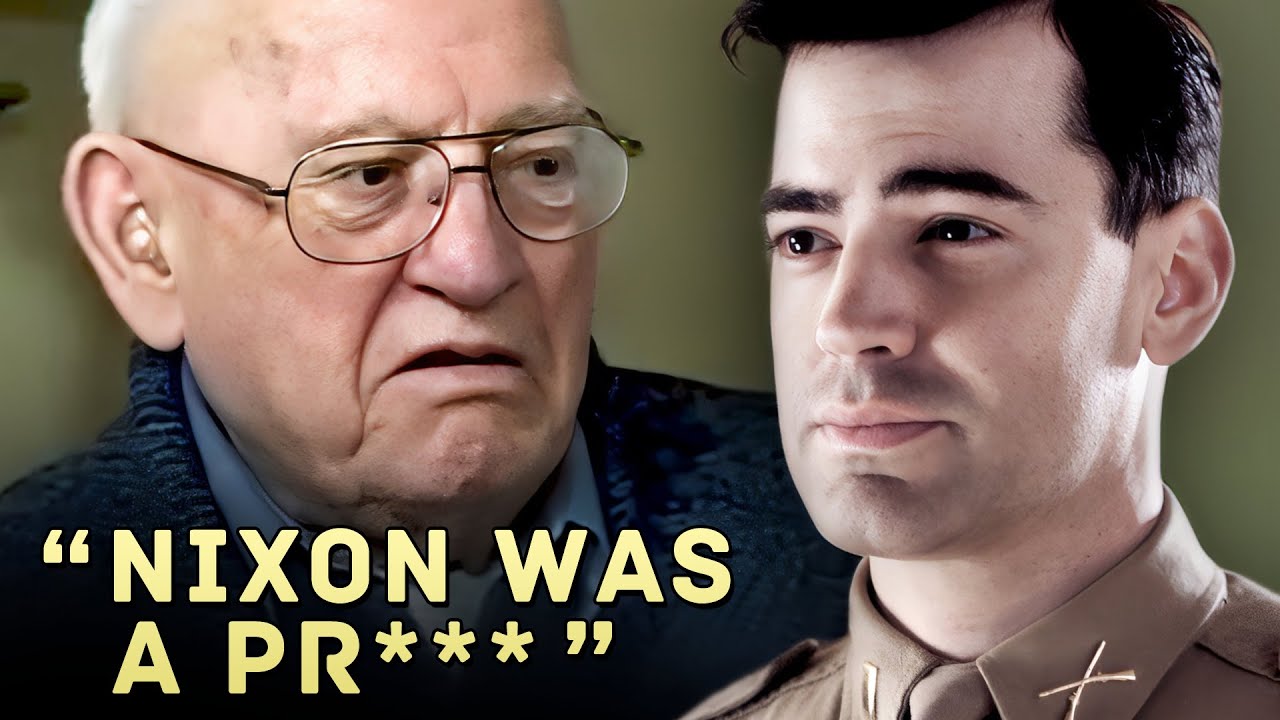
The remarks, captured in a 2007 interview and circulated again this week alongside archival footage from the World War II veterans’ community, reopen one of the most uncomfortable divides inside the legendary 506th Parachute Infantry Regiment, the unit immortalized in Stephen Ambrose’s book and the HBO miniseries “Band of Brothers.”
For millions of viewers, Nixon is the sardonic, wisecracking intelligence officer played by actor Ron Livingston, a man whose friendship with Major Richard Winters forms the emotional spine of the series. In Compton’s telling, that on-screen charm masked a very different man.
“Nixon was not one of my favorite people,” Compton said in the recording. “He seemed to have a drinking problem. More than that, he was just a prick, if you want to know.”
Compton, who died in 2012, was an All-American catcher at UCLA who played alongside Jackie Robinson, a two-way football guard in the 1943 Rose Bowl, and a Silver Star recipient who survived some of the war’s fiercest fighting before being evacuated from Bastogne with severe trench foot.
 He arrived in Easy Company in December 1943 as a replacement second lieutenant, joining veterans who had already bonded under the brutal discipline of Captain Herbert Sobel at Camp Toccoa. Compton later admitted he felt like an outsider among men who had shared that ordeal.
According to Compton, Nixon made that adjustment harder. The battalion intelligence officer, heir to a New Jersey chemical fortune and a Yale-educated engineer, took what Compton described as an immediate and unexplained dislike to him.
Compton recounted a confrontation in England after Normandy, when Nixon summoned him and delivered a gratuitous insult. “He said, ‘I’ve got no damn use for you jocks,'” Compton recalled. “He said, ‘You’re a bunch of jerks.
When I was in college I had girlfriends and we used to party a lot, and you’re out sweating and practicing.'”
What followed, Compton said, was petty retaliation. Nixon, who served on battalion staff and had no direct command over Compton, arranged for him to be appointed battalion physical fitness officer, ordering the entire unit out for early morning runs under his supervision.
Compton described standing on the road in a wool shirt and necktie, sweating alongside enlisted men in t-shirts, a humiliation he attributed directly to Nixon. “That’s Nixon,” he said. “It’s just chicken stuff like that.
 That’s why I say I just never liked the guy.”
Historians have noted that the punishment may have backfired. Forced to lead daily runs, Compton spent hours with enlisted soldiers and grew unusually close to them, a bond that would define his reputation within Easy Company.
Private Edward “Babe” Heffron later called Compton one of the nicest and most humble men he had ever known, and said that among all the officers, Compton was closest to the enlisted men. That closeness, however, drew criticism from Winters and other officers who believed fraternizing undermined authority.
Don Malarkey, another Easy Company veteran, wrote in his memoir that Nixon was the “resident lush” at headquarters and that nobody could understand how he and the teetotaling Winters became such close friends. Malarkey also recalled Nixon calling Compton a coward at a postwar reunion in Dallas.
Compton had been pulled off the line at Bastogne and hospitalized with trench foot. Ambrose’s book suggests he had been unnerved after seeing close friends Bill Guarnere and Joe Toye lose legs to artillery fire outside Foy, Belgium, and implies he may have used his injury as an exit.

Compton rejected that characterization in his own autobiography, writing that while the horrors of Bastogne affected him, he did not believe he was clinically shell-shocked as the miniseries portrayed. Malarkey reportedly silenced Nixon at the reunion by asking how many Silver Stars he had earned.
Compton left the war with a Purple Heart, a Silver Star and a Bronze Star. Nixon, who never fired a shot in combat, made three combat jumps into Normandy, Holland and Germany, and received a Bronze Star for carrying a map of German artillery positions three miles to Utah Beach.
Winters remained Nixon’s fiercest defender until his death, calling him the best combat officer he ever worked with under fire. “He never showed fear,” Winters wrote, “and during the toughest times he could always think clearly and quickly.”
That loyalty shaped the historical record. Ambrose relied heavily on Winters for his book, and Nixon appears far more prominently in the miniseries than in the memoirs of other veterans, where he is barely mentioned or described in negative terms.
The newly circulated interview offers no resolution to the contradiction, only a reminder that the men of Easy Company carried old grievances long after the guns fell silent, and that the heroes of “Band of Brothers” were, in the end, as complicated as the war that made them.