In the eastern hills of Kentucky, where the ridges draw so close together they resemble the knuckles of a closed hand, there was once a county called Caldwell. And in that county there was a piece of land that appeared on no map with a name.
In the autumn of 1856, the state land office in Frankfort placed a file on the desk of a surveyor named Ephraim Vale. He was forty-three that fall, tall and a little thin, the kind of man whose right hand had been stained so deeply by ink that soap no longer mattered.
He walked favoring his left leg, the result of a fall from a survey tower years earlier, and he had learned to carry the lean like a habit rather than a pain. The people who hired him liked his few words and his exact lines. A completed survey was one in which the boundary you walked returned to its starting point without a gap. That was his reputation, and he was proud of it the way a man is proud of something that needs no explaining.
The problem in the file was this: somewhere in a valley the maps did not agree on, there was a parcel of land that had not paid a cent of tax since roughly 1816. The state, which forgets nothing where debts are concerned, wanted it surveyed, assessed, and returned to the records. Simple work. Note the boundaries, check the lines, write down the names of whoever lived there, and come home.
The file was thin. That was its first flaw, though Ephraim did not yet know how to read it. Forty years of the place's history, and the whole file could have been hidden under a door.
Inside was a single sheet that did not belong with the rest. A short note in another man's hand, dated the summer of 1849. It said that a surveyor had been sent to the same land nearly seven years before Ephraim, a man named Corin Bell, and that Corin Bell had come back down from the mountain that fall and filed a report that, in the note's words, was unfit for preservation. No copy was attached. The note did not explain what "unfit" meant. It said only that the matter had been closed and the land left as it was. It was signed by a clerk who, when Ephraim later looked for him, had died that same winter.
So this was what Ephraim carried into the hills: a parcel with no taxes, a name with no page, and a man who had gone up before him and come back down and handed the county something it preferred to burn rather than keep.
The county seat was a place called Caldwell Courthouse, closer to a courthouse than a town, surrounded by a few streets that had lost their momentum and stopped growing. Ephraim reached it after two days on the road in a rain that had not intended to fall. He rented a room, dried his boots by a smoking stove, and in the morning went to find the man who kept the records.
That was Barnabas Coil, the county clerk, forty-nine years old, softly built, with a smile that seemed to arrive a second before it was needed. Barnabas Coil knew every record in that county by heart. He could tell you which family sold which field in which year, and who cheated whom in the deal. He was a man who knew everything.
When Ephraim laid the file on the counter and spoke the name written on the parcel, Harrow, in what the old maps called Sorrel Notch, Barnabas Coil stopped knowing everything. A smile crossed his face, then stayed too long. He said he would have to look.
He went into the back. He was gone a while. When he returned he carried a single heavy book, the deed and land-grant register for that district, and he opened it to the place where the Harrow parcel should have been written. There was nothing there. Not a blank line. A torn line.
Someone had used a blade to cut the binding and lift a single clean page, so clean that the stitching still held. The pages on either side had sat there for so long untouched that they had yellowed right to the cut edge, leaving a pale stripe where the missing page had blocked the light. Forty years of dust, and one clean scar running through it.
Barnabas Coil looked at that stripe the way a man looks at something that has just bitten him. He said quietly that he had not known it was missing. I believe he was telling the truth. That is the part that stays with me. The man who thought he knew everything had a hole in his knowledge the exact shape and size of one family, and he had never noticed, because the hole was old enough to have become part of how the whole county saw itself. You do not miss a tooth you were born without.
Ephraim asked him plainly about the Harrow family. Barnabas Coil took his time answering. He said there were people up in the Sorrows Pass who had been there a long while. They came down twice a year to trade, paid in old coin and antique silver, and never stayed in town after dark. He added that no Harrow had ever sat on a jury, filed a suit, been sued, married in the county church, or been buried in the county cemetery. In a place where everything was recorded, they had left behind no paper at all. And until that very morning, it had never occurred to him that this was strange.
Then he said the thing that made Ephraim take out his notebook and write it down word for word. He said: "You will not find a man in this town who will ride up there with you, whatever the pay." His instinct proved correct on that too.
Ephraim spent most of three days learning how many ways a mountain town can refuse without saying a word. Men suddenly found other obligations. A wheelwright remembered business in a neighboring county. An old farmer listened to the whole request, nodded his agreement, then simply walked back into his barn and closed the door, and that was his answer.
Ephraim was patient. Patience was another thing he was good at.
On the third night, a woman in town told him, without being asked, that if he was fool enough to climb to Sorrel Notch, he should at least stop first at the store below it and talk to Prudence Ashmore, because she was the last person on that road who would tell him the truth, and the last building before the truth stopped mattering.
So he went to the edge of the settled country, where the road turned from a road into something more like a suggestion. And there was the store, a low building of gray boards, leaning up the hill as if it had spent its whole life propped against something.
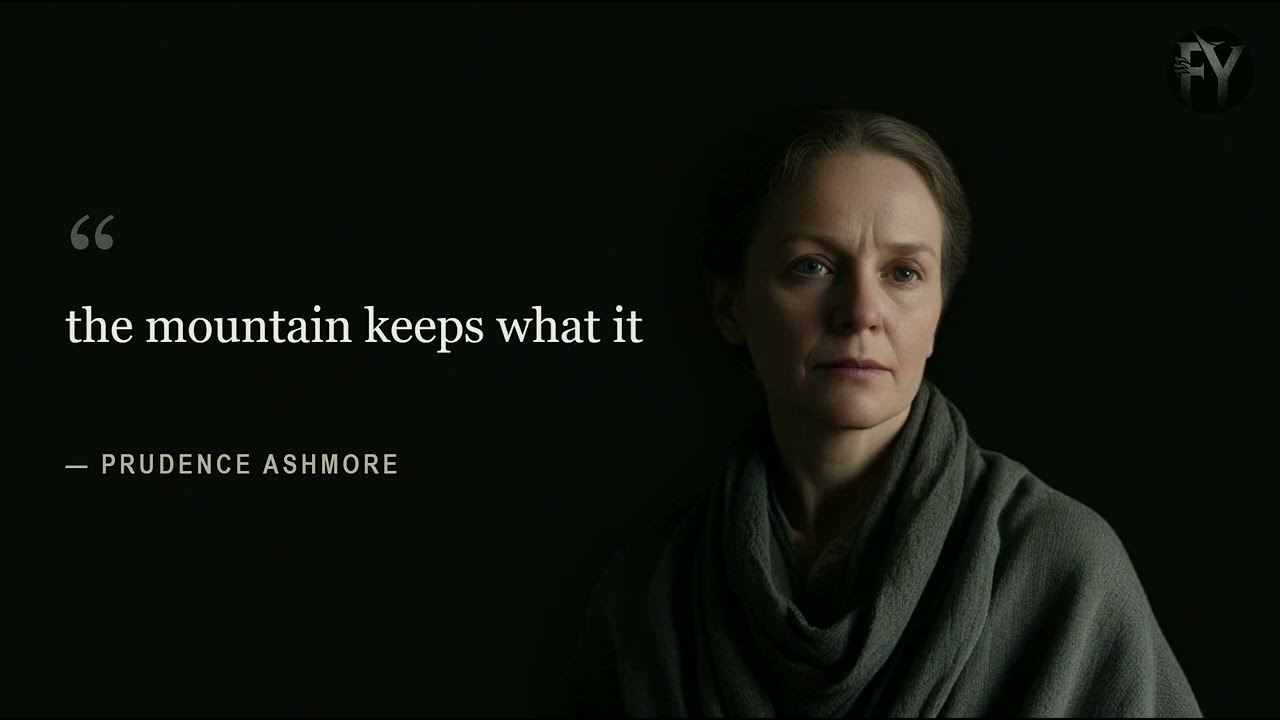
Prudence Ashmore was seventy-one, short, straight-backed, her hands thin as bird bones, her eyes steady and unmoving. She sold flour and lamp oil and nails to people close enough to need them and far enough to pay what she asked. She looked at Ephraim a long moment before letting him in, and her first word to him was not hello.
She said: "You're the second one they sent."
Ephraim said he supposed he was. She asked if they had told him what happened to the first. He said the paper had described the first man's work as unfit for publication. At that she made a small sound, not a laugh, and said the paper was being kind.
Then she poured him a cup of tea he had not particularly wanted and told him the parts the county had spent forty years carefully not saying.
She said the Harrow family had settled in that country around 1811, before her mother was born, from a place no one ever agreed on. They were not exactly hostile. They kept their own church, their own ground, their own dead. And they always married among themselves.
Here she stopped and chose her next words the way a person chooses a foothold on slick ice. She said the family had never grown, and never shrunk. The same names came down off that mountain to trade at her counter, generation after generation. Not the family name. The personal names. The same small set, smooth as river stones, handed down.
She said her mother had traded with a Harrow woman named Mahala when her mother was a girl, and that she herself, an old woman now, had traded with a Harrow woman named Mahala only two seasons ago, and that both of them had carried the same crook in the same finger. And that she had never once let herself think hard about it until she was old enough that thinking no longer had any effect on her.
Then she told him about the winter of 1831. She said that was the year something went wrong up there. A hard winter, sickness, something of the kind. She said that for the first time in living memory, none of the Harrows came down to trade that spring, so a few men from the county went up to see.
She said the men came back changed, and refused to talk about what they found, and that within a month the county court met behind a closed door and voted to seal everything those men had written, strike the name from the tax rolls, and leave the Harrow country to itself forever. She added that this was the true beginning of the blank space on the map. Not neglect. A decision, made by frightened men, to ignore a thing rather than face it.
Then she gave him the sentence he wrote down and underlined twice. She said: "This is the sentence I want you to carry up that mountain." She said the mountain keeps what it is owed, and it has been owed a long time. And if you go up there, you had better make sure you owe it nothing at all.
Prudence Ashmore was the one who found him a guide, though "guide" is a generous word for what the man agreed to do. There was an old man named Silas Ordway, sixty-two, who owned two mules, had a quick temper, and lived closer to the pass than was good for a person. His people had run the mill on the creek that comes down out of Sorrel Notch, back when there was enough traffic on that mountain to justify a mill.
Silas Ordway knew the lower road the way a man knows his way to his own bed in the dark. He said he would take Ephraim as far as the old mill, and not one step past it. He named a price that was really just a way of hoping to be refused. Ephraim paid it without a word.
They went up the next morning into a fog that had not been there at the store below, and that did not thin the whole way. That was the first wrong thing Ephraim truly noticed. The fog did not burn off or lighten the way clear weather does. It held. It kept a fixed distance in front of the mules. Everything was the same, six yards of gray, as if the mountain had decided in advance how much of itself it meant to show them, no more and no less.
The sound changed after that. Their own footsteps came back to them half a beat late, and from slightly the wrong direction, so that Ephraim turned more than once to look behind him at a step that was only his own. He felt a cold that had nothing to do with the climb. Not the ordinary cold of altitude. A cellar cold. The cold of a room long shut that does not want its door opened.
Silas Ordway did not speak a word for two hours. Then the trees opened, and there was the mill. It stood over the creek on a base of old stone, the wheel long stopped, half its paddles eaten away. The whole building leaned toward the water like a man dozing over a table.
Silas Ordway got down off his mule and did not tie it. He stood looking at the mill with a face Ephraim could not describe, then said his piece all at once, the way a man says something he has practiced so he will not lose his nerve in the middle of it. He said his grandfather built that mill and his father ran it, and that in his youth he had carried grain up this same track without a care. He said that ended the year he turned twenty. He did not say what ended it. He said only that past this mill a man goes on alone. That he had climbed this mountain as far as he ever would in his life. And that if Ephraim had a grain of sense, he would ride his mule back down now and leave the notch alone.
Ephraim asked him, since they were being honest with each other, whether he believed the stories. Silas Ordway looked at him and said it was not about believing. He said the notch is not a story, it is a place, and it is there right now, and it does not care what a man from Frankfort thinks about it. Then he took his mule and went back down into the fog, leaving Ephraim standing alone at the mill, his instruments on his back, the creek whispering to itself in the cold.
Ephraim climbed alone. The track past the mill was no longer a track in any real sense, just a memory of one. A groove worn by feet in ground covered with fallen leaves, feet that had stopped using it long ago. He climbed for about an hour, and the fog climbed with him, keeping its six yards.
The trees changed as he went up. Below, they had been ordinary hardwoods. Here they grew close and bent, all of them leaning the same direction, downhill, away from the top of the notch, as if every one of them had spent its life trying to leave quietly and had only managed to lean.
Then the ground leveled. The fog let go all at once, as if a held breath had been released. He was standing at the edge of Sorrel Notch. It was flat ground hemmed between two hills, and it looked greener than it had any right to be this late in the year.
The first thing he saw was not a house. It was the graveyard. It sat on a low rise inside the tree line, looking like the oldest thing in the notch, a patch of ground paved with tilted stones inside a low rock wall.
Ephraim was a man who liked to count. That was how his mind kept its balance. So, without meaning to, he counted the stones, and reached nineteen. He wrote nineteen in his notebook. Then he walked the boundary of the parcel for a while, considering its shape. On his way back he passed the graveyard again and counted again, as if checking a sum. This time he reached twenty-one.
He stood perfectly still. He counted a third time, slowly, touching nothing, moving his lips. Twenty-one. He convinced himself he had miscounted the first time, the way you tell a child something you do not believe yourself, and he wrote the new number under the old one. He did not underline either. And he never counted the stones again. Not that day, and not any day after.
Consider why. It was not that the number had increased. It was that he understood, standing there with the pen still in his hand, that if he counted a fourth time he might get a different answer, and that some part of him already knew which way things were going. That the man who keeps counting a thing like that is a man volunteering to become part of the sum.
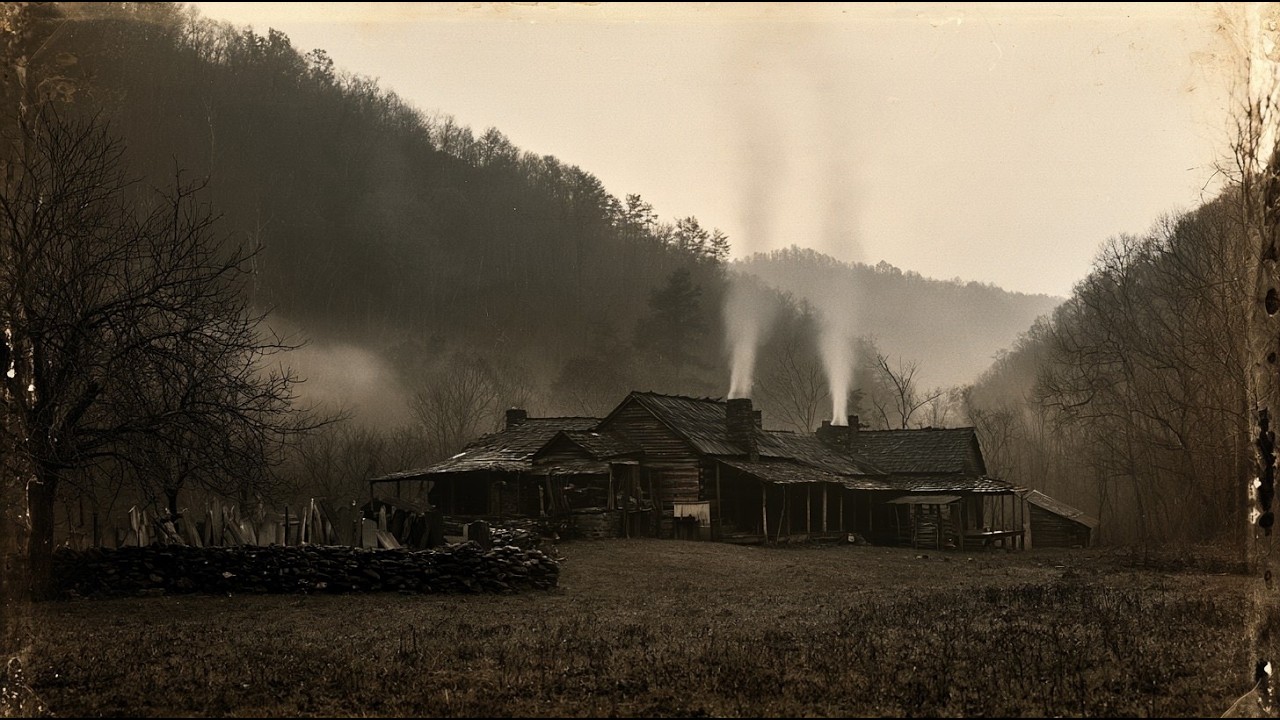
After the graveyard came the house. Houses, in fact, though they had grown into one another over the years the way old trees do. A main building of dark squared logs, with sheds and outbuildings and a low second dwelling, all connected by covered walkways, so the whole structure lay stretched along the ground like something that had long ago decided never to be dug up.
Smoke rose straight from two chimneys. There was a stone well in the yard under a peaked wooden roof, black with age. There were solid fences in good repair, a kitchen garden ready for the season, a woodpile. Everything you would expect of a working country place that had kept itself going for nearly a hundred years without help from anyone.
And the place was quiet. Not an empty quiet. An inhabited quiet. The quiet of a house where people had all stopped talking at the same moment to listen to the same sound. And the sound was you.
Ephraim stood at the edge of the yard and called hello. His voice went into the fog on the far side of the hollow and did not come back, which is not what usually happens, and he knew it, and he made himself go on anyway.
A woman came out onto the covered walk before he reached the door. She was old. That is the best I can do, because everyone who ever tried to put an age on a Harrow failed, and Ephraim was no different. She was old the way the stones of that wall were old, smooth and faded and somehow past the stage of wearing.
She wore a dark handwoven dress and an ash-colored shawl, and when she folded her hands in front of her, one finger was crooked, which Ephraim would remember later at the store. When Prudence Ashmore first spoke the name, he realized he had met that same crooked finger before and shaken that same cold hand.
She said her name was Mahala. She did not ask his. She said they had been expecting a man from the county for some time, and she said it mildly, the way you say the weather looks like rain, then took a step back and closed the door.
Every sound instinct Silas Ordway had tried to plant in him at the mill rose up at once and told him not to go in. He went in. Of course he went in. That is the trouble with a man who closes his own lines. He cannot leave anything unfinished.
The front room was warm and low and clean, and it held more people than a quiet house should. Ephraim counted, of course, and stopped at seven adults seated around the walls, all still, all watching him with a patience like someone watching a kettle they know will boil in its own time.
They resembled one another. Not the way a family resembles itself with a shared nose here and a chin there. They resembled one another the way coins from the same mint resemble one another, the same face struck over and over, distinguished only by wear. One nearly smooth, one still sharp-edged, all the same inside.
Mahala sat him at a long table and fed him, and the food was real and good. Cornbread and a soup made of something dark. And while he ate, she talked, and her talk was the second thing that ruined Ephraim's life after the stones.
She spoke of the founding of the county as if she had been part of it. She spoke of the hard winter of 1831, the one Prudence Ashmore had warned him about, as if it had happened to this room, to these specific people. And a man by the wall nodded, remembering. That man did not look a day over forty.
Ephraim set down his spoon. He said, as evenly as he could, that 1831 was twenty-five years ago, and that the man by the wall must have been very young. A silence came over the room in a new way, an amused silence. Mahala smiled at him with real warmth and said that time does not pool in this place the way it pools anywhere else. She said it pools here, in the low ground, the way cold air pools, and that the family had learned long ago to live in the pooling, and that this was their whole secret, and there was nothing else.
She said it the way you would explain a simple fact about your farm to a visitor from the city. And Ephraim, who had been raised his whole life to trust measurement over feeling, felt his certainty shake because he had found something it fit. This was the horror. It fit the stones. It fit the crooked finger he had shaken, and the hand of Prudence Ashmore's mother across sixty years. And it fit these names, worn smooth from being passed down, except that he now wondered whether passed down was the right phrase, or whether these names had never left anyone at all, and the same small set of people had carried them the whole time in that green vessel of pooled and standing time while the seasons turned outside like weather seen through a window.
He asked to see the family records. He said it was his work, that the county needed names and dates, and this was the truest thing he had said all day, because he needed them now to prove his feeling wrong.
Mahala brought him a book. It was a family record, the kind country people keep in the front of a Bible, births and marriages and deaths in one long column, the ink at the top so old it had gone the brown of dried river mud, the ink at the bottom fresh enough to look as if it had been written that year. The same names everywhere. Mahala, Alpheus, Verley, Amasa, the same eight or nine names repeating across two hundred years, and beside each name a birth date, and rarely a death date. A record spanning two centuries, and almost no one in it finished.
Ephraim turned the pages with a hand that had begun to tremble slightly, and near the back, pressed flat between two leaves like a dried flower, he found a single survey sheet in a hand that was not his own. It was a skilled, trained hand. He believed it was the hand of Corin Bell, the surveyor who had gone up in 1849 and come back down and filed a report unfit for preservation. This was a page from that report, or a page meant for it, that had never made it down the mountain. It was an unfinished chain of measurements and bearings and directions, the same tedious and sacred work Ephraim did, and it stopped in the middle of a line, in the middle of a number, as if the man writing it had been called away from the table and never came back to finish the figure.

Ephraim looked up from that unfinished number and around the warm watching room, at the seven still faces and the eight or nine names rooted across two hundred years, and did the arithmetic no one should do at a stranger's dinner table. Corin Bell had come here seven years ago. Corin Bell had never gone home, and no one in this room looked like a dead man.
He asked, very quietly, whether Corin Bell was still in the notch. Mahala folded her crooked hands and said that everyone who came to stay was still in the notch. She said it gently. She said the mountain keeps its own, and she said it the way you would say a prayer.
They gave him a room to sleep in, and it was a nice room, dry and warm, with a rope bed and a good wool blanket and a single tallow candle. And it was the most frightening room Ephraim Vale had ever been asked to sleep in, because it clearly belonged to someone before him.
There was a coat hanging on a peg by the door, a fine coat, town-cut, wrong for the mountain, gone stiff with age. There was a leather case in the corner with a surveyor's chain inside and a brass instrument gone green. Ephraim did not have to open the case to know whose initials would be cut into it.
He sat on the edge of the bed with the candle lit, and he did not undress, and he did not sleep. He listened. The house did not settle the way houses settle. It moved. Slow footsteps on the covered walks, back and forth, quiet all night, as if the people of the house did not sleep so much as take turns keeping watch.
Once, near what I take to be midnight, he heard the well in the yard, its wooden roof creaking, and the slow long movement of the bucket going down and down and down, far longer than any well of that depth should allow, and then no sound of striking bottom at all. Only the rope still paying out into perfect silence.
There were fainter sounds too, and those were the worst, because he could almost explain them and never quite could. A dry whisper running along the inner walls, low and patient, with the rhythm of speech but not its shape, as if the people of the house, on the other side of the dark logs, were reading a long list aloud in a language worn down to nothing but its cadence. Once he was almost sure he heard his own name folded into it. Once he was sure he heard the name Corin Bell. And once he heard a name he did not know, and understood, with a small shiver under his ribs, that it might be a name not yet given.
The candle went out though there was no draft to put it out. His breath began to show in front of him indoors, in a warm room, small pale clouds rising and fading the way breath does on a bitter winter night. And he sat there watching himself vanish into the cold, and thought about the trees outside, every one of them leaning downhill, longing to be anywhere but here. He had climbed of his own free will to the one place on that whole mountain where every living thing was trying to leave quietly. He was the only fool in a hundred years who had come on purpose.
He put the candle out after that. He decided a lit window told them he was awake, and he very much wanted them to believe he was not. And in the dark he did the thing that saved him, though he did not yet know it would.
He went back over every word Prudence Ashmore had said to him at the foot of the mountain, and he stopped at the important one. She had not said the mountain takes. She had said the mountain keeps what it is owed. And a debt is a thing you enter into. A debt requires agreement.
He thought about the soup he had eaten, and the warm bread, and the tea, and the roof over him, and the blanket over him. All of it given generously. And he understood that he had spent the whole evening quietly and politely signing his name in the ledger, one small kindness at a time, and that the record holding two hundred years of unfinished lives was not a record of the people the mountain had embraced. It was a record of the people who had accepted its hospitality, and by accepting had agreed to stay and repay it forever.
Corin Bell had eaten at that table too.
And so, in the dark, Ephraim made a decision. It was the coldest and most correct decision of his careful life. He would take nothing else. He would repay what he could. And he would leave that mountain before the debt came due at first light.
He did not gather his instruments. Understand this. His chain, his scales, his fine exact lines, the tools that were everything he was, he left in a strange house on a haunted mountain, because they were his livelihood, and he would not carry even a minute of their keeping back down the hill.
He went out the window instead of the door. He left the wool blanket folded on the bed, and the good coat on its peg, and the dead man's case in its corner. Then he dropped into the cold yard, and the fog was waiting for him there. And he began to walk.
The graveyard was the first thing he came to. He had promised himself he would not look, but he looked, because a man cannot help checking a sum he is trying to leave behind, and in the gray fog he could make out the stones, and there were more of them now. He did not count them. He kept his eyes low and his feet moving, and he did not count them. And that refusal was the second thing that saved him, because counting them was a question put to the mountain, and asking was a way of continuing to deal with it.
Behind him, the house stayed dark and quiet. No one called out. No one came running. That was the worst of it, the thing that made him feel the deep cold. They did not chase him. Why would they chase him? A man does not chase a debt that has already been paid. They simply let him go the way a patient man lets out a line, because the standing time of that notch was in no hurry. It had learned across two centuries that what is owed comes back on its own.
He walked, and the track bent under him. The descent was longer than the climb. The trees leaned over the path, all of them pointing downhill. And he understood now that they had not been trying to leave. They had been trying to follow him.
He passed the place where he thought the mill should be, and it was not there, so he kept walking and passed the place again, the same fallen trunk, the same cracked stone, and he understood that he was being walked in a slow circle in the fog, gently, without malice, the way you turn a tired animal back toward the barn.
He stopped in the gray fog and made himself stand still and think, though every part of him wanted to run, because running was exactly what the mountain was counting on from an exhausted animal. He had left his instruments and his blanket. He had left the coat that was not his and the case that was not his. He was almost certain he had taken nothing with him, and still the circle held him. Still the same cracked stone came around a fourth and a fifth time, and he understood that almost certain would not be enough tonight. That there was something small he still owed, something small of the mountain's generosity he had not returned, somewhere on him or in his pockets or in the memory of that warm dinner, and that he would circle slowly in this fog until he found it, or until the fog decided it had waited long enough.
Then, as Ephraim would later say, in the few times he was ever willing to speak of it, he stopped trying to find the path with his eyes and began to pay the debt with his feet.
He took the piece of bread he had put in his pocket without thinking during dinner, the only thing he had carried away, and he set it on a flat stone in the middle of the fog, and he said out loud to the mountain that he wanted no part of its keeping, that he had eaten, and here was the food returned, and that he owed it nothing and would owe it nothing. And he walked on without looking back at the stone, and the cold at the back of his neck eased a little. Only a little. Like a hand that had decided, for reasons of its own, to open.
He walked the rest of that night the way a man walks in a nightmare where the ground keeps agreeing to be ground and then quietly stops. The fog stayed with him but no longer pressed on him. It had thinned to the ordinary gray of any mountain morning waiting to happen. And somewhere in the last black hour before dawn, he understood that the circle had let him out. That the same fallen trunk and the same cracked stone had stopped coming around, and that he was truly descending now.
He did not feel relief. He said later that a man does not feel relief coming out of a place like that. He feels emptied, the way a cup is emptied, and he spends a long time wondering what poured out of him onto the mountain, and whether he will ever get it back.
When he finally reached the place where the mill should have been, it was only a mill, rotted and leaning and harmless in that dim light, and the sight of that honest ruin nearly stopped his legs. He put his hand on the cold stone of its base and stood there breathing until he had his confidence back, then went on the last stretch of track to where the road became a road again.
Prudence Ashmore's store had a lamp lit in its window, though it was not light enough yet. She was awake, dressed, sitting in a chair by the door with her bony hands folded in her lap, and Ephraim understood that she had been sitting there all night, the way a person sits with the sick, waiting to learn what would happen.
She looked at him a long moment in the doorway, at what was written on him, then got up and put the kettle on and did not say "I told you so." I have always liked her better for that than for anything else in this story.
She asked him one question while the water heated. She asked whether he had taken anything from the mountain. Ephraim said no. He said he had left his instruments in the house and his blanket on the bed. He told her about the piece of bread he had taken by accident, and how he had set it on a flat stone in the fog and given it back and said out loud that he owed the mountain nothing.
Prudence Ashmore closed her eyes when he said it. She let out a breath that sounded like one she had been holding since 1831. She said the bread was probably what did it. She said her grandmother had told her that the only ones who come back down the mountain are the ones who come back with no debts. That most men cannot do it, because they cannot bear to leave a good coat on a peg or a good tool in a corner. And the mountain has always known that about us and counted on it. She said Corin Bell had carried his fine brass instrument up there, and would have died before he left it behind. And that was the only difference between the two of them. The willingness to give up what was precious.
Then she gave him tea. And this time he drank it, because it was hers, and offered generously at the foot of the mountain rather than at the top. There is a difference. Both of them knew it.
He asked her, before he left, why she stayed. Why an old woman kept a store at the foot of a place like that, year after year, when she could have gone down to the town and spent her days with the fog never touching her window.
Prudence Ashmore looked up the track toward the fog and was quiet a moment. Then she said someone had to keep the last light burning on that road. Someone had to be awake when the next one came out. If one ever came out at all. She said the county had chosen to ignore that notch. And ignoring a thing does not make it safe. It makes it lonely. And she would not have someone walk out of that fog to a dark, empty store with no one there to tell them they were real.
She said it plainly, without decoration. And Ephraim wrote none of it in his notebook. Because some things a man keeps somewhere else. Somewhere that is not for the county.
He rode to Caldwell Courthouse that same day. He did not look back at the mountain. Prudence Ashmore watched him go from her chair by the door. And that was the last time the two of them ever spoke.
Barnabas Coil was waiting for him at the courthouse with a calm, eager face, the face of a man who had convinced himself that what he was about to hear would be ordinary. He asked how many families were up there. He asked for names, acreage, value, the neat tables the state had sent Ephraim to fill in.
And Ephraim Vale, who had not filed one incomplete line in twenty years of work, sat down at the clerk's desk and wrote the shortest report of his life. He did not name the families. He did not give a count of residents, because he did not know from one hour to the next how many there were. He did not put a figure on that page that might send someone up to check it.
He wrote that the parcel at Sorrel Notch could not be surveyed by the usual methods, that its boundaries were incomplete, and that in his professional opinion it should be excluded from the records and not passed around among men. Then he signed the document and handed it to Barnabas Coil, who read it twice, then looked at him and said quietly: "That is the same word the man before you used. Unfit."
Ephraim said yes. He said it was the only honest word that fit, and that the clerk should keep it beside what remained of Corin Bell's work, and that he would not send a third man to that mountain under any circumstances, because sending a third man would deliberately burden the county with an expense, and that kind of accounting was not to be tolerated.
Then he asked Barnabas Coil for one thing. He asked to see the deed register again, the one with the torn page. And when the clerk brought it, he laid his hand on the pale stripe where the Harrow page had been lifted. And he finally understood what he was looking at.
Someone, long ago, had done exactly what Ephraim had done. Someone had gone up and seen, and come down, and decided that the safest thing that could be offered to a place like Sorrel Notch was no page at all. The torn line was not a cover-up in the way the state had feared, a hidden crime, a buried scandal. It was a sanitary measure. It was a man with a knife and a steady hand deciding that the surest way to keep the notch from spreading down the mountain to the rest of us was to deny it the one thing it appeared to feed on: being written, and recorded, and counted, and made flesh in the records of ordinary men.
Do not give the dead your ink.
That was the secret the county had hidden from itself for forty years. They had been so afraid of it that they had forgotten they were keeping it.
Ephraim closed the register and put it back without adding a word to it. He looked for Silas Ordway before leaving the county, to return his fee or part of it, because the man had not been a guide the whole way, and that did not sit right with him. But Silas Ordway had gone silent and would not open his door, and a neighbor said the old man had not been right since the morning he came back alone with two mules and an empty saddle he could not explain. That he had stood at his gate a long while as if counting something in the fog, and had not ridden either mule on any track since.
Ephraim left the money with the neighbor and rode out of Caldwell County and did not come back.
Here is the part I can confirm for you, because the county paper confirms it. The parcel at Sorrel Notch was never surveyed. It stayed out of the records. When the state redrew the maps of that region years later, the mapmaker, working from the records he was given, found nothing to put in that square of ground. So he left it as it was. Blank. No water, no cliffs too steep for a road, just a faint emptiness where a careful pen had not dared to write a name. Exactly as I described it to you at the beginning, before you knew what that empty space was for.
And every mapmaker since has copied the one before. The blank space passes from mapmaker to mapmaker, the way the names pass, or never pass, in that notch. And to this day, if you find the old survey of the area and put your finger on that empty square, you are touching the quiet decision of a frightened, sensible man to leave something unrecorded so that it might, God willing, stay unkept.
As for Ephraim Vale, he never ran another survey. A man famous for his unbroken lines could not, after Sorrel Notch, force himself to walk another line, because he had stood in a place where the boundary between one year and the next no longer held. And once you have felt that give way under your feet, you cannot trust a straight line to stay where you left it.
He worked in Frankfort keeping other men's books, quiet indoor work, and those who knew him in his later years described him as a generous and cautious man, weighed down by painful memories, with two small habits he could not give up.
The first was that he counted things. Not out of worry exactly, but out of a need to be sure the number held. He counted the stairs he climbed, the panes in a window, the coins in his hand. If he counted something twice and got the same result both times, you could see something in his shoulders settle a little. And if he got, by ordinary error, two different answers, his face went pale and he had to sit down. The woman who kept his boarding house said he counted the fence posts along his walk to work every morning of his life, the same forty-one posts, and that the day one of them fell in a storm and left forty, he did not come to work at all, and no one could be persuaded to go on until a carpenter had been sent to put the post back and restore the count.
The second habit was the lamp. Ephraim Vale kept a lamp burning in his front window every night until the day he died, and the lamp was bright and faced the road. When people asked him why, he would only say that he did not like the idea of anyone walking a long way in the dark and arriving at last at a dark house with no one awake to tell them they were real.
And I think we know now where he learned that, and who taught it to him, and what such a light is really for.
He never spoke the name of that notch again, as far as anyone knew. But once, on a long evening, after Ephraim had had a glass more than usual, a friend asked him plainly whether he believed he had truly gotten rid of it back there, with a piece of bread on a stone, and whether a debt like that could be settled so cheaply, or whether he had only persuaded the mountain to be patient.
The friend said Ephraim Vale looked into the fire a while, and then said he did not know. That not knowing was the price. And that on some nights he woke a little before dawn with a deep chill at the back of his neck and a certainty that his name had been written somewhere in that green vessel of standing time, near the bottom of a very long column in wet brown ink, with the date of his arrival beside it, and the space for the other date left empty. That was how they left most of them. Empty. Waiting, without any hurry at all, for the account to be completed.
I have thought about this a long time, longer than most, and I will tell you what keeps bringing me back to it. It is not the moving stones, or the bottomless well, or the same crooked finger reaching across sixty years to shake two different hands. It is how reasonable every one of them was.
The court that sealed the record, and the clerk with the blade who cut the page so clean the stitching held. Corin Bell, who could not let go of his fine brass, and so is still there, if the word "there" means anything in a place where years pool like cold air. Ephraim Vale, who counted his fence posts for the rest of his life so that at least one column of numbers would hold still.
None of them was a fool. Every one of them acted sensibly on the information he had, and the sensible act, over and over, was to look away, to ignore what was seen, to leave that square of ground blank in the hope that a place denied its page would starve for lack of being written down.
Maybe that is true. Maybe a thing like the notch needs our ink to grow, and our best defense against it is our willingness, now and then, to admit that some ground is better left off the map.
Or maybe this is only a story frightened men tell themselves so they can sleep. And the debt was never cancelled, only transferred, from one county to the next, from one mapmaker to the next, along with the blank space, the way the names were transferred, or never transferred, in Sorrel Notch.
I do not know. I told you at the start that the blank space is a choice. Now you know whose choice it was, and why, and what it cost the careful man who was sent to fill it.
What I will say is this. The next time you are in country that looks too easy, a green valley of reclaimed ground where the grass is greener than the season should allow, and the house is quiet in a way that suggests it is occupied, and someone old and kind comes out onto the porch and offers you a chair and a warm plate and a roof for the night. All of it free. All of it given generously. I want you to remember Ephraim Vale at that dinner table, doing the arithmetic no one should do. And I want you to remember that the mountain keeps what it is owed, and that the debt is paid in small kindnesses, one at a time, and that the safest thing you can carry out of a place like that is nothing at all. Not a loaf of bread, not a coat, not even a minute borrowed from anyone.
So tell me. Do you believe there are places that have been left off the count on purpose? That we have drawn a careful blank around them because the alternative was worse? Or do you believe a thing like Sorrel Notch is only fog and old paper, and the way a lonely mountain plays with an exhausted man?
Leave your comment. I read them all, there in the dark with you. And if you know a story like this from your county, or your family, or from that blank spot on an old map that no one will explain to you, tell me that too. Some of the stories I have told here began as three lines in a strange comment, and the next file I open may be yours.
Keep a light in your window. And whatever you do, do not let anyone convince you that you owe the dark anything.