On the afternoon of October 22, 1934, a tired and filthy man sat down to eat in a farmhouse kitchen in eastern Ohio. His suit was ragged and his shirt was gray with dirt. He had been sleeping rough in the woods for two days, living on whatever he could find, covered in thistles and mud.
A widow named Ellen Conkle fed the stranger spare ribs, potatoes, rice pudding, and pie. He reportedly told her it was a meal fit for a king. Within the hour, he would be dead in her field, cut down by lawmen, and the country would run his name across every front page it had.
That man was Charles Arthur Floyd. The newspapers called him Pretty Boy Floyd, a name he could not stand. For four years, he had been one of the most hunted men in America, and by the fall of 1934, he sat at the very top of that list. The young Federal Bureau called him Public Enemy Number One.
Most people know the name. Fewer know how it actually ended. Fewer still know how little of the legend holds up when you look at the record. The crime that made him a national target may not have been his crime at all. The stories that turned him into a folk hero were most likely built on air, and the way he died is still argued over today because the men who stood in that field could not agree on what happened there.
To understand the ending, you have to know where the man came from. Charles Arthur Floyd was born on February 3, 1904, in Adairsville, Georgia. While he was still a boy, his family moved west to the Cookson Hills of Sequoyah County in eastern Oklahoma.
This was poor country, tenant farming, drought, and hard years with all of it. He grew up in a large farming family, and by most accounts from people who knew him, he was an ordinary farm kid well into his twenties. Nothing about the early years marked him for what came later.
The name came before the crimes people remember. There are competing accounts of how he picked it up. One story ties it to a payroll robbery in St. Louis in 1925, where a witness described one of the robbers as a pretty boy with apple cheeks. Another version says it came from his habit of wearing clean white dress shirts.
Whichever is true, the label stuck, and he despised it. To the people close to him, he was Choc or simply Charles. It is a small detail, but it tells you something honest. The name that made him famous was the one he wanted least.
His record starts in September 1925 in St. Louis with a robbery of a grocery company payroll worth around $11,000. He went to a Missouri prison for it and was paroled in 1929. From there, the pattern set in.
Floyd became a bank robber working small-town banks across Oklahoma, Ohio, Kentucky, Indiana, and Missouri, often with a partner named George Birdwell and a handful of associates. This was a regional armed robber running with small crews. He was not the head of a criminal family. He controlled no city. He answered to no commission and sat on no board. He robbed banks, he ran, and he was good at both.
There is violence in the early record, too, and it is worth being careful about how much of it we can actually confirm. Floyd was tied to the death of a former sheriff and to the killing of a federal agent in Kansas City in 1931. He was also blamed for the death of a neighbor named Jim Mills, the man acquitted of shooting Floyd's own father in a land dispute.
Mills vanished, his body was never recovered, and the law pinned the killing on Floyd based on prior threats and circumstance rather than proof. So even in the early years, you can already see the shape of this whole story. Some of the blood is his beyond question. Some of it was assigned to him because he was the obvious name to write down.
Then came the event that turned a wanted man into a national symbol. On the morning of June 17, 1933, at Union Station in Kansas City, Missouri, a group of gunmen tried to free a federal prisoner named Frank Nash. Nash was a career criminal being returned to the penitentiary at Leavenworth after an escape, and he was in the custody of several lawmen when the shooting started in the parking lot outside the station.
When it ended, Nash was dead, and four lawmen were dead with him, including a federal agent. It became known as the Kansas City Massacre, and it horrified the country. The Federal Bureau named its suspects fast. They said the gunmen were Vernon Miller, a hardened criminal for hire, along with Charles Floyd and an associate named Adam Richetti. Within a day, newspapers across the country were printing Floyd's name as part of the slaughter.
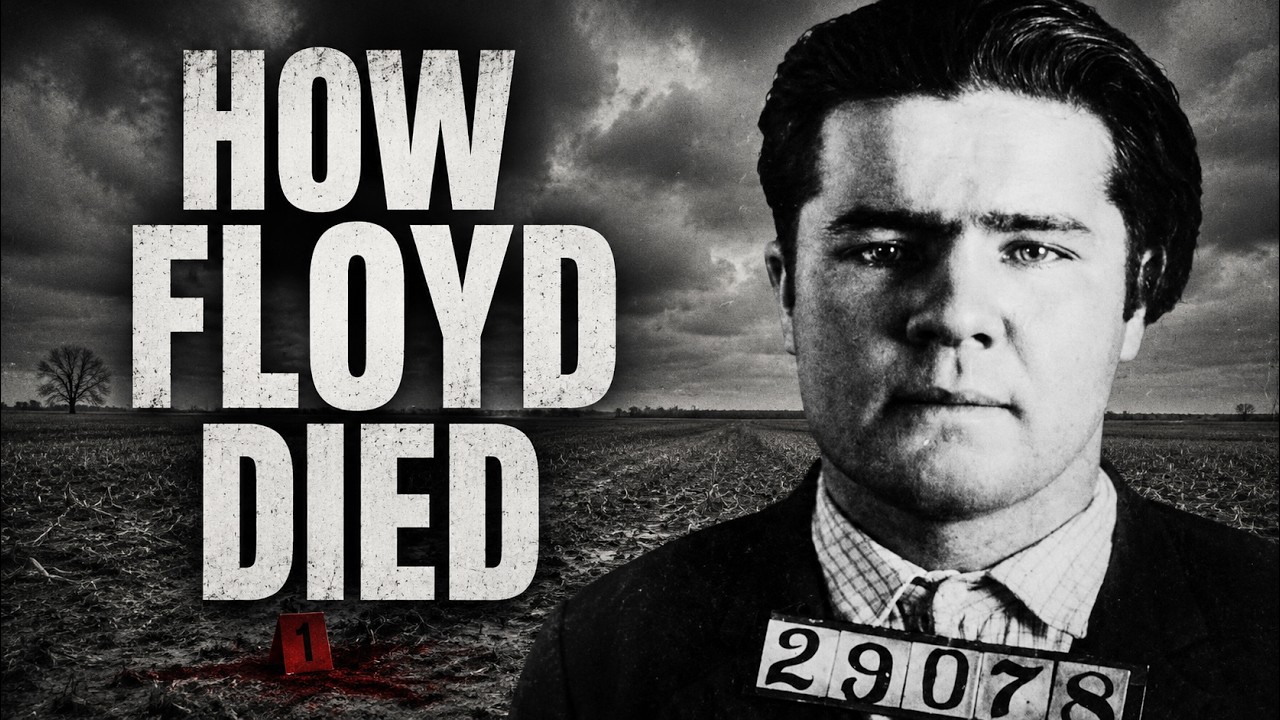
And here the story turns, because the case against Floyd was never as solid as the headlines made it sound. Floyd denied it. He denied it that summer, and he denied it with his last breath more than a year later. Shortly after the massacre, he sent a written message to the Kansas City police stating plainly that he had not taken part.
That alone proves nothing, of course. Men deny things. But the doubts did not come only from Floyd. A veteran Kansas City detective who had chased him for years said the massacre did not match how Floyd worked. It was chaotic and sloppy, and Floyd's robberies were planned and controlled.
The evidence tying him to the scene was thin and circumstantial. There was a shell casing later traced to one of his weapons months after the fact. There were eyewitness identifications that have since been challenged. There was a fingerprint belonging to Richetti found at Miller's hideout and an underworld account naming the two men. One fellow criminal later claimed Floyd had confessed to him, but that is a claim, not a proven fact, and it stands alone.
Weigh all of that honestly and you are left with real uncertainty. Miller was almost certainly there. He was found beaten and strangled near Detroit that November, killed in a dispute inside the underworld, so he never faced a courtroom. Richetti most likely had no active part at all. The most common account has him sleeping off a long night of drinking when the shooting happened.
And Floyd's own presence, the thing the entire national manhunt was built on, is exactly the part modern historians doubt the most. We do not know that Charles Floyd fired a shot at Union Station. What we know is that the Bureau decided he did and never let go of it.
The reason it never let go is not really about Floyd at all. It is about power. The massacre landed at the perfect moment for a young federal agency and its director, J. Edgar Hoover, who wanted more authority, armed agents, and a bigger place in American life. The killings gave him the argument.
In the aftermath, federal agents won the right to carry firearms and make arrests, and federal jurisdiction expanded over crimes like bank robbery and kidnapping. The public enemy campaign that followed made household names out of a handful of Depression-era outlaws. Floyd's name stayed welded to Kansas City because it was useful to keep it there. When a system needs a villain, it does not always go looking for the right one. Sometimes it keeps the one it already has.
By the summer of 1934, the campaign had its momentum. In July, the most famous outlaw of them all, John Dillinger, was shot dead by federal agents in Chicago. With Dillinger gone, the Bureau moved Floyd to the top of the list and declared him Public Enemy Number One. There was a reward on his head reported at around $23,000 dead or alive. He was now the most wanted man in the country for a crime that may not have been his.
Which brings us to the last days and to the thing that started their unraveling. It was not a raid. It was not an informant. It was a car accident.
In the middle of October 1934, Floyd decided it was time to go home to the Cookson Hills. He left a hideout in Buffalo, New York, with Adam Richetti and two women, and the four of them set out for Oklahoma by backroads. In the early hours in wet and foggy weather near Wellsville, Ohio, Floyd was at the wheel when the car skidded off the road and hit a telephone pole.
The car was damaged badly enough to need repairs. The two women took it into town to a garage. Floyd and Richetti pulled their guns out of the vehicle and settled down to wait in a patch of woods on the edge of town. That wait is what killed him.
A local resident spotted two armed, suspicious men on a hillside and called it in. The Wellsville police chief, John Foltz, went out to look with a couple of officers. When they reached the men, the shooting started. One officer was hit in the shoulder and the chief was wounded as well. Richetti fired until his gun was empty and was taken alive.
Floyd broke and ran. He dropped his heavier weapon, kept two pistols, and disappeared on foot into unfamiliar country. In the space of a few minutes, Public Enemy Number One had gone from a man in a car to a man alone in the woods with no plan and no way out.
The capture of Richetti set off a fight of its own, and it is worth pausing on because it shows how tangled the law itself was in this story. Federal agents led by Melvin Purvis, the same agent who had run the hunt for Dillinger, wanted Richetti handed over for questioning about Kansas City. Chief Foltz refused. He held his prisoner on local charges and would not give him up even under pressure from the top of the Bureau.

Richetti was arraigned on a weapons charge and moved to a county jail. His future was already written, even if no one could see it yet. Years later, in 1938, he would be executed in the gas chamber of the Missouri State Penitentiary for the Kansas City Massacre, put to death for a crime that historians now doubt he ever took part in.
One man's road ends in a field, the other's ends in a sealed room, and the case underneath both is one that may have named the wrong men from the start.
Floyd, meanwhile, was alone for two days. He moved through the Ohio countryside, sleeping in the open, hungry, filthy, trying to reach a city large enough to disappear in. He was a farm boy from Oklahoma lost in eastern Ohio. And by the time he stopped moving on the afternoon of October 22, he was worn down to almost nothing.
That is the state he was in when he walked up to Ellen Conkle's farm near a place called Sprucevale, told her he had gotten lost, and asked for food. She fed him. He praised the meal, offered her a dollar for her trouble, and asked to see recent newspapers, most likely looking for news of Richetti and of himself.
He then asked to be driven off the farm by a relative of hers who was working nearby. He never got the chance. A neighbor had already seen the stranger and passed word to a local constable, who relayed it to the East Liverpool police.
The city police chief, Hugh McDermott, gathered three patrolmen, among them a man named Chester Smith, and drove out toward the Conkle farm. Melvin Purvis and four federal agents followed in a second car. As Floyd stood near the vehicle that was supposed to carry him to safety, both cars came down the road toward the farm.
Floyd saw them and ran for the open field, a pistol in his hand. The officers opened fire. By most accounts, a great many shots were fired at the running man, and for once he did not shoot back. He was hit, went down, got back up, and was knocked down again for good.
And it is right here, at the moment of his death, that the record splits in two and never comes back together. The official account from the Bureau is straightforward. Floyd was cut down as he fled, questioned briefly as he lay dying, confirmed who he was, denied any part in Kansas City one final time, and died in the field at around 25 minutes past 4:00 in the afternoon. That is the version that went into the file.
The other account came decades later from Chester Smith, the local patrolman who had been there and who outlived every other lawman present. Years afterward, in public interviews, Smith told a different story. He said he had deliberately shot to wound Floyd, not to kill him, and that after Floyd was down, Purvis questioned him.
When Floyd cursed at him and refused to answer about Kansas City, Smith said Purvis ordered one of the federal agents to finish him where he lay. In this version, Floyd was not killed in the chase. He was executed on the ground.
Smith's account came very late, and it contradicts things he himself had said earlier. The agents who were there denied it flatly. There is no way now to prove which version is true. What we can say is that a man who was present claimed an execution took place, that the men accused of it denied it, and that everyone who could settle it is gone. This is one of those moments where the full truth died with the people in the field.
It may have been a killing in the heat of a chase. It may have been something colder. The record will not close the gap.
What is not in dispute is the plain accounting of the scene. Floyd had two pistols on him and did not fire either one that day. He had around $120 in his pockets. His body was carried to the shade of a tree, then taken into East Liverpool to a funeral home. The most wanted man in America was dead at 30 years old in a field far from home, run to ground after a car wreck and two days lost in the woods.
Then came the part of the story that outlived the man by generations. His body was taken back to Oklahoma, and the funeral was held near Sallisaw in the country where he had grown up. The crowd was enormous. Estimates run from 20,000 people to as high as 40,000, among the largest gatherings that part of Oklahoma had ever seen.

The Cookson Hills had protected him while he was alive, and they came out in the tens of thousands to bury him. Whatever the Bureau said about him, his own country did not see a monster. They saw one of their own.
That local loyalty grew into a legend, and the legend needs a clear eye. The most durable story is that Floyd, during his robberies, destroyed mortgage papers inside the banks, wiping out the debts of ordinary people and freeing them from the banks that had taken so much from them in the Depression. It is a powerful image. It is also most likely a story with very little truth under it.
There is scarce hard evidence that Floyd made a practice of burning mortgages. What is real is why people wanted to believe it. In the early 1930s, banks were foreclosing on farms and homes across the country, and a man who robbed those banks and got away with it looked to a lot of desperate people like justice with a gun. The legend told them what they needed to hear.
It got its final polish a few years after his death when the folk singer Woody Guthrie wrote a ballad about him. The song painted Floyd as an outlaw with a good heart, a man who fed the hungry and burned the debts of the poor. It became one of the most enduring things Guthrie ever wrote. And it left out the killings entirely.
Two portraits of the same man were built in the same years. One was a federal file that made him guiltier than the evidence could prove. The other was a folk song that made him kinder than he ever was. Neither one was the whole truth, and the real Charles Floyd disappeared somewhere in the space between them.
So who was he when you strip away both the file and the song? He was a poor farm kid who became a skilled and dangerous bank robber. He killed, and some of that killing was aimed straight at the men trying to stop him. He was hunted for years and shielded by his own community. He was blamed for a massacre he may have had nothing to do with, and turned into a hero for a good deed he probably never did.
And in the end, a wet road and two days in the woods finished what four years of manhunt could not.
Strip the headline away and look at Charles Floyd honestly. There was real violence in him in flashes, and some of it was pointed at lawmen, but his reach rarely left the back roads and the small-town banks. He built no empire and held no city. And while he lasted a few hard years as a hunted man, the law took him at 30 in the open with two guns he never fired.
The name at the top of the Bureau's list was bigger than the man who carried it, and that gap is the truest thing about him. Power needs stories, and stories need names to hang on. A frightened country reaching for order and a poor country reaching for a hero took the same tired bank robber and built him into two opposite legends. Neither of them quite real.
Charles Floyd died in that field believing to the end that he was innocent of the crime that made him famous. He may have been right, and that, more than any robbery, is what should stay with you. The system that hunts a man and the people who mourn him can both get him wrong, and the man himself can take the answer to the grave.
The one crime that made Floyd a national target, Kansas City, is the crime the evidence supports the least. And a young agency held onto his name anyway because it needed a villain more than it needed to be right.
His partner Richetti went to the gas chamber for the same weak case, and that is the quiet tragedy inside the loud one. A man very likely put to death for something he never did.
On the other side, the Robin Hood legend does its own kind of damage, because burning a mortgage that probably never got burned is a much easier thing to celebrate than a man who shot lawmen. The truth is that Floyd was neither the monster in the file nor the saint in the song. And both versions survive because both were useful to somebody.
His actual end was small and human. A skid on a wet road, two days lost and hungry in the woods, and a death nobody present could fully agree on afterward. The operator underneath was regional and the reach was short, even if the fame was national. And if there is a lesson here, it is that the story a country tells about a criminal usually says more about the country than it ever says about the man.