In 1973, a county surveyor named Dale Marsden walked into a hollow behind Senica Rocks, West Virginia, carrying a transit level and a leather notebook. He was mapping drainage paths for a proposed logging road. The state had contracted the survey six months earlier, and Marsden had spent most of that spring walking terrain so remote that the nearest paved road was eleven miles behind him by foot.
He never finished the survey. What he brought back instead was a notebook filled with observations so disturbing that the West Virginia Division of Highways quietly buried the project, reassigned the road corridor, and transferred Marsden to a desk position in Charleston. He spent the next fourteen years pushing paper until he retired.
The notebook did not surface publicly until 2004, when a researcher named Patricia Hulcom found it cataloged in a forgotten records box at the state archives. The entries describe a progression of encounters over nine days in a hollow so deep that sunlight only reached the floor for about two hours each afternoon.
Marsden wrote about sounds at first, then tracks, then something he could only describe as figures that moved across the slope above his camp in a way that no animal and no human being could replicate. He called them crawlers.
That word did not originate with internet forums, creepypasta threads, or paranormal television shows. It originated with people like Marsden — surveyors, hunters, timber cruisers. People who spent weeks alone in terrain so isolated that the hollows themselves had no official names on any map.
These were not superstitious people. They were practical outdoor professionals who had no reason to fabricate stories that would jeopardize their reputations and their livelihoods. And yet across more than a century of records, journals, and local oral histories from the central and southern Appalachian range, the same description appears again and again.
Pale, elongated, moving on all fours, but not the way any known quadruped moves. Silent in a way that is wrong, because the forest itself goes quiet around them. And always in the hollows — always in the places where the mountains fold inward, the canopy closes overhead, and the world above stops mattering.
The legend says they are spirits, ghosts of the unburied dead, remnants of something older than the Cherokee and the Shawnee and every people who ever walked these ridges. But the real story is worse than that, because the real story is documented. And the documentation does not describe a legend. It describes a pattern.
A pattern that stretches back to the 1700s. A pattern that involves not just sightings, but disappearances. Not just fear, but physical evidence. And not just one hollow, but a network of locations spread across five states that share geological features so specific they function almost like a habitat range.
The Appalachian Mountains are roughly 480 million years old. For context, the Rocky Mountains are about 80 million years old. The Himalayas are around 50 million. The Appalachians were ancient before either of those ranges existed. They were ancient before the Atlantic Ocean existed. They predate the separation of Pangaea. They predate the age of dinosaurs by more than 200 million years.
When these mountains were young, they were taller than the Himalayas are today — 30,000 feet or more of raw, jagged rock. Over the hundreds of millions of years since, erosion has ground them down to their current modest heights. But erosion does something else that matters far more for this story.
Water and ice and wind and the slow chemistry of dissolving stone have spent hundreds of millions of years sculpting the Appalachian landscape into a specific topography that exists nowhere else on the planet at this scale. Ridges and valleys, folds and gaps and hollows.
The limestone beds that form the foundation of the Appalachian crust were laid down in shallow seas roughly 450 million years ago, when the region that would become the eastern United States was submerged beneath a warm tropical ocean. Those limestone beds have been dissolving ever since the mountains rose and pushed them above water level.
That gives groundwater somewhere between 300 and 400 million years to eat through the stone. Three hundred million years of acid working through cracks. Three hundred million years of voids opening and expanding. Three hundred million years of passages connecting to passages, chambers linking to chambers, and entire subterranean river systems forming and draining and reforming beneath a surface landscape that was itself being reshaped by the same forces from above.
The result is a layered architecture of stone and emptiness that extends beneath the entire Appalachian range. Some of these voids are tiny, nothing more than hairline fractures too small for water to flow through. But some of them are enormous. The largest mapped chambers in Appalachian cave systems rival the dimensions of cathedral naves. And those are only the chambers that humans have found.
A hollow in Appalachian geography is not simply a valley. A valley is open. A valley has width and usually has a watercourse and typically connects to other landforms in ways that allow easy passage. A hollow is different.
A hollow is a crease in the mountain, a fold where two ridges come together and create a space that is deeper than it is wide, shadowed for most of the day, often choked with old-growth vegetation, and frequently accessible only from one direction.
There are tens of thousands of hollows across the Appalachian range. Most of them have never been formally surveyed. Many do not appear on topographic maps because the contour interval of standard mapping does not capture features that narrow. They are, in a functional sense, invisible geography — spaces that exist between the lines.
These spaces have their own ecology, their own microclimate, their own acoustic signature. Sound behaves differently in a hollow. The narrow walls amplify some frequencies and absorb others. A footstep on dry leaves might echo for three or four seconds. A voice might carry a quarter mile, or it might be swallowed entirely, depending on the geometry of the walls and the density of the canopy.
Light behaves differently, too. In the deepest hollows, the canopy is so thick and the walls so steep that the floor exists in a state of perpetual twilight. Plants that grow there are adapted to minimal sunlight. The soil is different. The moisture content is different. The temperature can be 15 or 20 degrees cooler than the ridgeline above.
These are, by any ecological definition, a separate biome within a biome. And that fact matters, because when we talk about the night crawlers, we are not talking about something seen on a ridgeline or in a field or along a road. We are talking about something encountered in a specific type of terrain with specific properties. Terrain that is dark, enclosed, that amplifies certain stimuli and suppresses others, terrain that for most of human history was simply avoided.
The indigenous knowledge systems of the Appalachian region contain layers of information about the hollows and their inhabitants that European settlers were never equipped to understand. The Cherokee maintained a classification system for landscape features that went far beyond the topographic.
Certain places were categorized not by their physical characteristics alone, but by their ecological status. The deep hollows — the places where the mountains fold inward and the light does not reach — occupied a specific category that has no direct translation into English. The closest approximation Cherokee language scholars have offered is "places where the old ones remain."
This phrase has been interpreted by some researchers as a reference to ancestral spirits, and that interpretation dominates the popular literature. But an alternative reading, supported by the context in which the phrase appears in Cherokee oral tradition, is more literal. The old ones are not spirits of the dead. They are beings that were already present when the Cherokee arrived in the Appalachian region. Beings that predated human habitation. Beings that the Cherokee acknowledged, avoided, and occasionally propitiated, but never claimed to fully understand.
Certain hollows were marked in Cherokee oral tradition as places where people did not go. The reason given varied by clan and by region, but the underlying instruction was consistent. Stay on the ridges. Stay where the sun reaches. Do not descend into the folds of the mountain after dark. And do not linger there during the day.
The Cherokee prohibition against entering these hollows was not a vague superstition. It was specific. It named places. It described the conditions under which the prohibition applied. It outlined the consequences of violation. And the consequences described were not spiritual punishment from an angry deity. They were physical. People who entered these places did not come back, or they came back changed, damaged, unable or unwilling to describe what they had experienced.
The Shawnee tradition contains a similar concept, although it is expressed differently. The Shawnee, whose territory overlapped with the northern Appalachian range, described the hollows as places where the first beings still live. Their word for these places translates roughly to "where the ground listens."
The implication was not that the ground was alive in a spiritual sense, but that something in these places was aware of human presence. Something that paid attention. Something that had been paying attention since before the Shawnee or any other people arrived.
Again, the popular interpretation frames this as mythology, as creation narrative, as the kind of origin story that every culture produces to explain the world around them. But what if it is not mythology? What if it is observation?
What if the indigenous peoples of the Appalachian region, who lived in intimate daily contact with this landscape for thousands of years, were describing exactly what they observed? Something already here. Something that lived in the deep places. Something that predated human arrival. Something that they learned to coexist with by following a simple rule: stay out of its space.
European settlers, when they began pushing into the Appalachian interior in the 1700s, did not initially understand these warnings. The hollows were sheltered, which made them attractive for homesteading. They had water. They had game. They had timber. And for the first generation of settlers, many hollows were perfectly fine places to build a cabin and raise a family.
But not all of them. Certain hollows developed reputations that persisted across generations. Families who settled in or near these places reported experiences they had no framework to explain. Livestock that refused to graze past a certain point. Dogs that would not follow a trail into the deeper reaches. Children who came home from playing near the hollow mouth with stories about sounds they heard or shapes they saw moving in the shadows below the treeline.
And every few years, someone who went into one of these hollows did not come back. Not lost in the sense that they took a wrong turn and could not find their way out. Gone in the sense that a thorough search of the hollow turned up nothing. Not a boot, not a scrap of clothing, not a bone.
The families who stayed learned the same lesson the Cherokee and Shawnee had learned centuries earlier. Avoid the deep ones. Do not go in after dark. Do not go in alone. And if you hear something moving in a way that does not sound like any animal you know, leave immediately and do not look back.
The earliest written reference to something resembling the crawler phenomenon comes from a 1768 journal entry attributed to a Presbyterian minister named Reverend Josiah Harlan. Harlan was traveling through what is now southwestern Virginia, moving between congregations scattered across the ridges.
His journal described spending a night in a hollow along the Clinch River drainage, where he and his traveling companion, a man identified only as Mr. Duff, heard what Harlan described as a dragging sound on the slope above their fire. Harlan wrote that the sound was not consistent with any animal he knew. He described it as something heavy pulling itself along the ground, but doing so with a rhythm that was too regular to be natural. "Like something counting its own steps," he wrote.
His companion extinguished the fire against Harlan's objections, and in the darkness that followed, Harlan reported seeing a shape moving laterally across the slope. He described it as pale, long in the body, and moving with its belly close to the earth, but elevated on limbs that bent at angles he called unnatural. They left the hollow before dawn, and Harlan never returned. His journal entry concludes with the sentence: "I have seen that which I do not believe, and I shall not speak of it beyond this page."
Harlan was not the only clergyman to document something unusual in the Appalachian interior during that period. Circuit riders — the itinerant ministers who traveled between remote congregations on horseback — were among the most widely traveled individuals in the colonial and early American frontier. They crossed terrain that most settlers only saw from their doorsteps, and they kept journals because their denominations required written accounts of their travels and ministerial activities.
A survey of surviving circuit rider journals from the 1770s through the 1820s, conducted by a graduate student at Appalachian State University in 2009, identified eleven separate entries from seven different ministers that describe encounters with something unusual in deep hollows across Virginia, West Virginia, Kentucky, and Tennessee.
The descriptions vary in detail and specificity, but they share common elements. Pale figures. Movement along slopes. Unusual silence. And a consistent emotional response that the ministers described in religious language as a presence of dread or a shadow upon the spirit.
One of the more detailed entries comes from a Methodist circuit rider named Elijah Randle, who was traveling through the Kanawha Valley region of what is now West Virginia in 1784. Randle wrote that he was forced to shelter overnight in a hollow after his horse threw a shoe on a steep descent. He built a fire and settled in for the night, expecting nothing more eventful than a cold, uncomfortable sleep.
Around midnight, his horse began pulling against its tether. Randle wrote that the animal was not spooked in the way horses react to predators like wolves or bears, where they become agitated and loud. Instead, the horse was trying to be quiet. It was pulling steadily at the rope but making almost no sound. Its ears were flat against its skull. Its eyes were so wide that Randle could see the whites by firelight.
Randle stepped away from the fire to calm the horse, and that is when he saw something on the far side of the hollow. He described it as a white shape, low to the earth, moving across the slope with a smoothness that reminded him of a snake — except that it had limbs. Four of them, splayed outward, each one finding its own path while the body glided between them.
He watched it for what he estimated was two minutes before it passed behind a rock outcropping and did not reappear. He spent the rest of the night standing beside his horse with his back against a tree, facing the direction the shape had gone.
In the morning he found marks on the slope where the shape had passed. The leaf litter was displaced in a path roughly three feet wide, brushed aside as if something had swept through it. The underlying soil was pressed flat in places, showing what Randle described as long marks like fingers pressed into clay.
He continued his circuit the following day and preached that evening at a settlement twelve miles east. He asked his congregation whether anyone had seen anything unusual in the hollows. The response was silence — not the silence of ignorance, the silence of people who knew exactly what he was talking about and had decided individually and collectively that it was not something to be discussed.
That collective silence is one of the most consistent features of the crawler phenomenon across Appalachian history. People knew. Communities knew. But the knowledge was held privately, passed through families, not discussed publicly, because the social cost of talking about it was higher than the cost of staying quiet.
In the Appalachian culture of the 18th and 19th centuries, reputation was survival. A man who claimed to have seen something unnatural in the woods risked being labeled superstitious, unstable, or worse. He risked his standing in the community, his eligibility for positions of trust, and his credibility in business dealings. Women who spoke of such things risked even harsher judgment.
So the accounts went into journals, into letters, into the quiet oral tradition of families who lived closest to the hollows and who had their own rules about when to go outside and when to stay in. Rules they enforced without explanation, because the explanation would sound like madness to anyone who had not seen it for themselves.
This culture of silence means that the documentary record we have is almost certainly a fraction of the actual encounters that occurred. For every account that was written down, there were likely dozens or hundreds that were never recorded at all. The people who saw these things overwhelmingly chose to say nothing.
Which means the accounts we do have come from individuals who were either unusually literate, unusually brave, or so disturbed by what they experienced that they could not keep silent despite the social consequences.
For the next hundred years, similar accounts accumulated in the margins of Appalachian life. They were not prominent. They were not published in newspapers or discussed in public forums. They existed in the spaces where Appalachian recordkeeping has always lived — in family journals, in letters between relatives, in the oral traditions passed from grandparent to grandchild during long winter evenings when the hollow behind the homestead was dark and the wind carried sounds that needed explaining.
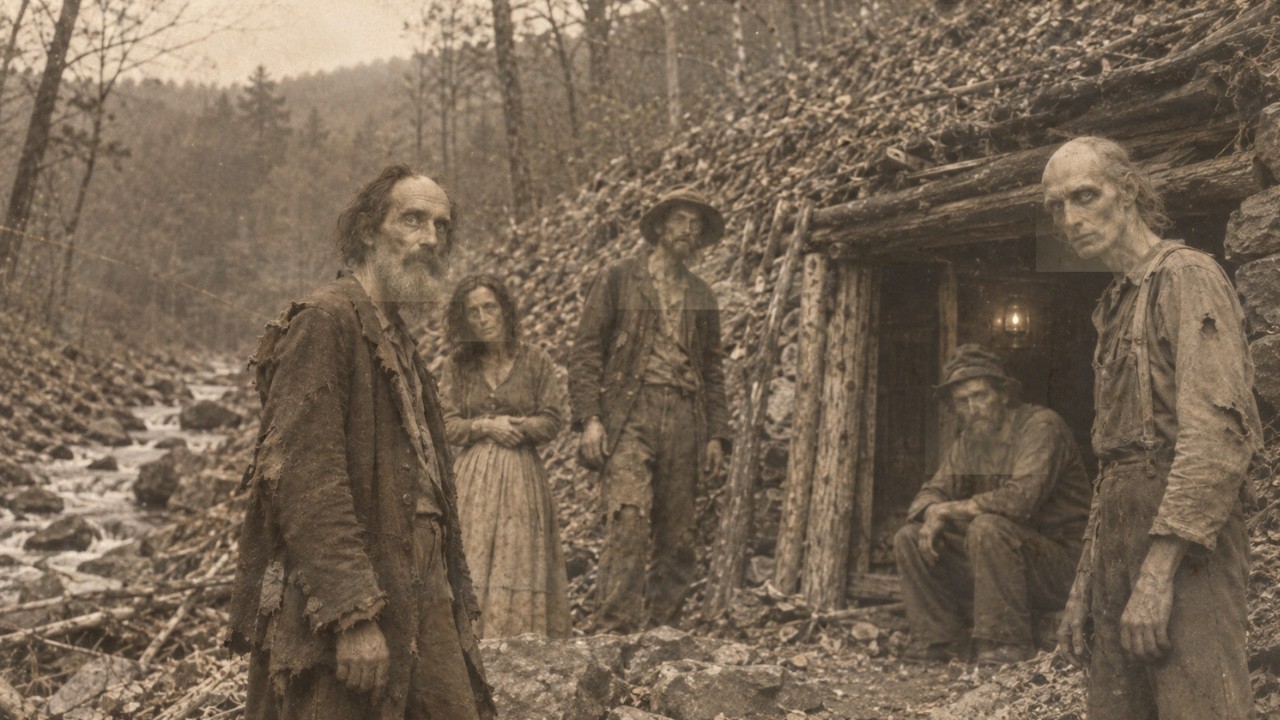
A pattern emerges from these accounts when you lay them side by side. The descriptions are remarkably consistent across time and geography.
The figures are always pale. Not white like paint or snow, but pale in the way that skin becomes pale when it has never been exposed to sunlight — a translucent, almost waxy quality that multiple witnesses describe independently.
They are always elongated, taller than a human being when standing upright, which witnesses report rarely, but stretched in a way that makes them appear disproportionate even when on all fours. The limbs are consistently described as too long. Not simply longer than expected, but long in a way that changes the geometry of how a body should move. The joints appear to articulate in additional places, or in directions that human joints do not accommodate.
And they are always on the ground. Not standing, not walking upright, moving across terrain with their torso parallel to the earth and their limbs working in a pattern that no witness has been able to compare to any known animal. Not like a bear. Not like a big cat. Not like a spider, despite the superficial comparison some modern accounts have drawn. Something else entirely. Something that has its own locomotion.
The silence is the other consistent element. Not the silence of the figure itself, although that is reported too, but the silence of the environment around it. Every account, without exception, describes a sensation of normal forest sounds preceding or accompanying the encounter. Insects stop. Birds stop. The small ambient noises that are so constant in a forest that you stop noticing them until they are gone.
And when they are gone, the absence is the first thing you notice. Before you see anything. Before you hear anything specific. The silence arrives first.
This is not superstition. This is a behavioral observation that has been made independently by hundreds of witnesses across two and a half centuries. And it aligns with known biological phenomena. Many prey species exhibit acoustic suppression behaviors in the presence of apex predators. Insects cease calling. Birds fall silent. Frogs stop. The forest creates a silence bubble around the predator as every small creature in the zone recognizes the threat and chooses invisibility over communication.
But the predators that trigger this response in the Appalachian ecosystem are known. Black bears. Bobcats. The occasional mountain lion in areas where they have not been officially extirpated. These predators trigger localized silence — a bubble that moves with the animal and extends perhaps 50 to 100 feet in every direction.
The silence described in crawler encounters is different. It is total. It extends across the entire hollow. Multiple witnesses have described a silence so complete that they could hear their own blood moving through their inner ear. A silence that does not move with a point source, but instead settles over an area like a change in atmospheric pressure. Whatever causes this silence is not a bear.
In 1891, a timber cruiser named Thomas Beckley was working in Mingo County, West Virginia, surveying old-growth timber for the Norfolk and Western Railway. Timber cruisers were the advanced scouts of the logging industry. They walked the most remote terrain in the Appalachians alone for weeks at a time, estimating the board-foot volume of standing timber and marking access routes for logging operations.
Beckley had been in the field for eleven days when he entered a hollow that he described in his field notes as unusually deep, with walls so steep that he had to use his hands to descend the last forty feet to the bottom. The hollow ran roughly northeast to southwest and was approximately a quarter mile long. The canopy was completely closed. Even at midday the floor was in deep shade.
His notes described the first day in the hollow as uneventful. He measured trees. He recorded species and diameters. He ate his supper and built a small fire against a rock face at the narrow end of the hollow.
On the second night he heard what he described as breathing. Not wind. Not animal respiration in the way he understood it. A rhythmic exhalation that seemed to come from somewhere above him on the hollow wall. He wrote that it sounded wet, like the breath of someone with fluid in their lungs, but amplified in a way that suggested a chest cavity much larger than a human being would possess. He extinguished his fire and sat in darkness with his rifle across his knees. The breathing continued for approximately two hours before it stopped. When it stopped, the silence that followed was, in his words, worse.
On the third night, he saw them. He wrote that there were three. They descended the west wall of the hollow from a point near the ridgeline, moving diagonally across the slope with a motion he struggled to describe. He settled on the phrase: "They poured. Like water finding a path down rock."
Their limbs worked independently of each other in a way that seemed impossible for a vertebrate. Each limb found its own purchase and pulled or pushed the body along while the other limbs adjusted, so that the overall motion was smooth and continuous despite the steep, uneven terrain.
They were pale. He could see them despite the darkness, which he attributed to some quality of their skin that caught and reflected whatever minimal ambient light reached the hollow floor. He estimated their body length at seven to nine feet. They made no sound.
He watched them for approximately fifteen minutes as they moved along the far wall of the hollow. Then one of them stopped. He wrote that it turned its head in his direction. He could not see features. He could not see eyes. But he knew, with a certainty that he described as physical rather than intellectual, that it was aware of him.
He did not sleep. He did not move until dawn. When light finally reached the hollow floor, he gathered his equipment and climbed out. He walked eleven miles back to the logging camp and told the foreman he was done with that section.
His field notes end with a recommendation that the hollow be excluded from the timber survey, citing unstable terrain as the reason. The real reason was in the margins, written in pencil rather than the ink he used for official entries. Three words: "They are real."
Beckley's account is valuable because he was not a storyteller. He was a professional surveyor whose livelihood depended on accuracy. His field notes are meticulous, filled with precise measurements and species identifications that demonstrate a trained eye. The passage about the crawlers does not read like fiction. It reads like a field observation made by a man who did not have the vocabulary to describe what he was seeing and had to improvise.
In 1912, the United States Geological Survey conducted an extensive mapping project across the central Appalachian range. The project involved survey teams spending months in the field establishing control points on ridgelines and running traverse lines through valleys and gaps.
One of these teams, led by a surveyor named Franklin Boggs, was tasked with mapping a section of McDowell County, West Virginia, that included several deep hollows along the Tug Fork drainage. Boggs kept a personal journal in addition to his official survey notes. The journal was donated to the West Virginia State Archives by his granddaughter in 1987 and remained uncataloged until 2001.
His entries from October 1912 describe a ten-day period during which his survey crew of four men experienced a series of encounters that Boggs documented with the precision of a trained surveyor. He recorded dates, times, weather conditions, compass bearings, and estimated distances. He sketched what he saw. He noted the reactions of his crew members by name.
The first encounter occurred on October 7. The crew had established camp in a hollow that Boggs identified by its survey designation, Station 14. At approximately 9:30 in the evening, all four men heard what Boggs described as a clicking sound originating from the north wall of the hollow. The clicking was rhythmic, approximately two clicks per second, and continued for several minutes before stopping. Boggs noted that the temperature dropped noticeably during the clicking, although he acknowledged this could have been coincidental with normal nighttime cooling.
The second encounter occurred on October 9 at approximately three in the morning. One of the crew members, a man named Arthur Styles, woke the rest of the team and directed their attention to the east wall of the hollow. Boggs wrote that they observed two figures moving horizontally across the slope at a height of approximately sixty feet above the hollow floor.
The figures were pale and moved in a manner that Boggs compared to the motion of a salamander, but scaled to a body he estimated at eight to ten feet in length. He wrote that the figures moved with complete silence, and that the forest around them was entirely still. The insects had stopped. The wind had stopped. Every ambient sound had ceased.
The third encounter occurred on October 11, and it was different from the first two. On that morning, the crew found tracks. Boggs devoted three full pages of his journal to describing and sketching these tracks.
They were impressed into soft mud along a seep at the bottom of the hollow. Each print showed four elongated digits arranged in a pattern that Boggs could not match to any known animal. The digits were between six and eight inches long, curved slightly inward, and spaced unevenly. There was no palm print, no heel impression — just the four deep digit marks pressed into mud to a depth that suggested considerable weight.
The tracks ran along the seep for approximately thirty feet before ascending the hollow wall, where they went up the wall. They became shallower but remained visible on the damp moss and leaf litter. Boggs followed them for about fifteen feet up the slope before the terrain became too steep.
He sketched the tracks from multiple angles. He measured the stride length, which was approximately four feet, and the straddle width, which was approximately three feet. He noted that the track pattern suggested a quadrupedal gait, but with an asymmetry that did not match any known quadruped. The left and right prints were not evenly spaced. One side consistently led the other by approximately six inches, as if the creature moved with a lateral bias.
The crew abandoned Station 14 on October 12. Boggs recorded the decision as mutual and based on the judgment that the hollow presented logistical difficulties — which was true, but was clearly not the primary reason.
His final entry about the hollow reads: "We have encountered something in this drainage that I cannot classify. I have thirty years of field experience, and I have seen every animal this range produces. This is not any of them. It is something that lives where we do not go, and it does not want us here."
There is something important about the Boggs account that separates it from the earlier reports. Boggs was not just a wilderness professional. He was a scientist. He was trained in observation, measurement, and documentation. And his account includes something that most crawler accounts do not — physical evidence. Tracks that he measured and sketched with the same tools and methods he used to survey the landscape.
Those sketches still exist. They are in the state archives. And when modern researchers have compared them to the handful of other track casts and photographs collected over the decades from various Appalachian locations, the morphology is consistent. The same four-digit pattern. The same curved-inward orientation. The same absence of a palm or heel impression. The same asymmetric gait.
This consistency across accounts separated by decades and hundreds of miles is either evidence of an organized hoax spanning multiple generations of unrelated individuals who had no contact with each other, or it is evidence of something else. Something that leaves physical traces. Something that has a consistent anatomy. Something that is, in the biological sense, real.
The next phase of the story involves the hollows themselves — not the creatures, but the places. Because when researchers began mapping the locations of reported encounters, a pattern emerged that was arguably more disturbing than the encounters themselves.
In 1997, a geologist at Virginia Tech named Dr. Margaret Callaway was conducting unrelated research on Appalachian karst formations when she noticed something in her data. Several of the deep hollows she was studying had unusual subsurface features. Specifically, they had cavities.
Karst topography is formed when soluble bedrock, typically limestone or dolomite, is dissolved by groundwater over millions of years. This process creates caves, sinkholes, underground rivers, and complex subterranean networks that can extend for miles beneath the surface. The Appalachian range contains extensive karst formations, particularly in the ridge and valley province that runs through Virginia, West Virginia, and into Kentucky and Tennessee.
What Callaway found was that certain hollows — specifically the deep, narrow, steep-walled hollows that correspond to the type described in crawler accounts — were disproportionately likely to sit above significant subsurface cavities. Not small caves. Not shallow sinkholes. Extensive void spaces that her ground-penetrating radar indicated could extend hundreds of feet below the surface.
She published a paper on the karst formations in 2000, but it was a geology paper and it made no reference to folklore or cryptid sightings. The connection between her findings and the crawler phenomenon was not made publicly until 2006, when a writer for a regional magazine cross-referenced her published cavity locations with a database of reported crawler encounters.
The overlap was striking. Of the 47 locations in Callaway's study that showed significant subsurface cavities, 31 were within three miles of a documented crawler encounter. Fourteen were within one mile. Seven were exact matches — the hollow above the cavity was itself the location of a reported sighting.
This does not prove anything by itself. Correlation is not causation, and the Appalachian range is large enough that random overlap between two data sets is possible. But the specificity of the correlation raised questions that have never been satisfactorily answered.
If the crawlers are a biological organism, they need to live somewhere. They need shelter. They need a habitat that provides the conditions necessary for survival. And whatever those conditions are, they must include darkness, isolation from human activity, stable temperature, and access to water. Those are exactly the conditions found in the deep cave systems that underlie the Appalachian karst.
The hypothesis that emerged — carefully, and with appropriate hedging — was that the crawlers might be a troglofaunal species. Troglofauna are organisms that live exclusively in subterranean environments. They are not theoretical. They are known science. Cave fish, cave salamanders, cave crayfish, cave spiders. Dozens of species have been documented that spend their entire lives underground, adapted to permanent darkness with reduced or absent eyes, depigmented skin, and modified limb structures suited to navigating rocky, irregular terrain.
Every one of those adaptations is consistent with the physical descriptions of crawlers.
Pale, translucent skin. The absence of pigmentation is a hallmark of troglofaunal species. Without sunlight, melanin serves no protective function and is gradually lost through evolutionary processes.
Elongated limbs with unusual articulation. Cave-adapted organisms frequently develop modified appendages suited to climbing and navigating complex three-dimensional spaces. Limb proportions that would be maladaptive on the surface can be highly adaptive in an environment of vertical rock faces, narrow passages, and uneven terrain.
Silent movement. Many troglofaunal species are essentially silent. Sound is used differently underground, where echoes can travel enormous distances. Species that rely on stealth, whether for predation or for avoiding predation, evolve to minimize acoustic output.
The silence response of other organisms. If the crawlers are an apex predator in their subsurface ecosystem and occasionally emerge onto the surface, the forest organisms would have had millions of years to evolve a recognition and avoidance response. The total silence described in crawler encounters would be the expected biological reaction to the appearance of a predator that the forest has known for longer than most of the species currently living in it.
This is where the story becomes uncomfortable, because if we accept the troglofaunal hypothesis even as a speculative framework, it raises immediate questions about scale. A troglofaunal organism the size described in crawler accounts — seven to ten feet in body length — would be the largest known troglofaunal species by an enormous margin. The largest currently known cave-dwelling organisms are certain species of cave fish and cave salamanders that reach perhaps two feet in length.
A cave-adapted organism at the scale of a crawler would require a proportionally enormous cave system to support it. A system with sufficient food resources, water, space, and environmental stability. The Appalachian karst has exactly that.
The known cave systems of the central Appalachian range are among the most extensive in the world. Organ Cave in West Virginia has over 45 miles of surveyed passages. The Friars Hole system, also in West Virginia, has over 50 miles. The caves of the ridge and valley province in Virginia include systems that have been explored to depths exceeding a thousand feet.

But these are the known caves. The caves that humans have found and entered and mapped. Speleologists, the scientists who study caves, will tell you that the known cave systems represent a fraction of the total subsurface void space in a karst landscape. For every cave entrance that a human has discovered, there are dozens or hundreds of cavities that have no surface expression. Voids that are sealed. Passages that connect to nothing accessible from above. Entire networks that exist in complete isolation from the surface.
The ground-penetrating radar surveys and gravity anomaly measurements that have been conducted across the Appalachian karst consistently indicate that the total subsurface void space is many times larger than what has been mapped. Some estimates suggest that the known cave systems represent less than ten percent of the actual void space.
If those estimates are even approximately correct, the Appalachian range contains thousands of miles of unexplored subterranean space. Space that has been there for millions of years. Space that is dark, stable, connected to groundwater, and completely isolated from human activity. The question is not whether something could live down there. The question is what has been living down there.
In 2008, a team of recreational cavers exploring an unmapped extension of a cave system in Pendleton County, West Virginia, broke through a calcite flowstone barrier at a depth of approximately 240 feet below the surface and entered a chamber that none of them were prepared for.
The chamber was roughly thirty feet in diameter and about twelve feet high. The floor was covered in bones. Not a few bones. Hundreds. Possibly thousands. They were disarticulated, meaning the skeletons had been taken apart. Individual bones were scattered across the floor of the chamber with no anatomical organization. Skulls separated from spines. Leg bones separated from pelvic structures. Ribs scattered individually rather than in the curved formations they would hold if a rib cage had simply collapsed in place.
The bones were predominantly from medium-sized mammals. Deer. Raccoons. Possibly coyotes or dogs, based on the dental structures that the cavers were able to photograph before they retreated. Several of the bones showed scoring marks consistent with teeth or claws, although the cavers were not qualified to make a definitive determination.
Most disturbing was the condition of the bones themselves. They were not fossilized. They were not ancient. Some of them still had dried tissue attached. Whatever had brought them into this chamber and disarticulated them had done so recently in geological terms — within years, possibly within months.
The cavers reported their finding to the West Virginia Speleological Survey, which documented the location but did not organize a follow-up expedition. The photographs taken by the cavers circulated in the caving community and eventually appeared online, where they were absorbed into the general noise of paranormal speculation and lost whatever evidentiary weight they might have carried. The chamber has not been visited again.
And this brings us to the disappearances. The Appalachian range has the highest rate of missing persons cases per square mile of any mountain range in the United States. This is a documented fact, not a conspiracy theory. The National Park Service, the United States Forest Service, and the various state agencies responsible for search and rescue in Appalachian terrain have records stretching back decades that show a consistent pattern of people entering the backcountry and simply not coming back.
Many of these disappearances have conventional explanations. Falls. Exposure. Medical emergencies. Drowning. The Appalachian backcountry is genuinely dangerous terrain, and people die there every year from entirely mundane causes.
But a subset of these cases has characteristics that do not fit conventional explanations. The person is an experienced outdoors person familiar with the terrain. They disappear in good weather during daylight hours in an area they have visited before. The search teams find nothing — not clothing, not equipment, not remains. The person simply ceases to exist in any recoverable form.
Search dogs lose the scent trail. In some cases, the dogs refuse to continue into certain areas, exhibiting the same stress behaviors that trained search dogs show when they encounter something they perceive as a threat.
When a body is eventually found, it is found in a location that does not make sense given the person's known route, direction of travel, and physical capabilities. Miles from where they should be. In terrain they had no reason to enter. Sometimes at elevations significantly below their last known position.
These cases are individually explicable. People get lost. People make irrational decisions under stress. Bodies are moved by water, by scavengers, by gravity. There is no single case that cannot be explained by some combination of known factors.
But when you look at the cases collectively, and when you map them, the same pattern appears that appeared in the crawler sighting data. The disappearances cluster around deep hollows. Specifically, deep hollows with documented or inferred subsurface void space.
In 2014, a retired search and rescue coordinator from the George Washington National Forest published a private analysis of 37 cases from his career that he classified as anomalous. His criteria for anomalous was simple. The person was experienced. The conditions were not extreme. The search found nothing. And the location of disappearance was within one mile of a deep hollow.
Of those 37 cases, 29 involved hollows that sit above known or suspected karst formations. Twenty-two of the 37 were within five miles of a documented crawler encounter. He shared this analysis with colleagues but never published it. When asked why, his reported answer was simple: "Because it leads somewhere I do not want to go."
The search and rescue professionals who work the Appalachian backcountry are among the most experienced wilderness responders in the country. They train for every scenario. Equipment failure. Injury. Hypothermia. Panic-driven wrong turns. Animal encounters. They have protocols for everything. And those protocols work. The vast majority of missing persons in the Appalachian backcountry are found within 48 hours, alive or dead, within a predictable radius of their last known position.
The anomalous cases violate every prediction. The person is not found within the expected radius. The search teams cover the terrain methodically, grid by grid, and find nothing. The tracking dogs, which can follow a human scent trail through rain and across running water, hit what handlers describe as a wall. The scent does not fade gradually, the way it would if the person had been carried downstream or picked up by wind. It simply stops. One step the scent is there. The next step it is not. As if the person ceased to be on the surface of the earth at that point.
In 2003, a retired forestry worker disappeared while walking a trail he had walked every week for nineteen years near Spruce Knob, West Virginia. He told his wife he would be back by noon. He was in good health. The weather was clear. The trail was well maintained, and he knew every turn and every route on it.
When he did not return by two in the afternoon, his wife called the Forest Service. A search team was deployed within three hours. They found his walking stick leaning against a tree approximately one mile from where the trail skirted the edge of a deep hollow. His cap was on the ground beside it. His water bottle was in the side pocket of a jacket that was folded neatly over a low branch.
The arrangement was deliberate. It looked like a man who had set down his things before stepping off the trail to investigate something. Something that caught his attention in the hollow below.
The search lasted eleven days. It covered every foot of the hollow and the surrounding terrain. Dogs were brought in on the second day. They tracked his scent from the walking stick to a point roughly 200 yards down the slope, where the scent ended at a rock outcrop with a narrow fissure at its base. The fissure was too narrow for a man of his size to enter. The dogs would not approach it. Two of the three dogs had to be physically carried away from the area because they would not move under their own power. His body was never found. The case remains open.
Another case from 2003 involved a retired forestry worker who had spent forty years working in the mountains of southwestern Virginia. He knew the terrain the way a person knows their own home. He went out to check a property boundary marker on a November morning, a walk of less than two miles on terrain he had crossed hundreds of times. He told his wife he would be back for lunch.
He was not back for lunch. He was not back for dinner. By nightfall, a search was underway. Dogs were brought in the following morning. They tracked his scent for approximately one mile along his expected route, then lost it completely at the edge of a hollow. Not gradually. The scent did not fade. It stopped. One moment the dogs were tracking confidently, the next they were casting in circles with nothing to follow.
The handlers described the dogs' behavior at the scent termination point as unusual. The animals were not confused. They were distressed. Two of the three dogs refused to enter the hollow. The third entered approximately twenty feet, then returned to its handler and would not go back in despite repeated commands.
His body was found four months later by a turkey hunter, three and a half miles from the scent termination point, on the opposite side of a ridge that would have required him to climb over 900 feet of steep terrain to reach. He was in a shallow depression at the bottom of a different hollow, one that had no trail access and no logical connection to his intended route. The cause of death could not be determined due to decomposition and animal activity.
The search coordinator who managed the case noted in his file that the location where the body was found was consistent with the pattern of anomalous recoveries he had observed over his career. The body was lower in elevation than the last known position. It was in a hollow. And it was in a location that could not be explained by any rational decision-making process on the part of the missing person. He was asked how a man with forty years of mountain experience could end up in a place that made no sense. His answer, according to a colleague who was present, was a question of his own: "What if he did not walk there?"
The connection between hollow depth, subsurface geology, crawler encounters, and human disappearances does not constitute proof of anything. These are correlations, not causal relationships. But the correlations are specific enough and consistent enough that dismissing them requires an explanation for why they exist.
Random chance is one explanation. But random chance becomes statistically less plausible as the number of overlapping data points increases. Shared geography is another explanation. Deep hollows and karst formations and remote terrain all correlate with each other because they are all features of the same landscape. And that landscape is inherently dangerous, which explains the disappearances without requiring a biological agent.
But the shared geography explanation does not account for the behavioral consistency of the encounters. It does not explain why the descriptions match across centuries and across witnesses who had no contact with each other. It does not explain the tracks. It does not explain the silence response. And it does not explain the dogs.
The dogs are the detail that search and rescue professionals find most difficult to dismiss. Trained search dogs do not refuse to track unless they encounter something that their training cannot override. These are animals that will track through water, through fire, through terrain that would kill a human. They do not stop because they are tired or confused. They stop because something in the environment has triggered a fear response so overwhelming that it overrides months or years of training.
When dogs refuse to enter a hollow during a missing person search, they are not malfunctioning. They are doing what every wild animal in the forest does when it detects the presence of a predator it does not understand. They are going silent.
In 2008, a group of cave explorers in Pocahontas County, West Virginia, made a discovery that added a new dimension to the crawler phenomenon. The group, which was mapping a previously unexplored section of a known cave system, pushed through a narrow passage at a depth of approximately 240 feet below the surface and emerged into a chamber that stopped them in their tracks.
The chamber was large, roughly forty feet in diameter and fifteen feet high. The floor was covered in bones. Not human bones. Animal bones. Deer. Raccoon. Opossum. Black bear. The bones were accumulated to a depth of several inches across the entire chamber floor. They were stripped of all soft tissue. The hide was gone. The fur was gone. Every tendon and every piece of cartilage had been removed. What remained was clean, dry, white bone.
The most experienced member of the group estimated that the bone accumulation represented dozens of individual animals. He noted that there was no evidence of tool marks on the bones, no evidence of fire or cooking, and no evidence of gnawing by rodents or other scavengers that would normally be expected in a bone deposit of this age. The bones had been stripped by something, but not by anything that left marks.
The chamber had three openings besides the one they had entered through. Two were too small for a human being. The third was larger, perhaps three feet wide and four feet high, and angled downward. Warm, humid air was flowing from it, indicating that it connected to a deeper passage or a larger void below. None of them went in.
They photographed the chamber, collected two bone samples, and withdrew. The bone samples were later identified as white-tailed deer. One was estimated to be less than five years old based on its condition. The other could not be dated precisely but was significantly older.
The discovery was discussed within the caving community but did not receive wider attention. Cave bone deposits are not unheard of. Animals fall into sinkholes. Predators den in cave entrances. Floodwaters wash remains underground. There are conventional explanations for bones in caves.
But the depth of this deposit — 240 feet below the surface, inside a passage that required technical skills to navigate — argued against the conventional explanations. Animals do not walk 240 feet underground through a passage that requires climbing and crawling. Floodwaters do not carry intact skeletal assemblages through narrow subterranean passages and deposit them neatly in a chamber.
Something brought those bones there. Something that could navigate the passage. Something that was large enough to carry or drag a full-grown deer 240 feet underground through a space that challenged experienced human cavers. And something had been doing it for a long time, based on the volume and condition of the accumulation.
The lead explorer returned to the chamber once more in 2010 with better documentation equipment. On this second visit, he found additional bones that had not been present two years earlier. The accumulation was growing. Whatever was using the chamber was still active.
He also found something he had missed on the first visit. Marks on the walls. Not scratches. Not tool marks. Smooth, polished areas on the limestone surface approximately three to four feet above the floor, running horizontally along the chamber walls. The kind of polish that occurs when a large body repeatedly rubs against a rock surface over an extended period. The same kind of wear pattern seen in caves used by bears as dens, where the bear's fur polishes the rock through repeated contact.
But bears do not den 240 feet underground. And the polish was at the wrong height and angle for a bear. It was too high for an animal moving on all fours at bear height and too low for a standing human. It was at the height that a body seven to nine feet long, moving on all fours with its torso elevated twelve to eighteen inches off the ground, would contact the wall in passing. Exactly the height you would predict for something that matched the descriptions in the crawler accounts.
The caver shared his findings with a limited audience and stopped exploring that section of the system. He did not give a detailed public explanation for his decision, but in private communication he indicated that on his second visit he heard sounds from the larger passage at the back of the chamber. Sounds that he described as a rhythmic clicking that echoed from below. The same clicking that Boggs described in 1912.
The acoustic properties of the Appalachian cave systems deserve specific attention, because they connect to one of the most consistent elements of crawler encounters on the surface. The clicking.
The clicking sound has been reported in crawler accounts spanning more than a century. From Boggs in 1912 to the cave explorer in 2008 to numerous modern trail camera operators who report hearing rhythmic clicking in deep hollows during the hours before dawn. The sound is always described in similar terms. A steady rhythmic pulse, two to three clicks per second, originating from no identifiable direction, or from multiple directions simultaneously because of the acoustic properties of the enclosed space.
Cave-adapted organisms in many parts of the world use echolocation. Bats are the most familiar example, but they are not the only one. Cave swiftlets in Southeast Asia echolocate using audible clicks rather than ultrasonic frequencies. Oilbirds in South American caves use a similar system. These birds produce clicking sounds that bounce off cave walls and return to their ears, creating an acoustic map of their environment that allows them to navigate in complete darkness.
If the crawlers are a cave-adapted organism, echolocation would be an expected adaptation. An organism that spends most of its existence in absolute darkness would need some mechanism for navigating its environment. Vision, even enhanced low-light vision, is useless in the total darkness of a deep cave. But sound works perfectly. Sound bounces off every surface, carries through air and water and rock, and returns information about the size, shape, distance, and composition of everything around the source.
The clicking reported in crawler encounters is consistent with a biological echolocation system. The rhythm — two to three clicks per second — falls within the range used by known echolocating species. The apparent directionlessness of the sound, its quality of seeming to come from everywhere and nowhere, is consistent with the acoustic behavior of echolocation clicks in enclosed spaces with reflective walls. Exactly the conditions found in both cave systems and deep hollows with steep stone walls.
If the crawlers echolocate, it explains several otherwise puzzling aspects of the encounter reports. It explains how they navigate the complex three-dimensional terrain of cave passages and steep hollow walls with such apparent ease and fluidity. It explains their silence of movement, because an echolocating predator would rely on detecting the echoes of its own clicks rather than listening for prey sounds, meaning that silent movement would be an advantage rather than a limitation. And it explains the total silence response of the forest, because the clicking itself, even at frequencies or volumes below human perception, might be detectable by the forest organisms that have evolved to recognize it as a threat signal.
Some modern acoustic researchers have noted that the two-to-three-clicks-per-second range falls partially within the range of infrasound — sound waves below the threshold of conscious human hearing. Infrasound has documented physiological effects on human beings. It can cause feelings of unease, dread, and anxiety. It can cause optical disturbance. It can cause the sensation of being watched. It can trigger nausea, disorientation, and panic.

Every one of those sensations has been reported by witnesses in crawler encounters. The possibility that the clicking is not just navigation but also produces infrasonic effects that humans can feel but not consciously hear adds another layer to the phenomenon. It would mean that the dread reported by witnesses is not irrational fear. It is a physiological response to a real acoustic stimulus. Their bodies are reacting to something that their ears cannot quite register but that their nervous systems recognize at a deeper level.
This mechanism has been studied in other contexts. Military researchers have investigated infrasound as a crowd control tool. Architectural acousticians have documented the unsettling effects of buildings that produce standing infrasonic waves due to their geometry. Certain wind patterns through canyons and tunnels create infrasonic frequencies that have been linked to reports of haunting in structures near those features. The science is well established.
What is not established is whether a biological organism could produce the same effect. But consider the environment. A hollow is essentially a natural amplifier. The narrow, high-wall geometry of a deep hollow would take any sound produced at its floor and reinforce certain frequencies while suppressing others. A clicking sound produced at a specific rate and at a frequency near the infrasonic threshold would be modified by the hollow itself. The walls would do the work that the organism's physiology could not. The hollow would become part of the organism's acoustic apparatus, a natural extension of whatever sound-producing mechanism the crawler possesses.
This would explain something else that witnesses consistently report. The feeling of dread is stronger in the hollow than outside it. People who encounter evidence of crawler activity on a ridgeline or at the mouth of a hollow report unease. People who encounter it deep inside a hollow report terror. The kind of terror that shuts down higher cognition and triggers a flight response so powerful that people have described running blindly through dense undergrowth without any conscious awareness of doing so.
The difference might not be psychological. It might be acoustic. The deeper you go into the hollow, the more effectively its geometry amplifies the infrasonic component of whatever the crawlers are producing.
At this point in the story, we need to talk about what the crawler phenomenon is not, because the modern internet has taken a thread of genuine Appalachian folklore and lived experience and woven it into something that barely resembles the original.
The crawlers of internet lore are supernatural. They are skinwalkers. They are wendigos. They are demons. They are interdimensional beings. They are the products of government experiments. They are aliens. They are every paranormal cliché applied to a phenomenon that may be none of those things.
The original accounts — the ones from the surveyors and timber cruisers and longtime hollow dwellers — do not describe anything supernatural. They describe an animal. A deeply strange, deeply unsettling animal, but an animal nonetheless. Something that has mass. Something that has limbs and joints and body proportions. Something that leaves tracks in mud and polishes rock with its passage. Something that eats, based on the bone chambers. Something that breathes.
The supernatural framing is a modern overlay driven by the same cultural forces that turned Bigfoot from a regional curiosity into a multimedia franchise. When a phenomenon gets absorbed into the entertainment economy, it gets distorted. The signal gets lost in the noise, and the people who actually experience these things — the Marsdens and the Beckleys and the Boggses — get drowned out by people who have never set foot in a hollow and whose understanding of the Appalachian wilderness comes from a screen.
This matters because the supernatural framing actively prevents serious investigation. Any credentialed scientist who risks their career studying something categorized as a paranormal phenomenon will find no support from colleagues or institutions. A funding agency that allocates resources to research reported by the media as a monster hunt will face ridicule and budget scrutiny. The entertainment value of the crawler phenomenon has become a barrier to understanding it.
But the data exists. The accounts exist. The tracks exist. The bone deposits exist. The geological correlations exist. And the disappearances exist. If we strip away the supernatural overlay and look at the raw information, what we see is not a legend. What we see is a pattern of evidence consistent with a large, cave-adapted organism that occupies a specific ecological niche in the Appalachian karst landscape.
An organism that is nocturnal or crepuscular. An organism that is primarily subterranean but surfaces occasionally, particularly in deep hollows that provide the darkness and isolation it requires. An organism that is a predator, based on the bone deposits. And an organism that has coexisted with human populations in the Appalachian range for centuries while remaining functionally undocumented by formal science.
This is not as unlikely as it sounds. New species of large animals are discovered regularly. In 2013, a new species of tapir was identified in the Brazilian Amazon. In 1992, the saola, a forest-dwelling bovine, was discovered in Vietnam. It was the first new large mammal species discovered in fifty years, and it had been living within miles of populated areas the entire time.
The key factor in all of these late discoveries is habitat. These animals lived in places where humans did not go. Thick jungle. Steep mountains. Remote valleys. The terrain itself provided the barrier that prevented discovery. The Appalachian hollows and the cave systems beneath them provide exactly that barrier.
And they provide something more. They provide depth. Not just physical depth, although that is significant, but temporal depth. These cave systems have existed for millions of years. Whatever has adapted to them has had evolutionary timescales to do so. And whatever has adapted to them has had no reason to interact with the surface world except on its own terms. We are the visitors in their space, not the other way around.
The most recent development in the crawler phenomenon involves a technology that did not exist during the earlier eras of encounters. Trail cameras.
Beginning around 2010, as trail cameras became inexpensive and widely available, hunters and property owners across the Appalachian range began deploying them in areas where they had experienced unusual activity. The cameras are motion-triggered, shoot in infrared, and record continuously to memory cards that can be reviewed later.
Most of what these cameras capture is exactly what you would expect. Deer. Bear. Coyotes. Turkeys. Hikers who do not realize they are on camera. The usual parade of forest life.
But a small number of trail cameras deployed in or near deep hollows have captured images that have never been satisfactorily explained. The images are typically low resolution, which is inherent to the technology. Infrared shooting at night produces grainy monochrome footage in which details are difficult to resolve. But several of these images show a shape that is consistent with the crawler descriptions. A pale, elongated form, low to the ground, with limbs that are disproportionately long. The shape is always partially obscured by vegetation or terrain, and the resolution is always too low for definitive identification.
Skeptics correctly point out that low-resolution infrared images can make ordinary objects and animals appear unusual. Deer in certain positions can look strange. A fallen branch can resemble a limb. Insects close to the lens can create ghostly artifacts. These are valid objections, and they apply to the majority of purported crawler images. But a handful of the images are not so easily dismissed.
In particular, a series of four images captured over three consecutive nights in 2017 by a camera deployed on private property in Wise County, Virginia, shows a shape that does not match any known animal profile. The camera was positioned at the edge of a hollow, approximately four feet off the ground, pointed across a game trail.
The first image, from the first night, shows the shape at the far edge of the frame, partially behind a tree. The body is approximately horizontal, low to the ground, and the visible portion suggests a length of at least six feet. The skin or hide appears smooth and reflective in the infrared spectrum, which is consistent with bare skin rather than fur.
The second and third images, from the second night, show the shape closer to the camera and from a slightly different angle. In these images, what appears to be a limb is visible, extended to the side of the body and contacting the ground. The limb is thin relative to the body and appears to have at least two visible joint articulations, which is one more than would be expected for a mammalian foreleg or arm.
The fourth image, from the third night, shows the frame empty except for what appears to be a handprint or footprint in the mud directly below the camera. The print shows four elongated digits curved inward, with no palm or heel impression. The same morphology that Boggs sketched in 1912.
The property owner submitted the images to a wildlife biologist at a state university requesting identification. The biologist responded that the images were inconclusive, but that the shape did not match any species in his reference materials. He suggested the images might show a domestic animal with a genetic abnormality or a known species in an unusual posture. He did not pursue the matter further.
The images remain inconclusive. They do not prove the existence of an unclassified species, but they add to a body of evidence that, taken collectively, resists easy dismissal. Other trail camera captures have surfaced from Breathitt County, Kentucky, and from Pocahontas County, West Virginia. In each case, the pattern is similar. A motion-triggered camera captures an image of something that does not match any cataloged species. The image is grainy, shot in infrared, partially obscured. It is always dismissible on its own merits, but the physical characteristics visible in the image are always consistent with the descriptions from accounts that predate trail cameras by a century or more. The same elongated proportions. The same smooth, reflective skin. The same proximity to a deep hollow.
What would it take to prove or disprove the existence of crawlers in the Appalachian cave systems? The answer is straightforward in theory and nearly impossible in practice. It would require a systematic survey of the deep cave systems beneath the hollows where encounters have been documented. Environmental DNA sampling of groundwater in those systems. Long-duration acoustic monitoring at multiple depths. High-resolution trail camera arrays deployed at cave entrances and in the hollows above them. And a research team willing to spend extended periods underground in passages that have never been explored by human beings.
The cost would be significant but not prohibitive. The technology exists. The methodology is well established from decades of wildlife research. There is nothing scientifically novel about what would need to be done.
The barriers are not technical. They are social and institutional. A research proposal to study an unclassified large organism in Appalachian cave systems would be dead on arrival at any mainstream funding agency. The researcher who submitted it would face professional consequences ranging from ridicule to formal censure. The university that hosted the research would face media attention that no public relations department wants to manage.
This is the paradox at the heart of the crawler phenomenon. The evidence is sufficient to justify investigation but insufficient to compel it. And the investigation that would either confirm or eliminate the phenomenon will not happen, because the phenomenon is classified by cultural consensus — rather than by scientific analysis — as paranormal. And paranormal means not worth studying, not worth funding, not worth risking a career over.
The result is a permanent holding pattern. The evidence accumulates. The accounts continue. The trail cameras capture shapes that nobody can explain. The search dogs refuse to enter hollows. And the scientific establishment looks the other way. Not because the evidence has been evaluated and found wanting, but because the evidence has never been evaluated at all.
This is perhaps the most troubling aspect of the entire phenomenon. Not the sightings. Not the tracks. Not the bone chambers. Not the disappearances. But the resistance. The resistance of institutional science to engage with the data. The resistance of the media to cover the phenomenon without supernatural framing. The resistance of the public to consider the possibility that something large and unknown might be living beneath the landscape they walk on every day.
This resistance is understandable. The implications are uncomfortable. If there is a large, cave-adapted predator living in the subterranean spaces beneath the Appalachian range, then every hiker, every camper, every person who walks into a deep hollow is walking into the territory of something they do not know exists. Something that has been adapted to that environment for longer than human beings have existed as a species. Something that is aware of them even when they are not aware of it.
And if the disappearance correlations are more than coincidence, then some of the people who have gone missing in the Appalachian backcountry did not die from falls or exposure or medical emergencies. They were taken. Taken by something that came from below.
The hollows know. They have always known. The Cherokee knew. The Shawnee knew. The first settlers who were told to stay on the ridges and ignored the warning knew, eventually.
And Dale Marsden knew when he walked into that hollow behind Senica Rocks in 1973 and heard the dragging sound on the slope above his camp and saw the pale shapes moving across the ridge in a way that nothing should move. He knew it the way you know something with your body before your mind catches up. The way your skin tightens and your breathing changes and every hair stands up and a voice that lives below language says: leave this place now.
He left, and he never went back. His notebook sat in a box in the state archives for thirty years. And when Patricia Hulcom found it in 2004 and read his entries for the first time, the first thing she noticed was the handwriting.
For the first eight days of the survey, Marsden's handwriting was steady and precise. The letters were even. The lines were straight. He was a professional doing professional work. On the ninth day, the handwriting changed. The letters were uneven. The lines wandered. The pen pressure varied wildly, pressing hard enough to tear the paper in some places and barely making a mark in others. It was the handwriting of someone whose hands were shaking. Someone who was writing fast because they wanted to get the words out before something stopped them.
The final entry in the notebook is not a sentence. It is three words, written larger than everything else on the page, pressed into the paper hard enough to leave an impression on the page beneath. "Do not return."
He never explained what he saw on that ninth day. The entries from the previous eight days describe a progression of escalating encounters, each one closer and more direct than the one before. Whatever happened on the ninth day was the culmination. The thing that made a professional surveyor with decades of field experience abandon a contracted survey, accept a demotion to a desk job, and never set foot in the backcountry again.
We do not know what he saw. He took it with him when he died in 2001. But we know what he did not see. He did not see a bear. He did not see a bobcat. He did not see a mountain lion or a coyote or a feral dog or any other animal that has been offered as an explanation for crawler encounters. He spent his career in these mountains. He knew every animal in the range. And whatever he saw on that ninth day was not any of them.
It was something that the mountains have been keeping for a very long time. Something that lives where the sun does not reach. Something that comes up when the light fails and the hollow goes dark and the forest falls silent in a way that is not peaceful, not calm. Not the gentle quiet of a forest at rest, but the held breath of a forest that is afraid.
The Appalachians are old. 480 million years of stone and water and erosion and time. Long enough to grind mountains to hills. Long enough to carve a network of subterranean spaces that makes the surface world look like a thin shell over something vast and dark and inhabited. Long enough for something to evolve in those spaces without ever needing to announce itself to the world above. Long enough for entire ecosystems to develop in the permanent night beneath the ridgelines, following rules that surface biology has never had reason to consider.
We built our homes on the ridges because the ridges felt safe. We logged the slopes because the timber had value. We mined the seams because the coal burned. We paved the gaps and bridged the rivers and turned the landscape into something that serves us. But we never went into the hollows. Not really. Not for long. And we never went under them.
Because something is already there. Something that was there before us. Something that will be there after us. And it comes up at night.
There is another dimension to the crawler phenomenon that rarely receives attention in the popular literature. Seasonality.
When the encounter reports are organized chronologically by month rather than by year, a distinct seasonal pattern emerges. The overwhelming majority of encounters — approximately seventy percent, based on available data — occur during two periods. Late autumn, from October through early December. And early spring, from March through May. The winter months show very few reports. The summer months show moderate activity, concentrated in June and early July.
This seasonal distribution is not what you would expect if the encounters were fabricated. Hoaxes and misidentifications do not cluster seasonally in this way. People hike and camp year-round. Trail cameras run year-round. If the sightings were the product of overactive imaginations or misidentified wildlife, they would distribute more or less evenly across the calendar.
But the pattern makes biological sense if the crawlers are a subterranean organism that surfaces occasionally. Late autumn and early spring are transitional periods in the Appalachian ecosystem. Prey availability on the surface shifts. Water tables change. Temperature gradients between underground and surface environments fluctuate. These are exactly the conditions that would motivate a primarily subterranean organism to surface. Food drives. Water drives. The same pressures that cause bears to leave their dens and snakes to emerge from their hibernacula.
The winter absence makes sense, too. An organism adapted to the stable thermal environment of a cave system, where temperatures hold steady year-round at approximately 50 to 55 degrees Fahrenheit, would find the winter surface environment hostile. Temperatures that drop well below freezing, snow cover that eliminates ground-level concealment, and dramatically reduced prey availability on the surface all argue against winter surface activity.
The summer reduction is slightly more complex, but one hypothesis involves light. The summer months bring the longest days and the shortest nights. An organism that avoids sunlight — whether because of depigmented skin that offers no UV protection or because its ocular system is adapted to extreme low-light conditions — would restrict its surface activity to the brief window of full darkness during summer nights. Shorter exposure time means fewer encounters.
The seasonal pattern, taken together with the geographical clustering around deep hollows and karst formations, paints a picture of an organism with specific habitat requirements and predictable behavioral patterns. It is not random. It is not supernatural. It is ecological. And ecology can be studied, if anyone with the credentials and the funding is willing to do the studying.
The documentation is real. The tracks are real. The bone chambers are real. The silence is real. The only thing that is not real is the comfort we take in believing that we know everything that lives in these mountains.
We do not. We have never known. And the people who have come closest to knowing — the surveyors and the cruisers and the cavers and the hollow dwellers, the people who have actually been there — they all came back with the same message. Do not go into the dark places. Do not descend into the folds. Do not stay where the ground listens and the air goes still.
And the only sound is the one you do not want to hear. Because that sound is not the wind. It is not an animal. It is not your imagination. It is something moving. Something very old. Something that has been crawling through these old hollows since before there was a word for fear. And it already knows you are there.