BUDAPEST — In the shattered aftermath of World War II, across the ruins of Hungary and Czechoslovakia, a brutal and deliberately humiliating form of public execution was resurrected to punish those accused of betraying their nations — and among the condemned, women were marched before enormous crowds to die on wooden posts in spectacles designed to shame them in their final seconds.
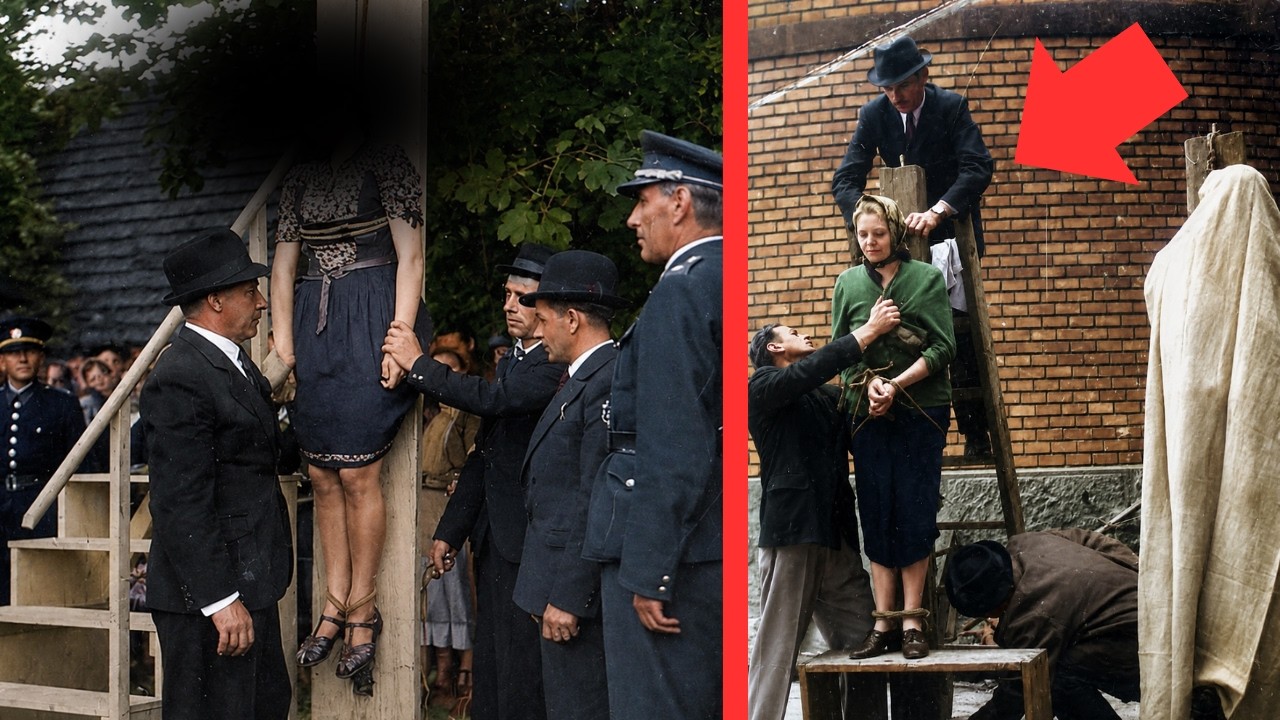
The method, known as pole hanging, was used almost exclusively in the lands that had once fallen under the influence of the Austro-Hungarian Empire. It was not a traditional gallows. It was a three-meter wooden post or metal pole, a chest sling, a narrow noose, and a pulley system that turned death into theater.
Authorities claimed the method was more humane than the gallows. Witnesses and historians say the reality was far different. In many cases, the condemned did not die instantly.
They strangled slowly, twitching and jerking against the post while thousands watched in silence or celebration.
The executions were carried out in public squares, prison courtyards, and meadows on the edges of towns. Crowds gathered in the tens of thousands. In some Czech towns, spectators reportedly purchased tickets to secure the best vantage points, turning the killings into something resembling a medieval carnival.
Among the women executed by pole hanging was Herta Kašparová, a Czech citizen born in 1923 in the town of Triesch. She spoke both Czech and German, and during the Nazi occupation she went to work for the German criminal police in Jihlava as an interpreter.
Kašparová translated during Gestapo interrogations of Czech citizens suspected of resistance activity. She reported on those who defied the occupation. Prosecutors later said her work helped send numerous people to torture and death.
But her crimes went further. In the final months of the war, as German forces retreated, she identified eleven men and boys to German soldiers after her home was broken into. All eleven were dragged into the courtyard of the town hall and executed by firing squad.
Among them, allegedly, were people who had bullied her at school before the war.
At her trial, Kašparová admitted the truth. “I know that I caused the deaths of several people,” she said. “I acted out of revenge.”

On September 13, 1946, more than a year after the war ended, she was brought to the execution post before a crowd of thousands. She wept. She fell to her knees when she saw the pole.
Guards had to carry her to it.
As the chest sling was fastened and the noose secured around her neck, she screamed and shrieked. The drop was released. Her body plunged downward.
The executioner attempted to dislocate her neck with his hand, but she struggled violently on the post, her head twitching from side to side for several minutes before a doctor declared her dead.
The executioner then threw his white gloves to the ground — a symbolic gesture of disgrace. Her body was placed in a cheap coffin and buried in a grave in front of the crowd.
In Budapest, another woman met the same fate. Mária Nagy, also known as Manci Nagy, was condemned as a war criminal and executed in March 1946 before a large crowd in the Hungarian capital.
Little documented evidence of her crimes survives. What is known is that she was accused of torturing young women, possibly Jewish prisoners, and that she was believed to have collaborated with the Germans. Some historians suggest she may have worked inside a concentration camp or prison.
Others believe she may have informed on hidden Jewish women, who were then deported to extermination centers.
Photographs of her final moments show an elderly woman wrapped in a sweater, looking petrified as she is led to the execution post. A priest accompanied her. The executioner, dressed in a suit and hat, prepared the noose.
A white sheet covering the body of a previously executed prisoner hung on the adjacent pole.
Her legs and arms were bound. The rope was passed around her middle. She climbed onto the wooden step.
The noose was fastened. The step was removed. Within minutes, she was dead.
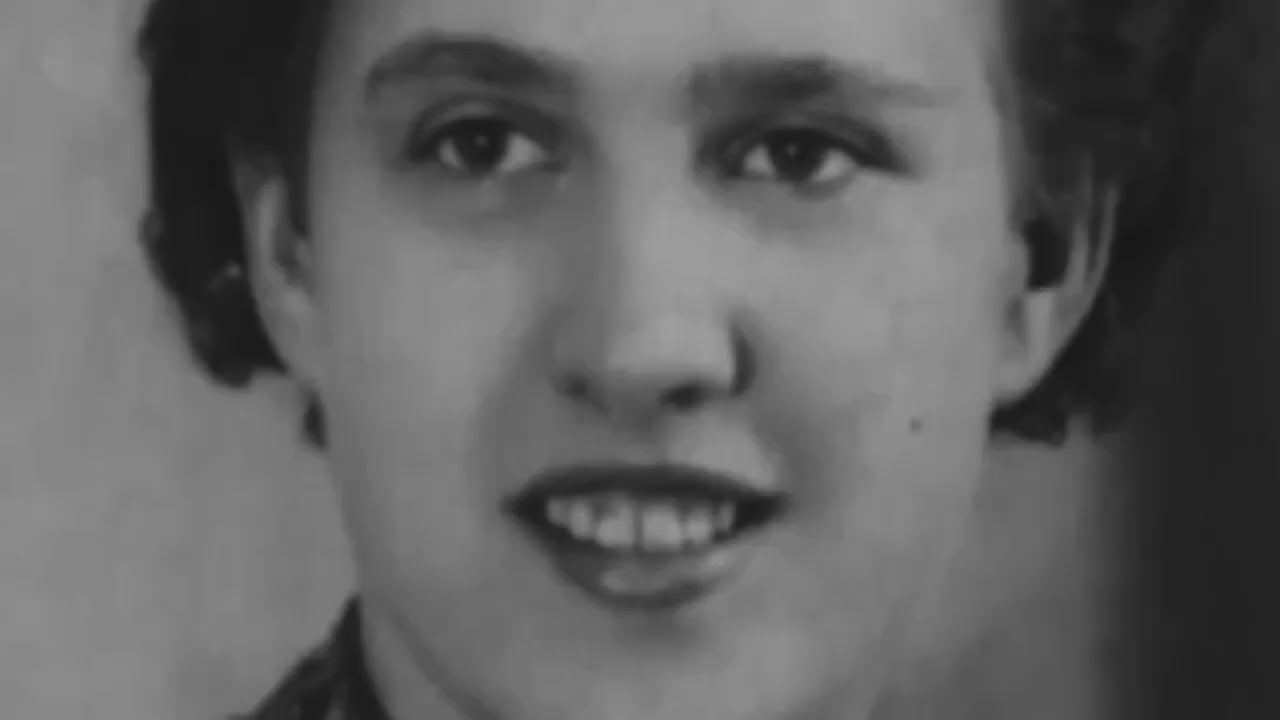
It is believed she was executed outside the Academy of Music in Budapest, the same site where former Prime Minister Ferenc Szálasi and other high-ranking Arrow Cross officials were pole hanged. The location became synonymous with the executions of those who had plunged Hungary into a catastrophic alliance with Nazi Germany.
Also among the female pole hanged was Ruth Elfriede Hildner, a German woman born in 1919 who was conscripted into the concentration camp system in July 1944. She trained at Ravensbrück, the all-female camp, and was then sent to Dachau and later to a subcamp of Flossenbürg known as Helmbrechts.
At Helmbrechts, Hildner earned a reputation for extreme brutality. Prisoners feared her. She beat inmates with weapons if they did not work hard enough.
It is believed she killed some with her bare hands. She was in her mid-twenties.
In April 1945, as U. S. forces approached, Helmbrechts was evacuated.
Hildner oversaw a death march, during which she beat and murdered young girls too weak to walk. She then fled, blending into the chaos of refugees moving through Czechoslovakia.
She evaded capture for nearly two years. In March 1947, Czech police identified her. She was arrested and brought before the Extraordinary People’s Court in Písek.
Survivors testified about her cruelty. The judges were shocked that a woman so young could have committed such atrocities in barely a year.
She was sentenced to death and executed the same day. In the prison courtyard, she was led to a three-meter post. A rope was attached to her feet and passed through a pulley.
She was hoisted up. A chest sling held her in place. A noose was looped around her neck and hooked at the top.
The chest sling was released. She plunged downward. The executioner tried to force her head to one side to dislocate her neck.
The noose snapped taut. Her body was guided by an assistant pulling a foot rope. She was dead within minutes.
The pole hanging executions were not limited to women. In Hungary, members of the Arrow Cross Party, including Prime Minister Ferenc Szálasi and his associates, were executed in the same manner and possibly on the same posts as Mária Nagy. A Hungarian priest, András Kun, who had rampaged through Budapest slaughtering civilians, was also pole hanged.
But the images of women dying on those posts — some weeping, some screaming, some struggling for minutes — became among the most haunting of the postwar reckoning. Their executions were meant to send a clear message: collaborators would be punished, and the old regime was finished.
In France, women accused of “horizontal collaboration” with German soldiers had their heads shaved and were paraded through streets. In Hungary and Czechoslovakia, the punishment was far more absolute. The pole, the noose, and the crowd were the final instruments of a justice that sought not only to 𝓀𝒾𝓁𝓁 but to humiliate.
After the drop was released and death confirmed, a white sheet was thrown over the body. The corpse was often left hanging in a public square for hours, a final warning to anyone who might consider betrayal in the future.
Historians continue to debate the legality and morality of these executions. Some were clearly guilty of horrific crimes. Others were condemned on thin evidence, their fates sealed by neighbors’ accusations and the chaos of liberation.
What remains undisputed is the brutality of the method and the spectacle that surrounded it.
The female traitors of World War II who died on those poles — Herta Kašparová, Ruth Hildner, Mária Nagy, and others whose names are lost — were executed in a manner designed to strip them of dignity in their final moments. Whether they deserved that fate is a question that still divides memory and history.
What is certain is that in the ruins of postwar Central Europe, justice and vengeance became inseparable. The pole hanging executions were not quiet, private affairs. They were public rituals of shame, witnessed by thousands, remembered for generations, and photographed for history.
The images remain: the elderly woman in the sweater, the screaming interpreter carried to the post, the young guard plunging downward as the noose snapped tight. They are the faces of a reckoning that was as brutal as the war itself.