The boy did not own a razor. He had never needed one. At 14 years old, he marched away from his family’s farm in Caldwell County, North Carolina, with the 26th North Carolina Infantry, carrying a haversack packed by his mother with cornbread, two pairs of socks, and a Bible. She did not cry where he could see.
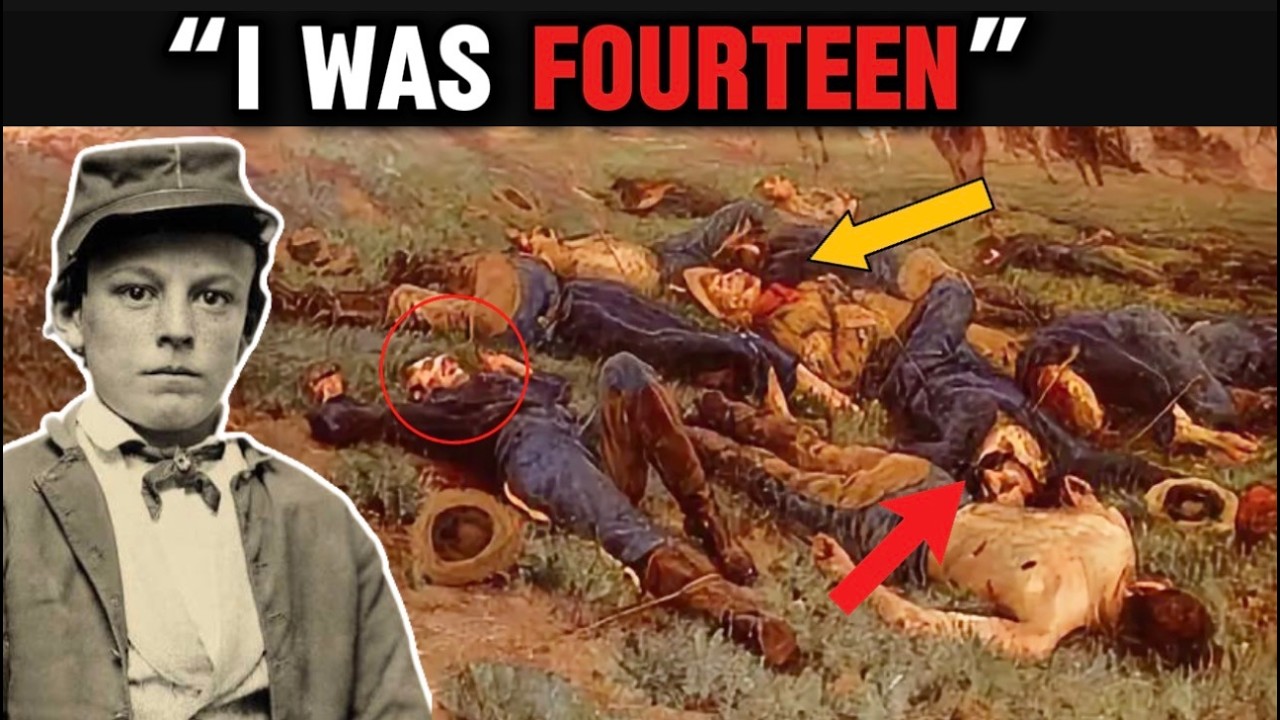
The muster rolls recorded his name the way they recorded most boys’ names—without ceremony, wedged between farmers and blacksmiths and men with families waiting at home. Nobody asked his age twice. He was tall enough to carry a rifle, and in the spring of 1863, that was the only arithmetic that mattered. The march north began in June.
By all surviving accounts from soldiers his age and younger, it did not feel like what they had been told war was supposed to feel like. The land changed as they crossed the Potomac. Green Pennsylvania farms rolled out on either side of the columns, fat and quiet, nothing like the worn Virginia roads they had spent two years bleeding across. Some of the men laughed.
Some officers let soldiers pull cherries off the trees along the road. One private wrote home that Pennsylvania looked like God had been considerably more attentive up north. The boy had been told this was a liberation campaign, that the North would fold if General Robert E. Lee could win one decisive victory on their own soil.
He was 14. He believed it. The army reached the Pennsylvania town of Gettysburg on July 1, 1863—though reached is not quite the right word. They stumbled into it.
What began as a reconnaissance by Harry Heth’s division looking for shoes became, within hours, the largest battle of the entire war. Nobody planned it that way. Lee had not wanted a general engagement in Pennsylvania without Jeb Stuart’s cavalry screening his movements, but Stuart was off on one of his mounted raids, conspicuously absent. Lee was in effect blind, maneuvering 75,000 men through enemy country without reliable intelligence about where the Army of the Potomac was.
He found out at Gettysburg. Union commander George Meade, who had taken the helm of the Army of the Potomac only three days earlier, learned where Lee was at almost the same moment. Two armies collided in a crossroads town neither had specifically chosen. The 26th North Carolina was part of Pettigrew’s Brigade.
They came up the Chambersburg Pike and hit the Union First Corps along McPherson’s Ridge in the late morning. What happened next is documented in enough letters and regimental histories to reconstruct almost moment by moment. The federal position was anchored by the Iron Brigade, the black-hatted Midwesterners who were, man for man, among the hardest fighters in the Union Army. When the 26th North Carolina crossed that open ground toward Herbst’s Woods, the Iron Brigade did not run.
The two lines tore each other apart at ranges sometimes close enough that men could read the expressions on the faces trying to kill them. The regiment went in with 800 men. By the end of the day, 588 of them were dead, wounded, or missing. In a single afternoon, the 26th North Carolina suffered the highest regimental casualties of any unit on either side in any engagement of the entire Civil War.
Company F went in with 91 men and came out with three. The boy survived July 1st. What he described about those first hours at Gettysburg was not heroism in the way the recruitment posters had framed it. It was noise so total it stopped being sound and became something physical, a pressure you felt in your teeth.
It was the man beside you disappearing mid-stride and the way your feet kept moving forward because stopping felt worse than the alternative. It was the smell—black powder smoke, copper wet air, churned earth, and underneath all of it, something else that had no name in polite language. The boys who made it back to the Confederate lines were not the same boys who had crossed. Something had been removed.
It showed in the letters they wrote that evening. The sentences get shorter, the handwriting changes. Whatever elaborate patriotic grammar they had been using since 1861 mostly disappears, replaced by something plain and stripped down and true. July 2nd brought the kind of waiting that soldiers consistently described as its own form of cruelty.
The army reorganized its lines along Seminary Ridge. The dead lay where they had fallen, and nobody was going out to retrieve much of anyone. Officers counted heads and wrote down names. Men who had shared rations and marching songs with someone the day before spoke about them in past tense with the flat, careful tone of people who had not yet fully processed what they were saying.
A 14-year-old sitting on a fence rail somewhere along that ridge would have spent the daylight hours listening to Longstreet’s corps hammering the Union left at the Peach Orchard and Devil’s Den. He could not see it. He could only hear it and wait. What came next was Pickett’s Charge—though in accurate history, it should more rightly be called Pickett’s-Pettigrew’s Charge, because Pickett’s three Virginia divisions did not go forward alone.
Pettigrew’s men went with them. The decimated 26th North Carolina, down to a fraction of its July 1st strength, was expected to step back out into the open. The order came on July 3rd in the early afternoon, after nearly two hours of artillery bombardment. The Confederate guns fired first, 170 of them.
The Union guns fired back. A soldier in another regiment wrote that he pressed himself flat behind a stone wall and prayed with a sincerity he had never managed in church. Then the guns stopped, and the order to advance went down the Confederate line. The charge covered nearly a mile of open ground.
The Union cannon that had gone quiet during the Confederate bombardment—quiet in part to save ammunition, not because they had been silenced—opened again the moment the grey line stepped into the field. At close range, a cannon loaded with canister was not a cannon anymore. It was a large shotgun pointed at a formation of men. The boy walked into that.
In the fragmented account that survived through the recollections of his post-war community, he wrote that he stopped being afraid somewhere in the middle of that field. Not because he had become brave, but because he had, as he put it, run out of room inside himself for fear. He kept walking because the alternative was to stand still in a field where standing still would kill you faster. Some of Pettigrew’s men got within yards of the low stone wall at Cemetery Ridge, where the Union line bent at a right angle—the place that would come to be called the high water mark of the Confederacy.
A few crossed it, not many. The Union defenders held. The retreat was, by every account, worse than the charge. Coming back meant walking across the same ground that had just been crossed, past the men who had been cut down going the other direction, past the rifles dropped mid-stride and the flags of regiments that no longer existed as functional fighting units.
At Gettysburg, regimental flags mattered the way they mattered nowhere else in common life. Losing a flag was the kind of wound that a unit talked about for decades. Lee met the survivors as they came back. He rode among them on Traveler and told them it had been his fault, not theirs.
The soldiers who wrote about this moment later never quite recovered from seeing Robert E. Lee say that. Some of them called it the moment they knew the war was going to end the way it ended. The boy from Caldwell County was among the men who made it back.
He was 14 years old and had now participated in two of the three days of the bloodiest battle ever fought on American soil. What did he do that night? The accounts don’t say specifically. What the accounts from young Confederate soldiers at Gettysburg generally describe is silence—not the dramatic silence of fiction, but exhaustion so complete that even grief couldn’t find a foothold.
Men lay down where they stopped walking. Some ate, some didn’t. Some wrote letters home that they kept short because they didn’t know how to make them long without making them real. The army withdrew from Gettysburg on July 4th, retreating south through rain that turned the roads to mud and made the wagons loaded with wounded men into a column of extended suffering that stretched 17 miles.
The boy walked in that rain with whatever was left of the regiment he had marched north with six weeks earlier. He made it home eventually. He outlived the war, which was not guaranteed given how many men who survived Gettysburg were killed in the grinding campaigns that followed—The Wilderness, Spotsylvania, Cold Harbor, the Siege of Petersburg. He lived into the 20th century, long enough that the world he came back to looked almost nothing like the one he had left.
The country had been through Reconstruction, through the rise of the Lost Cause mythology that tried to put a romantic frame around what he knew had simply been three days of men killing each other in Pennsylvania farm fields. He knew what the cornfield at McPherson’s Ridge smelled like on a hot July afternoon after the shooting stopped. He knew what his own boots felt like crossing open ground with artillery working through a formation of men walking beside him. He knew what 588 casualties inside one regiment inside one afternoon looked like on the ground when you were standing on it.
He had been 14 years old. He had packed a Bible. His mother had not cried where he could see. The weight of Gettysburg was not carried by the generals who planned it or the politicians who made the decisions that led armies there.
It was carried by boys like this one, who went in barely old enough to shave and came out carrying something they would spend the rest of their lives trying to find words for. Most of them never quite managed it. Some things are not meant to be described from the outside.
You had to have been there, standing in that field, 14 years old, with the guns starting up again.