Richard Nixon was in New York City monitoring the California primary results when word reached him shortly after midnight on June 5, 1968, that Senator Robert F. Kennedy had been shot at the Ambassador Hotel in Los Angeles — and the man who had just lost the toughest opponent he would have faced in November responded with a formal, measured statement calling the shooting “terrible and senseless.”
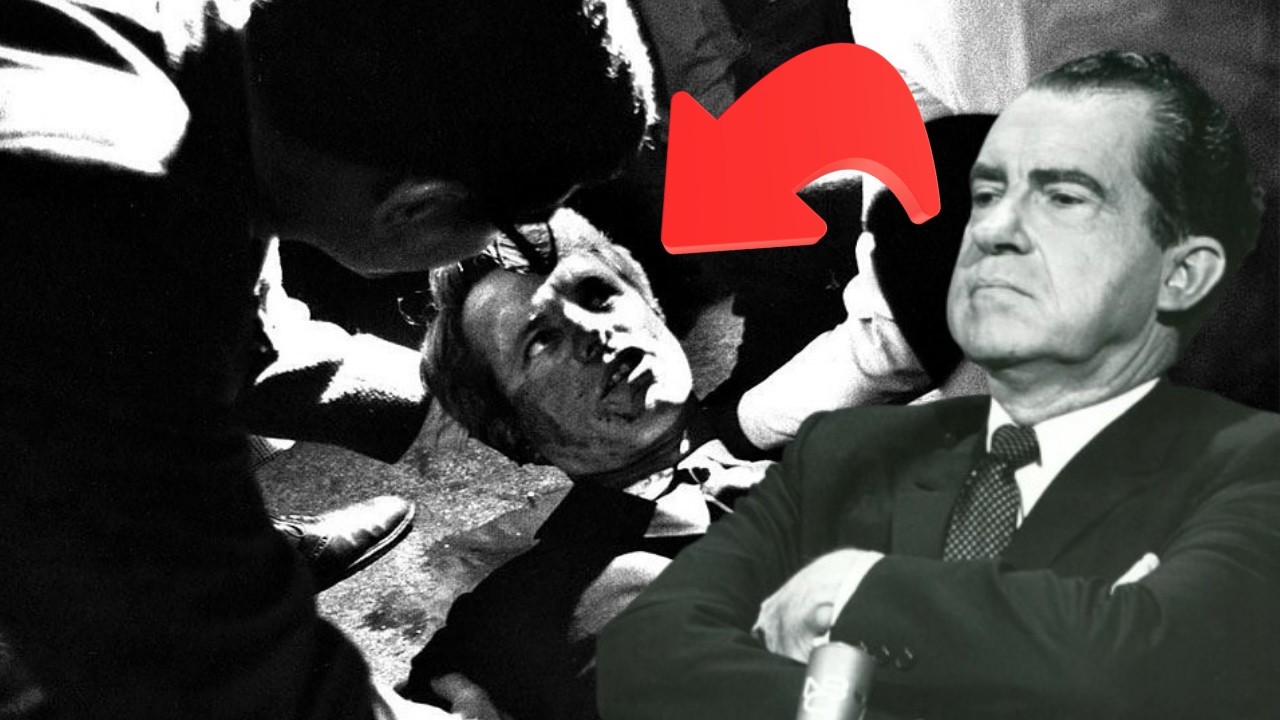
But the historical record, assembled from memoirs, archived interviews, and first-hand accounts, shows that Nixon’s private reaction was far more layered than his public words. According to photographer Harry Benson, who was embedded with the Kennedy campaign and documented its final days, Nixon told him personally that Kennedy would probably have beaten him in the general election.
The admission, recorded in Benson’s own account and referenced across multiple histories of the 1968 campaign, stands as one of the few moments in the documented record where Nixon’s private assessment of Kennedy’s electoral threat can be seen directly. It was spoken simply, without apparent distress, to a man whose job was to record images rather than conduct political analysis.
Kennedy, 42, was shot at approximately 12:13 a. m. in a narrow pantry corridor of the Ambassador Hotel kitchen, minutes after finishing his California victory speech in the Embassy Ballroom.
A 24-year-old man named Sirhan Bishara Sirhan stepped forward from a crowd near a tray table and fired a . 22 caliber revolver at near point-blank range.
Kennedy was struck by three bullets. Five bystanders were also wounded. He was rushed to Good Samaritan Hospital, where surgeons operated for nearly four hours.
A bullet had entered behind his right ear and traveled through his brain. He never regained consciousness and was pronounced dead at 1:44 a. m.
on June 6, 1968.
When the news broke, the world stopped. The shooting came just 83 days after Kennedy entered the race and two months after the assassination of Dr. Martin Luther King Jr.
in Memphis. It was the second assassination of a Kennedy in fewer than five years, and the third violent death of a major American political figure in the span of a single decade.
Nixon’s immediate public response was a formal statement in which he called the shooting terrible and senseless and expressed sympathy for the Kennedy family. He suspended his campaign activities in the immediate aftermath, a decision consistent with the national atmosphere of shock and grief.
He also made a public statement directed at the country that carried a specific and documented theme. Echoing language he had used in 1963 after President Kennedy’s assassination, when he publicly called on Americans to reduce the hatred that drives men to such terrible deeds, Nixon returned to the theme of national violence and division.
This framing was consistent across both assassinations in terms of Nixon’s public posture. He positioned himself in both cases as a voice calling for unity and a reduction in the climate of political hatred. His language was measured and formal, and he made no political arguments in the immediate aftermath of the shooting.
It is worth being precise about what Nixon said publicly versus what he thought privately, because the historical record contains evidence of both and they are not identical. The most candid documented assessment Nixon ever gave of Kennedy’s political abilities came not from a speech or a press statement, but from a private remark.
The broader picture of Nixon’s view of Robert Kennedy is assembled from multiple documented sources. In a 1983 recorded interview with journalist Frank Gannon, preserved at the University of Georgia and deposited at the Nixon Library, Nixon gave one of his most extended on-record assessments of the Kennedy family.
When discussing Bobby Kennedy specifically, Nixon said, as recorded in the Gannon interview transcript, “Bobby Kennedy I met when he was working for Joe McCarthy. See, I was an investigator and so was he. He was very intense, very different from Jack.”
Nixon described Bobby Kennedy as having qualities that Alice Roosevelt Longworth had once characterized memorably — that where Jack Kennedy was a debonair man of the world and Teddy was a gregarious Irish politician, Bobby was like an 18th century Jesuit priest. Nixon then added his own assessment.
“Bobby Kennedy was humorless. He was very intense, very hard-working, very dedicated.” This description, intense, hard-working, dedicated, is not a political enemy’s dismissal.
It is, from Nixon, who was himself relentlessly hard-working and intensely competitive, something closer to a form of recognition.
The qualities Nixon listed in Robert Kennedy were qualities Nixon respected in anyone, including himself. In “In the Arena,” his 1990 memoir, Nixon wrote more generally about the political landscape of 1968 and reflected on the role the assassinations played in shaping the year.
He described 1968 as the most turbulent year in American political life since the Civil War era, a description consistent with what virtually every political historian of the period has also concluded. The relationship between Nixon and both Kennedy brothers had always operated on multiple levels simultaneously.
There was the level of public political rivalry, genuine and unambiguous. There was the level of private assessment in which Nixon, despite his public framing of the Kennedys as advantaged by wealth and family connections, clearly recognized their political gifts.
And there was a third level, perhaps the most human of all, the level at which the repeated violent deaths of major American political figures made clear that the violence affecting the country was not partisan, was not selective, and was not something any political advantage could protect against.
Nixon understood this viscerally. He had run against Jack Kennedy in 1960 and lost by a margin so thin it is still debated by historians. When Jack Kennedy was killed in Dallas in November 1963, Nixon had been in that city that very morning, having flown in on a commercial flight and left before the motorcade.

He learned about the assassination later that day in a cab in New York. That proximity was documented and something Nixon referenced at various points in later years. The knowledge that he had been in Dallas the morning of the assassination was not something Nixon ever fully set aside.
When Robert Kennedy was shot in June 1968, the resonance with JFK’s death five years earlier was immediate and overwhelming for the entire country. For Nixon, whose entire political life had been entangled with the Kennedy family, the resonance had an additional and impossible to ignore dimension.
The man who had just been shot was the man who was most likely to defeat him in November. Robert Kennedy’s assassination removed from the 1968 presidential race the candidate who posed the most credible threat to Nixon’s election. This is a documented political reality, not a moral judgment.
The evidence for RFK’s competitive threat to Nixon in November comes from multiple documented sources. The May 1968 Gallup polling data showed Kennedy and Nixon running within a few percentage points of each other in general election matchups. Kennedy at approximately 35 percent against Nixon at 37 percent in one survey.
These were competitive numbers, and they reflected Kennedy’s extraordinary cross-coalition appeal. Robert Kennedy in the spring of 1968 was pulling support from black voters, from white working-class voters in states like Indiana, from Latino communities, from anti-war youth, and from Americans who responded to his particular combination of toughness and evident compassion.
This was a coalition that Nixon’s law and order appeal alone could not replicate or fully counter. The Nixon Library’s own exhibition on the 1968 presidential campaign states plainly that Nixon’s campaign was aided by the tumult within the Democratic Party that year, and specifically cites the assassination of Robert Kennedy on June 5th as part of that tumult.
This is the Nixon Library’s own institutional acknowledgement based on the historical record. The Democratic National Convention in Chicago in August 1968, held in the absence of Robert Kennedy and in the aftermath of his assassination and Martin Luther King’s assassination two months before, descended into chaos.
Inside the convention hall, a bitter contest between Humphrey and McCarthy 𝓮𝔁𝓹𝓸𝓼𝓮𝓭 every fracture within the Democratic coalition. Outside the convention hall, Chicago police clashed violently with anti-war protesters under the direct orders of Mayor Richard J. Daley.
Television cameras captured the confrontations on live broadcast.
The images were seen by millions of Americans and did enormous damage to the Democratic Party’s image as the party of order and responsible governance. Nixon, by contrast, had held a comparatively quiet and well-organized Republican convention in Miami Beach in early August. He had secured the nomination on the first ballot.
He had chosen Governor Spiro Agnew of Maryland as his running mate, a pick that surprised many observers but was calculated to appeal to border state voters and those uncomfortable with the unrest in major cities. Nixon’s campaign emerged from August 1968 in a substantially stronger position than it had entered it.
In November, Nixon defeated Hubert Humphrey by approximately 500,000 popular votes, a margin of 43. 4 percent to 42. 7 percent, one of the narrowest general election popular vote margins in modern American history.
Third-party candidate George Wallace won nearly 10 million popular votes and 46 electoral votes from the deep south.
Nixon won the Electoral College 301 to 191. The closeness of the final vote between Nixon and Humphrey is itself historically significant when placed beside the spring polling that had shown Kennedy competitive with or slightly trailing Nixon. The counterfactual of a Kennedy versus Nixon general election cannot be answered with certainty.
But the documented polling, the documented coalition Kennedy was assembling, and Nixon’s own private admission to photographer Harry Benson, all point in the same direction. Nixon knew that Robert Kennedy was his hardest match up.
Nixon’s documented public statement on the shooting and death of Robert Kennedy called the assassination a tragedy for the country and for the Kennedy family. He expressed condolences to Ethel Kennedy, Robert’s wife, who was present in the hotel ballroom and who was pregnant with the couple’s 11th child at the time of the shooting.
He called for the nation to reject violence. His language was measured and formal, consistent with the public posture he had adopted toward political violence throughout 1968. It is important to note what Nixon did not say publicly because the restraint is itself part of the documented record.
He did not make political arguments in the immediate aftermath of the shooting. He did not reference the campaign. He did not, in any documented public statement immediately following the assassination, discuss what Kennedy’s death meant for the presidential race.
This restraint was politically prudent and morally appropriate given the circumstances.
Nixon also declined to advocate strongly for expanded gun control legislation in the aftermath of RFK’s assassination, despite significant public pressure across the country for Congress to act. This was consistent with his broader positioning on law and order, which focused on enforcement and deterrence rather than restrictions on firearm access.

Robert Kennedy, by contrast, had been a vocal advocate for gun control legislation, and had made a passionate plea for federal restrictions during a campaign stop in Roseburg, Oregon on May 27th, 1968, just days before his assassination. The gun that killed him was purchased legally.
The Gun Control Act of 1968, which established the federal framework for firearms regulation that still forms the basis of current law, was signed by President Lyndon Johnson in October 1968, in part as a direct legislative response to the assassinations of Martin Luther King Jr. and Robert Kennedy.
Nixon, as president from January 1969, inherited and implemented this framework without dismantling it, but his presidency was not defined by an active push for further gun legislation. The most extended and candid documented record of Nixon’s views of the Kennedy family comes from the June 1983 interview Nixon gave to Frank Gannon.
This interview, conducted at Nixon’s home in Saddle River, New Jersey, and preserved in the university archive at the University of Georgia, covered Nixon’s entire political life and included substantial discussion of his relationships with all three Kennedy brothers. In that interview, Nixon read aloud a handwritten letter Jacqueline Kennedy had written to him following President Kennedy’s assassination in 1963.
The letter, which Nixon reprints in his memoir “RN: The Memoirs of Richard Nixon,” referred to Nixon and Jack Kennedy as two young men, colleagues in Congress, adversaries in 1960, and now look what has happened. Whoever thought such a hideous thing could happen in this country?
This letter, documented in Nixon’s own memoir and read by Nixon in the recorded Gannon interview, is evidence of the genuine human texture of the Nixon-Kennedy relationship beyond the political framing that dominated their public encounters. In the same Gannon interview, when the conversation moved to Robert Kennedy specifically, Nixon’s assessment was precise and notably free of bitterness.
He noted that Bobby Kennedy had been very intense, very different from Jack. He noted the Longworth description of Bobby as an 18th-century Jesuit priest. He noted that Bobby Kennedy had not been in the Senate long enough to establish the same kind of record his brother Ted eventually built there.
What Nixon did not do in any of his recorded interviews or in his published memoirs was speculate extensively about what might have happened in November 1968 if Robert Kennedy had lived and won the Democratic nomination. This absence of speculation is itself notable.
Nixon was a man who thought in strategic terms about nearly everything. The fact that he largely declined to engage with the counterfactual of a Kennedy-Nixon general election in any of his public remarks suggests either that he found the question too personally uncomfortable or that he had already drawn his own private conclusions about the answer.
Robert Kennedy died at 1:44 a. m. on Thursday, June 6th, 1968.
He was 42 years old. He left behind a wife, 10 children born to him and Ethel, and a nation that had now watched the violent deaths of a president, a civil rights leader, and a presidential candidate within the span of fewer than five years.
When the news of Kennedy’s death was confirmed, the response across the country and around the world was one of profound grief and something beyond grief, a kind of collective exhaustion with violence, a despair at the pattern that had emerged in the 1960s of political assassination recurring with an almost systematic regularity.
The photographer Harry Benson, who had been embedded with the Kennedy campaign from its beginning and was present at the Ambassador Hotel the night of the shooting, wrote later that in the crowd at the hotel, people had begun screaming “Another Dallas” when the shots rang out. The connection to JFK’s assassination was instantaneous and universal.
Robert Kennedy’s body was flown from Los Angeles to New York City. A funeral mass was held at St. Patrick’s Cathedral in midtown Manhattan on June 8th.
Senator Edward Kennedy delivered a eulogy for his brother that included the words, “My brother need not be idealized or enlarged in death beyond what he was in life to be remembered simply as a good and decent man who saw wrong and tried to right it, saw suffering and tried to heal it, saw war and tried to stop it.”
Kennedy’s coffin was then placed on a train for the journey to Washington, D. C. and burial at Arlington National Cemetery, where his brother, the president, was also buried.
The train traveled south from New York through New Jersey, Philadelphia, Wilmington, and Baltimore.
Along the entire route, a journey of more than 200 miles, people lined the tracks to watch the train pass. Families stood at grade crossings in small towns holding candles and American flags. The images of those crowds stretching the length of the Eastern Seaboard to pay their respects became among the most documented and widely seen images of the entire decade.
Nixon, like every major political figure in the country, paused his campaign through this period. The campaign silence was not merely strategic. The country was in a state that did not permit ordinary campaigning.
Nixon attended no events, made no speeches, and issued formal statements that were respectful and measured.
The question of what Nixon said when he heard RFK was shot has two kinds of answers. The first is the formal, documented, public answer. Nixon suspended his campaign, issued statements calling the assassination a tragedy, called on the country to reduce its hatred and its violence, expressed condolences to the Kennedy family, and returned to campaigning only after a respectful interval.
The second answer is harder to locate in any single document, but it is assembled from the documented pieces of the historical record, including the Gannon interview, Nixon’s memoirs, the campaign histories by Christopher Matthews and Evan Thomas, and Harry Benson’s account.

This second answer is that Nixon privately believed Robert Kennedy was his most dangerous opponent, had known this since at least the spring of 1968, and was willing to say so privately to at least one journalist while consistently declining to say so in any public forum.
The combination of these two answers, the formal public response and the private assessment, is what makes Nixon’s reaction to RFK’s assassination historically interesting. It would have been easy to dismiss Nixon’s public statements as purely political calculation, but the private remark to Benson suggests something more complicated.
Nixon genuinely reckoned with the political significance of what had happened and was honest about it in private in a way he would never have been in public. There is one more documented detail that deserves mention here because it speaks to the human texture of this story in a way that the political analysis alone cannot.
When Nixon was running for president in 1960, Jack Kennedy’s campaign aggressively sought to portray Nixon as ruthless, dangerous, and unfit for the presidency. Robert Kennedy, as the campaign’s de facto manager and his brother’s closest political adviser, was deeply involved in this effort.
The opposition between Nixon and Bobby Kennedy in 1960 was not just a professional political rivalry, it had a personal intensity to it documented across multiple accounts of the campaign that went beyond normal electoral competition. And yet, by 1968, Nixon’s private assessment of Bobby Kennedy was not that of a man describing an enemy.
It was the assessment of one intensely competitive, relentlessly hard-working, serious political operator describing another. The Jesuit priest description Nixon borrowed from Alice Roosevelt Longworth and applied to Bobby Kennedy is not a dismissal.
For Nixon, who took ideas and convictions and hard work more seriously than he ever took charm or charisma, describing a man as intensely dedicated and hard-working was about as close to a form of respect as his political vocabulary permitted.
The year 1968 ended with Nixon’s election to the presidency. He won by the narrowest popular vote margin in modern American history. He inherited a war in Vietnam that would consume the first years of his presidency.
He inherited a country still raw from the violence of the preceding year.
And he inherited a political landscape permanently altered by the death of Robert Kennedy, a man who had, by the documented assessments of people ranging from polling analysts to the Nixon campaign’s own private reckoning, represented the most credible alternative version of where the country might have gone.
The historian John A. Farrell, author of “Richard Nixon: The Life,” one of the most comprehensive Nixon biographies of recent decades, documents the complexity of Nixon’s relationship with both Kennedy brothers across the full arc of their shared political careers.
Farrell’s research, drawing on previously unavailable materials and extensive interviews, paints a portrait of Nixon’s relationship with the Kennedys as one of the defining rivalries of post-war American political life, not simply an opposition between two parties or two ideologies, but a sustained and multi-layered competition between individuals who, in some respects, had more in common with each other than either would have comfortably acknowledged.
The fact that Nixon’s most honest assessment of RFK’s electoral danger was given not to a political aide, not in a diary, not in a formal interview, but to a documentary photographer embedded with the Kennedy campaign, suggests that Nixon spoke that truth more freely precisely because it seemed like the kind of conversation that wouldn’t end up in the political record.
He told Harry Benson that Kennedy probably would have beaten him. He said it simply and without apparent distress. As an acknowledgement of a political reality, it was as direct as Nixon ever got on the subject.
The country Nixon was elected to lead in January 1969 was different from the one it would have been had Robert Kennedy survived the kitchen of the Ambassador Hotel.
Whether different means better or worse is a question historians have been debating for more than 50 years, and it will not be resolved here. What can be said, based on the documented record, is that Nixon knew the difference was real, and he said so privately at least once to one person who wrote it down.
Nixon was asked many things over the course of his public life. He was asked about Vietnam, about détente with China, about the Soviet Union, about Watergate, about his resignation. He was asked about John Kennedy’s assassination, about his own near miss with political death in 1962, about the enemies list and the tapes and the cover-up.
He answered some of these questions honestly, some evasively, and some in ways that historians are still working to untangle. But the one thing he said with apparent simplicity and unambiguous directness, recorded by Harry Benson and referenced in multiple historical accounts of the 1968 campaign, was this: that Robert Kennedy would probably have beaten him.
In those words, spoken in private, not in any speech or press conference or formal interview, Nixon told the truth about what June 5th, 1968 had meant to him and to the country. This is a story that lives at the intersection of personal rivalry, political calculation, national tragedy, and the private thoughts that powerful men rarely share in public.
Richard Nixon was not a man given to open emotional expression. His documented public response to RFK’s assassination was formal, measured, and politically appropriate. His documented private response was more honest, an acknowledgement that the man who had just been shot in a hotel kitchen was the most dangerous electoral opponent he had.
Between those two responses is the full story of what Nixon said when he heard Robert Kennedy had been shot. The story, as documented, is complicated enough without embellishment. 1968 ended.
Nixon won. Bobby Kennedy was buried at Arlington, a few yards from his brother. The country moved forward, as it always does, carrying what it couldn’t set down.