In the spring of 1879, a Texas Ranger named Cashes Holloway rode alone onto the Staked Plains to capture a man who had been living beyond the reach of the law for nearly a year. Reports described a solitary figure spotted near homesteads, missing cattle, and a man so large that witnesses could not agree on his height. Holloway, a veteran of 18 years with the Rangers, dismissed most of the stories as exaggeration. He believed he was pursuing a Comanche man who had refused to move to the reservation after the surrender at Fort Sill.
Holloway left Coldwell Junction on a Monday in late April, telling the town marshal he would be back within a month or not at all. He carried a Sharps rifle, two pistols, rations, and a pair of irons heavy enough to hold an ox. For eleven days he found nothing but cold fire rings arranged in a pattern he did not recognize and tracks in a dry wash that did not match the shape of any boot he had seen. On the twelfth night, the wind stopped.
On the caprock, where wind is as constant as daylight, the stillness woke him. He saw a single fire burning three or four miles out on a flat shelf above a canyon. By morning, he rode to the site. The fire was cold, but enormous tracks led down into the canyon.
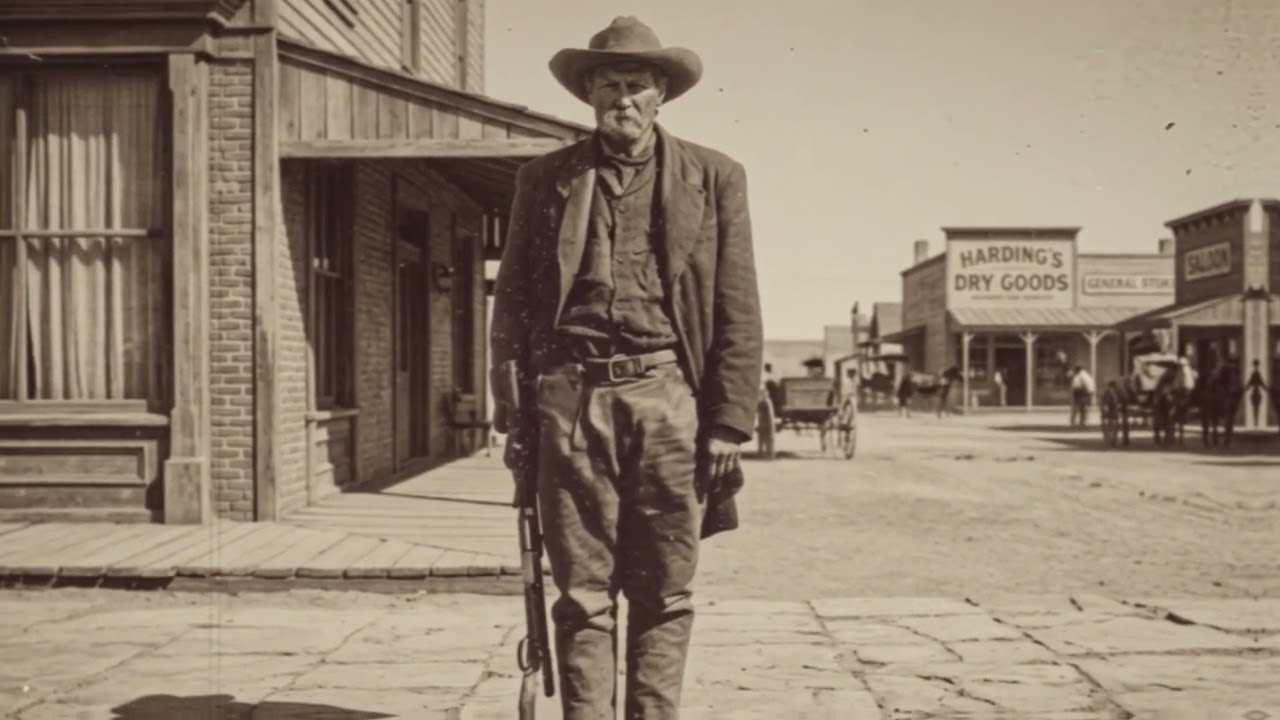
He tied his mare at the rim and went down on foot. He found the man about an hour in, sitting on a flat rock by a creek with a bone knife across his thigh. Holloway raised his rifle and announced that he was a Texas Ranger and the man was under arrest. The man stood up.
Holloway later wrote in the margins of a Bible, which he carried for the rest of his life, that the man kept standing, and that for a moment he thought he had miscounted how tall a person was supposed to be. The captive was roughly 6 feet 9 inches tall, built like an old oak, with hair gone half silver and a face that could have been 40 or 70 years old. He set down the knife carefully, held out his wrists, and did not speak for four days as Holloway rode him back to Coldwell Junction. The town watched them arrive in silence.
The blacksmith dropped his hammer, a woman crossed herself, and the marshal kept his hand on his sidearm. The man filled the jail cell from corner to corner, sitting with his knees drawn up, his head nearly brushing the rafters when he stood. The first words came at moonrise. The prisoner asked Holloway why he had not shot him.
Holloway said a man who lays down his knife is not the kind of man you shoot. The prisoner nodded and said, “Then we have time to talk. ”
Over four nights, the man gave his name as Takahote and told Holloway that he was the last of a line far older than the Comanche. He said there was a thing beneath the caprock that had been there since the world was younger, and that his line had kept it from coming up by standing watch at the place where it slept.
He said his mother had trained him, that he had walked to that place more than 200 times, and that the line was ending with him. His people, he said, were broken and scattered, and the next watcher would have to be a man with quiet in him. On the third night, Takahote told Holloway something he had never told anyone. He repeated the final 22-word sentence of a dying soldier at Adobe Walls, a private message about a specific creek bend where the man wanted to be buried.
Holloway had been the only living person who knew those words. He wrote that he stood in the middle of the street that night and believed. Takahote warned that soldiers would come to take him to Fort Concho, and that Holloway must not go. He said he would not arrive at the fort.
He gave Holloway directions to a dry canyon south and west of Coldwell Junction, a stone shelf with a crack in it, and told him the watcher stands there without fire, without deep sleep, for nine days at a time, and does not leave. A wagon and escort arrived on the afternoon of the fourth day, carrying orders from a colonel and heavier irons. The officer in charge, Captain Lockidge, invited Holloway to ride with them. Holloway said he would think on it.
That night, Takahote told Holloway to leave before sunrise, to be in the street and gone before the soldiers found the cell empty. He made Holloway repeat the directions to the canyon. Holloway left the Ranger badge on the marshal’s desk with a note that said only, “Gone. Do not follow.
”
He rode south at three in the morning. The dogs of Coldwell Junction watched him go without a sound. When the soldiers opened the cell at first light, it was empty. The irons lay on the floor, locked.
The door was locked, the key on the marshal’s desk, the window untouched, the rear wall solid. The captain searched the town for two days and found nothing. His report to the fort was three sentences long: the prisoner was not at Coldwell Junction, the means of his departure could not be determined, and Ranger Holloway had deserted. Holloway was officially listed as a deserter on May 5, 1879.
He never drew another pay, never collected a pension, and his name was struck from the rolls. His commanding officer wrote to the governor, asking that the case be quietly closed on the grounds that Holloway had served honorably for nearly 19 years and that something had happened in the field that the army did not have the wisdom to understand. The governor agreed, and the file was closed. Holloway did not disappear.
He went where he had been told. In 1896, a sheep rancher named Allard Crowley found a tin box wedged into the crack of a stone shelf at the head of a dry canyon feeding into the Pecos River. It contained a Bible, a pile of cleanly broken bone buttons of the kind that came off a Texas Ranger’s coat, a carefully folded blanket, and the ashes of a fire cold for less than a week. There were no human remains.
Crowley took the Bible to the sheriff in Coldwell Junction. The new sheriff read it through in one evening, returned it, and asked Crowley never to speak of where he had found it. The Bible stayed in Crowley’s family until 1941, when it was donated to a small museum in Lubbock. The last entry in Holloway’s hand has no date.
It reads, “He was not lying about being afraid of me. ”
Local stories from the following decades describe a tall figure seen at sundown on the canyon rim, a survey crew refusing to camp because someone was watching from the rocks without blinking, and horses walking with ears flat for two days through that country. None of these reports prove anything individually. Taken together, they suggest that someone remained in that territory for a long time.
Holloway’s final entry was written by an old man, in a thinner hand and fainter pencil. He put the Bible in the box and wedged it into the crack where he must have known someone would one day find it. It is not known what became of Holloway after that.
The record ends with that one sentence, and with the implication that he returned to the shelf to do the work that had been passed to him, a line now in its 147th year.