In the spring of 1816, one of Europe’s most famous poets was forced to flee England after a scandal threatened to destroy his reputation. While Lord Byron escaped the storm, the woman at the center of the controversy remained behind. Her name was Augusta Leigh, his half-sister, and the rumors of incest that surrounded their relationship would haunt her for the remaining 35 years of her life. Augusta Mary Byron was born in Paris on January 26, 1783.
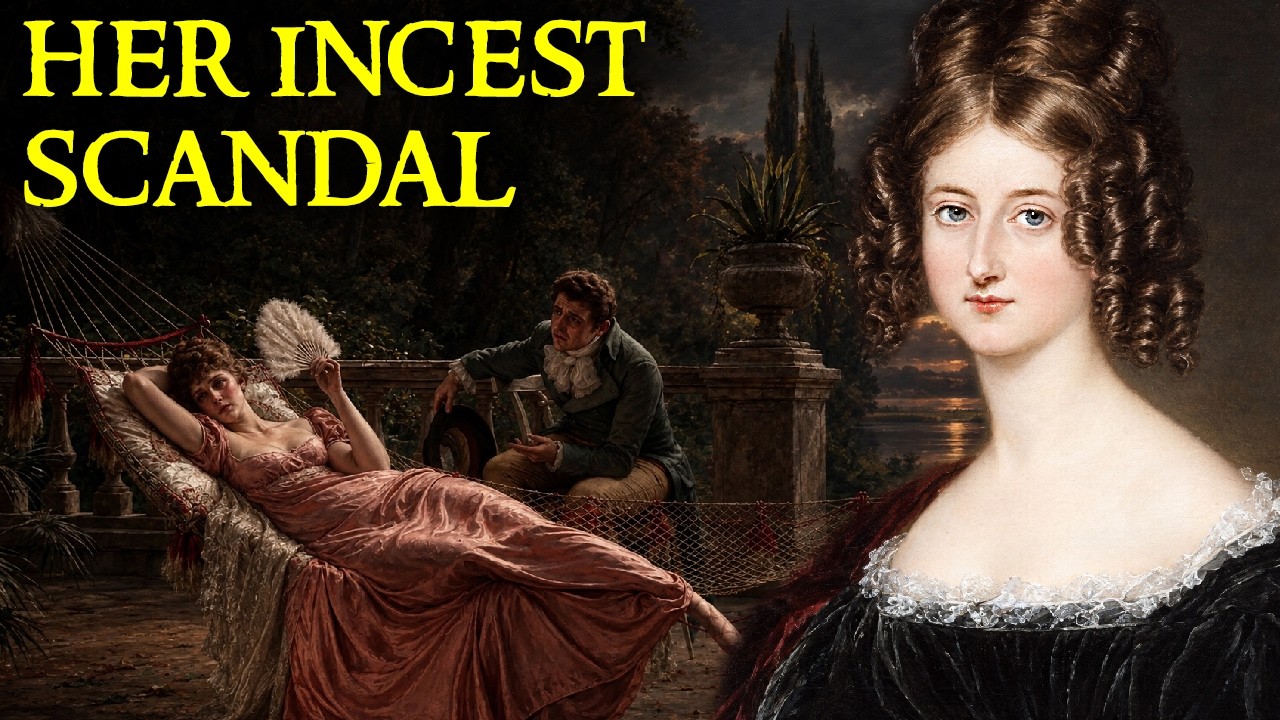
Her father was Captain John Byron, known publicly as Mad Jack, a handsome military officer with a reputation for charm and extravagance. He had already exhausted his own family’s fortune and was in the process of squandering another—belonging to Augusta’s mother, Amelia, the Baroness Conyers—when Augusta was born. Amelia had left her first husband to run away with Jack Byron to France. About a year after Augusta’s birth, her mother died.
Augusta remained in France while Jack returned to England to escape his French creditors. Upon arriving home, he married a Scottish heiress, Catherine Gordon of Gight, whose estate he managed to destroy with the same efficiency he had shown twice before. In 1788, they had a son, George Gordon, who would become known to the world as Lord Byron, the celebrated Romantic poet. Jack Byron returned to France and died there in 1791 at age 35, likely from tuberculosis.
Augusta was effectively orphaned, though she had been rescued from France years earlier when her grandmother, the Countess of Holderness, took over her care. Augusta remained separated from her half-brother throughout her childhood, moving between aristocratic households without a permanent home. She lived among the highest echelons of English society—from the Duke of Leeds to the Earl of Carlisle at Castle Howard and the Harcourt family at Windsor. As she grew older, Augusta was described as beautiful and graceful, with soft black hair and an attractive face.
But behind her elegant appearance, she was a shy and introverted girl. At eighteen, her grandmother died, leaving Augusta a trust fund of £7,000—a modest sum worth roughly half a million pounds today. For the first time, Augusta enjoyed some wealth and independence, but money would not protect her from the scandal to come. The half-siblings did not meet until around 1802, when Byron was fourteen and Augusta was approaching twenty.
He had by then become the sixth Lord Byron. They got along well from the start and maintained regular correspondence. Both were shy and sensitive by nature—quite unlike their father’s lively, reckless personality—and they confided in each other. Byron even shared his difficult relationship with his mother.
Scholars have noted that Byron’s Romantic poetry was unusually influenced by his relationships with female relatives. Marriages between second and third cousins were common in early 19th-century England, and European royal families frequently married first cousins. The women who inspired Byron’s works—Mary Duff, Mary Parker, and Mary Chaworth—were nearly all relatives. Augusta also inspired his writing, but something about their bond was unusual.
They were half-siblings who barely knew each other before their teenage meeting, strangers from the same family, and society soon began whispering about what was happening between them. In 1807, Augusta married her cousin, George Leigh, a colonel in the 10th Hussars and an equerry to the Prince of Wales. Three years later, George became the effective ruler of Britain when his father, George III, was declared unfit to govern—a role he held throughout the Regency until 1820. The marriage was not widely welcomed.
Augusta’s extended family and George’s relatives opposed it, believing neither had enough money to support a household fitting their noble status. Their determination to marry suggested genuine affection, though Lord Byron was horrified by his half-sister’s decision and called the marriage shameful. The Prince of Wales gave the young couple a house in Six Mile Bottom near Newmarket. Its location beside the famous racecourse proved catastrophic.
Whenever George was not on military duty, he spent excessive time and money at the races, leaving Augusta to face mounting debts and impatient creditors. History seemed to repeat itself: Augusta found herself in a marriage much like her late mother’s with Mad Jack. Augusta had seven children during those years. Her second daughter, born in 1811, was soon found to suffer from mental illness and required lifelong care.
Combined with George’s behavior, there were periods when the family could not pay their servants. Meanwhile, Lord Byron was away on his famous travels in the East, and contact between the half-siblings remained limited. But when he returned to England in 1811, something changed. Their correspondence resumed, and they began to grow noticeably closer.
Within a few years, their relationship would take a turn that would follow them both. Byron’s fame began spreading in 1812 with the publication of the first part of Childe Harold’s Pilgrimage. He became the talk of Regency London, constantly summoned from his home in Nottinghamshire to attend parties and literary salons. This gave him and Augusta the opportunity to spend extended time together for the first time.
She came to London in June 1813, and the half-siblings, whose relationship had developed mostly through letters, now spent long periods together. Byron’s letters from this period help explain why many believed his relationship with Augusta had crossed normal brotherly boundaries. His letters to his close friend Lady Melbourne were ambiguous, and she warned him clearly that continuing the relationship with Augusta, if word got out, would result in his permanent expulsion from English society. Byron replied that the fault was not Augusta’s but his own.
In January 1814, while staying at Newstead Abbey, they were snowed in for three weeks. Just three months later, on April 15, Augusta gave birth to a daughter. The child was named Elizabeth Medora, after a heroine of The Corsair, a poem Byron had written at Newstead that winter with Augusta. The question of Elizabeth Medora’s paternity quickly became the subject of malicious gossip in London.
With Augusta’s husband frequently absent as the Napoleonic Wars neared their end, rumors spread that Lord Byron was the father of his half-sister’s newborn child. The truth was far from certain—George Leigh had been home at the right time and never seemed to doubt that Medora was his daughter. But Byron’s own behavior only made things worse. Days after the birth, he traveled to Swynford Paddocks in Cambridgeshire to see the baby.
He then wrote a strange letter to Lady Melbourne about Medora. He did not explicitly admit to being her father, but his words have long been interpreted as a veiled confession: he wrote that it was worth it, that he could not tell her why, that the child was not an ape, and if she were, it would be his fault. Whatever the truth about Elizabeth Medora’s paternity, more serious troubles awaited Byron. The obvious solution to the escalating storm of insinuation was for him to marry.
Augusta encouraged this. In September 1814, five months after Medora’s birth, Byron became engaged to Annabella Milbanke. They married in January 1815. The marriage was a disaster from the start.
Annabella quickly became convinced that her husband, far from being the celebrated poet others saw, was psychologically unstable. By that time, Augusta had secured a prestigious position as one of the Queen’s Ladies of the Bedchamber, with an apartment in St. James’s Palace. But behind the palace walls, her private life was deteriorating.
She spent most of her time at Byron’s house on Piccadilly, trying to repair his troubled marriage while watching her half-brother slip further out of control. Byron had become addicted to laudanum, an opium-based tincture, and openly boasted to his pregnant wife about his numerous affairs. In December 1815, Annabella gave birth to a daughter—a girl, when Byron had desperately hoped for a son. The child was named Augusta Ada Byron, after his half-sister.
That baby would one day become Ada Lovelace, the pioneering mathematician whose ideas helped lay the foundations of modern computer programming. But while Ada’s future was set for greatness, her parents’ marriage was collapsing around her. Just five weeks after Ada’s birth, Annabella left London, taking her infant daughter with her. Augusta continued corresponding with her, keeping her informed of Byron’s erratic behavior.
What Augusta did not know was that Annabella was secretly passing those letters to her lawyers while pursuing legal separation proceedings. It was Annabella who ultimately ignited the scandal. She told some of her closest confidants about her suspicions regarding the nature of the half-siblings’ relationship—which, combined with the rumors of the previous year, turned suspicion into a full-blown crisis. Facing accusations of incest and homosexuality in London, Byron signed the separation papers his wife wanted and sailed from Dover to the European continent in April 1816.
He had said goodbye to Augusta days earlier. They never met again. What followed was perhaps the strangest period in Augusta’s entire life. Instead of being cut off from British high society, she maintained a good relationship with her estranged brother’s influential wife.
Annabella demanded that Augusta implicitly acknowledge wrongdoing and send a series of cold letters to Byron in exile. Through this arrangement, Augusta was able to preserve her position at court and protect her children. In Italy, Byron was bewildered by the tone of his half-sister’s letters. He wrote to her in 1819 that his attachment to her knew no limits and that he regretted nothing in his past conduct except his unfortunate marriage.
In late 1816, he had begun work on the play Manfred, in which the hero is destroyed by his love for his sister Astarte. When the text was first published, newspapers immediately linked it to a near-confession. Byron never returned to England. In 1824, at just 36 years old, he traveled to Greece to join the independence struggle.
Before he could achieve his ambitions, he fell seriously ill and died of fever in Missolonghi. His body was later brought back to England, but Westminster Abbey refused to bury him in Poets’ Corner, largely due to his controversial reputation. Instead, he was buried in the family vault at Hucknall Torkard. Byron was gone, but for Augusta, the story was not over.
She was left to live with the consequences of everything that had happened and with rumors that would pursue her for the rest of her life. The final quarter-century of Augusta Leigh’s life saw her gradual decline in British high society. The scandal of her relationship with her half-brother—which was largely true—only slowly faded over the years. Then, in 1831, another appalling scandal erupted within Augusta’s own family.
Henry Trevanion, who had married Augusta’s eldest daughter Georgiana, abandoned his wife and began an affair with her younger sister. That sister was Elizabeth Medora—the daughter whose paternity had long been the subject of rumors, with Lord Byron said to be her real father. The situation was scandalous enough, but darker claims followed. Some gossip alleged that Trevanion had also been involved with Augusta herself.
Augusta tried desperately to intervene, but her efforts only pushed Medora further away from the family. Eventually, Medora fled to France with Trevanion, where their troubled relationship continued for years. As Medora grew older, she became increasingly convinced of the rumors surrounding her birth—that she was not Colonel George Leigh’s daughter at all, but the child of her mother and her uncle, Lord Byron. Financial hardship also worsened the family’s position.
Augusta borrowed money against her children’s rights to the Byron estate at exorbitant interest rates, eventually ending up in Chancery Court to demand repayment. Her appeals to Annabella, by then a wealthy woman, were rejected. In their final years, Augusta and Annabella’s relationship grew strange. They met in April 1851, for the last time.
Annabella demanded that Augusta confess to poisoning Lord Byron’s mind against her during their brief marriage—a request Augusta refused. Augusta died a few months after that final meeting with her half-brother’s former wife. She passed away on October 12, 1851, at age 68, in St. James’s Palace, with her youngest daughter Emily at her side.
Many historians and literary scholars believe Elizabeth Medora was indeed the product of a forbidden relationship between Augusta and her half-brother. But the evidence was never completely conclusive, and nearly two centuries later, the undeniable truth behind one of England’s most notorious Regency scandals remains a tantalizing mystery.