In March 1976, inside Kensington Palace, Princess Margaret answered a telephone and learned from her private secretary that her husband wanted out. The news did not come from Tony Armstrong-Jones himself, but through an intermediary, formalized before it had been spoken. Margaret was 45 and had been married for nearly 16 years. By later account, she did not cry or plead. She said it was the best news he had ever given her.
That moment marked the point at which one of Britain's most glamorous couples stopped being an image and became what they had privately been for years. Their household had been built on silence, humiliation, divided loyalties, and damage the public never saw. The story spans nearly two decades of marriage and four decades of aftermath, touching three generations.
To understand how a princess of the United Kingdom ended up searching her own drawers for evidence of her husband's contempt, the story begins with two separate inheritances, one royal and one not, and the quiet logic by which they were always going to collide.
Princess Margaret Rose was born on August 21, 1930, at Glamis Castle in Scotland, the younger daughter of the Duke of York and Elizabeth Bowes-Lyon. By the time she was six, history had rearranged her life without consulting her. Her uncle, Edward VIII, had abdicated to marry Wallis Simpson. Her father was made king against his own temperament, and the family moved from 145 Piccadilly to Buckingham Palace.
Margaret did not choose any of this. She was absorbed into the apparatus of monarchy, the rituals, public duties, and protocol, with the expectation that private feeling would always yield to institutional need. She was not the heir. That was Elizabeth, four years older, steady and serious, groomed for the throne from childhood. Margaret's function in the system was less clearly defined, and her temperament was wildly unsuited to its constraints.
She was the livelier sister, the wittier one, the one who sang, smoked, stayed up late, and made people laugh. Where Elizabeth was measured and composed, Margaret was sharp, vivid, and restless. She had a singing voice professionals took seriously and a sense of humor that could charm a room or cut a man to pieces. She was genuinely, dangerously beautiful in a way that drew attention.
By her twenties, she had become one of the most glamorous women in Britain, a style icon and a fixture in London social life. Photographers loved her, designers wanted to dress her, and the public adored her with an intensity that was partly admiration and partly projection. She seemed to feel things, and she made royalty look for a moment like something more than duty.
But underneath that image, Margaret was learning the central lesson of her life: that she could want things desperately, visibly, and still not be allowed to have them. The proof came in the form of Group Captain Peter Townsend. He was 16 years her senior, a decorated Battle of Britain hero, handsome, honorable, and divorced. By the early 1950s, he and Margaret were deeply in love.
The relationship was not exactly secret. Courtiers knew, and the family knew. At the Queen's coronation in June 1953, Margaret was observed brushing a piece of lint from Townsend's jacket, a gesture so intimate it was noticed by journalists and reported around the world. The implication was unmistakable. The princess was in love with a man she could not marry.
Townsend was divorced, and Margaret was third in line to the throne. The Church of England, of which her sister was supreme governor, did not recognize remarriage after divorce. The same institutional rigidity that had caused the abdication crisis a generation earlier now stood between Margaret and the only man she had ever loved with uncomplicated conviction.
The establishment closed ranks. The prime minister was consulted, and the Archbishop of Canterbury made his position clear. Margaret was offered a choice that was not really a choice. She could marry Townsend and renounce her place in the succession, her civil list income, and her position within the royal family, or she could give him up.
In October 1955, Margaret issued a public statement. She would not marry Townsend, citing her duty to the Commonwealth and the church. She was 25 years old. In that moment, she learned that the institution would always come first, that her desires were negotiable, and that the price of being a princess was the surrender of the one thing that might have made the title bearable.
That wound never fully healed. It is the piece of Margaret's story that makes everything that came after intelligible, not as excuse but as context. She did not simply move on from Townsend. She moved on from the belief that her own happiness would ever be permitted to win.
When a few years later she met a man who seemed to offer everything Townsend had represented, excitement, desire, escape from the suffocating predictability of royal life, she reached for him with the urgency of someone who had already been denied once and could not bear to be denied again. Without that urgency, the marriage to Tony Armstrong-Jones looks like a mismatch anyone could have predicted. With it, it becomes the most human decision Margaret ever made.
Anthony Charles Robert Armstrong-Jones was born on March 7, 1930, the same year as Margaret, into a family that occupied a particular stratum of English life: gentry, professional, cultured, connected, but not royal and not insulated by the kind of wealth that makes eccentricity affordable. His father, Ronald Armstrong-Jones, was a barrister who moved in good society. His mother, Anne Messel, came from a distinguished Anglo-German family with deep roots in the arts. Her brother, Oliver Messel, would become one of the most celebrated stage designers of the 20th century.
The family had taste, intelligence, and access. What it did not have was stability. Tony's parents divorced when he was a small boy, and both remarried. He grew up divided between households, between countries, between competing versions of what family meant. He spent school holidays at Birr Castle in Ireland with his mother and stepfather and term times at English boarding schools where the other boys' families were more straightforwardly intact.
He learned early that charm could compensate for rupture, that wit was a form of armor, and that if you were clever enough and amusing enough, the doors of rooms that had not been built for you would open. Once inside, you could make yourself indispensable before anyone thought to ask whether you truly belonged.
At 16, polio struck. Tony spent a year in hospital and lost significant function in one leg, a disability he would spend the rest of his life disguising with such determination that many people who knew him socially had no idea he walked with a limp beneath the careful tailoring. The illness marked him and gave him a particular fury about vulnerability, his own and eventually other people's.
The lesson he drew was not patience or empathy, but resolve. He would not be pitied, limited, or seen as diminished. That resolve drove his ambition, his restlessness, his professional brilliance, and eventually his cruelty. A man who cannot tolerate weakness in himself will often punish it savagely when he finds it in someone he is supposed to love.
He went up to Cambridge, where he read architecture, coxed the university boat, and discovered photography, not as a hobby but as a vocation that suited his temperament perfectly. The camera gave him access without requiring submission. He could enter any room, study any face, capture any intimacy, and remain in control of what the image said.
By his mid-twenties, he had built a serious professional reputation. He shot theater programs, magazine assignments, and society portraits that were technically accomplished and psychologically acute. He had a gift for making his subjects feel they were the only person in the room, a gift that was as much a seduction technique as an artistic one. The National Portrait Gallery holds his work as a significant contribution to 20th-century British portraiture.
He was not a dilettante who happened to marry well. He was a working artist who understood images, surfaces, staging, and public myth, and who entered Margaret's world already armed with a vocation and a self that did not depend on her. That independence was part of the attraction.
After the gray years of dutiful appearances and appropriate suitors who bored her, after the slow humiliation of being the princess who had been denied, Tony must have felt like oxygen. He was funny, irreverent, and came from the arts rather than the aristocracy, though he understood the aristocracy well enough to move through it without deference. He did not treat Margaret's rank as a barrier to intimacy. He teased her, challenged her, and refused to play the courtier. For a woman surrounded by people who either deferred to her or controlled her, that refusal was intoxicating.
Through Tony, Margaret gained access to a London she had only glimpsed from the edges: photographers, theater people, designers, musicians, bohemians, men and women who lived by talent rather than title. Margaret, who had always been artistic, responded to that world with an appetite that told you everything about how starved she had been.
But there was a darker inheritance running alongside the brilliance. Tony's romantic life before Margaret was complicated and entangled. His relationship with Jeremy and Camilla Fry was close in ways biographers would spend decades trying to untangle. Jeremy had originally been named as Tony's best man for the royal wedding but withdrew under circumstances never fully explained, officially due to ill health.
Camilla Fry gave birth to a daughter, Polly, in 1960, the year of Tony's wedding to Margaret. Decades later, in 2004, a DNA test confirmed that Polly's biological father was not Jeremy Fry but Anthony Armstrong-Jones. That fact lay 44 years in the future at the time of the wedding, but the entanglement was already present at the foundation of the marriage. Tony did not arrive at the altar as a man whose emotional life was simple.
His father reportedly warned him that marrying Margaret would ruin his career. Tony went ahead anyway. Whether he loved her, wanted her, wanted the challenge, wanted the access, or simply could not resist the most dramatic conquest of his life is a question the marriage itself would answer more honestly than any proposal.
Queen Elizabeth II was not a spectator. She was the institutional weight of the story: older sister, sovereign, head of the family, guardian of continuity. She had consented to the engagement and had watched her younger sister suffer through the Townsend affair. When Margaret chose Tony, Elizabeth did not block the match, and the palace machinery moved to accommodate it.
But Elizabeth's role was more complex than consent. She was the throne itself, and every act of Margaret's life existed inside the frame of her sister's reign. Elizabeth could not rescue Margaret from an unhappy marriage without acknowledging that unhappiness publicly, and public acknowledgement threatened the image of stability on which the monarchy depended. So she maintained, managed, trusted discretion, and waited.
The Queen Mother occupied a different space. Elizabeth Bowes-Lyon was the older generation's warmth and its silence simultaneously: indulgent, glamorous, socially brilliant, and absolutely steeped in the aristocratic conviction that appearances were not merely important but sacred. She had been pleased by Margaret's engagement and liked Tony's wit and charm. What she could not have foreseen was that the qualities that made him delightful in company would make him devastating in private.
Lady Anne Glenconner was the witness. Margaret's lady-in-waiting, her closest friend, and her companion on Mustique and in London, she came from the same aristocratic world but carried a quality that made her indispensable. She paid attention, she remembered, and she eventually spoke about what she had seen with a specificity that gave the private reality of this marriage a texture no newspaper had ever captured.
Anne would later describe the notes Tony left for Margaret in drawers and in books, private insults tucked where only she would find them, calculated not to wound in the heat of argument but to ambush her in moments of solitude. That testimony is the intimate first-person account of a woman who stood closer to Margaret's daily life than almost anyone outside it.
Peter Townsend, alive and living in France with a Belgian wife and children of his own, haunted the story without being present in it. He was the love Margaret had lost to duty, and his ghost was corrosive in a specific way. Every time the marriage to Tony turned cruel, the memory of Townsend was there, the reminder that she had been promised freedom after sacrifice and had instead found a different variety of captivity.
Two more figures belong here. The first is Roddy Llewellyn, who would not enter Margaret's life for more than a decade. When he did, he would arrive at the exact moment when the marriage had hollowed her out and she was reaching for anyone who could make her feel visible again. Roddy was 17 years younger, charming, unsteady in his own life, a would-be gardener and socialite who lacked Tony's ferocity but offered something Tony had long since stopped providing: kindness.
He was not a solution. He was a symptom. But he would become the figure through whom Margaret's private unhappiness finally became a public scandal. A photograph of them together on holiday would do what years of discreet misery could not. It would force the institution to acknowledge in the language of official statements that this marriage was over.
The second is Lucy Lindsay-Hogg, who enters Tony's story later as the woman he is with when the marriage finally collapses. She matters because she transforms his pattern from serial infidelity into structural replacement. By 1978, she would be his second wife. By 1979, she would be the mother of his daughter, Frances. The speed of that transition, divorce finalized in July and remarriage in December, would tell Margaret and the watching world everything about how thoroughly she had been superseded.
And then there are the children. David Armstrong-Jones, born in 1961, and Lady Sarah Armstrong-Jones, born in 1964. They are the generation that inherits the cost. They would grow up inside this marriage, absorbing its atmospheres, witnessing its deteriorations, learning what love looks like when it has curdled into performance and warfare. In adulthood, both would turn away from the public spectacle that defined their parents' union and toward quieter vocations: David to furniture making and design, Sarah to painting and the fine arts.
The wedding took place on May 6, 1960, at Westminster Abbey. There were 2,000 guests, 20 million television viewers in Britain, and hundreds of millions more around the world. It was the first British royal wedding to be broadcast live on television in its entirety, which made Margaret's marriage one of the founding myths of televised royalty. The nation did not simply hear about this union. They watched it, invested in it, and believed in it.
Margaret wore a gown by Norman Hartnell, the same designer who had dressed her sister for the coronation. The ceremony was conducted by the Archbishop of Canterbury. The cheering along the route from the abbey to Buckingham Palace was genuine and enormous, full of the hope the country attached to its beautiful, complicated princess. Tony looked handsome and slightly dazed by the scale of what he had entered. Margaret looked radiant.
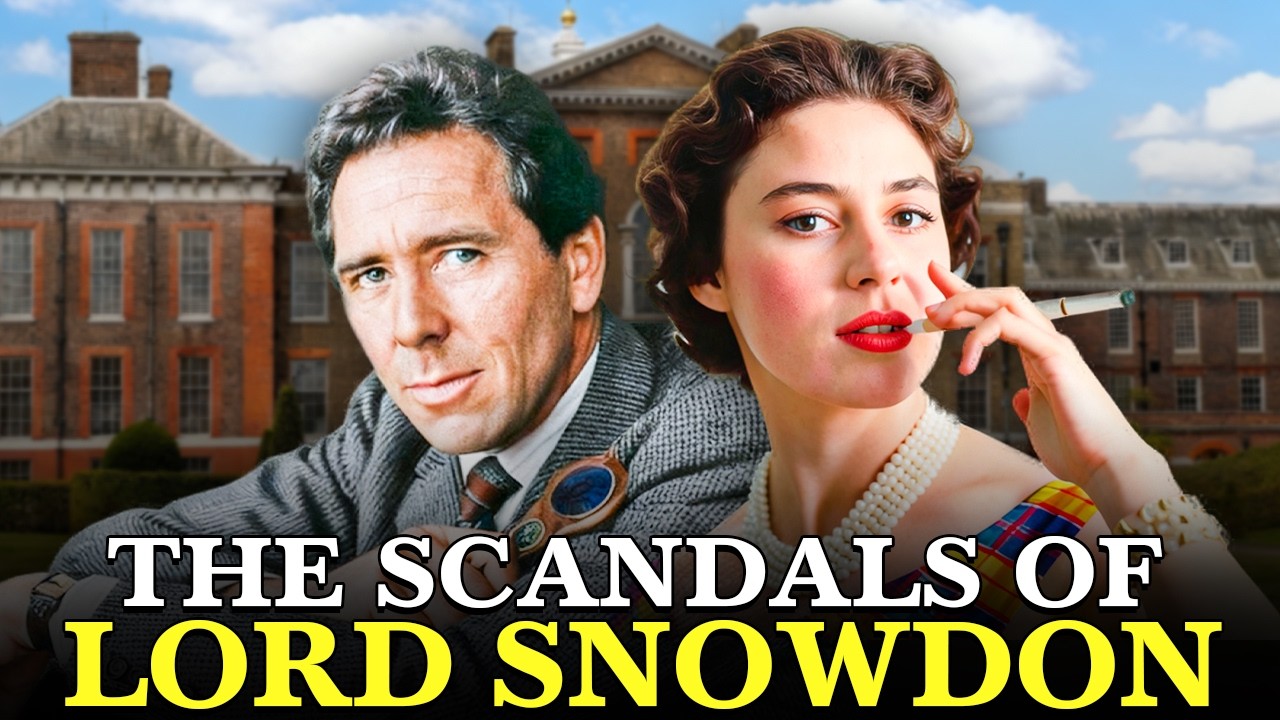
They departed for a honeymoon in the Caribbean aboard the Royal Yacht Britannia, a beginning so perfect it could have been staged, and in a sense it had been, given that both bride and groom understood the power of images better than almost anyone alive. They settled into an apartment at Kensington Palace, not a house they had chosen together but rooms within a royal property allocated by the institution, surrounded by staff, protocol, and the quiet surveillance that was the price of Margaret's birth.
In October 1961, Tony was created Earl of Snowdon and Viscount Linley, receiving the title the palace considered necessary for the husband of a princess. The earldom gave him a place in the system. He was no longer simply the photographer who had married a princess but a peer of the realm. Whether he wanted that place, quietly resented it, or merely accepted it as the cost of the life he had chosen, his later behavior would answer more honestly than anything he said at the time.
David was born on November 3, 1961, barely 18 months after the wedding, and christened David Albert Charles. He arrived into a household that was still functional, with two parents still charmed by each other and a palace apartment that hummed with staff, visitors, and creative energy. Sarah followed on May 1, 1964, by which time the atmosphere had already begun to shift.
Neither child would later speak publicly in any sustained way about what it was like to grow up inside this particular marriage, and that silence is itself revealing. They absorbed the code of the world they had been born into, the Windsor code of endurance and discretion, and carried it forward into adult lives defined by craft, privacy, and a conspicuous absence from public emotional display.
For a few years, the Snowdons looked like what the future might hold if the institution loosened its collar and let talent sit beside title. They attended premieres and gallery openings and entertained lavishly, filling their Kensington Palace rooms with guests who would not normally have been invited inside the royal perimeter: photographers, theater directors, ballet dancers, magazine editors, people whose credentials were creative rather than hereditary.
Friends from this period would later describe the marriage's early years as genuinely exciting. Two clever, attractive people who shared a physical ease, a taste for irreverence, a love of swimming and ballet, and late-night conversation. There was laughter in those rooms and real intimacy. The children were small and photogenic, and the photographs Tony took of his family during this period are among the best he ever made, tender and informal. For a time, the images were not a lie.
But underneath the entertaining, a geometry was forming that would prove inescapable. Tony kept his career, photographed for the Sunday Times magazine, worked on documentary films, and spent long hours in his basement workroom at Kensington Palace, a space Margaret rarely entered and where she was not always welcome. He vanished into assignments for days at a time and came back charged with a vitality that domestic life could not match. Upstairs, Margaret waited.
The house argument crystallized everything. Margaret wanted a country home near Sunninghill, close to her family and embedded in the royal infrastructure that had always surrounded her. Tony wanted Old House on the Nevill estate in Sussex, a place tied to his Messel family and to childhood memories that had nothing to do with Margaret. She thought it cold and remote. He went ahead with the restoration anyway, pouring time, attention, and money into a property that represented his independence and his refusal to be absorbed entirely into her world.
Old House would later become the place where he entertained friends, worked in peace, and eventually conducted affairs, a second domestic space beyond Margaret's reach. The disagreement was never simply about property. It was the marriage rendered in architecture: her need for proximity and security set against his need for autonomy and rooms that belonged to him alone.
By 1964, the year Sarah was born, the competition between them was already audible. Two people accustomed to commanding every room they entered were now living inside the same household, each needing to be the more vivid presence. He descended to the basement workshop and closed the door. She remained in the rooms above, surrounded by gilt and silence, and the faint awareness that the man she had married for his vitality was already directing that vitality elsewhere.
The Snowdon marriage did not explode. It corroded. Corrosion is invisible until the structure it has been eating gives way. Before the basement became a symbol of distance, it was also a workroom, and the work Tony did in it was serious. His photographs for the Sunday Times magazine were not society fluff. He shot assignments across the world, documentary pieces on poverty, on disability, on communities a Sunday supplement's readers might never otherwise have encountered. He made a television film about loneliness among the elderly that was broadcast by the BBC and was by most critical accounts genuinely affecting.
His professional reputation during the 1960s was not borrowed from Margaret's name. It was earned image by image. Margaret, to her credit, recognized it. She was proud of his work and understood what it cost him to be taken seriously as a photographer rather than dismissed as a princess's husband. In the early years, she supported that ambition with a generosity her later bitterness would sometimes obscure.
The difficulty was not that Tony worked. The difficulty was what his work meant about the marriage's internal economy. Every assignment took him away physically, emotionally, and psychologically. He returned with stories, contacts, and the restless energy of someone who had been doing something that mattered. Margaret, meanwhile, had her own calendar of duties that were real but not chosen, and that carried none of the creative satisfaction his work gave him.
The first signs of decline were atmospheric. Tony's absences grew longer, and his returns grew more perfunctory. The basement workroom became a barrier, a closed door he enforced with increasing rigidity. When Margaret came downstairs to find him, she was sent back up. That detail, reported in later biographical accounts, captures the particular cruelty of a marriage in which one person is told repeatedly and without explanation that they are not wanted. Margaret was not being screamed at. She was being dismissed, by a man she had married precisely because he had once made her feel more wanted than anyone else ever had.
The notes began. Tony had a habit, attested in Lady Anne Glenconner's memoir-based reporting and repeated across multiple biographical accounts, of leaving written insults where only Margaret would find them, inside books, in drawers, tucked among her gloves or her stationery. The content of at least one was vicious: a message telling her she looked like a Jewish manicurist and that he hated her. The phrasing was calculated to wound on multiple levels.
But the method was worse than the content. These were not insults hurled in the heat of an argument, where anger at least acknowledges the other person's presence. They were ambushes, designed to be discovered in private, in quiet moments, when Margaret was alone with her own thoughts and her husband was elsewhere. The cruelty was not impulsive. It was architectural. Tony constructed humiliations and left them in her domestic space like traps.
The cumulative effect was to make her feel unsafe in her own home. The Princess of the United Kingdom, one of the most photographed women in the world, opening a drawer in Kensington Palace and finding among her own belongings a note from her husband telling her he hated her. All that ceremony, all those staff and private secretaries, and still there was no protection against the person closest to her.
The palace could manage her schedule, her public appearances, her wardrobe, and her engagements. It could not manage what happened inside her marriage, because the marriage was supposed to be the one space where management was not required, where she was not Princess Margaret performing a role but Margaret living a life. Tony turned that space into a theater of contempt, and she had no audience to appeal to and no protocol for how to survive it.
The affairs followed, or perhaps ran alongside the notes. What the biographical record makes clear is that Tony's infidelities during this period were numerous, sustained, and conducted with a boldness that suggested he was not especially concerned about being discovered. He maintained relationships from his premarital life, formed new attachments, and exercised the sexual freedom he had always claimed as his right, within a marriage whose institutional constraints made it almost impossible for Margaret to respond in kind without triggering a public scandal.
The most devastating single scene from this phase took place at the London Clinic. Tony was hospitalized, and Margaret, still his wife, came to visit him. She arrived to find Lady Jacqueline Rufus Isaacs already there, already at his bedside, already occupying the position that should have been Margaret's. Margaret, standing in the hospital room, reportedly said something to the effect that she could nurse him herself, a line devastating precisely because it sounds not furious but plaintive, not commanding but diminished.
A princess of the blood, the sister of the Queen, reduced to competing for access to her own husband's sickbed. That scene was the first fracture, not because it was the first betrayal, but because it was the first moment when the betrayal became impossible to reinterpret as anything else. Margaret absorbed it, as she had been trained to do, the way she had absorbed the Townsend renunciation: with control, with pride, with a refusal to collapse that was simultaneously her greatest strength and her most costly inheritance.
The Windsor code, one does not speak, one does not seen, one endures, had been bred into her since childhood. It was the only response she knew, and it was the response the institution required. A princess sobbing in public about her husband's infidelity would have been a crisis. A princess carrying her humiliation privately was, in the palace's calculus, merely a difficulty.
Elizabeth knew, of course. Not necessarily the specific details of the London Clinic scene, but the broad contours of what was happening inside her sister's marriage. The Queen was not a woman who missed things. She had access to information, to staff reports, to the quiet observations of courtiers whose job it was to notice when the royal household's foundations were shifting. But knowing and acting are different things when you are the sovereign, and Elizabeth's position was structurally impossible. She could not intervene without acknowledging that the marriage was failing, and acknowledging the failure publicly would create the very crisis royal protocol existed to prevent.
So Elizabeth watched. She sympathized in the private, constrained way that royal sympathy is expressed: a telephone call, a concerned word to a lady-in-waiting, an invitation to Balmoral that carried the unspoken subtext of refuge. But she did not, and perhaps could not, offer Margaret the one thing that might have made a difference: permission to leave.
The Queen Mother maintained her position too. She adored Margaret, but she belonged to a generation for which marital unhappiness was not a reason for divorce but a reason for better behavior at dinner. If Margaret had described the notes in the drawers and the humiliation at the hospital, the response would almost certainly have been sympathy laced with the expectation of endurance. One bears it, one carries on, one does not allow private misery to become public spectacle.
But something shifted after the London Clinic. Not publicly. There was no announcement or confrontation. The shift was internal. Margaret began to harden. Her wit, always sharp, developed an edge that could draw blood. Her drinking increased. Her social life became more frenetic, as though filling every evening with guests and laughter could compensate for what was missing when the guests went home and the apartment fell silent.
She did not leave Tony. She could not, not yet, not without triggering the constitutional and institutional consequences her sister's government would have to manage. So she stayed and adapted, and the adaptation took the form of endurance laced with increasing bitterness. Then she began to look elsewhere, not immediately, but with the slow, almost inevitable gravitational pull of a woman starved of tenderness.
The biographical record names Anthony Barton, a Bordeaux wine merchant, and Robin Douglas-Home, a pianist and nephew of a former prime minister, among Margaret's attachments during this period. These were not casual flings in the way Tony's serial conquests were casual. They were attempts, clumsy and sometimes desperate, to recover something the marriage had destroyed: the feeling of being desired, valued, seen as a woman rather than an institution.
Here the story demands a distinction the tabloid version has never been interested in making. Tony's affairs and Margaret's affairs were not equivalent. Tony's affairs were exercises of appetite. He pursued women because he wanted them, because conquest was his habit, because sexual novelty was the fuel his restlessness required. He conducted them with a confidence bordering on indifference to discovery, because he understood correctly that the institutional machinery surrounding his wife would protect him.
Margaret's attachments were acts of survival. Each man she turned to represented not a thrill but a rescue, a brief respite from the daily experience of being married to someone who had made it clear in notes and absences and closed doors that she was unwanted. That distinction does not excuse the pain her affairs caused, but it explains the emotional logic, and the emotional logic matters if the story is to be honest about who these people were.
Robin Douglas-Home's story carries particular weight because his relationship with Margaret did not end cleanly. He was a fragile man, charming but unsteady, talented but unable to sustain the momentum his talent should have generated. His connection with Margaret was intense and for a time genuinely tender, but he could not survive the pressures of her position. After the relationship ended, Douglas-Home spiraled into a depression that would years later contribute to his death by suicide. Margaret was not responsible for that death, but the knowledge added another layer of guilt and grief to a woman already carrying more than she could comfortably bear.
None of this was public. The palace's machinery of discretion ensured that Margaret's private pain remained private, and the cost of that privacy was that she bore it essentially alone. Tony, meanwhile, was not merely conducting affairs. He was constructing parallel lives. Old House had become a second domestic world, a place where he entertained friends, worked, and conducted relationships beyond Margaret's knowledge or control.
The Fry thread remained quietly present. Polly, born in 1960, was growing up as Jeremy Fry's acknowledged daughter, but the truth of her paternity lay buried beneath decades of social convention and the mutual interest of everyone involved in not asking questions whose answers might be inconvenient. Tony's capacity for compartmentalization was remarkable. He could be the charming dinner guest at Kensington Palace on a Tuesday and the attentive lover at a separate address on a Wednesday, and the wall between those versions of himself appeared to cause him no visible distress. It was the people around him who absorbed the cost of his flexibility.
The marriage was now a private war. It was not yet a public scandal, because the machinery of royal discretion was still functioning, because the press of the 1960s and early 1970s operated under different rules than it would a decade later, and because both Margaret and Tony had their own reasons for maintaining the facade. Neither could afford to be the one who broke the surface.
So they continued smiling at public engagements, hosting their famous evenings, appearing in photographs that showed a couple whose marriage was lively and unconventional, while behind the camera the notes piled up in drawers and the cruelty accumulated in the rooms where no one was watching. The children were watching, of course. David was old enough by the late 1960s to register the atmospheres even if he could not yet name them. Sarah, three years younger, absorbed what children always absorb: not the specifics of adult conflict but its emotional weather.
They lived in Kensington Palace surrounded by nannies and staff and the strange formality of a royal household, and they watched their parents' marriage unravel from the inside with the helpless clarity that only children possess. Neither child has spoken publicly in any sustained or detailed way about what growing up in this household was like. That silence has held for more than 50 years, and it is perhaps the most telling inheritance they received.
By the early 1970s, the marriage existed in a state of armed suspension. Tony had his work, his lovers, his compartments. Margaret had her duties, her drinking, her slow accretion of private sorrow. The palace maintained its discretion, and the press, not yet equipped with the invasive reach it would develop later, reported on the Snowdons as a glamorous if unconventional couple and left the rest alone.
Into this suspended world, sometime around 1973, a new figure began to move. His name was Roddy Llewellyn. He was 25 to Margaret's 43, handsome in a soft, unthreatening way that was the precise opposite of Tony's angular charisma. He was a would-be landscape gardener, the son of a Welsh baronet, whose principal gifts were charm, warmth, and the ability to make Margaret feel that someone was paying attention to her not because she was a princess but because she was a person who deserved kindness.
Their first meeting, arranged through mutual friends in the social circle that orbited Mustique and the London party world, was unremarkable. Their second and third meetings were less so. Roddy did not compete with her, did not test her, did not use his intelligence as a weapon. He simply liked her and let her know it. For a woman who had spent a decade being told in a hundred small ways that she was hateful and unwanted, that simple liking was powerful enough to break through every caution her position should have imposed.

By the time Margaret invited him to Les Jolies Eaux on Mustique, the relationship had crossed whatever invisible line separates friendship from attachment. They swam together, sat in the sun together, stayed up late on a terrace overlooking the Caribbean. It was an affair conducted in paradise, and for Margaret it felt briefly and dangerously like the freedom she had been promised when she married Tony 15 years earlier and had never actually received.
But Roddy was also a symptom. He was the mirror image of what Tony had once been: vivid, flattering, an answer to humiliation, except that where Tony had offered danger and brilliance, Roddy offered gentleness and simplicity. Margaret reached for him not because she had found a great love but because she was drowning, and he was the nearest solid thing.
The parallel to her earlier life was exact and cruel. Once again she had chosen a man who existed outside the usual royal orbit. Once again the relationship carried the risk of institutional disapproval. Once again her private desire was on a collision course with her public position. The institution that had managed her unhappiness for more than a decade was about to discover that it could not manage this, because Roddy was not a discreet arrangement conducted behind closed doors in London. Roddy was Mustique and sunshine and a young man's arm around a princess on a beach where the light was good and the sightlines were long.
The photograph was taken in February 1976 on Mustique, in the kind of light that makes the Caribbean look like paradise. The image itself was not dramatic: Margaret and Roddy Llewellyn together in swimwear on a beach. No embrace, no kiss, nothing that would have scandalized a viewer who did not know who these people were. But the viewer did know. The woman in the photograph was Princess Margaret, Countess of Snowdon, youngest sister of the Queen, married, a mother, a member of the most visible family in the world. The man beside her was not her husband.
The photograph was published by the News of the World, and within hours the careful architecture of discretion that had held the Snowdon marriage together in public lay in pieces. But that photograph did not appear out of nowhere. It was the detonation point of a chain of events that had been building for years.
By 1974, Tony had perfected compartmentalization to a degree that would have been impressive if it had not been so destructive. He maintained his professional life with undimmed energy, his social life with the charm that had always made him welcome in any room, and a public performance of his marriage sufficient for the press to photograph the Snowdons together without irony. Alongside all of these, he maintained a private life of extraordinary complexity, with women whose names circulated in the social world he and Margaret shared.
At the center of it all was a deepening attachment to Lucy Lindsay-Hogg that would within a few years become the next marriage. Lucy was not a fling. She was an arrangement, a woman Tony was building a life with even as the formal structure of his existing life remained nominally intact. She was the former wife of the film director Michael Lindsay-Hogg, socially well-connected, attractive, and willing to occupy the position his compartmentalized existence required.
Tony did not see this as contradiction. He saw it as management. He was a man who had always believed he could have everything: the title, the career, the wife, the freedom, the lovers. For years the belief had been confirmed by the system he operated within. Royal discretion protected him, Margaret's endurance sustained him, and the press's restraint shielded him. If the arrangement was cruel to Margaret, that cruelty was, in Tony's internal accounting, simply the price of his autonomy.
Margaret, meanwhile, was moving in the opposite direction, not toward more compartments but toward fewer, toward a narrowing world in which the options for happiness or even relief were shrinking year by year. Her drinking had increased. That fact appears consistently across the biographical record and should be stated plainly. She drank more as her marriage worsened, and the drinking was both symptom and accelerant, dulling the pain while making her more volatile and more difficult for the people around her to manage.
She smoked heavily, and her cigarette holder became almost a parody of the glamour it had once represented, a prop from a life that was no longer glamorous but merely endured. Her public engagements continued, but friends and staff observed a change in her manner. The wit was still there, but it had curdled into something sharper and less generous. She was not well. That is the simplest and most important thing to say about Margaret in this period.
The systems that should have supported her, her family, her household, the institution itself, were designed to manage appearances rather than treat causes. The palace did not have a mechanism for acknowledging that a princess was unhappy. It had a mechanism for ensuring that her unhappiness did not become visible. Those are not the same thing, and the difference between them is the space in which Margaret suffered.
Her relationship with Roddy was deepening in ways that were both sustaining and dangerous. He visited her in London, she invited him to Mustique, and they appeared together at small private gatherings where the other guests understood the nature of the relationship and maintained the silence their social world expected. Roddy was not equipped temperamentally or practically to be the partner of a princess. He lacked the ambition, the professional gravity, the social armor such a position required. But he gave Margaret something no one else in her life was providing: uncomplicated affection.
Mustique became her refuge and her stage simultaneously. Les Jolies Eaux, the house completed in 1973 on the plot Colin Tennant had given her as a wedding present, was by now a fully realized domestic space, her space in a way Kensington Palace had never been. On Mustique, Margaret could swim and sunbathe and stay up until three in the morning, liberated for a few weeks at a time from the protocol and the gray London schedule that defined the rest of her year.
But Mustique was also a trap, because the privacy it offered was an illusion. The island was small, the social circle was gossipy, and the staff at Les Jolies Eaux included local workers with no particular loyalty to the British monarchy's code of silence. Margaret, buoyed by the relief of being away from London and the warmth of Roddy's company, was not as careful as her position demanded.
The publication of the photograph in February 1976 was a different kind of event from anything the Snowdon marriage had previously produced. Previous crises had been private, known to family and friends but not to the public at large. The Mustique photograph was public, printed, and seen by millions. In the language of the institution, it was unmanageable.
The palace's response was what it always was in moments of crisis: silence, followed by the minimum possible acknowledgement, followed by an attempt to move on as quickly as possible. But this time the silence could not hold, because the photograph had given the press a story that could not be unwritten, and because the rules of engagement between the monarchy and Fleet Street were shifting. The deferential press culture that had protected the royal family for decades was eroding.
Within the palace, the mood was one of controlled alarm. Senior courtiers understood that the separation, long anticipated in private, would now have to become public. The question was not whether, but when, and in what language, and with what degree of choreography. The machinery began to move. Private secretaries consulted one another. Constitutional implications were reviewed. The Queen was briefed, and the prime minister was informed.
Tony, sensing perhaps that the balance of public sympathy had shifted, or simply ready at last to formalize what had been true in practice for years, moved toward separation. He had Lucy, he had his career, he had a life outside the marriage fully constructed and ready to occupy. All he needed was the exit, and the Mustique photograph had provided it. In the public narrative, Margaret was the transgressor, and Tony could leave the marriage with his reputation largely intact.
Anne Glenconner watched all of this from closer range than almost anyone. She had been with Margaret on Mustique. She had seen the relationship with Roddy develop and observed the toll that years of Tony's cruelty had taken on her friend. She had also seen, with the clear eye of a woman who loved Margaret but was not blind to her faults, that the affair with Roddy was not merely therapeutic but reckless. She understood what the photograph would mean.
The ironies multiplied, and they were the savage ironies of a system designed to protect the powerful and now punishing the person who had been least protected all along. Margaret, who had sacrificed Peter Townsend to protect the monarchy's image, was now the person whose behavior threatened that image. Margaret, who had endured Tony's far more numerous infidelities in silence for over a decade, was now the one whose single visible attachment was treated as a scandal.
The weeks between the photograph's publication and the formal announcement of the separation were grim. The atmosphere at Kensington Palace was one of barely suppressed crisis. Tony and Margaret were still technically sharing the apartment, though their lives within it had long since separated into parallel tracks. Conversations that should have taken place between husband and wife were conducted through intermediaries, the institutional buffer that spared both parties the indignity of direct confrontation but also denied them any possibility of honest reckoning.
David was 14. Sarah was 11. They were at school, living the bifurcated lives of children whose parents occupied the intersection of public celebrity and private dysfunction. Whatever they were told, they would have understood with the intuition of adolescence that their family was breaking apart in a way that was not merely personal but national. The particular cruelty of being the children of famous parents in a moment of public crisis is that there is no private space in which to process the shame.
In March 1976, the decisive move came. Not through a personal conversation, not across a kitchen table, but through the institutional machinery that now mediated every aspect of the relationship. Margaret's private secretary, Lord Nigel Napier, placed a telephone call to the princess. A husband ending a marriage of 16 years, and the news arrived not from the husband himself but from a private secretary on the telephone.
The content of the call was simple. Lord Snowdon wished to end the marriage. Margaret's response, according to the biographical account that has entered the public record, was dry and devastating. She reportedly told Napier that it was the best news he had ever given her. That line is not one of grief or anger. It is a line of relief, the exhausted, bitter relief of a woman who has been trapped in a burning building for 16 years and has just been told she is allowed to leave.
The formal announcement came on March 19, 1976. The language was palace language: precise, bloodless, designed to convey information without emotion and to close down inquiry rather than invite it. The couple had mutually agreed to live apart. There were no plans for divorce proceedings. The statement used the word "mutually," which was technically accurate in that both parties had by this point accepted the reality of the situation, and deeply misleading in that it implied a symmetry of decision-making that did not exist.
Tony had wanted out. Margaret had been told she was being left. The institution had drafted the language, and the press officer had distributed it. The public read it in their morning newspapers and drew their own conclusions, which were largely that Margaret, glamorous, difficult, indiscreet Margaret, had brought this upon herself by conducting an affair with a younger man in the Caribbean while her husband was elsewhere being patient and long-suffering.
The statement occupied a few column inches. Sixteen years of a marriage, of love and cruelty and children and notes in drawers and hospital bedsides and parallel lovers and institutional silence, were reduced to a paragraph of diplomatic prose. That compression is itself part of the story. The palace's language was a final act of management: take a catastrophe, strip it of texture, remove the human beings, and present what remains as an administrative matter.
That narrative was unjust, and Margaret knew it was unjust. The knowledge that the public version of her marriage's collapse bore almost no resemblance to the private reality was a wound that would not heal. She had endured years of Tony's cruelty, and the public believed she was the unfaithful one. She had been the one left, and the public believed she had been the one leaving. The gap between perception and reality was vast, and the institution had no interest in closing it.
Tony moved toward Lucy and the life he had been constructing in parallel for years. He was, by all accounts, relieved. The marriage had been a constraint, and constraints were what Tony had spent his entire life refusing. With the separation formalized, he could live openly with Lucy, continue his professional career, and begin reinventing himself not as the Earl of Snowdon who had failed Princess Margaret but as the artist and photographer who had outgrown a marriage that was never going to contain him.
Margaret remained at Kensington Palace, publicly humiliated, privately devastated beneath the performance of resilience. Her relationship with Roddy continued, but it was now stripped of the privacy that had made it bearable. Every appearance together was noted, every holiday scrutinized. The press, which had once treated Margaret with a mixture of affection and deference, now treated her with a prurience that fed on the Mustique photograph.
Roddy himself was struggling under the weight of the attention. He had never sought fame and had not entered Margaret's life intending to become a tabloid fixture. He was a young man with modest ambitions who had stumbled into the orbit of one of the most scrutinized women in the world, and the scrutiny was more than he was equipped to handle. The defining fact of his public life would always be that he had been Princess Margaret's lover.
Elizabeth watched from the other side of a constitutional divide that sympathy could not bridge. She was the Queen. Her sister's marriage had failed in the most public possible way. The monarchy would survive it, as it survived everything, but the cost was real: a crack in the image of the family, a precedent that would make future royal separations and divorces slightly more thinkable, and the quiet private knowledge that her sister was in pain and that the institution Elizabeth embodied had not protected her from it.
The Queen Mother absorbed the blow with dignity and composure, but with a sadness that friends later noted she never entirely lost. She had wanted the marriage to work and had believed it could. The failure was a failure of the world she represented, a world in which charm and breeding and a good dinner party were supposed to be enough to hold a marriage together.
The divorce itself was still two years away. In those two years, the true shape of Tony's character would become clearer than it had ever been. He did not waste them. Margaret experienced the separation as a wound, as the formal acknowledgement that something she had once believed might save her had instead become another private catastrophe. Tony experienced it as movement. He had Lucy, he had work, and he had the confidence of a man who had spent years living in several emotional rooms at once and had never once been forced to admit in any complete way what he was doing in each of them.
Once the announcement was made, he did not seem chastened by exposure. He seemed freed by it. The separation gave him something he had wanted for years: a way out of one life without surrendering the prestige that life had given him. He remained Lord Snowdon, a photographer of reputation and a man of consequence in the world of publishing, design, and society. He was not being cast out or disgraced. He was being allowed once again to move forward while someone else absorbed the uglier part of the story.
Margaret did not have that luxury. The institution had always treated her private life as an extension of public duty, and now it treated her collapse the same way. She still had engagements, patronages, and the daily machinery of being dressed, driven, announced, photographed, and returned to Kensington Palace as though her life were merely entering a new administrative phase. But what had actually happened was harsher. She had spent 16 years in a marriage that had diminished her, and when it finally broke in public, the country was inclined to believe she was the guilty party.
Snowdon's betrayals had been numerous, brazen, and within aristocratic and media circles widely understood. Margaret's relationship with Roddy Llewellyn became the national scandal not because it was more serious but because it was visible. That was the old bargain of this world: men were permitted privacy inside their bad behavior, and women were judged once their unhappiness could be photographed.
By 1976, Roddy had also become a symbol, and symbols are punished for meanings they did not choose. He was called her toy boy, written about as though he were both ridiculous and predatory, a younger man simultaneously mocked for immaturity and blamed for the end of a royal marriage.
Inside Kensington Palace, the texture of Margaret's days grew harder. Some of her habits had been fixed for years: late rising, breakfast in bed, hours of reading newspapers and smoking before the day properly began, evenings that stretched too long and required too much from drink and company. After the separation, these habits no longer looked like the eccentric routines of a difficult princess. They looked like the structure of someone trying to dull the consciousness of her own life.

By the spring of 1978, strain had become illness. Margaret was taken ill in May, at the very moment the legal machinery of divorce was moving into its final stage. Reports at the time and later biographical accounts described a princess physically depleted, emotionally exhausted, and increasingly unable to pretend that the damage done in private had not entered her body. Scandal has a physiology. It changes the way a person sleeps, appetite, the breath in the chest, and the quality of silence in a room. By the time Margaret's divorce reached court, she was no longer merely embarrassed. She was worn down.
Tony, by contrast, kept moving with the unnerving ease of a man whose own emotional weather rarely settled into remorse. By then he was filming in Australia with Lucy Lindsay-Hogg, the woman who would become his second wife later that same year. Publicly, he issued statements in the cool, almost patrician register he knew how to perform so well. Privately, he was already arranging the next life. Within 18 months, he had begun another long affair with the journalist Anne Hills, as though even the woman who had replaced Margaret could not actually contain him.
That repetition matters. It rescues the story from a false explanation. Margaret was not uniquely impossible. Snowdon was repeating himself. The children, meanwhile, were old enough by now to understand what endings really are. David was 16, Sarah was 13. They had already lived through years of atmosphere and silence, but separation and divorce were different. They were public. They put dates onto things that had previously been felt rather than named.
For children born into publicity, there is a particular brutality in watching the country narrate your family before you have the language to narrate it to yourself. Much of the dignity of David's and Sarah's adult lives has consisted in not supplying the world with that kind of material after the fact, but the restraint itself tells you something. They had learned the family code: that one survives by keeping hold of one's interior life.
David would move toward craftsmanship, wood design, the solidity of made things. Sarah would move toward painting, private looking, the long discipline of making an image in quiet. Neither path feels accidental. Children do not always become the opposite of their parents. Sometimes they become the correction.
On May 24, 1978, Princess Margaret's divorce case appeared in the Supreme Court of Judicature daily cause list for hearing in the London Divorce Court, in courtroom 44 of the Queen's Building. It was listed 20th in a batch of 28 cases. That detail matters because of how ordinary it is. After the wedding at Westminster Abbey, after the carriage procession and the television cameras and the fantasy of modern royal romance, the marriage ended in a queue.
The hearing was expected to take only a couple of minutes. That is the scale on which the law handles the collapse of lives. Margaret was not there. She did not need to be. The divorce moved through the court in her absence, on paper, with the speed and impersonality the system reserved for consent and inevitability. A judge in a London courtroom, files moved from one side of a desk to another, names read out, counsel speaking in the neutral cadence of procedure.
It is tempting to make the central tragedy loud: a smashed glass, a public confrontation, a dramatic walkout. But that is not what this tragedy was. Its devastation lay in how administrative it became. Two people had once imagined that marriage might rescue them from other injuries. Eighteen years later, it was being disposed of in the same city with barely more emotional ceremony than a disputed tenancy. The heartbreak is not in spectacle. It is in the reduction.
The decree nisi was granted that May. By July, the divorce was finalized. It was the first divorce of a senior British royal in the modern era, and even then the language around it remained curiously clipped, as though the establishment still hoped brevity might limit significance. But significance does not work that way. A marriage that had been sold to the public as glamour, modernity, and romance had ended in legal failure. The monarchy had crossed a threshold it had long pretended could not be crossed.
Margaret was 47, Tony was 48. Neither was old, yet the marriage already belonged to the past tense. Margaret, by several accounts, did not greet the divorce with theatrical devastation. She greeted it with something colder and sadder: relief, certainly, but relief can be one of the bleakest emotions in the world when it arrives after years that should never have had to be survived.
What followed almost immediately made the wound sharper. On December 15, 1978, Snowdon married Lucy Lindsay-Hogg. There are moments in family histories when time itself behaves like an insult, and this was one of them. July, the divorce completed. December, the remarriage. The speed said what Tony did not have to say aloud: the next arrangement had not been discovered after the end of the first. It had already been waiting. By the following year, there would be a daughter, Frances, a new household, new rooms, new photographs.
Margaret could be caustic. She could be vain. She could be difficult in ways that exhausted the people around her. All of that was true. And still, there is something pitiless about imagining what that winter must have felt like from inside Kensington Palace. The country had watched her marriage crack. The law had finished with it. Her former husband had remarried before the year was out. She was left in the same royal rooms, under the same portraits, with the same title, except that now the title carried the memory of public failure as well as privilege.
Yet even here the story refuses simplicity. Over time, after the worst years had passed, there were postcards again. There was a grim, exhausted kind of affection, old jokes and old habits of address that survived the legal death of the marriage. That does not redeem what happened. It complicates it. Most real marriages do not end in a single emotion. They end with anger, relief, loyalty, memory, dependency, contempt, and familiarity, all knotted together so tightly that even the people inside them cannot always separate one strand from another.
The divorce had ended the marriage. It had not ended the pattern. If anything, it made the pattern easier to see. And once you could see it, you could not unsee it again.
Margaret's relationship with Roddy Llewellyn continued, and for a time it continued to do what it had always done: soften her. Friends noticed it, and Glenconner remembered it. Even the Queen years later reportedly acknowledged it. After Margaret's funeral, Anne said the Queen thanked her for having introduced her sister to Roddy because he had made Margaret really happy. That is an extraordinary sentence, not because it is romantic but because it is so modest. Not he saved her, not he was the great love of her life, simply that he made her really happy.
But happiness of that sort is fragile when the press has already converted it into caricature. Roddy had not married into the royal family. He had been dragged into its glare. He was mocked in headlines, treated as decorative, and reduced to a type. The relationship lasted for years, but it did not create a stable second life. It could not. Margaret remained Margaret, famous, scrutinized, difficult, formed by old disappointments and by an institution that did not know how to let its members become ordinary.
When Roddy married Tatiana Soskin in July 1981, Margaret did not respond with public drama. By then she had had years of learning how to lose people without spectacle. What survived between them was friendship. That two matters. It suggests that what she had sought in him was never possession in the ordinary sense. It was solace, warmth at a time when warmth had become scarce. Once that season ended, the gratitude remained, even if the romance did not.
Margaret herself never remarried. She had once been denied a marriage she wanted, and then had endured one that degraded her. Marriage had already revealed both of its faces. There was no reason to expect she would trust it a third time. What followed instead was a narrower, lonelier life than the public often understood. There were still houses and staff and holidays and photographs, but the radius of real emotional safety remained small.
Her health deteriorated slowly, then unmistakably. Heavy smoking, long years of drinking, emotional strain, and simple bad luck all played their part. In February 1998, while at her holiday home on Mustique, she suffered a mild stroke. A year later, she severely scalded her feet in a bathroom accident, an injury that badly affected her mobility. In 2000 and 2001, she suffered further strokes. By then, the image of Princess Margaret that had once dominated the culture had been replaced by a sadder, more physically vulnerable figure, often in a wheelchair, moving through a much reduced life.
Even in those final years, she continued where she could to support the organizations that had structured so much of her public life. She had patronages, a long genuine connection to the arts, and a devotion to ballet that spanned decades. The same woman who could be cruel at dinner could also be loyal in her commitments for half a lifetime. Neat moral arrangements fail around real people because they never contain enough of the truth.
On February 9, 2002, Princess Margaret died at the King Edward VII Hospital after a further stroke. She was 71. Her children, Lord Linley and Lady Sarah Chatto, were at her side. The image that remains is of the son and daughter who had grown up inside the marriage that defined her adult life, standing at the end of the story with her when almost everyone else from the opening chapters was gone. People may not be able to save one another from history. They still arrive at the bedside.
Her funeral, held at St George's Chapel, Windsor, was unusual in one important respect. Margaret was cremated and her ashes were placed in the King George VI Memorial Chapel. Even in death, there was a faint sense of her doing things a little differently from the older royal script.
Snowdon's aftermath followed the pattern one might have predicted. His marriage to Lucy Lindsay-Hogg produced a daughter, Frances, in 1979. For a time that new household seemed to promise what the first had not delivered: steadiness, domesticity, a second chance. But the essential fact about Tony had never changed. Within 18 months of the wedding, he had begun a long affair with the journalist Anne Hills. Lucy, discreet and loyal, remained by his side for years despite that.
Then came the next revelation. In the late 1990s, while working with Country Life editor Melanie Cable-Alexander, Snowdon fathered a son, Jasper, born in April 1998. Lucy moved out, and divorce proceedings were set in motion. The public by then was no longer surprised. That may be the most damning thing that can happen to a man's reputation: not that people think him wicked, but that they think him predictable.
And there was more. The old secret of Polly Fry, born in 1960 to Camilla Fry, finally hardened into documented fact in 2004, when a DNA test confirmed that Snowdon, not Jeremy Fry, was her biological father. That revelation reached back across 44 years and altered the beginning of the story from the far end. It meant that even before the wedding to Margaret had properly settled, another child already existed in the outer ring of his life.
When people describe Snowdon as complicated, that is what they usually mean. But complication can sometimes become too polite a word. He was not merely complex. He was structured around secrecy, and secrecy always leaves someone else carrying the weight.
None of this erased his work. Snowdon remained in the artistic sense significant. The National Portrait Gallery describes him as a photographer, filmmaker, designer, and campaigner for disability rights, with hundreds of portraits in its collection. His portraits of politicians, artists, and members of the royal family helped define the look of postwar British public life. He designed the aviary at London Zoo with Cedric Price and Frank Newby, and he campaigned for disabled people with a seriousness shaped in part by his own experience of polio.
He was, in professional terms, much more than Princess Margaret's husband, and it would be dishonest to pretend otherwise. The difficulty is that talent does not cancel damage. The world is full of gifted people who leave wreckage in private. Snowdon belonged to that old and very crowded category. He died on January 13, 2017, at his home in Kensington, aged 86. By then Margaret had been gone for almost 15 years.
The children are where the story's long emotional line becomes clearest. David Armstrong-Jones was born into one version of the family and inherited another. Born in November 1961, he entered the world as Lord Linley, son of a princess and a rising photographer who had not yet become Lord Snowdon. By the time he was old enough to form stable memories, the marriage was already under strain. By the time he was a teenager, it had collapsed in public.
And yet his adult life suggests less appetite for spectacle than for construction. He trained as a craftsman in wood, opened a workshop in Dorking in 1985, and built the company that became Linley, associated with bespoke furniture, marquetry, and a particular kind of highly finished British luxury. In a family history marked by emotional instability and public theater, the son turned toward joinery, grain, structure, finish, and endurance.
After his father's death in 2017, he inherited the earldom and became the second Earl of Snowdon. Professionally, he remains associated with the design world through Linley and through the reputation he built as David Linley long before the title came to him. He inherited his father's eye for design and his mother's place within the royal story, and he seems to have made of those inheritances something steadier than either of them managed together.
Sarah, born on May 1, 1964, took a quieter route still. She trained at Camberwell and the Royal Academy Schools and has long exhibited under the name Sarah Armstrong-Jones rather than trading heavily on royal styling. In 2024, she became president of the Royal Ballet School, a role that carries a direct line back to her mother, who had loved ballet and served as the school's president for many years. That is one of the gentler threads in the aftermath. Not all inheritance is damage. Some of it is continuity, taste, discipline, the passing on of an enthusiasm in better condition than the marriage itself.
What remained physically is more scattered. Kensington Palace still stands, but not as the private world the Snowdons once inhabited. Old House at Nevill Holt remains with its wider estate. And on Mustique, Les Jolies Eaux still exists, transformed now into a rentable villa, a royal refuge converted into luxury history. That may be the most modern fate possible for such a place: the site of private joy and public scandal repackaged as experience.
The cultural afterlife of Margaret and Snowdon has been vigorous. The Snowdon biography, published in 2008, remains one of the key works in shaping modern understanding of him. Lady Anne Glenconner's memoir gave later audiences some of the most intimate glimpses of what Margaret's daily life had actually felt like. Netflix's The Crown made the marriage globally legible all over again, with Vanessa Kirby and Matthew Goode for the earlier years and Helena Bonham Carter and Ben Daniels for the later implosion.
The series captured a great deal: the allure, the sexual charge, the class friction, the emotional asymmetry, the way glamour can disguise corrosion for years. What it could not fully capture, because no screen version can, was the long administrative grind of real damage. The patience of humiliation, the repetitive nature of contempt, the years in which nothing explodes and yet a life is steadily being made smaller. Adaptation gives you pattern. History gives you residue.
History leaves drawers, court lists, hospital rooms, old postcards, children who do not tell all they know, and a family that goes on carrying a version of the event long after the newspapers lose interest. The name remains. Windsor remains. Snowdon remains. Titles continue. David carries the earldom, and Sarah carries the visual inheritance of both parents into a quieter artistic life.
What does not remain is the illusion that the marriage was only what the photographs showed. The public once saw a glamorous princess and a gifted bohemian photographer standing at the front edge of a more modern monarchy. What was happening behind that image was lonelier, harsher, and much more recognizable than the fantasy allowed.
Wealth and title did not protect Margaret from private humiliation. Talent and freedom did not make Snowdon kinder. The palace could preserve the facade for years, but the effort of preserving it consumed the energy that might have been used to face what was actually wrong. The children inherited not a fortune in any meaningful emotional sense, but a set of silences, atmospheres, and strategies for survival. That is often what dynasties pass down when the cameras are gone.
In the end, perhaps the most revealing image is still the smallest one. Not Westminster Abbey, not Mustique, not the court list, but a note hidden in a drawer, a private insult placed where only one person would find it. The whole story is in that gesture: the public render outside the room, the private cruelty inside it, and the long silence required to keep the two from touching.