In 1883, a state surveyor named Gideon Ashworth arrived in the isolated mill town of Hollow Meer, West Virginia, to assess property boundaries. The town, nestled so deep in a valley that sunlight reached it only a few hours each day, ran on water-powered mills and kept an uneasy distance from outsiders. Residents answered questions with the fewest words possible, and Ashworth noted that they watched him when they thought he wasn’t looking. On his ninth day, while surveying land on the north side of town near an abandoned mill, Ashworth found a basement entrance that had been sealed with far more brick and mortar than necessary.
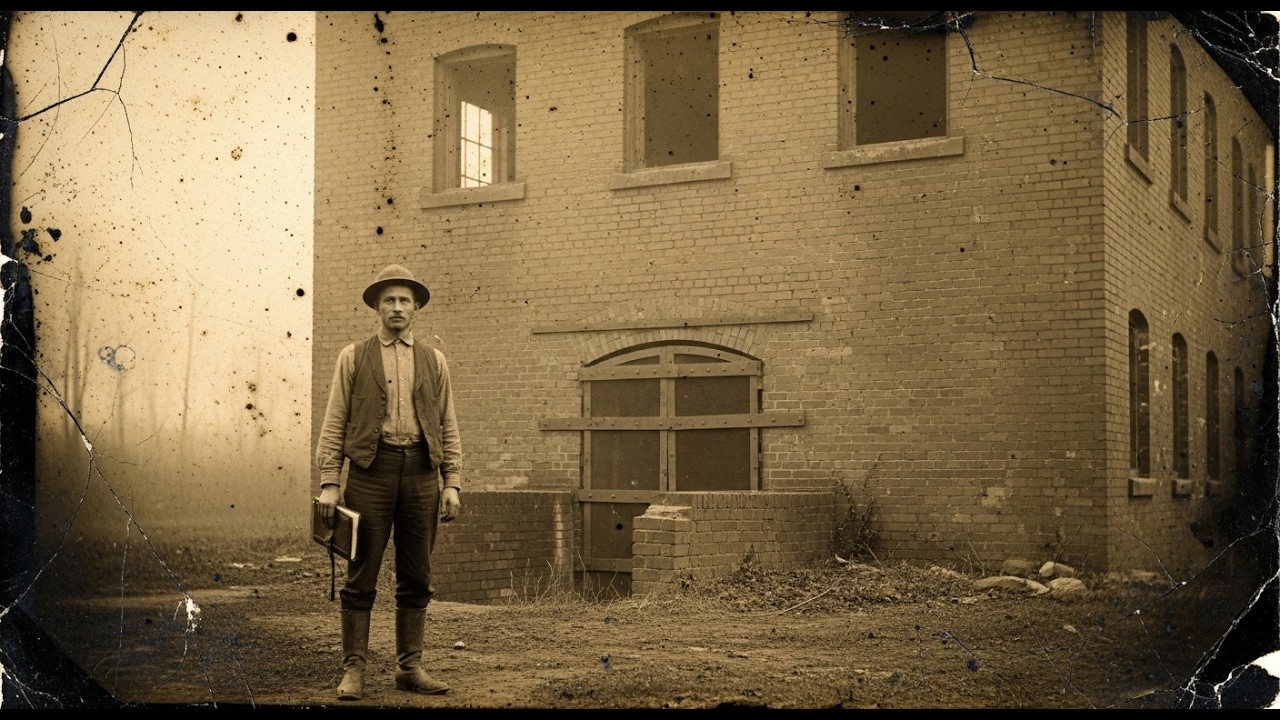
Iron bands were driven into the wall, and the structure emitted a faint chemical smell like lime or lye. The property records showed the town council had purchased the mill in 1879, but there was no indication what they had done with it. When Ashworth asked the boarding house owner, Sophronia Merritt, about the building’s history, she told him it hadn’t been used for a long time and warned him to stay away. When he pressed further, she replied, “Some things are better left alone, Mr.
Ashworth. The past is the past. ”
The warning did not stop him. Armed with a pry bar borrowed from the livery stable, Ashworth returned to the mill and broke through the wall.
He found stone steps leading down to a vast basement. The walls were marked with deep scratches, some resembling gouges made by fingernails or claws. At the bottom, he discovered a room filled with tables arranged in neat rows, surgical instruments with unusual curves and clamps, and hundreds of jars lining the shelves containing what appeared to be human organs and tissue samples preserved in cloudy liquid. On a desk in the far corner, Ashworth found a ledger.
It contained meticulous records dating from 1867 through 1879, documenting procedures that had no names in any medical textbook. Each entry included a reference number, a brief description, and an assessment. One entry read: “Subject 23. Female, age 24, admitted 1868 for nervous disorder.
Procedure seven applied. Subject survived eight days post treatment. Vocal cords functional throughout. Minimal scarring.
Results inconclusive. ” Another read: “Subject 47. Male, age 31. Admitted 1870 for melancholia.
Procedure 14 applied. Subject survived three days. Consciousness maintained until final hour. Spinal column extracted intact.
Results promising. ”
The ledger recorded more than 160 subjects, all admitted for ailments such as nervous disorders, melancholia, hysteria, and consumption. The procedures appeared designed not to cure but to explore what the human body could endure while consciousness remained. Each entry was signed with a single initial: M.
Climbing back toward the exit, Ashworth noticed additional markings on the walls, words carved into the stone. “Help us,” one read. Another read, “He is not a doctor. ” And repeated over and over: “We are not mad.
We are not mad. ”
Ashworth took the ledger to the sheriff’s office. Sheriff Horace Venn did not touch the book. He told Ashworth to pack his things, leave Hollow Meer that day, and forget what he had seen.
When Ashworth insisted he would take the evidence to state authorities, the sheriff warned that accidents happen all the time, as do men who fall into rivers or get lost in the woods, and that sometimes they are not found in any condition to tell stories. Ashworth ran toward the train station but found himself being followed by townspeople, including the butcher, the clerk from the general store, and a woman from the restaurant. They closed in from both directions, driving him away from the station. He climbed a ladder to a rooftop, where he could see the entire population of the town gathered below, standing still, watching him.
He tore pages from the ledger and hid them in his shirt and pockets. He threw the ledger down into the street, where the sheriff retrieved it. Ashworth then descended and ran through alleys toward the station, but was pulled into a doorway by a telegraph operator named Malachi Hart. Hart told him to stop fighting and explained that a freight train would pass through in 20 minutes and slow down at a bend half a mile east of the station.
Hart said he had worked the telegraph while people were being brought in and had never said a word, calling himself a coward. He offered to create a distraction. He stepped back into the street and shouted that he had seen Ashworth heading toward the boarding house. Ashworth ran through the cemetery, noticing graves that appeared too new given that Merritt had said no one had died recently.
He reached the bend as the freight train approached, ran alongside it, caught an open door, and pulled himself inside as the town receded behind him. When the adrenaline faded, Ashworth realized the pages he had hidden were gone, lost during his escape. He had no physical evidence left. After two days on the train, Ashworth got off in Pennsylvania and went to a law office.
Lawyers listened politely and promised to investigate, but nothing came of it. Newspaper editors refused to print the story without proof; one suggested he had suffered a breakdown and invented the whole thing. Ashworth returned to surveying but never recovered from what he had seen. He began keeping his own records of towns that felt wrong, of sealed basements, and of people who changed the subject when asked about local history.
Over the years, he noticed patterns, what he believed were other places with buried secrets. In 1897, fourteen years after his escape, Ashworth received an unsigned package with a smudged postmark. Inside was a single yellowed page covered in the same cramped handwriting from the ledger. It was an entry dated 1879, the last one, made just before the mill was shut down.
It read: “Subject 163. Male, age 49, admitted for exhaustion and delusions of persecution. Procedure 21 applied. Subject expired during treatment.
Final words: they all knew. Every single one. They let me continue because they were afraid of what I knew. ” It was signed, “Dr.
Mordecai Ashford. ”
Below that, in different, fresher ink, was a single line: “He was right. We all knew and we’re still here. ”
Ashworth burned the page but understood the message.
Hollow Meer was still protecting its secret. He died in 1922 at age 73. His obituary made no mention of Hollow Meer or his decades-long quest, describing him only as a respected surveyor. His records were found after his death.
His family, embarrassed by what they saw as obsessive ravings, donated the collection to a historical society in Vermont. In 1968, a researcher looking into 19th-century asylum practices discovered the files. He tried to verify the claims, but Hollow Meer no longer existed. The last mill had closed in 1942, and the town had been abandoned by the 1950s.
When the researcher reached the site, he found only rubble. The mill had been demolished, and the ground where the basement entrance had been was freshly disturbed but impermeable, mixed with something that made excavation impossible without industrial equipment. The researcher published his findings in a small academic journal with a circulation of about 500. The paper was cited twice in footnotes and then forgotten.
State records show no town called Hollow Meer ever officially existed, but they do show records of several mill towns in isolated valleys that were abandoned in the mid-20th century, property transactions from the 1870s and 1880s that reference structures in locations that cannot be precisely identified today, and incomplete, contradictory records of a Dr. Mordecai Ashworth who practiced medicine in the region during that period. The question of whether it all happened may never be answered. The evidence is gone, the witnesses are dead, and the land has been reclaimed.
What remains is a story that has survived in fragments, suggesting to those who learn it that more than 160 people may have been tortured and killed over 12 years with the complicity of an entire town, and that the techniques used to hide it all worked remarkably well.