James Longstreet has been called many things: slow, stubborn, insubordinate, even a traitor to the cause he served. But the story of how he became the Confederacy’s scapegoat for Gettysburg is one of the most remarkable acts of historical revisionism in American memory. The accusation against him was not entirely invented—he did move slowly, and he did express doubts about the tactics Lee ordered—but the narrative that he alone lost the battle was built on a premise that was simply false. The Confederacy did not lose Gettysburg because James Longstreet moved too slowly; it lost because Robert E.
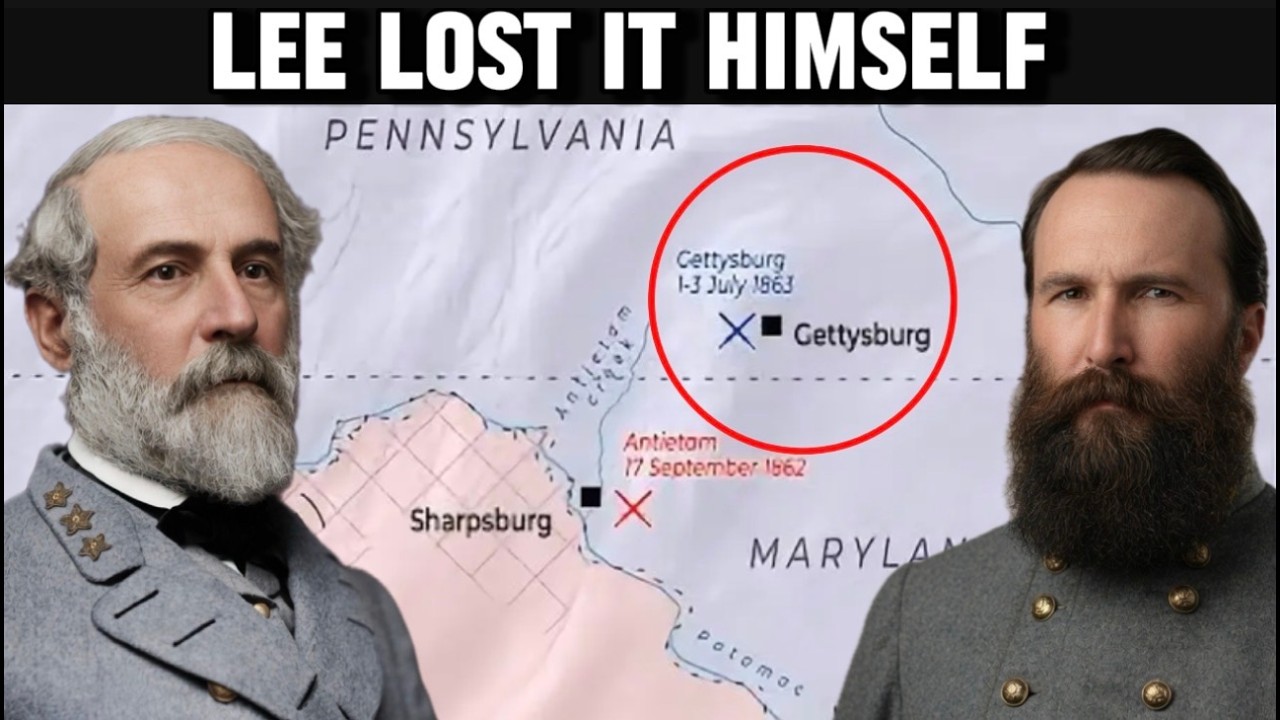
Lee fought a battle his army was never equipped to win. The roots of that overconfidence stretched back to Chancellorsville, perhaps the most audacious tactical performance of the war. There, Lee split his army in the face of a superior force, sending Stonewall Jackson on a flank march that should have failed. It worked, but partly because Union General Joseph Hooker lost his nerve at the critical moment, and partly because Jackson was still alive to execute the impossible.
The victory convinced Lee that his army could overcome disadvantages in men, materiel, and strategic position that would have paralyzed a more cautious commander. That belief was the first thing that killed them at Gettysburg. The army that marched north two months later was the same in name and spirit, but it had a hole in its command structure that no reorganization could fill. With Jackson dead, Lee split his army from two corps into three, promoting Richard Ewell to command Jackson’s old corps and keeping Longstreet in place at the head of the First Corps.
On paper, it looked rational, but in practice, it handed enormous operational responsibility to two men who had never commanded at that level. It sent them into unfamiliar territory against an enemy that had learned slowly but genuinely from every previous defeat. The battle itself began almost by accident. When A.
P. Hill’s corps stumbled into contact with Union cavalry west of Gettysburg on the morning of July 1st, it was not part of any deliberate plan. Henry Heth had sent brigades into town looking for shoes, a story so mundane it obscures how much it reveals about the disorganization of the Confederate advance. The greatest army in the Confederacy’s history blundered into the battle that would define its fate while looking for footwear.
By the evening of July 1st, the retreating Union soldiers were consolidating on Cemetery Hill and its adjacent ridges, high ground that any professional soldier would recognize as extraordinarily strong. Lee saw the opportunity and ordered Ewell to take the hill if practicable. But Ewell, whose discretionary instincts had been blunted by the loss of his leg and the weight of his new command, failed to press the attack. It was perhaps the single most consequential tactical decision of the entire battle, and it was not Longstreet’s failure.
The phrasing of Lee’s order was the same language he had used throughout the war with Jackson, who understood it as a strong expectation rather than a genuine option. But Jackson was gone, and the army’s shared vocabulary of aggressiveness had died with him. On July 2nd, Lee ordered Longstreet to attack the Union left. Longstreet had argued for a defensive posture, urging Lee to move around the Union flank and force them to attack, but Lee refused.
Longstreet’s assault was slow in getting underway, but it was a command failure that implicated every level of the Confederate chain of command. The attacks on the flanks on July 2nd and the center on July 3rd cost the Confederacy men it could not replace, produced no decisive result, and left the Union Army battered but intact on its heights. The infantry were asked to walk across open ground under artillery fire, cross fences, traverse the Emmitsburg Road, reform, and assault a defended stone wall at the crest of a ridge while being shot at from multiple directions. The moment historians call the high water mark was real, with Confederate soldiers standing inside the Union line for a matter of minutes before being shot down or captured.
But the breakthrough was never going to hold. The order for Pickett’s Charge was given, but no one had told Richard Anderson’s division, which was supposed to exploit any breakthrough, to do so with urgency. The cavalry failure compounded everything else, leaving Lee’s army blind in enemy country. The campaign to blame Longstreet began almost before the smoke had cleared.
Jubal Early, the man who had failed to take Cemetery Hill on July 1st, became the point man for a decades-long prosecution of Longstreet for crimes against the Confederacy. Early never forgave Longstreet for becoming a Republican after the war, for accepting a federal appointment from Ulysses Grant, and for refusing to perform the penitent role that Lost Cause mythology required. Longstreet spent the rest of his long life in a country that did not want to hear the truth, outliving almost everyone who had been his superior officer, and dying without ever fully clearing his name in the court of Southern public opinion. But clearing Longstreet is not the same as explaining Gettysburg.
The explanation requires sitting with an uncomfortable truth about one of the war’s most revered figures. Robert E. Lee attacked when he should have reconsidered. The battle was lost not because one man was slow, but because an army that had been running on audacity and brilliance had finally met an enemy it could not overcome.
Gettysburg was lost before Longstreet ever unlimbered his artillery on the afternoon of July 2nd. It was lost in the structural gaps of a reorganized army, in the absence of Jackson, in the failed cavalry, and most of all in the decision to fight an offensive battle at all, on ground chosen by the enemy, in a war the Confederacy was slowly and irreversibly losing. History does not offer a single villain whose removal would have changed the outcome.
It offers only the hard patient work of understanding how armies fight and why they fail.