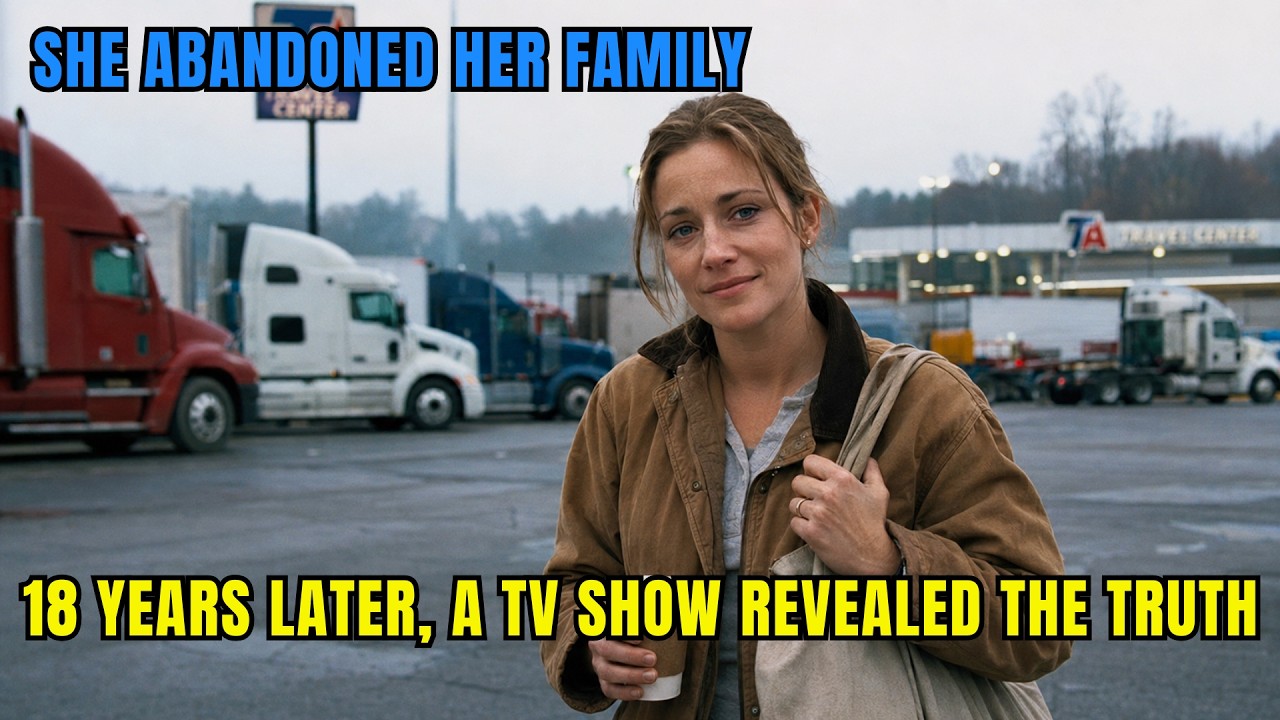
On September 13, 2003, the sky over Candler, North Carolina, was clear and bright, with late-summer sunlight spreading across Interstate 40, one of the busiest freight corridors in the eastern United States. Candler, on the western edge of Asheville, was a quiet, small community at the time, where truck stops, stores, and restaurants operated around the clock to serve long-haul drivers crossing the Appalachian Mountains. At the TA Travel Center, truck convoys moved constantly in and out of the parking lot, the sound of diesel engines mixing with air brakes and drivers' radios to create a noise no one paid attention to anymore.
Amid that rushing flow of people, a woman quietly stepped down from an old pickup truck, unaware, as others were, that it would be the last time anyone saw her. That woman was Rachel Mercer, 33, who had just been released from the Buncombe County jail after being arrested for driving under the influence. Under a court order, she was required to report to a substance abuse treatment center that same day.
Daniel Reed, the friend who had agreed to pick Rachel up after her release, drove her to the truck stop as a temporary solution because Rachel insisted she needed more time to think before starting treatment. Throughout the drive from Asheville to Candler, Rachel said almost nothing beyond a few terse words. When Daniel asked if she was sure about her decision, Rachel only looked out the window at the trucks lined up heading west, then answered quietly that she wanted to choose the next path of her life herself.
Daniel offered to stay a few extra minutes, but Rachel shook her head, took a small cloth bag containing some clothes and personal items, and stepped out of the vehicle. Daniel watched Rachel walk slowly across the parking lot crowded with trucks, pause in front of the truck stop restaurant area, look at the trucks leaving one by one, then fade behind a row of raised truck cabs. That was the last time anyone who knew Rachel Mercer saw her.
Daniel assumed she would call once she calmed down, so he drove away from Candler, completely unaware that he had just become the last witness in a disappearance that would last for years. By late afternoon, the treatment center called the family to say Rachel had never arrived to complete her intake paperwork. Margaret Mercer immediately called her daughter's phone, but got no answer, suggesting the phone was off. Claire Mercer drove to her sister's apartment in Asheville and found the room completely intact, with no sign that anyone had returned to collect additional belongings.
The mother and daughter kept calling friends, hospitals, and places Rachel used to frequent, but no one had seen her since that morning in the truck stop parking lot. As the clock ticked steadily toward midnight, worry turned into real terror. Margaret and Claire entered the Buncombe County Sheriff's Office and told the officer on duty that Rachel Mercer had disappeared after being dropped off at the TA Travel Center in Candler, pleading with police to begin a search immediately before all trace of her vanished, at 12:18 a.m. on September 14, 2003.
After Margaret Mercer reported her daughter missing at the Buncombe County Sheriff's Office in Asheville, the case file was immediately handed to Detective Samuel Hayes of the Criminal Investigations Division. Hayes opened his notebook and told his colleague, Detective Linda Brooks, "Our first priority is to determine precisely who saw Rachel last." Just a few hours later, Daniel Reed, the friend who had driven Rachel to the TA Travel Center in Candler, was asked to return and give a statement.
Hayes asked him to recount every detail in precise chronological order. Daniel said that on the morning of September 13, he met Rachel outside the Buncombe County jail after her release following her DUI arrest, where a court order required her to go to a substance abuse treatment center that day. But on the way, she suddenly changed her mind. Daniel clearly remembered the last question he asked her. I can take you to the center now. Rachel simply stared calmly toward the distant mountains and replied, "I need to decide my own life first."
At about 9:42 a.m., Daniel drove into the TA Travel Center parking lot. Rachel took her small cloth bag, declined his offer to wait, and walked toward the truck stop restaurant area. Daniel watched her pause for a few seconds to watch the semi-trucks preparing to leave the lot before she disappeared behind a row of trucks. That was the last time he saw Rachel Mercer.
To verify his account, Hayes asked Daniel to trace the entire driving route on a map and match it against the fuel receipt printed at 9:46 a.m. at the truck stop. The timestamps matched perfectly. Daniel's Ford F-150 was also booked for forensic examination. The forensics team examined the cab, the truck bed, and the entire interior, but found no signs of struggle, blood stains, or any evidence suggesting Rachel had been assaulted before getting out of the vehicle.
However, since Daniel remained the last person confirmed to have seen Rachel alive, Hayes asked him to undergo a polygraph test. Daniel agreed immediately. The test was conducted the following afternoon at the North Carolina State Bureau of Investigation office, and the results indicated no deception when he answered questions about Rachel.
Meanwhile, Margaret Mercer and her younger daughter Claire Mercer continued to provide information about Rachel's background. They told him Rachel had suffered from alcohol addiction for years, that her latest arrest was the biggest shock of her life, and that the whole family viewed the court-ordered treatment as a last chance to change the course of her life. After taking notes, Hayes spoke frankly. "We have to consider the possibility that Rachel left of her own free will. She is an adult and was under a lot of pressure."
Margaret shook her head immediately in rejection. She looked directly at the detective and replied, "Rachel might run away for a day or two when she feels desperate, but my daughter never disappeared without calling me. If she were free, she would have found a way to tell me she was okay." That response left Hayes silent for a few seconds. He realized the family was sensing something far more unusual than a routine runaway case.
By the end of September 14, after checking hospitals, shelters, and treatment centers without finding any trace of Rachel, the Buncombe County Sheriff's Office officially opened an active missing person investigation, issued a regional missing person bulletin to law enforcement agencies, and began an investigation no one expected to last nearly eight years.
On the morning of September 15, 2003, less than two days after Rachel Mercer's disappearance, Detective Samuel Hayes and Detective Linda Brooks returned to the TA Travel Center in Candler, hoping to retrace her last steps precisely. The parking lot buzzed with massive transport trucks flowing constantly to and from Interstate 40, making Hayes immediately realize how a place like this could swallow someone without leaving almost any trace.
Their first stop was the cashier's office inside the store. The morning shift employee, Melissa Grant, looked at Rachel's photo for a few seconds before nodding, confirming she had seen her on the morning of September 13. Melissa remembered Rachel entering the store around 9:45 a.m., buying a small cup of coffee, and standing for a few minutes by the window overlooking the parking lot. "She looked tired but fully alert," Melissa recounted. I thought she was waiting for someone, so I didn't pay extra attention.
When Hayes asked her which exit Rachel used to leave the store, Melissa only shook her head. The store was extremely busy that morning, forcing her to constantly serve customers, so she did not notice where Rachel went after taking her coffee. Afterward, investigators interviewed truck drivers who had been at the travel center that morning. After hours of combing through fuel receipt records, they found Robert Jenkins, a long-haul truck driver from Tennessee.
Robert remembered seeing Rachel standing near the area designated for trucks preparing to depart. According to him, Rachel appeared to be talking with a man wearing a dark blue jacket and a baseball cap. The two were standing about 30 meters from Robert's truck, so he could not hear their conversation. Robert said, "I just remember the man was pointing toward the trucks preparing to head west." I thought they knew each other, so I didn't think twice about it. When shown dozens of suspect photos, Robert could not identify the man. This became the first significant eyewitness account, but it remained entirely vague.
Hayes then requested all surveillance camera footage from the truck stop parking lot. The remaining tapes showed Rachel entering the store at 9:44 a.m., getting a cup of coffee, and exiting a few minutes later. However, once she left the main door, the camera angle was blocked by a row of trucks parked along the lane, and no camera captured her subsequent direction. One investigator sighed as he reviewed the video repeatedly. All we know is that she walked out the door. After that, it was as if she evaporated from the face of the earth.
Over the following days, the Buncombe County Sheriff's Office coordinated with the North Carolina Highway Patrol to inspect every truck that refueled at the TA Travel Center during the period Rachel was there. More than 100 drivers were contacted through payment records, shipping manifests, and parent companies. Many remembered seeing a woman standing alone in the parking lot, but no one confirmed giving Rachel a ride or seeing her get into any vehicle. A number of independent drivers left incomplete information, making it impossible for police to verify each driver individually, but every lead reached a dead end quickly.
While the official investigation faced obstacles, Rachel's family refused to wait in despair. Margaret Mercer and Claire Mercer printed thousands of flyers bearing Rachel's photo alongside the words "Missing: Rachel Mercer, last seen in Candler, North Carolina," and set out with friends to hang them along Interstate 40 at gas stations, roadside restaurants, bus stops, and stores from Asheville to Knoxville. Local television station WLOS broadcast the disappearance details in its evening news segment, urging anyone who had seen Rachel after the morning of September 13 to contact the Buncombe County Sheriff's Office.
The hotline phones rang constantly with tipster calls, but the vast majority turned out to be name mix-ups or unverifiable accounts. Every new lead was carefully examined by Hayes and then crossed off the list. After about a week of investigation, every trace of Rachel Mercer seemed to end at the TA Travel Center. There were no bank transactions, no phone calls, no further surveillance footage, and no witness who actually saw her leave Candler. Before investigators remained only an inexplicable void, as if Rachel had walked out of the store that morning and simply faded into the endless stream of trucks moving along Interstate 40.
By September 16, 2003, with three full days passing without finding Rachel Mercer, the Buncombe County Sheriff's Office decided to expand the search beyond the TA Travel Center to include the entire Candler area and the roads leading to Interstate 40. Detective Samuel Hayes coordinated with Lieutenant Mark Ellison, head of patrol operations, to divide the area into multiple small sectors for comprehensive searches. Search teams on foot combed open fields, drainage ditches, scattered wooded areas, abandoned parking lots, and side roads leading to the hills west of Asheville. Every location where someone could suffer an accidental injury, foul play, or forced abduction was mapped and searched thoroughly.
Hayes knew that if Rachel had been harmed shortly after leaving the truck stop, the likelihood of leaving evidence a few miles away was significant. That morning, the Buncombe County K-9 unit sent two dogs, Rex and Molly, to the scene. They were given Rachel's jacket to pick up her scent, and tracking began from the store exit. Initially, Rex followed the trail toward the transport truck area, but within minutes he began circling and lost the trail amid hundreds of overlapping scents from drivers and vehicles. Molly achieved a similar result, stopping near the ramp leading to Interstate 40 before completely failing to determine any other direction of travel.
The dog handlers explained that the massive traffic density and constant pedestrian movement had heavily contaminated the trail, making tracking practically useless. No clear path of movement could be determined. Meanwhile, investigators combed all motels, hotels, hospitals, emergency rooms, rehabilitation centers, and shelters in Asheville, Candler, and surrounding areas. Rachel's photo was shown to dozens of hotel managers, and medical staff were questioned about any unidentified females admitted after September 13, but the response was identical each time. No one remembered seeing her. There were no lodging records, no patients matching Rachel's physical description, and no unidentified women transferred to social assistance centers.
As the police search stalled, the local community rallied to support the Mercer family. That weekend, more than 200 volunteers gathered in a local church parking lot in Candler to split into small groups and distribute flyers. "Missing Rachel Mercer" posters appeared at gas stations, stores, post offices, supermarkets, and truck stops along Interstate 40. Several long-haul truck drivers even carried the flyers to Tennessee, South Carolina, and Georgia in hopes that someone would recognize her.
The sheriff's office hotline began receiving a flood of calls. One person claimed to have seen a woman resembling Rachel in Knoxville, Tennessee. Another insisted she had appeared in Greenville, South Carolina. There was even a call from Bristol, Virginia, saying Rachel was working at a roadside restaurant. Hayes sent investigators to verify each tip the same day, but they all led to completely different people. None of those reports related to Rachel Mercer. As the volume of false reports grew, her family's exhaustion grew from the endless swings of hope and disappointment.
To keep public attention alive, Margaret Mercer and Claire Mercer agreed to appear on the WLOS evening news on September 20, 2003. During the interview, Margaret held her daughter's photo and held back tears. Rachel, if you are watching this, please call home even once. I don't care what happened. I just want to know you are alive. Claire followed her mother, her voice trembling. If anyone sees my sister, even for a few minutes, please call the police. One small detail could save our entire family.
Following the broadcast, dozens of new calls poured in. However, the result remained unchanged. Throughout weeks of searching, the investigation team failed to find any personal item belonging to Rachel. No cloth bag, no clothes, no identification papers, no phone, not even a single item proving she had left the TA Travel Center area. The complete disappearance of an adult without leaving any physical trace made even veteran investigators feel something was profoundly abnormal.
By late September 2003, after hundreds of hours of searching, thousands of flyers distributed, and countless leads checked, the investigation remained stuck at zero. Rachel Mercer seemed to have evaporated from Candler without leaving a single clue about her destination or what happened to her, forcing law enforcement to move into a more difficult phase where hope diminished with each passing day.
In early November 2003, as Rachel Mercer's disappearance began fading from local news broadcasts and the investigation reached a dead end, the Buncombe County Sheriff's Office unexpectedly received a new missing person case. The person who disappeared was Megan Price, 21, who had previously worked part-time at a building materials store in Asheville, where Rachel Mercer had also worked a few years earlier. According to her family, Megan left her apartment on the evening of November 6 to meet her boyfriend and never returned. Her car was found the next morning in a shopping center parking lot in south Asheville, doors closed but her bag and phone missing.
The case was initially assigned to Detective Samuel Hayes because he was still heading the Rachel Mercer case. When reviewing Megan's personal network, investigators discovered she had been in an on-and-off relationship for about a year with Travis Boone, 34, an industrial equipment mechanic living in Hendersonville. Megan's friends described Travis as quick-tempered, controlling, and someone who had repeatedly threatened her after their breakup. A friend named Ashley Collins told police. Megan once said, "If I ever disappear, look for Travis first."
That statement immediately caught Hayes's attention. Travis's file was quickly pulled for review. Investigators discovered he had been detained by police several times on charges of domestic violence and disorderly conduct, though he had never been convicted due to lack of evidence. More importantly, in 1996, Travis was investigated in connection with the murder of Lillian Harper, a 27-year-old woman found dead near a wooded area in Henderson County. At the time, Travis was the last person seen with Lillian, but forensic evidence was not strong enough, forcing authorities to close the file without filing charges.
Hayes immediately requested the entire 1996 case file for careful re-examination. As investigators placed the Rachel and Megan files side by side, several striking similarities began to emerge. Both were young women. Both disappeared without leaving almost any trace. Neither conducted any financial transactions or communications after their disappearances, and both worked in the exact same area of Asheville. Although there was no direct evidence that the two women knew each other well, the fact that Megan was a former coworker of Rachel made the possibility of a connection seem more than coincidence.
Hayes stated during an investigative briefing, "If these are not two separate incidents, then we are dealing with a much more dangerous suspect." News of Megan quickly reached the Mercer family. Margaret Mercer hoped the emergence of a new victim would help police solve the mystery of Rachel's disappearance. She told Hayes after a meeting, "If there is someone behind both cases, please don't let another family go through our painful waiting."
Meanwhile, local media began strongly questioning whether a predator targeting young women was operating in western North Carolina. WLOS TV and the Asheville Citizen-Times repeatedly highlighted the similarities between the two disappearances, escalating public concern. Under increasing pressure, police summoned Travis Boone for questioning. During the interrogation on November 12, 2003, Travis admitted dating Megan but insisted he had not seen her for weeks before her disappearance. When Hayes placed Rachel Mercer's photo on the table and asked if he knew her, Travis glanced at it for a few seconds before answering firmly. I never met her. I don't know who she is.
Over hours of questioning, Travis maintained his account and denied any involvement in the disappearances of Rachel or Megan. Given the lack of strong physical evidence to hold him, police had to let Travis leave after obtaining voluntary samples of his fingerprints and DNA. However, from that moment on, the course of the investigation changed significantly. Instead of pursuing the hypothesis that Rachel left voluntarily, the Buncombe County Sheriff's Office officially prioritized the possibility of a criminal suspect, and Travis Boone's name rose to the top of the persons of interest list.
Following the initial interrogation of Travis Boone, Detective Samuel Hayes and Detective Linda Brooks decided to devote their full resources to investigating this man's past. North Carolina State Bureau of Investigation records revealed that Travis, 34, lived alone in a mobile home in Hendersonville and had been arrested several times on charges of assault, threatening others, and disorderly conduct, though all charges ended in minor fines or were dropped when victims refused to cooperate.
The 1996 murder of Lillian Harper remained the most notable. At the time, Travis was the last person seen with Lillian before her body was found near a forest in Henderson County. But forensic techniques then were insufficient to file formal charges. On November 14, 2003, after obtaining a judicial warrant, police conducted a comprehensive search of Travis's residence. Investigators seized clothing, shoes, a personal computer, numerous boxes of documents, and a black Chevrolet Silverado truck. Travis drove it regularly.
The forensics team used blood detection reagents to examine the truck's cab, bed, and garage, collecting hair, fiber, and multiple DNA samples for testing. Police also dug several areas in the backyard that appeared to have been recently excavated, after neighbors reported seeing Travis digging there in late September. However, the results produced no breakthrough in the case. No blood stains belonging to Rachel Mercer were found. None of her personal belongings were found, and no physical evidence emerged proving Rachel had been present at that property.
Hayes continued matching Travis's statements with previously interviewed witnesses. Travis insisted that on the morning of September 13, 2003, the time Rachel disappeared, he was working at Blue Ridge Industrial Equipment, a machine repair shop in Hendersonville. Investigators seized time cards and delivery receipts, and interviewed the shop foreman Michael Dawson along with several coworkers. Records indicated Travis clocked in at the shop around 7:10 a.m., but shortly before 10:00 a.m., he left the premises for approximately an hour, claiming he was buying spare parts.
When Hayes asked why there were no purchase receipts for that period, Travis explained the store lacked the parts, so he returned empty-handed. Some coworkers confirmed Travis left the shop, but no one knew exactly where he was. This uncertain time coincided with Rachel's appearance at the TA Travel Center, prompting Hayes's intensive scrutiny, although the distance between Hendersonville and Candler was not enough to definitively place Travis at the scene.
At the same time, police continued analyzing the relationship between Travis and Megan Price. Megan's friends provided archived text messages showing Travis was calling and messaging frequently and trying to reconcile with her after their breakup. A friend named Ashley Collins testified that Megan was terrified of Travis because he lost his temper badly when rejected. However, this data only served to strengthen suspicions in Megan's disappearance case, rather than proving a direct link to Rachel.
Hayes repeatedly reviewed the statement of truck driver Robert Jenkins, who reported seeing Rachel talking with a man in the truck parking lot, but Robert could not definitively identify Travis when shown his photo. Similarly, surveillance cameras failed to capture the mysterious man's face. After about three weeks of continuous investigation, forensic laboratories began submitting their analysis reports one by one. No DNA, fingerprints, or biological traces belonging to Rachel were found in Travis Boone's home or truck.
Despite his inner feeling that Travis was hiding something, Hayes had to admit to his superiors that there was not enough direct evidence to charge or arrest him. Meanwhile, another report was officially completed. After cross-referencing all statements, polygraph results, phone records, travel timelines, and forensic examination of his pickup truck, Daniel Reed was officially cleared from the list of main suspects in Rachel Mercer's disappearance. From that moment, Daniel was treated only as the last witness who saw Rachel alive.
By late November 2003, the investigation reached a dead end. Travis Boone remained the main person of interest, but could not be prosecuted without evidence, while Rachel Mercer seemed to have evaporated without leaving any physical trace. The deeper the investigation went, the wider the gap between suspicion and proof grew, plunging the case into its first long stalemate.
As December 2003 arrived, and with the investigation yielding no new evidence, Detective Samuel Hayes was forced to expand verification outside North Carolina. Every hotline call was logged as an individual record, even if it was just a vague claim that someone had seen a woman resembling Rachel. During the first three months, police received more than 100 reports from Tennessee, South Carolina, Georgia, Virginia, and even Florida.
One caller claimed Rachel was working as a waitress at a restaurant in Knoxville. Another claimed she appeared at a shelter in Greenville, while a truck driver believed he had driven her to the outskirts of Atlanta. Hayes sent investigators to contact local police, requesting cross-checks of detainee photos, witness statements, and surveillance footage if still preserved. The results were all similar. The person seen was not Rachel Mercer.
Refusing to miss any chance, Margaret Mercer and Claire Mercer frequently drove hundreds of miles themselves to verify leads they thought might be real. The mother and daughter once traveled to Knoxville just because a store employee insisted he had spoken with Rachel, then continued on to Greenville after receiving an anonymous late-night phone call. Each trip ended in disappointment when the reported woman turned out to be someone who merely resembled Rachel.
Yet Margaret never gave up. She always carried a stack of her daughter's photos, asking everyone she met, "Have you seen this girl?" Most simply shook their heads. Meanwhile, another painful task was quietly underway in the background. Whenever an unidentified woman's body was found in North Carolina or neighboring states matching Rachel's age description, the Buncombe County Sheriff's Office received notification. Hayes was repeatedly forced to call Margaret to request DNA samples or ask the family to review physical characteristics for identification.
Throughout 2004, Rachel's DNA was matched against records of several unidentified bodies in Tennessee, Georgia, and South Carolina. On one occasion, a body was found near the Virginia state line, giving the entire investigation team hope they would finally find an answer. But subsequent laboratory results confirmed the victim was another woman who had disappeared months earlier. Each time this happened, Margaret felt relief that her daughter was not among the unidentified victims, and agony because it meant Rachel had left no trace behind.
By mid-2004, every DNA comparison result gave the same answer. No match. Meanwhile, media attention began to wane. News reports that had appeared almost weekly on WLOS TV were now only aired when the family organized search efforts or on the anniversary of Rachel's disappearance. Local newspapers moved on to cover new crimes, and Rachel's photo gradually faded from front pages.
Hayes realized this was a common path in long-term missing person cases, but he also knew it meant the chances of getting new witnesses were shrinking day by day. The hotline that once received dozens of calls each week now went through days of complete silence. Occasionally, someone still called after seeing an old poster, but most were unverifiable information or name mix-ups.
During an investigation meeting in September 2004, Hayes spread maps, reports, and crime scene photos on the table, then said quietly to Linda Brooks, "If Rachel were still alive and wanted to reach out, we would have received some kind of signal by now." Linda did not answer immediately. She just stared at Rachel's photo and asked in a low voice, "Do you think she is dead?" Hayes was silent for a few seconds before replying, "I hope I am wrong." "But the more time passes without bank transactions, phone calls, medical records, or employment, and without anyone reliably seeing her, the lower the probability that Rachel is still alive."
That was the first time the lead detective in the case admitted to a colleague that he was beginning to believe Rachel might have become a murder victim. However, this belief was not supported by any physical evidence. There was no body, no crime scene, no weapon, and no reliable eyewitness. Travis Boone remained on the suspect list, but he could not be convicted on mere intuition.
By late 2004, after thousands of hours of searching, hundreds of verifications, and countless leads that faded one after another, there were no new avenues left to explore in Rachel Mercer's file. The investigation remained open, but everyone realized the case was approaching a dead end, where the files of many other missing persons had faded into oblivion over the years.
In early March 2006, when news of Rachel Mercer's disappearance had almost vanished from news reports and was only raised during periodic briefings at the Buncombe County Sheriff's Office, an envelope with no return address suddenly arrived at Detective Samuel Hayes's office. Inside was only a scrap of paper torn from an ordinary notebook bearing a brief typewritten message. Stop looking for Rachel in Asheville. She is dead. Check the area north of Lake Oeola near Hendersonville. You will find the truth.
There was no signature, no clear fingerprints, and the postmark indicated only that the letter had been sent from a public mailbox in Greenville, South Carolina two days earlier. Hayes immediately referred the letter to the document analysis unit and called a meeting with Detective Linda Brooks, Lieutenant Mark Ellison, and representatives from the North Carolina State Bureau of Investigation. Although many investigators suspected it was just a cruel hoax, Hayes decided it could not be ignored because it was the first tangible lead after more than two years of stalemate.
On the morning of March 10, 2006, more than 40 police officers along with search and rescue personnel from the Henderson County Sheriff's Office were deployed to the area north of Lake Oeola, exactly as described in the letter. The search team used police dogs, metal detectors, ground-penetrating radar, and various specialized equipment to divide the terrain into small sectors and survey every meter of ground. Hayes managed the site operations himself while Linda Brooks recorded every searched location on a map.
Upon learning the search was underway, Margaret Mercer and Claire Mercer also arrived at the scene. The mother and daughter stood behind the police cordon from early morning until late afternoon, silently watching every shovel strike by the search teams. Margaret clutched an old photo of Rachel so tightly that its corners wrinkled, and whispered to Hayes as he passed, "If my girl is here, please bring her back to us." Hayes simply nodded, not daring to make any promises while he himself did not know whether this search would lead to answers.
Over the next two days, search teams uncovered multiple sites showing signs of soil disturbed years earlier. Each time, the area was cordoned off for forensic teams to excavate carefully. One pit contained the decomposed body of a deer. Another area yielded rusty metal pieces and old construction debris. Near the lake shore, searchers found several small bone fragments that halted work at the entire site for hours. However, subsequent forensic analysis confirmed they were all animal bones.
Old plastic bags, torn clothing, and various household items seized also proved unrelated to Rachel Mercer. After about three days of continuous work, the area specified in the letter was fully examined without finding a body, biological traces, or any of Rachel's personal belongings. The result cast a pall of gloom over the place. Margaret broke down crying when Hayes told her the search had ended without significant discoveries. Hayes said gently, "At least we checked that location." If there was anything related to Rachel, we would not have missed it.
After the search ended, forensic experts continued analyzing the anonymous letter. They failed to recover any usable DNA. Fingerprints had been completely wiped, and the paper and ink were common commercial products widely sold on the market. Investigators traced the postmark and reviewed surveillance footage around the Greenville mailbox, but the video had long been erased. No witness remembered seeing the person who sent the letter. Hayes also re-evaluated individuals previously connected to the case, including Travis Boone, but there was no evidence proving he wrote the letter.
Ultimately, the letter was filed as an unconfirmed lead. The letter did not help find Rachel Mercer, nor did it identify the perpetrator, but it raised another major question in the investigation. Who knew about the area near Lake Oeola? And why did they assert that Rachel had been killed? With no answers to these questions, the anonymous letter became a new mystery, wrapping Rachel Mercer's disappearance in another layer of doubt and confusion.
By late 2006, after more than three years of tracking Rachel Mercer's disappearance, Detective Samuel Hayes decided to conduct a comprehensive review before recommending next steps. For several consecutive weeks, he and Detective Linda Brooks reviewed every interview transcript, every forensic report, every tape of surveillance footage, every hotline call, and hundreds of pages of documents collected since September 13, 2003. They reconstructed Rachel's complete timeline from the moment she left the Buncombe County detention center, rode in the truck with Daniel Reed, appeared at the TA Travel Center in Candler, and then disappeared just minutes later.
Hayes requested that all timestamps be matched against data collected over the past three years to ensure no detail was overlooked. However, the results remained unchanged. Every working hypothesis previously proposed had been systematically disproven. The theory that Rachel voluntarily fled to avoid the court-ordered treatment program was no longer convincing, as she had not used a credit card, bank account, or Social Security number for years. The theory that she ran away with an acquaintance also lacked basis, as no contact was detected before or after her disappearance date.
The possibility that Rachel suffered an accident and remained undiscovered was effectively ruled out after multiple intensive searches around Candler and surrounding areas. Even the hypothesis that Travis Boone abducted or killed Rachel could not advance further, because every search failed to find direct evidence. Hayes once said in an internal meeting, "We have plenty of suspicions, but suspicion cannot replace evidence."
Throughout 2006, the sheriff's office received virtually no new reliable witnesses. Everyone who called to report seeing Rachel was verified and ruled out. Not one person could confirm seeing her after that morning at the TA Travel Center. Employees who used to work at the truck stop remembered no additional details beyond the statements they had given three years earlier.
The investigation team continued sending inquiry requests to banks, tax agencies, the Social Security Administration, hospitals, and driver's license offices across multiple states in hopes that Rachel had used her real identity somewhere. The responses received matched previous attempts. There were no new financial transactions, no employment records, no tax filings, no applications for alternative identification, and no legal activity whatsoever under the name Rachel Mercer since September 2003.
Communications data analysts also confirmed that Rachel's cell phone registered no further signal after the day of her disappearance. No outgoing calls, no incoming calls, no cell tower signals. The phone appeared to have been turned off or destroyed that same day. What worried Hayes more was that after dozens of searches, multiple crime scene excavations, and endless DNA matches with unidentified bodies across the southeastern United States, law enforcement still had not found Rachel's body or any personal belongings that could confirm her fate.
There was no crime scene, no biological evidence, and insufficient physical proof to move the case to criminal prosecution. With investigative leads exhausted, Rachel's family also began sliding toward despair. Margaret Mercer kept her daughter's room as it was and kept the landline phone in the living room. She clung to the hope that Rachel would call home someday. But with each passing year, that hope diminished.
Claire Mercer continued attending missing persons memorials and distributing her sister's photo whenever possible, even while admitting to herself that fewer and fewer people still remembered the case. Hayes visited the family multiple times to provide updates. But he no longer had any positive news to share. During one meeting with Margaret in November 2006, she asked in a low voice, "Are you still looking for my daughter?" Hayes looked at the mother, who appeared noticeably older over three years, and replied, "Honestly, we never stopped." We just no longer know where we can search anymore.
In early 2007, after evaluating the entire case file and confirming there were no actionable investigative leads, the Buncombe County Sheriff's Office began procedures to classify Rachel Mercer's disappearance as a cold case, hoping that a new piece of evidence or future technological developments would break the silence that had lasted for years.
In early February 2007, after more than three and a half years of investigation that yielded no new evidence, the Buncombe County Sheriff's Office officially transferred Rachel Mercer's file to cold case status according to protocol for long-term missing persons cases lacking actionable leads. The decision was made during a meeting chaired by Captain Richard Coleman, attended by Detective Samuel Hayes, Detective Linda Brooks, and representatives from the North Carolina State Bureau of Investigation.
Hayes presented a summary of dozens of pages, listing everything law enforcement had carried out since September 2003. Hundreds of witness statements were taken, multiple search warrants executed, extensive searches conducted, thousands of vehicles audited, DNA tests run against unidentified remains, all financial records verified, and hundreds of citizen reports investigated. The final result remained unchanged. There was no evidence proving Rachel was alive, and no evidence proving she was killed.
After the meeting, Hayes carefully packed the entire investigation file into multiple storage boxes, from crime scene maps, photos of the TA Travel Center, forensic reports, Daniel Reed's statements, Travis Boone's file, a copy of the anonymous letter, to hundreds of witness verification reports. He signed the papers transferring the file to the sheriff's office cold case unit, then stood silently in front of the archive shelves for a few seconds. Hayes whispered to Linda Brooks, "The only hope I have is that someone someday will come and reopen these boxes."
Despite the file being transferred to cold case status, the Mercer family never considered it over. Margaret Mercer kept Rachel's old phone number active, refrained from canceling her daughter's apartment lease for several months, and lit a candle in front of her picture in the living room every birthday. Claire Mercer continued managing missing persons awareness pages, sent Rachel's photo to family support organizations, and regularly called Hayes to ask if there was any news. Each time, Hayes had to give the exact same answer. We still have no new leads.
According to Buncombe County Sheriff's Office procedures, Rachel's case was subject to periodic annual review. During these reviews, investigators matched DNA databases, evaluated newly discovered unidentified bodies, reviewed emerging criminal records, and assessed whether new forensic technologies might help. However, from 2007 to 2010, every periodic review report ended with a brief line: No new findings. Hotline communications nearly ceased entirely. Rachel's missing posters on roadside billboards faded before being removed one by one, and local media stopped mentioning the case outside unresolved missing persons lists.
For the vast majority of Asheville and Candler residents, Rachel Mercer's name gradually faded into oblivion with time. Only her family and a few investigators directly involved in the case still clearly remembered the morning of September 13, 2003, when a woman stepped out of a car at the TA Travel Center and disappeared without a trace into the archives of the Buncombe County Sheriff's Office. The storage boxes bearing Rachel Mercer's name sat silently on steel shelves, waiting for new evidence or an opportunity no one then knew would come after many long years.
In the years following the transfer of Rachel Mercer's file to cold case status, life for the Mercer family seemed to move forward, but it never truly returned to normal. Margaret Mercer kept the cell phone number Rachel had used the day before her disappearance. Although the service provider repeatedly notified her that the line would be disconnected due to inactivity, she paid the fees regularly to maintain it, hoping her daughter would someday remember the old number and call home. Whenever the phone rang, Margaret flinched and looked at the screen before realizing it was just a call from friends or relatives.

In Rachel's bedroom, everything remained exactly as it was on the last morning she left home. Photos on the shelf, the jacket hanging behind the door, and some novels she had been reading stayed in their exact places. Margaret did not allow anyone to clean the room because she firmly believed her daughter would need a place to return to. Claire Mercer lived on the same hope. After her sister's disappearance, Claire repeatedly refused job opportunities to move to another state, fearing that if Rachel suddenly returned, the family would not be together.
Whenever a new lead appeared, no matter how small, Claire was always the first to call the Buncombe County Sheriff's Office to ask whether police had investigated it. She kept every old news clipping about Rachel in a cardboard box stored under her bed, taking them out to read from time to time, as if keeping those memories alive would prevent her sister from being forgotten. For the Mercer family, the year-end holidays were always the most difficult period. Every Thanksgiving, Christmas, or Rachel's birthday, Margaret still set an extra place at the dinner table. Rachel's chair always remained empty. No one had sat in it for years.
When friends advised her to accept reality in order to move on with her life, Margaret would only reply gently, "I don't know if my daughter is alive or dead. As long as there is no answer, I will keep a place for her." Those words frequently made the family fall completely silent during meals. Over time, those who knew Rachel began to view the case differently. Many former coworkers believed the possibility of her being alive had completely faded. Some considered her deceased in their hearts, though no one dared to say those words in front of Margaret. Her name was rarely mentioned at class reunions or gatherings among friends. Everyone's lives continued to evolve, while Rachel's disappearance gradually became a sad memory of the past.
Only the Mercer family remained unable to let go. They continued participating in missing persons family programs, resending Rachel's photo whenever national search campaigns occurred, and regularly contacting Detective Samuel Hayes on every anniversary of her disappearance. Hayes always found time to meet them. Although he had no new information, he realized that what the family sometimes needed was not an answer, but simply knowing that someone out there had not given up on Rachel.
As the years passed quietly, the Mercer family's hope grew weaker than ever. Yet none of them accepted closing the chapter. For Margaret and Claire, Rachel Mercer was not just a name inside a cold case file. She remained a daughter and sister who might knock on the door and come home on any afternoon, even if that miracle seemed increasingly distant with each passing year.
In early 2018, as next-generation DNA analysis technology began being widely adopted at the North Carolina crime laboratory, several unsolved murder cases in the state were selected for re-examination using more advanced methods. Among them was the 1996 murder of Lillian Harper in Henderson County, a case investigated with Travis Boone but never prosecuted due to lack of evidence.
At the request of the North Carolina State Bureau of Investigation's cold case unit, all evidence that had remained sealed for more than 20 years was submitted, including the victim's clothing, hair samples, fabric fibers, and biological samples collected from the crime scene, for re-analysis using DNA extraction techniques far more sensitive than those of the 1990s. Detective Maya Collins, newly assigned to oversee major cold cases, personally monitored the process alongside forensic expert Dr. Kevin Marshall.
After weeks of testing, the laboratory announced it had successfully recovered a complete DNA profile from a portion of the evidence previously believed insufficient for analysis. The new DNA profile was entered into the state database and quickly showed a match to Travis Boone, who had voluntarily provided a biological sample during the 2003 investigation into Megan Price's disappearance. For the first time in more than two decades, investigators had direct forensic evidence linking Travis to Lillian Harper's murder.
On April 18, 2018, Travis Boone was summoned for additional questioning. Confronted with the new forensic results, he continued to deny any involvement, claiming the presence of his DNA on the evidence was merely a result of his acquaintance with the victim. However, the cold case unit decided the new evidence was strong enough to reopen the full investigation with Travis. Meanwhile, while reviewing all missing persons or unsolved murder files in which his name appeared during previous investigations, Maya Collins ordered the creation of a master list of files with similar timing, location, or victims, including the disappearances of Rachel Mercer and Megan Price.
When re-reading the thick file labeled "Rachel," Collins noticed several details previously considered hopeless but now appearing far more significant. Rachel disappeared without a trace just minutes after appearing at the TA Travel Center. Megan had been in a romantic relationship with Travis Boone, and Travis himself was the former suspect in the Lillian Harper case. Although there was no evidence proving Travis met Rachel before her disappearance, the emergence of DNA evidence in the 1996 case forced a comprehensive reassessment of the threat level this man posed.
Collins stated in a briefing to the cold case unit. If Travis can be linked to a murder we could not prove for more than 20 years, "we have no reason to ignore the other files in which his name appeared." Under the unit's direction, Rachel Mercer's file was officially placed back on the priority review list. Investigators began digitizing all archived documents, re-analyzing witness statements, evaluating forensic findings using modern technology, and re-examining every lead previously discarded due to analytical limitations.
In 2018, news of the reopened investigation into Lillian Harper's murder quickly reached the Mercer family. Margaret Mercer received a phone call from Maya Collins in late April 2018. Collins made no promises of finding Rachel, but assured her that her daughter's file would be reviewed from scratch using all available resources and technologies. After years of near-total despair, this was the first time the Mercer family heard a detective say that Rachel's disappearance case was no longer just a neglected file on an archive shelf. The investigation officially entered a new chapter, opening the first real opportunity in more than a decade to find answers to a mystery that had dragged on far too long.
In early June 2018, after the cold case unit decided to reopen Rachel Mercer's disappearance, the file was officially assigned to Detective Rebecca Sloan, an experienced investigator in handling stalled missing persons cases. Unlike the original investigation, which faced pressure to find answers in its early days, Sloan chose to start almost from scratch. She hung a large board on her office wall with every timeline entry for September 13, 2003, in sequence. From the moment Rachel left the Buncombe County detention center, the phone call to Daniel Reed, the drive to the TA Travel Center in Candler, the time she bought a cup of coffee, to her final minutes before disappearing, Sloan told her partner Detective Eric Malone, "Let's find what we missed. We have to forget all the old assumptions."
Over the following weeks, she re-read every statement, every note written in Detective Samuel Hayes's handwriting, every crime scene report, and every criminal record collected since 2003. Not a single document was ignored. Sloan also decided to re-interview the original witnesses after 15 years. The first was Daniel Reed, now married and living in Hickory. Daniel recounted the same story he had told many times before. Rachel remained silent the whole way, refused to go to the treatment center, got out of the truck carrying a small cloth bag, and walked toward the truck parking area.
When Sloan asked if there was any detail he had hesitated to mention before or forgotten, Daniel shook his head. If I remembered anything else, I would have said it long ago. I still blame myself for not staying a few extra minutes. Sloan found no contradictions in Daniel's statement and again confirmed he was merely the last witness to see Rachel alive.
Sloan then sought out Melissa Grant, the cashier who sold Rachel coffee at the TA Travel Center. After 15 years, Melissa remembered few details beyond the fact that Rachel looked tired but calm. Long-haul driver Robert Jenkins, who once saw Rachel talking with a strange man near the semi-truck area, was also re-interviewed. However, his memory had faded over time. Robert remained unable to identify the man and was no longer sure whether he had actually seen them talking or whether they were just standing near each other. Sloan noted that although this statement retained reference value, it lacked sufficient reliability to serve as evidence.
Alongside the witness re-interviews, the cold case unit began leveraging federal databases that had not been fully interconnected. In 2003, Rebecca Sloan submitted requests for cross-checks of Rachel Mercer's information through the National Crime Information Center, the NamUs system, the Social Security database, the FBI, the Department of Homeland Security, and several nationwide identity record systems. Her goal was to determine whether Rachel had used her real identity at any time to apply for a job, receive medical treatment, apply for a passport, be arrested, or appear in any administrative record after her disappearance date.
The results obtained after weeks of screening were completely negative. Rachel Mercer appeared to have ceased existing in any system since the morning of September 13, 2003. Sloan then moved to auditing all unidentified remains files discovered from 2003 through 2018. Hundreds of cases across the United States were placed on a list for comparison based on Rachel's age, height, physical characteristics, and DNA. A number of files initially showed similarities, but after deeper analysis, all were ruled out. No unidentified body was identified as Rachel Mercer.
After nearly four months of re-investigation, Rebecca Sloan was forced to admit to her superiors that despite a comprehensive review of the file using modern technology, it still lacked a crucial link. There was no new physical evidence at the scene, no new witnesses, no electronic data, no direct forensic evidence, and no indication whether Rachel was alive or dead. In her report submitted to the cold case unit at the end of September 2018, Sloan wrote that the case remained completely trapped in the same void that had persisted for 15 years. What happened to Rachel Mercer just minutes after she walked out the door of the TA Travel Center store? Without the emergence of a completely new source of information, the investigation would continue to stand before a wall that multiple generations of previous investigators had failed to overcome.
In early 2019, the cold case unit's investigation saw a sudden and major turning point when the North Carolina crime laboratory completed forensic testing on several preserved pieces of evidence from Megan Price's 2003 disappearance. In previous years, DNA samples extracted from Megan's car and personal belongings were too minimal to create a complete profile. However, using new DNA extraction and amplification techniques, forensic experts were able to recover a biological sample of sufficient quality from the car's interior door panel.
Cross-matching revealed that the DNA sample belonged to Travis Boone, who had previously claimed he had not gone near Megan's car after their breakup. This discovery immediately changed the entire course of the investigation. Detective Rebecca Sloan and Detective Eric Malone quickly called a meeting with representatives from the North Carolina State Bureau of Investigation, the Henderson County District Attorney's Office, and the original investigators on Megan's case file.
Sloan presented the full new chain of evidence, highlighting the fact that Travis lied about his connection to Megan's car. At the district attorney's request, investigators began auditing phone records, financial files, and statements from people who had dealings with Travis during Megan's disappearance. A previous witness, Ashley Collins, agreed to submit her phone again, which contained numerous old text messages that had not been fully extracted before. Among them were multiple messages in which Travis repeatedly threatened Megan after she ended their relationship. The message contents did not include direct confessions to a crime, but they clearly demonstrated Travis's obsession and controlling behavior toward his ex-girlfriend.
At approximately the same time, a former resident who had lived near Travis's home in Hendersonville contacted the cold case unit on his own initiative after learning the case had been reopened. This person stated that in late November 2003, he saw Travis driving his car toward an isolated area near a forest road several times late at night, though he did not think it unusual at the time. This information prompted law enforcement to obtain a search warrant for the mentioned area. After several days of using ground-penetrating radar and excavation work, the forensic team discovered human remains of a female buried at a depth of about one meter.
DNA identification later confirmed the victim was indeed Megan Price, who had been missing for more than 15 years. Autopsy results indicated Megan was killed very shortly after her disappearance and buried to conceal the crime. This constituted the biggest breakthrough ever since the cold case unit was established. With Travis's DNA inside the car, new witness statements, the victim's history of being threatened, and the discovery of Megan's remains in an area associated with him, investigators officially classified Travis Boone as the prime suspect in the murder.
On August 22, 2019, Travis was arrested and taken to the Henderson County Sheriff's Office for questioning. When confronted with the array of new evidence, he continued to deny all allegations, insisting he was the victim of a biased investigation. However, this time, investigators were not relying solely on suspicions as they had 15 years earlier. District Attorney Helen Ward began preparing an indictment file spanning hundreds of pages, combining DNA analysis results, witness statements, Travis's prior history of violence, and the complete timeline of his relationship with Megan.
In a briefing with the investigation team, Helen Ward emphasized, "We will prosecute based on what can be proven in court, not based on hunches." Although Travis's arrest generated significant hope for the Mercer family, Rebecca Sloan insisted on keeping Rachel's case separate from Megan's file. She explained that up to that moment, no forensic evidence existed proving Travis met Rachel, let alone any evidence confirming her death. No DNA belonging to Rachel was found in Travis's home, car, or locations associated with him. No eyewitnesses saw the two together. There was no body, no crime scene, and no direct physical evidence.
Sloan told Margaret Mercer during a meeting in late August, "The fact that Travis is being tried in Megan's case does not mean we know what happened to Rachel." We will not state what the evidence cannot prove. Margaret nodded silently. After 16 years of waiting, she realized that a suspect finally facing justice was good news. Yet it still could not answer her family's most important question. Rachel Mercer remained legally missing. There was no death certificate, no conclusion about the cause of her disappearance, and no evidence confirming she fell victim to Travis Boone or anyone else.
While prosecutors focused on preparing for Travis's trial for Megan Price's murder, Rachel Mercer's file remained open, waiting for new evidence that might fill the largest remaining gap in an investigation that had spanned 16 years.
On the morning of August 22, 2019, after months of assembling evidence in the Megan Price murder case, Judge William Harper of the Henderson County Superior Court signed an arrest warrant for Travis Boone on charges of first-degree murder and concealment of a human body. Just hours later, special agents from the North Carolina State Bureau of Investigation, in cooperation with the Henderson County Sheriff's Office, carried out a tactical arrest at Travis's mobile home on the outskirts of Hendersonville.
At exactly 6:05 a.m., several police cars gathered outside the residence while investigators quickly secured the perimeter. Travis emerged from the door several minutes after receiving instructions to surrender. He showed no physical resistance but repeatedly insisted on his innocence. As one investigator read the arrest warrant, Travis merely replied briefly, "You are arresting the wrong man." After being handcuffed and placed in a patrol car, Travis was taken directly to the Henderson County Detention Center to await questioning.
That morning, Detective Rebecca Sloan and Detective Eric Malone conducted the first post-arrest interrogation of Travis. They systematically presented the DNA test results, witness statements, and threatening text messages sent to Megan that were recovered from Ashley Collins's old phone. Travis refused to answer most questions, repeatedly demanded a lawyer, and continued to deny any connection to Megan's murder. Sloan did not try to force a confession. She realized the most important objective was to use the recently court-approved search warrant to examine Travis's property fully one last time.
In previous years, this residence had been searched, but forensic technology at the time was limited. This time, the investigation team brought advanced equipment along with experts from the North Carolina State Crime Laboratory. Every room was photographed, measured, and re-examined from scratch. Investigators dismantled parts of the wooden floor in the garage, inspected drainage systems, tool storage areas, and the shed behind the yard. Travis's black Chevrolet Silverado was also impounded for a second forensic examination using new biological trace detection methods.
During the search, police seized additional physical evidence related to Megan's case, including several digging tools, old clothing stored in the shed, multiple digital storage devices, and dozens of personal notebooks. Some items were immediately transported to the laboratory for DNA and trace analysis. Rebecca Sloan also requested a full audit of all seized computers, hard drives, and old phones to determine whether Travis had ever searched for information related to Rachel Mercer or contacted her before her disappearance.
However, despite conducting the search far more thoroughly than any previous attempt, investigators failed to find personal items, DNA, or any direct evidence linking Travis to Rachel. This meant her disappearance still could not be legally linked to Travis. Nevertheless, news of Travis Boone's arrest spread quickly throughout North Carolina and appeared prominently in major American media. The Associated Press, ABC News, and several regional newspapers simultaneously reported that a suspect in a mysterious case more than 15 years old had finally been arrested thanks to modern DNA technology.
In these broadcasts, Rachel Mercer's name was repeatedly mentioned as a woman who had mysteriously disappeared, whose case had once been investigated alongside Travis but who had never been found. For the Mercer family, this was the first time in many years that Rachel's name returned to the spotlight. Margaret Mercer and Claire Mercer followed every news report, hoping Travis's arrest would force something about Rachel to surface. Margaret told reporters gathered outside her home. If he knows anything about my daughter, I just want him to say it. No matter how painful the truth is, we need to know it.
Rebecca Sloan also met privately with the family to clarify that Travis's arrest did not mean Rachel's case had been solved. She stressed, "We will take every opportunity to question him about Rachel, but currently all charges relate only to Megan Price." We cannot draw conclusions without evidence. The family understood. But they still regarded Travis's arrest as the most important development since the day Rachel disappeared. They believed that if this man had indeed hidden multiple secrets for more than 15 years, one of them would sooner or later lead them to the answer they had long awaited.
While District Attorney Helen Ward worked diligently to finalize the indictment against Travis Boone, cold case investigators continued examining every new piece of evidence, clinging to a faint hope that among hundreds of items, a detail would emerge to break the silence that had shrouded Rachel Mercer's disappearance for the past 16 years.
In early May 2020, Travis Boone's trial for Megan Price's murder officially began in Henderson County Superior Court, drawing media attention from across North Carolina. From the first day, the courtroom buzzed with journalists, local residents, and victims' families. District Attorney Helen Ward opened her presentation by emphasizing that the case had been solved through a combination of modern DNA technology and investigations spanning more than 15 years.
She systematically presented to the jury the DNA test results extracted from Megan Price's car, the threatening text messages Travis sent before Megan's disappearance, witness statements about the violent relationship between them, and evidence proving Travis repeatedly lied to investigators throughout the investigations. Forensic experts from the North Carolina State Crime Laboratory were called to explain the new DNA testing protocols and why 2019 technology could reveal traces that a 2003 laboratory could not process.
Detective Rebecca Sloan then took the witness stand, explaining in detail the cold case unit's process of reopening the file, reviewing all physical evidence, and identifying Travis Boone as the prime suspect. Sloan explained that Travis's arrest was not based on a single piece of evidence but on the accumulation of DNA evidence, witness statements, violent history, and multiple independent data points.

Ashley Collins then testified in court about the period when Megan was continuously harassed by Travis after their breakup. She read aloud several threatening text messages Megan had sent her seeking help. Another witness, a former neighbor of Travis, confirmed he saw the defendant driving his car to the isolated plot where Megan's remains were later found.
For the defense, attorney David Harmon argued that the prosecution's entire case was based on conclusions built after many long years. He contended that the presence of DNA inside the car did not prove Travis was the killer, given their prior romantic relationship, and that witnesses were recalling events from more than 15 years ago, making their memories highly unreliable. Harmon also tried to raise doubts about the long chain of custody, arguing that cross-contamination or technical error could not be ruled out.
However, under questioning by the prosecution, forensic experts confirmed that all physical evidence had been stored according to protocol and that test results met current scientific standards. Throughout the proceedings, Rachel Mercer's name was mentioned several times, not as a victim in the trial, but as a missing person previously investigated alongside Travis Boone. Helen Ward carefully explained to the jury that Travis had been questioned in Rachel's case but was never charged due to the absence of direct evidence.
Similarly, Rebecca Sloan confirmed under oath that the cold case unit had carefully reviewed Rachel's file when reopening Megan's case. However, even as of the trial date, no legal evidence had been found proving Travis's involvement in Rachel Mercer's disappearance. Judge William Harper repeatedly reminded all parties that the jury was instructed to consider only evidence related to Megan Price's death and was barred from inferring guilt from unproven matters.
Nevertheless, the mention of Rachel's name in the courtroom prompted media once again to question whether Travis was linked to other disappearances. In a brief statement in his own defense, Travis Boone continued to deny all charges. When the prosecution directly asked whether he had ever met Rachel Mercer, Travis answered firmly, "No, I never knew that woman." When asked whether he had any role in Rachel's disappearance, he looked directly at the jury and said, "I don't know where she is, and I am not the person who caused her disappearance."
That was all Travis said regarding Rachel throughout the trial. No follow-up questions could force him to change his testimony, and the prosecution did not attempt to prove what the case file lacked evidence to confirm. For Margaret Mercer and Claire Mercer, each time Rachel's name echoed in the courtroom, it brought a flicker of hope quickly extinguished by silence. They realized this trial might deliver justice for Megan Price, but it could not answer what happened to Rachel.
As closing arguments concluded, the jury was instructed to deliberate only on evidence related to Megan's murder, while Rachel Mercer's file remained separate and stayed on the cold case unit's list as an unresolved case, waiting for new evidence strong enough to solve a mystery that had lasted for years.
After nearly three weeks of trial and days of intense argument, Henderson County Superior Court entered the most critical phase of the case on May 27, 2020. Following final instructions from Judge William Harper, the twelve jurors withdrew to the deliberation room. In complete isolation, they reviewed every piece of evidence presented during the trial, from DNA test results, forensic expert testimony, records of threatening text messages sent to Megan Price, to witness statements about contradictions in Travis Boone's statements.
As the jury deliberated, the atmosphere in the hallway outside the courtroom was charged with tension. District Attorney Helen Ward quietly reviewed her files. Rebecca Sloan sat with cold case investigators, but almost no one spoke. In the seats reserved for victims' families, Megan Price's parents and relatives held each other's hands in silence. Not far from them, Margaret Mercer and Claire Mercer were also present. They realized this was not Rachel's trial, but they hoped a conviction of Travis Boone would open a new opportunity to learn what happened to her years earlier.
After about eight hours of deliberation, the jury returned to the courtroom. Tension filled the air as the court clerk stood to read the verdict. On the charge of first-degree murder, the jury convicted Travis Boone. On the charge of concealment of a human body, the verdict was also guilty. As the final words were read, many in the courtroom broke into tears. Megan Price's mother embraced her husband after waiting nearly 17 years for justice. Ashley Collins lowered her head and wiped her tears. Rebecca Sloan exhaled quietly, as if lifting a burden she had carried for years since the cold case unit reopened the case.
In stark contrast to those emotions, Travis Boone remained motionless, with almost no expression on his face. When allowed to address the court before sentencing, he maintained his innocence and stated that the jury had made a mistake. Judge William Harper rejected that argument and sentenced Travis to life in prison without the possibility of parole, plus an additional penalty for concealing a body under North Carolina state law. The judge affirmed that the evidence presented in court proved the defendant's responsibility for Megan Price's murder and that this sentence was necessary to protect society.
As the session adjourned, Megan's family left the courtroom with mixed emotions. They realized no verdict could bring Megan back, but the legal truth had finally been established after years of waiting. During a press conference outside the courthouse, District Attorney Helen Ward stated, "Justice delayed is better than justice denied. Megan's family deserved this answer."
However, for the Mercer family, the feeling was entirely different. Margaret stood quietly watching reporters cover Travis's verdict and whispered softly, "I am glad Megan's family knows the truth, but we still don't know where Rachel is." Claire also acknowledged that while the trial closed one case, it did not end her family's pain.
Although Travis Boone was convicted and sentenced to spend the rest of his life in prison, Rachel Mercer's file remained legally unchanged. She remained recorded as a missing person without a death certificate, without an investigative conclusion determining the cause of her disappearance, and without direct evidence holding Travis Boone responsible for her fate.
Following the proceedings, Rebecca Sloan met privately with Margaret and Claire in the courthouse hallway. She said, "Travis's conviction does not mean we are closing Rachel's file." The cold case unit will continue investigating if any new evidence emerges. Margaret nodded in gratitude. Yet in her eyes remained the deep void of a mother who had waited for years without ever receiving a final answer.
For Megan Price's family, May 27, 2020, represented the end of a journey for justice. For Rachel Mercer's family, it was just another stop on a continuing road toward a truth with no end in sight.
In early September 2021, more than 18 years after Rachel Mercer's disappearance, the Investigation Discovery television network rebroadcast an episode of a series about unresolved missing persons cases in the United States. The program devoted about 15 minutes to summarizing Rachel Mercer's case. From the morning of September 13, 2003, at the TA Travel Center in Candler, the investigation that lasted for years, the anonymous letter, the questioning of Travis Boone and his subsequent conviction in Megan Price's murder, to the fact that Rachel remained listed as a missing person despite her body never being found.
Photos of Rachel at age 33 appeared alongside age-progression composites on the screen, accompanied by a call for viewers to contact authorities if they had met her or had any information about her. That evening in Bend, Oregon, a 58-year-old woman named Linda Foster happened to be watching the program after work. When the age-progressed face appeared, she suddenly stood up. The woman on the screen immediately reminded her of a neighbor who lived just a few blocks away.
For many years, that neighbor had always introduced herself as Emily Carter, worked part-time at a craft store, lived an isolated life, never mentioned her past, and rarely interacted with anyone beyond brief greetings. Linda had often felt on many occasions that Emily resembled the woman who appeared on television, but she never thought they could be the same person. After the program ended, she took out her phone to re-examine the information broadcast on the screen and compared it with old photos taken at a neighborhood party a few years earlier. The more she looked, the more certain she became that the two shared many matching features, from the eyes and jawline to a small scar near the left eyebrow.
The next morning, Linda called the Bend police department and told the duty officer, "I don't know if I am right, but I think the woman who appeared on last night's program lives in my neighborhood." The call was quickly transferred to Detective Jason Miller, who was responsible for missing persons identification cases. Miller asked Linda to recount everything she knew. According to her, Emily Carter had moved to Bend about eight years earlier, rented a small house on the west side of town, always paid rent on time, caused no problems with neighbors, and almost never talked about her family.
She also mentioned that Emily usually avoided having her picture taken and refused to participate in community activities. Upon receiving the information, Miller contacted the cold case unit at the North Carolina State Bureau of Investigation. Detective Rebecca Sloan immediately sent Rachel Mercer's complete identity file, old photos, and age-progression composites to Oregon. A few hours after receiving the documents, Miller and another detective quietly went to the neighborhood where Emily lived to conduct surveillance.
The woman they saw appeared much older than the 2003 photos, with short, dark-dyed hair, but many of her facial features still bore a strong resemblance to Rachel Mercer. However, the investigators decided not to approach her immediately to avoid causing any disturbance if she was merely a lookalike. They began verifying Emily Carter's identity through rental records, Oregon driver's license files, employment records, and other administrative documents. These documents showed that Emily had used a legal identity for many years, had no criminal record, and had never violated the law. This fact itself made the matter more puzzling.
While the investigation team quietly verified the details, the woman called Emily continued her usual daily routine, completely unaware that her life was under surveillance by law enforcement agencies in two states. According to neighbors, Emily was polite but reserved, often read in her backyard, and rarely traveled far from Bend. No one in the neighborhood knew that her real name might be Rachel Mercer, the person considered missing for nearly two decades.
What surprised Rebecca Sloan most was that if Emily was indeed Rachel, she had not contacted her family at all during that entire period, and she did not know that many people in North Carolina believed she had been killed, and that her file had become one of the state's most famous cold cases. When preliminary verification showed an increasing number of matching points, Sloan decided to fly to Oregon to participate directly in the final step of the investigation, hoping that the mystery of Rachel Mercer was finally about to unravel after 18 years of waiting.
Two days after Rebecca Sloan arrived in Bend, Oregon, final verification was conducted in coordination between the Bend police department, Oregon State Police, and the North Carolina State Bureau of Investigation. On the morning of September 15, 2021, Sloan and Detective Jason Miller arrived at the small house where the woman called Emily Carter lived. When they knocked on the door, the woman, now about 51 years old, emerged with a cautious demeanor. Sloan introduced herself gently and asked, "Ma'am, we need to verify some information." Have you ever lived in North Carolina?
The woman was silent for a few seconds before slightly shaking her head spontaneously. But the confused look in her eyes made Sloan realize she was trying to remember something. When Sloan took an old 2003 photo of Rachel Mercer from her file and placed it in front of her, the woman stood still for a long time. She stared intently at the photo and then said quietly, in a trembling voice, "I… I remember this face." I think she was me a long time ago.
The investigators did not rush to ask more questions but invited her to the Bend police station for formal verification. There, her fingerprints were matched against archived records of her North Carolina driver's license before 2003. The results came back after only a few hours, confirming that the two sets of fingerprints matched exactly. A DNA sample was also quickly taken and compared with a sample from Margaret Mercer, who had voluntarily provided her DNA years earlier in a missing persons program. Forensic analysis confirmed a maternal relationship with near-absolute probability. There was no longer any doubt that the woman called Emily Carter was indeed Rachel Mercer, who had disappeared from Asheville 18 years earlier.
Upon learning her true identity was confirmed, Rachel lowered her head for a long time before beginning to recount what happened after September 13, 2003. She stated that after Daniel Reed dropped her off at the TA Travel Center, she fell into a state of despair due to alcohol addiction, debts, and the feeling that she was only a burden to her mother and sister. Rachel recounted that she got a ride with a truck driver who was on a cross-country trip. The driver had no idea she was a missing person and simply assumed she wanted to start a new life elsewhere.
Over the following months, Rachel worked all kinds of temporary jobs on farms, in restaurants, and at construction sites in several western states. Wanting to leave no trace, she always accepted jobs that paid cash, never signed long-term employment contracts, and moved constantly. Rachel admitted that at the time she simply wanted to disappear completely from her previous life. She never used her Social Security number again for fear of being discovered. She also never opened bank accounts or used credit cards. When she needed medical care or housing, she used the identity of "Emily Carter," a name she had made up years earlier.
According to Rachel, during the early years, her life was completely unstable. Sometimes she slept in a trailer. Sometimes she stayed with friends she met on the road. After moving to Bend in 2013, her new life gradually stabilized. She worked part-time at a craft store and took on additional cleaning and repair work for old items, all paid in cash. The store owner knew her only as "Emily" and did not ask much about her past.
Rachel said that the longer she lived under the new name, the more she felt she lacked the courage to return. She avoided registering for any services requiring verification of her real identity, did not join social media, did not register to vote, and did not contact any relatives in North Carolina. What surprised investigators most was that Rachel had not followed any news from her hometown at all. She rarely watched television, did not read local newspapers, and almost never used the internet except for basic necessities.
Thus, for 18 years, she did not know her family had reported her missing. She also did not know her disappearance had been investigated as a criminal case and later became a famous cold case. When Rebecca Sloan gently explained that her name had appeared in hundreds of news reports, multiple national television programs, and had once been investigated alongside Megan Price's murder, Rachel was shocked and fell silent. She repeatedly asked, "Did everyone think I was dead?" Sloan nodded and recounted that for many years investigators suspected Rachel might have been a victim of Travis Boone, though no confirming evidence was ever found.
Rachel covered her face with both hands, burst into tears, and said in shock, "I just thought everyone would be angry with me and gradually forget." I had no idea my mother lived all those years in torment. And I had no idea at all that I was part of a murder investigation. In the interrogation room that day, no one spoke another word for several minutes. After 18 years of searching for a person presumed dead, investigators had finally found Rachel Mercer alive. But the truth was painful in a way no one had imagined.
In late September 2021, after completing all identity verification procedures and sessions with investigative authorities in Oregon, Rachel Mercer agreed to return to Asheville, North Carolina, for the first time after 18 years of disappearance. The flight landed at Asheville Regional Airport on a cloudy afternoon. In the arrival area, Margaret Mercer and Claire Mercer had been waiting since very early. No one knew what to say when the arrival hall doors opened.
Rachel walked slowly toward her family, her hair mixed with gray, and the signs of time clearly visible on her face. Margaret recognized her daughter almost immediately. She stepped forward, hugged Rachel tightly, and burst into tears. Rachel could not hold back her tears either. For long minutes, the three simply embraced in silence. It was not the perfect reunion they had imagined over two decades, because the joy of meeting was mixed with pain, regret, and questions that could not be answered by an embrace alone.
During the first days back in Asheville, the atmosphere at home was often heavy. Margaret repeatedly asked herself why her daughter could live for long years without calling home even once. Claire admitted that at times she believed her sister had been killed and had gone to the cemetery many times just to sit in front of an empty grave the family had established as a place to hold onto hope. Rachel did not try to defend the decision she made in 2003. She simply apologized quietly to her mother and sister, admitting that when she left, she thought she was leaving behind only a failed life, and never imagined her disappearance would turn into 18 years of torment for those she left behind.
Over the following weeks, the Mercer family attended counseling sessions together at the suggestion of a specialist in supporting missing persons families. They learned to talk about the traumas that had accumulated over the years, and about the anger, guilt, hope, and despair each of them had experienced. The process did not completely erase the cracks in family bonds, but it helped them step by step understand each other better and accept that healing would require a great deal of time.
Meanwhile, the Buncombe County Sheriff's Office, in coordination with the North Carolina State Bureau of Investigation, completed the final report on the case. After reviewing fingerprint matching results, DNA, Rachel's statements, and all investigation documents from 2003 to 2021, investigative authorities officially concluded that Rachel Mercer was alive and had left her place of residence of her own free will. With no evidence indicating she was the victim of abduction or murder, the missing person file was officially closed, ending one of the longest investigations in Buncombe County.
In a press statement announcing the findings, the sheriff's office expressed gratitude to the hundreds of investigators, volunteers, search teams, and citizens who had provided assistance over the years. The statement also acknowledged that although the final outcome differed completely from the initial hypothesis, all previous investigative decisions were made based on the evidence and information available at each time. Regarding Travis Boone, prosecutors officially confirmed he was not involved in Rachel Mercer's disappearance. After Rachel was found alive, all suspicions surrounding Travis in Rachel's case were removed.
However, this did not change his legal fate. Travis continued serving his life sentence without the possibility of parole for Megan Price's murder and related charges issued at the 2020 trial. The fact that Rachel was alive did not reduce or affect any sentence he was serving.
As for Rachel, she decided not to immediately return to her old life. After several sessions with doctors and mental health specialists, she enrolled in a long-term treatment program for individuals with a history of alcohol addiction and chronic psychological crises. She also began procedures to restore her legal identity, request reissuance of her personal documents, and gradually use her Social Security number again after nearly two decades of absence from administrative systems.
Rachel told Rebecca Sloan during their final meeting. I cannot recover the eighteen lost years, but I can decide how I will live the rest of my life. Sloan smiled and replied that finding a person alive sometimes requires no less courage than solving a murder case. A few months later, Rachel moved to live near her mother and Claire so they could start over. Her new life proceeded quietly, away from media attention. But for the first time in many long years, the Mercer family was able to sit together at the dinner table without needing to wonder where Rachel was.
Rachel Mercer's case was not closed by finding a perpetrator, but by finding the very person who had disappeared. That story became a reminder to investigators and the community that not every missing person is the victim of a murder, and not every mystery ends the way people expect. Yet every disappearance, whether caused by crime or by the missing person's own choice, leaves deep wounds for family, friends, and the entire community. For that reason, every missing person file deserves to be pursued to the end. Because behind every name is a life, a family, and a truth waiting to be found. Even if it takes a few days, or years, or nearly two decades for the file to finally be closed.