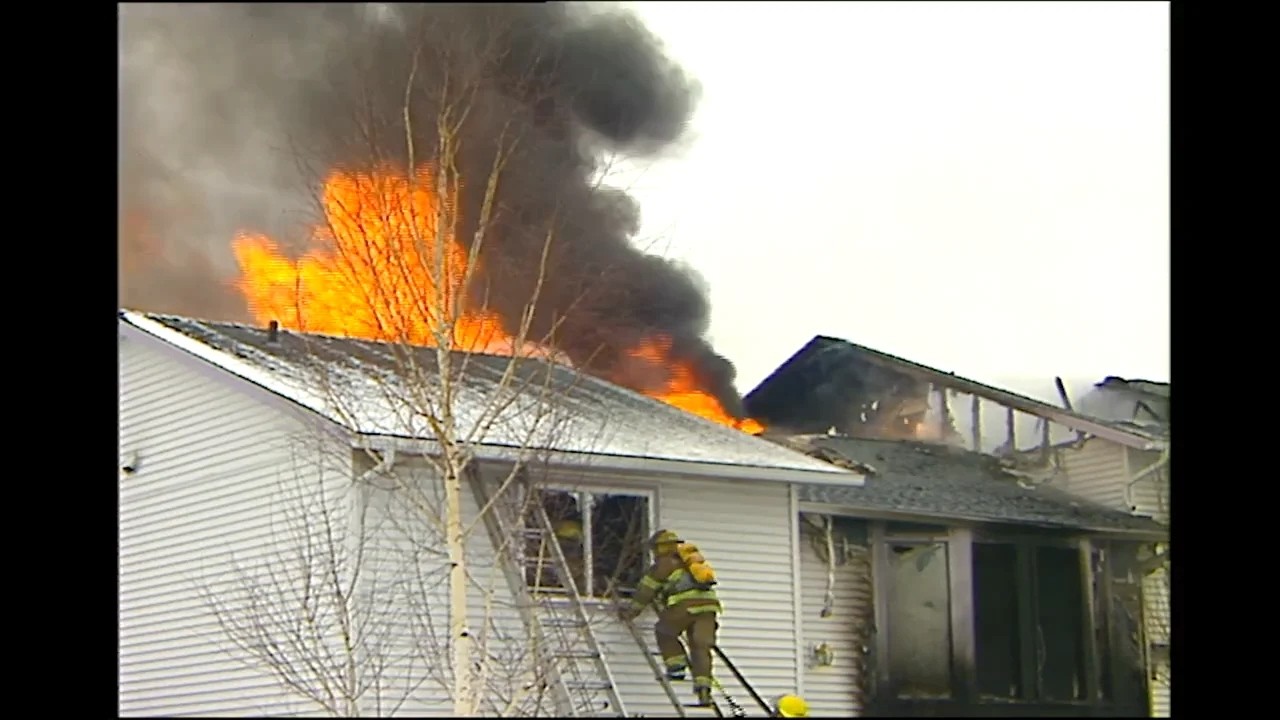
On February 9, 1999, a fresh layer of snow covered a neighborhood in Newman Lake, Washington. More than three and a half inches had fallen the day before. When a fire broke out at a home on North Blue Skies Road, no one realized the snow would become part of an attempt to conceal one of the region's most notorious crimes.
When firefighters arrived at 5711 North Blue Skies, their first concern was not the burning house. It was Christopher Wood, an 11-year-old boy they feared was inside. His father had last seen him watching cartoons in the family room just an hour before the blaze was reported.
Firefighters ran dogs through the house and determined the boy was not there. Although his house was destroyed, all Bob Wood could think about was his son. "That stuff can be replaced," he said.
Throughout the day and into the night, family, neighbors, and Spokane County sheriff's deputies combed the valley for any sign of the boy. Neighbors posted flyers at stores and took pictures of Christopher door-to-door. Deputies scoured the neighborhood for clues.
Christopher's parents believed their son might be hiding at a friend's house or running away, afraid to come home. Bob Wood admitted his son had a habit of playing with matches, but finding the cause of the fire mattered less to him than finding his son. "He doesn't need to worry about the house," he said. "He just needs to get himself home."
As the hours ticked by, Christopher did not turn up at a friend's house. Thirty-six hours later, the neighborhood was crawling with volunteers, bloodhounds, and questions. Search and rescue teams intensified their search for the missing 11-year-old.
Bloodhounds and their handlers concentrated on a mile-and-a-half area around the family's home. "The scent article's pretty tainted that we have because it's so smoky," one handler said. More than 40 people and eight dog teams were involved in the search.
The family's house was checked several times with no sign of the boy. Late that night, volunteers asked neighbors to search their own homes in hopes the 11-year-old was hiding. "The longer the period of time, the more concerned, but we just have a focus right now finding him," an official said.
The cold night of searching in Newman Lake proved fruitless. Christopher was not in the neighborhood, and he was not scared about being in trouble for starting the fire as his father had suggested.
Hope flickered briefly when Christopher's blue Dallas Cowboys backpack was found along Forker Road, a few miles from his home. Thirty minutes later, that hope was gone. A road grader driver, 50 miles away in Stevens County, spotted a body down a steep and snowy bank near Deer Lake.
"It does not appear that it's accidental at this point," an investigator said. "The location of the body off the roadway, there are no homes in the immediate area, no signs of any kind of vehicle accident, so I think we can pretty much rule out accidental causes. Certainly suspicious."
Christopher's body was only 10 feet from South Shore Road, but it lay down a steep hill and could not be seen from the road. A dog first spotted the body. A road maintenance worker then saw it and called the sheriff's office at 9:05.
Investigators from Stevens and Spokane counties were at the scene for more than six hours before the body of the 11-year-old was removed and taken to Spokane. The mother who had been searching for a missing son was now being asked to identify his body.
Police refused to say whether there were any signs on his body indicating how the fifth grader may have died. That determination would come with the autopsy.
Back at the burned home, cheerful flowers, cards, and balloons turned the front yard into a Chris Wood memorial. Less than 50 feet away, inside the ruined house, investigators searched for clues to a murder. "We're not ruling out anything right now," said Valley Fire Chief Pat Humphrey, who added that arson was still the probable cause.
Investigators returned to the scene to make sure something like a heater was not to blame, and to continue their search for an accelerant that may have been used to ignite the flames. Crews used a tarp to cover potential evidence.
"You always go back and question to make sure, and especially in a case that involves a possible homicide, whether the homicide occurred there or not, we don't know," Humphrey said. "We just want to make sure that we've got all the answers when we go into court."
A steady stream of friends brought flowers to the house, but this time they had to leave their mementos outside the police tape that blocked off Blue Skies Road. "It's touching, but we just can't afford to have people wandering in and out of the police lines," an official said.
Spokane County detectives and state and federal agents carefully washed off any trace of contamination before entering the scorched home, which had been left untouched since the fire. "We don't want to take any evidence or anything that could be considered as contaminating the evidence that's already in the house with something from the outside," one investigator said.
All day they sifted through the ashes looking for a sign of what caused the blaze. Was it someone playing with matches? Was there some other reason? Were there accelerants? They also scoured the home for clues about Chris Wood's final hours.
"The whole search is about Chris and what's happened to Chris," an investigator said. "We want to see if there's anything here that'll help us answer all of the unanswered questions that we have so far."
Christopher's death hit not only his neighborhood but also Colville, where he lived with his mom and dad before the two divorced. Both communities turned out to say their goodbyes. One memorial was held in Colville, the other at his school.
At the services, mourners remembered a happy, vibrant child who was crazy about the Power Rangers, loved to jump on his trampoline, and was always smiling. One tribute read, "Your smile could brighten anybody's bad day. Why did you have to go so young?"
As late as June 1998, Chris had written, "I've been wondering what it would be like to have kids, but I guess I'm too young to worry about that." His mother called him "my diamond in the rough. He was all sparkle. He had many facets. And he was flawlessly bright."
Nearly 250 mourners of all ages came from all over. Some brought flowers, while others expressed their love and goodbyes on colorful posters hung in the church entryway. As young pallbearers brought the casket out of the church, friends said they believed Chris Wood was looking down at the crowd below.
There was one person who was not at either memorial, one person who should have been. The results of the autopsy performed on Christopher had come back the day after his body was found, several days before the memorials. The person who should have been there would have had to ask a judge for permission to attend.
At the center of the puzzle was a little boy, arson, murder, and a father arrested on the same day Christopher's body was found on suspicion of stealing more than $100,000 from his employer.
The autopsy showed Christopher did not die of hypothermia out on a cold snowy night. He had been strangled. Investigators believed Chris was murdered in Spokane County.
Robert Wood, 43, appeared in court on theft charges. Prosecutors asked for a high bond, saying not only was the theft charge serious, but that he was also a person of interest in his son's death. The judge granted that request.
"We did not want to see Mr. Wood released from jail," a prosecutor said. "We wanted him there because we believe that he is a suspect in this case."
It came out in that court hearing that his former employer accused him of spending more than $100,000 of company money on personal things like gas, equipment, and building supplies. In the coming days, court documents would paint Robert as a man in need of money, and the puzzle of the motive began to fall into place.
As hundreds of people crowded into a church in Colville to say goodbye to Christopher, his father sat alone in a cell at the Spokane County Jail. He spoke about the murder, his son, and his time behind bars.
"The only thing I can think of is Chris was scared and running, and maybe somebody perhaps picked him up," Robert said. "He knows better than to get in cars with strangers, but I don't know. Maybe he didn't have a choice. Maybe he was forced into a car."
Asked whether he could imagine what Chris went through, Robert said, "It takes a sick, sick person to do something like that to a child. I just can't even imagine. The terror that was going through him had to be awful."

Robert admitted to past financial problems. "I've done some things I'm not very proud of, and I was the first one to admit I'd done them," he said. "I betrayed my friends there. I betrayed the company and I betrayed my family by doing what I did. But I did it. I admitted to it."
Asked whether he had a life insurance policy on Christopher, Robert said, "I think there's some life insurance on him, yes. I think I've got 10 or 15,000 on him, and his mom had some life insurance that she couldn't pay, so I picked up the premium on it. I would never do anything to my kids even if I had a ton of insurance on them."
While Robert Wood sat in jail on theft charges, the lens of the investigation narrowed and came into focus on him. Detectives went door-to-door asking Chris Wood's neighbors what they saw and heard the morning of the fire.
A rough timeline emerged. Robert told deputies he last saw his son at their Newman Lake home about 8:20 on Tuesday morning. At 8:41, the fire was reported, with the house engulfed in flames. Two days later, Christopher's backpack was found west of Newman Lake along Evergreen and Bigelow. That same day, his body was found off Highway 395 near Deer Lake.
Detectives asked the public for help with another piece of the puzzle: Dennison-Chattaroy Road, which connects highways 395 and 2. "We believe that road was traveled by Mr. Wood either on his way to or home from the areas he visited that morning in the north end of the county," an investigator said. They were looking for anyone who may have seen something significant between 7:30 and noon.
It took two weeks for detectives to conclude that only one person was responsible for Christopher's murder: his father. The sheriff called a press conference to announce the arrest of Robert Wood.
Since the beginning of the case, detectives had interviewed 300 people and completed seven separate searches. "It's a very emotional case," Sheriff Sterk said. "Detectives had a lot of long hours. They worked very hard on this case to collect the evidence before any more of it was destroyed. It's taken a toll not only on the family members of Chris, but it's also taken a toll on our staff here."
Lab tests and DNA took time, and investigators waited for the results. Christopher's last breakfast, a bowl of Marshmallow Mateys cereal, held more than colorful shapes in milk. It held the key to finding a killer.
Court records painted a horrendous story of a terrible crime. They detailed what Robert Wood was accused of doing: using some sort of ligature to strangle his young son, setting the family sofa on fire with perhaps a match, then reportedly throwing his son's body into the back of his pickup truck and dumping it near Deer Lake.
Chris Wood's last day of life began like any other. His sister saw him in the family room where he usually ate cereal. She left him alone with their father.
"We don't have an eyewitness that saw exactly what took place for either the arson or the murder situation," an investigator explained. "So what we do is build a circumstantial case. We take all the pieces that we can find and put together through scientific evidence, through witness statements, and this type of information, and put it together in a case that we feel is strong enough to convince a jury."
Documents said Chris Wood vomited shortly before or after he died. The affidavit said he vomited Marshmallow Mateys, the same kind of cereal found in their house. Lab tests said that vomit was found on Chris's clothing, in the back of the pickup truck driven that day by Robert Wood, and on another car found inside the garage of the burning house, a car Robert had to walk past to get to his truck that morning.
There were more suspicious details in the affidavit. For instance, Chris Wood's shoes were on the wrong feet. "When you put everything together, we feel that in fact the victim was killed definitely in Spokane County in the home, and that it was as a result of Robert Wood," an investigator said.
Detectives laid out a timeline. It began at 7:00, when Chris's sister last saw him as she left the house. Witnesses said Robert Wood left between 8:00 and 8:20. He told detectives he was on his way to Colville. The fire was reported by 8:35. Wood was notified on a cell phone he hadn't answered all morning around 9:50. He reportedly said he was 40 minutes away. Prosecutors alleged he was just miles from where Chris's body was found. Almost two hours later, he returned home saying he had slipped off the road.
One person stuck by Robert through it all: his former wife and Christopher's mother, JoLynn Wood. She said she would stand by Robert until everything was over. She said she had not seen him since he was arrested for theft, but he called her every day, including just before he was arrested for murdering their son.
"He goes, 'I'm scared. I'm scared to go to court,'" JoLynn recalled. "He said, 'Because you see on TV, lots of times where people are railroaded, their circumstances make it look like they did it and you find out later that they didn't do it.' He said, 'I'm just scared.'"
Despite the evidence detectives said was piling up, JoLynn insisted the wrong man was behind bars. "I think because they haven't looked at anybody else, and because of Bob's financial problems, he fits the mold really good, and so they aren't looking anywhere else," she said.

If there was another suspect, JoLynn said she could not imagine where detectives should look. "I don't know who would do that to a little boy, much less anybody else," she said. "It's even worse because it's a child. And especially Christopher, for me."
Investigators did not talk much about a motive, but they discovered that Robert had taken out three insurance policies on Christopher totaling $80,000. The house was also insured.
Detectives focused on three points. First, realtors told Wood he could not get the money he wanted out of his house and had advised him that he had overbuilt. Second, detectives seized film showing Wood had taken pictures of six rooms in his house before the fire, then went through again after the fire and took pictures of those exact same rooms. Finally, detectives recovered insurance files Wood had left at a neighbor's house. Most had gone through the fire, all but one: the file with the insurance policies for Christopher and the house.
The case would end much sooner than JoLynn Wood expected. On Memorial Day 1999, Robert used a piece of coaxial cable to hang himself from an air vent in his cell.
Robert Wood was jailed in an old part of the jail separated from most other inmates. "Because he was a suspect in a child murder, we didn't feel like it was safe to mix him with the rest of the population," a deputy said. "Typically, what happens is that puts them at greater jeopardy of injury or assault."
Deputies said Wood skipped exercise time and went instead back to his cell. Sometime in the next hour, he hanged himself from a grate with a piece of coax cable. He left behind letters to his family and an attorney. He had talked about suicide, but it was not known whether he said anything about the charges he faced.
"For all practical purposes, the Chris Wood case now is closed," an official said. Wood had always been the primary suspect, but he told everyone he was innocent. Many wondered whether the case detectives built against him would ever be known.
"I feel like the people in our community should know what the case consisted of," an investigator said. Within the next week, hidden details of the investigation began to emerge. Many were left wondering why Wood chose Memorial Day, just two days before his birth date, to end his life.
A little more than a month later, the prosecutor released all the evidence that had been collected. The evidence, they said, would have led to Robert being convicted of murdering his little boy.
A look at the overview of the case showed detectives believed Wood always knew where Chris was, dumped off the side of the road near Deer Lake. Wood took what happened that day to his grave when he hanged himself.
"Most of the people that we spoke to from the community felt like they needed some closure," an official said. "They wanted some closure to make sure that the sheriff's office had gathered the right kind of evidence for the right person."
Evidence Robert Wood apparently left at almost every turn. The morning of the fire, court records said Robert and Chris were the only people inside the Newman Lake house. The doors were locked from the inside. None of the neighbors told detectives Chris ever left the house.
Lab tests said Chris likely did not set the fire. He had no soot or carbon on his hands or in his lungs.
But one piece of evidence tied Wood closest to Chris's murder. Chris vomited after he was strangled. That vomit was found on both sides of his clothes, indicating the killer dressed him after he was dead. The same vomit was found on a car fender in the garage Wood had to pass on the way to the truck. More vomit was found on that truck's bedliner and inside a garbage can found several weeks later at a car wash near Wood's house.
The question remained: what motivated Wood? "This was probably one of the only ways that he could see to clear that debt," an investigator said.
Detectives said Wood put his homeowner's policy, Chris's life insurance policy, and an 8×10 photo of his son inside his briefcase before the fire started. When he was told by detectives that they had the documents, he reportedly said, "I'm screwed and I am never getting out of here."
Robert Wood did get out of jail on his own terms, dying in a similar fashion as his son. He had apparently told people he doubted he was Christopher's biological father, and he had taken out three insurance policies on Christopher totaling $80,000.