On April 11, 1945, a United States Army sergeant named Edwarderovic was among the first American soldiers to cross the gate of Buchenwald. He had fought in North Africa, landed in Normandy, and advanced through the hedgerows of France and the forests of Belgium. He believed he had seen everything war could show a man. He had not seen Buchenwald.
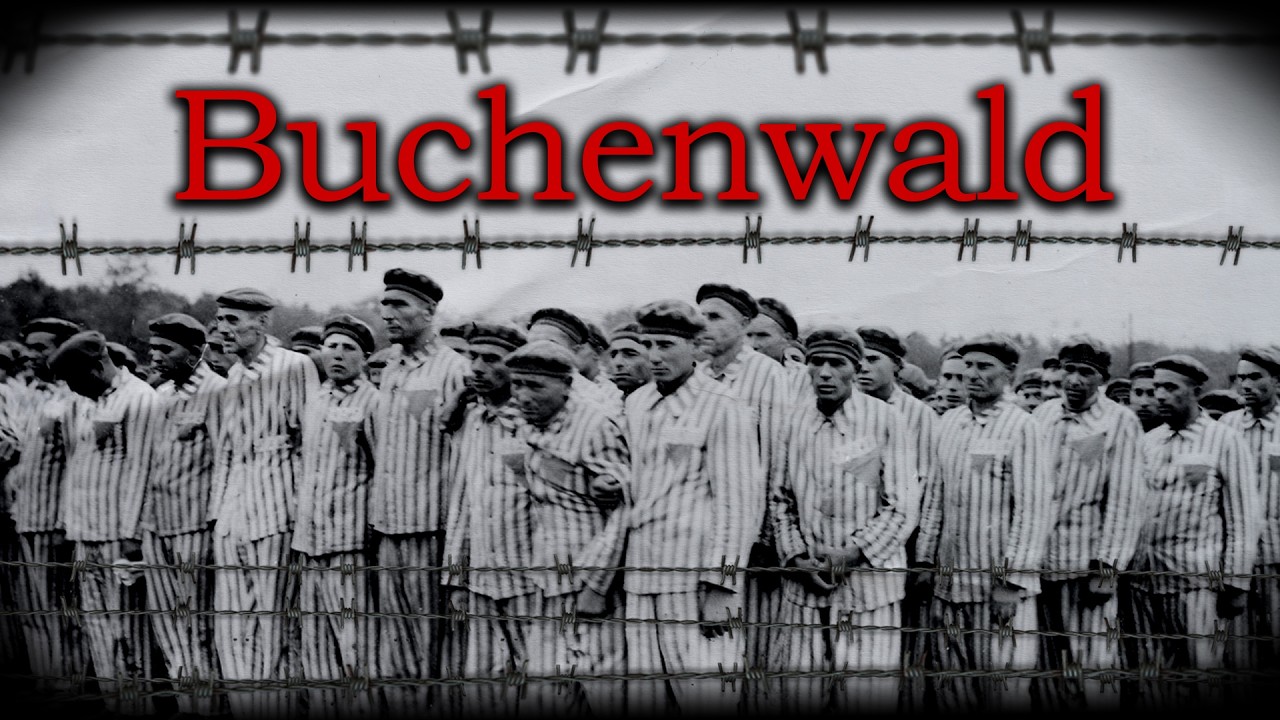
Inside the wire, roughly 21,000 prisoners remained. They were the ones too weak, too sick, or too close to death to have been evacuated in the death marches that preceded liberation. Many weighed less than 40 kilograms. They lay three or four to a bunk in barracks built for a fraction of that number, in temperatures that had not risen above freezing for weeks. The bodies of those who had not survived the night still lay beside them in the bunks. There was no one left to carry them away.
The correspondent Edward R. Murrow walked through the camp four days later and sent a radio dispatch that would be rebroadcast in living rooms across the United States and Britain. He described a boy of perhaps 10 with the eyes of someone from whom the world had already been taken. He described a man who lifted his shirt to show a body so reduced that his ribs could be counted from across the room. Murrow, who was not given to sentimentality, told his listeners he was not sure most of them would believe what he was about to tell them. Still, he told it. His broadcast ended with a sentence that has not lost weight in the 80 years since. He said, "If I have offended you with this rather moderate account of Buchenwald, I am not sorry in the least."
The story of Buchenwald does not begin in 1937. It begins in 1933, with a political movement that had decided violence was an instrument of government. When Adolf Hitler was named chancellor of Germany on January 30, 1933, the Nazi Party's paramilitary organization, the SA, or Sturmabteilung, immediately began imprisoning its political opponents. Communists, socialists, union leaders, journalists, and the lawyers who had defended them were arrested within weeks.
The official prison system could not absorb them. Improvised detention centers were set up in police stations, warehouses, and former factories across Germany. Conditions in these early camps were brutal and largely unsupervised. Prisoners were beaten, tortured, and killed without any formal legal procedure.
Heinrich Himmler, who commanded the SS, a rival and eventually dominant paramilitary organization within the Nazi structure, saw an administrative opportunity in this chaos. He moved to centralize the camp system under SS control, replacing the improvised brutality of the SA with something more organized and, in its own way, more systematic. The model he used was Dachau, established near Munich in March 1933, which became the template for what the SS called a concentration camp: a controlled environment in which the state could imprison, exploit, and when necessary eliminate people it considered enemies without the inconvenience of a functioning legal system.
By 1936, Himmler controlled the entire German police apparatus and had expanded the camp network, but he wanted a new facility, larger, better situated, and designed from the outset according to the principles his administration had developed over three years of trial and error. The site chosen was the Ettersberg, a wooded plateau about 8 kilometers north of Weimar, in the state of Thuringia. The hill was high enough to be isolated, close enough to a rail line to be logistically practical, and surrounded by forests dense enough that the camp's operations would be partly hidden from the city below.
Construction was ordered in the spring of 1937. The first prisoners arrived on July 16 of that year. One hundred forty-nine men transferred from Sachsenhausen were forced to begin building the camp that would hold them. They felled the forest by hand and extracted stone from an open quarry on the slope. They carried materials uphill in the summer heat, without adequate water, food, or shelter. Those who collapsed were beaten. Those who argued were punished in ways meant to be witnessed. The purpose was not only to build a camp. It was to establish from the first day that the prisoners were entirely in the power of the SS and that no appeal, no complaint, and no act of resistance would change that fact.
The camp was named Buchenwald, beech forest, as if the natural setting could domesticate what was being built inside it. It could not.
SS Obersturmführer Karl Otto Koch was named commandant in August 1937. Koch was 40 years old. He was a career SS officer who had served at Dachau and at Columbia-Haus, one of the early improvised detention centers in Berlin. Within the SS, he was known for his administrative efficiency and for a personal cruelty that went beyond ideological conviction. Guards at Buchenwald would later testify that Koch seemed to enjoy the suffering of prisoners in a way that disturbed even other members of the SS. His wife, Ilse Koch, accompanied him to the Ettersberg and would develop her own particular form of infamy in the years that followed.
Under Koch's command, Buchenwald's infrastructure was completed by the end of 1937. The main camp, the Stammlager, occupied a cleared plateau at the top of the hill. Below the main gate, which bore the SS motto "Jedem das Seine," to each his own, were the prisoner barracks, the roll-call square, the workshops, and the crematoria that would process the dead. Around the entire perimeter ran electrified wire, watchtowers, and floodlights that burned through the night.
From the beginning, the camp's internal economy depended on a system of prisoner labor designed to be exploitative to the point of lethality. Prisoners were organized into work details assigned to the quarry, to forest clearing, or to construction brigades, and were required to meet production quotas regardless of their physical condition. SS officers and kapos, prisoner functionaries who acted as foremen, enforced those quotas with beatings. Medical care was minimal and was often denied as a form of punishment. The food ration was calculated to keep a prisoner just strong enough to keep working and nothing more.
In its first year, Buchenwald's population grew from a few hundred to several thousand. The original contingent of German political prisoners was joined by growing numbers of men classified as asocial, the homeless, petty habitual criminals, and men detained for violating laws that had not existed a year earlier. By the end of 1937, the camp was operating as its designers had intended. What no one yet knew was how far it would expand and how much worse it would become.
On November 9, 1938, the order went out from Berlin at 11:55 p.m. By midnight it was underway. Across Germany and Austria, SS and SA units coordinated with local police to unleash what the regime would later describe as a spontaneous popular uprising against the Jewish population. In reality it was a carefully organized state action. Synagogues were set on fire. Jewish businesses were looted and destroyed. More than 90 Jews died directly from the violence. Broken glass from shop windows covered the streets of German cities, giving the night its name: Kristallnacht, the Night of Broken Glass.
The following morning, Reinhard Heydrich, who headed the SS security apparatus, issued orders to arrest between 20,000 and 30,000 Jewish men across the Reich. The criterion was simple. Jewish males in good physical condition between the ages of 18 and 60 were to be sent to concentration camps. Buchenwald received approximately 10,000 of them.
They arrived over several days in train cars without warning or preparation. The camp had capacity for perhaps 8,000 prisoners under the crowded conditions it already maintained. The arrival of 10,000 new people within days produced a crisis that the SS made no attempt to resolve humanely. The new prisoners were held in a section of the camp outside the regular barracks system, in open assembly areas and improvised enclosures without shelter against the November cold. Their personal belongings had been confiscated at the gate. They received barely any food. They were denied access to the limited sanitary facilities available to the already established prisoners.
The roll calls, the daily formations at which every prisoner's presence had to be verified, lasted for hours at subzero temperatures. Men who the week before had been businessmen, doctors, teachers, and factory owners stood in the dark, without adequate clothing, in formations whose only purpose was to demonstrate the absolute power of the SS over every detail of their survival. Guards moved among the crowd with clubs and whips.
There was no formal policy of murder. The Kristallnacht arrests were intended as a tactic of terror and a mechanism of financial extortion, not as an extermination operation. But the conditions made death inevitable. In the roughly six weeks that the Kristallnacht prisoners remained at Buchenwald, between 24 and 25 of them died. They died of cold, of hunger, of beatings, and of what the camp's medical records described with bureaucratic precision as heart failure.
The survivors were released in stages between November and January on the condition that they emigrate from Germany and surrender their goods and property to the state. Most did. The mechanism of coercion had worked as intended. Terror, followed by extortion, followed by forced expulsion. Jews were being driven out of Germany, their wealth confiscated, their communities shattered, at a pace the Nazi leadership considered satisfactory for the moment.
But the Kristallnacht episode revealed something about the concentration camp system that would shape its later development. It demonstrated that the camps could absorb almost unlimited numbers of prisoners under almost any conditions and with almost no external accountability. No German court intervened. No international body compelled access. The populations of nearby towns did not rise in protest. The machinery of mass imprisonment could be scaled almost without limit. The lesson was noted.
Throughout 1939, as Germany moved toward war, Buchenwald's prisoner population shifted again. Political prisoners, German communists, socialists, and union organizers remained the dominant group, but they were increasingly joined by Jehovah's Witnesses, who refused on religious grounds to serve in the German army and were therefore imprisoned indefinitely, as well as by Roma and Sinti men, detained under the racial laws the regime was steadily extending to cover every group it wished to persecute.
In September 1939, Germany invaded Poland. The war began, and with it the concentration camp system entered a new phase, one in which the prisoner population would come from every corner of occupied Europe and the purposes of the camps would expand in ways even their designers had not fully articulated. Buchenwald was ready to receive them.
The SS did not regard human beings simply as enemies to be imprisoned or destroyed. They regarded them as a resource. From the early years of the camp system, Heinrich Himmler and his administrators had developed what they called the concept of annihilation through work: the idea that prisoners could be exploited to the point of physical destruction while generating maximum economic output before they died. This approach united ideological elimination with economic productivity in a way that appealed to the industrial and financial logic of the Nazi state.
At Buchenwald, this concept took an especially organized form. The camp's main forced labor operation was a quarry, the Deutsche Ausrüstungswerke, German Equipment Works, an SS-owned company that extracted stone from the slope of the Ettersberg for construction projects throughout the Reich. The quarry was the most dangerous destination in the camp. Prisoners worked 12-hour shifts moving stone by hand, with inadequate tools and under deliberately abusive supervision. Falls, crushings, and collapses under the weight of rocks were recorded as accidents. Many were not.
Beyond the quarry, the camp operated a series of workshops: metalworking, carpentry, tailoring, bookbinding, which produced goods for SS use and for commercial sale. The work was unpaid. Prisoners received rations calculated to maintain the minimum capacity for labor and nothing more. When a prisoner's capacity fell below the point of economic usefulness, there was a mechanism for that too. Transfer to the invalids' barracks, formal reclassification as unfit for work, and subsequent death by neglect or deliberate action.
The prisoner population performing this work came increasingly from outside Germany. After the occupation of France, Belgium, the Netherlands, Norway, and Denmark between 1940 and 1941, thousands of prisoners from Western Europe arrived at Buchenwald: resistance fighters, hostages taken as collective punishment, political opponents of collaborationist regimes, and individuals detained under the broad definitions of criminality used by the Nazi security apparatus. They arrived speaking different languages, holding different political convictions, and with very unequal capacities to survive the conditions they encountered.
The arrival of Soviet prisoners of war in 1941 represented a categorically different development. After the German invasion of the Soviet Union in June 1941, the Wehrmacht captured millions of Soviet soldiers in the first weeks of fighting. Nazi ideology classified Soviet prisoners not as captives entitled to the protections of the Geneva Convention, but as racially inferior enemies whose deaths were acceptable and in many cases desirable. Of the roughly 5 million Soviet soldiers captured by Germany during the war, close to 3 million died in captivity.
At Buchenwald, Soviet prisoners of war were subjected to a specific extermination program under the term Sonderbehandlung, the SS euphemism for execution. Soviet officers and political commissars were transferred to the camp and systematically killed. The method involved a dedicated execution installation located in the basement of the camp's stable block. Prisoners were led in individually, told they were to be measured for clothing, and placed against a hidden measuring board. In the board was a slot through which an SS guard in the adjacent room fired a pistol into the back of the prisoner's neck. The body was then removed through a separate exit. The clinical precision of the design was intentional. It reduced the psychological burden on the executioner and increased the capacity of the process.
The number of Soviet prisoners of war killed at Buchenwald by this mechanism has been estimated at approximately 8,000. Some historians suggest the figure was higher. The records, like much of Buchenwald's documentation, were destroyed or falsified in the camp's final days of operation.
By 1942, Buchenwald had expanded beyond the main camp to include a network of satellite facilities, Aussenlager, distributed across central Germany. These dependent camps were tied to factories, construction sites, and military installations where prisoner labor was in demand. The main camp on the Ettersberg served as the processing and administrative center for this expanded network, which at its peak encompassed more than 87 satellite facilities and held tens of thousands of additional prisoners beyond those counted in the main camp's official records.
This industrial scale of organized human exploitation was not a byproduct of the war. It was a deliberate architecture. It was designed by men who wore uniforms, held ranks, and submitted quarterly reports. And it did not operate in isolation, but in collaboration with German corporations and government agencies that knew in sufficient detail exactly what they were using.
One of those men wrote his findings in a notebook. He noted infection dates, the progression of symptoms, the dates of death. He submitted his reports through the proper SS administrative channels, received feedback, suggested adjustments to his methodology, and continued his work. His name was Erwin Ding-Schuler. His rank was SS Sturmbannführer, equivalent to major. His title was doctor. And the subjects of his experiments were the prisoners of Buchenwald, who had not consented to participate and had no mechanism to refuse.
Medical experimentation at Buchenwald was an organized program, not a series of individual crimes committed by isolated actors. It was authorized by the SS medical apparatus, coordinated with German pharmaceutical companies, and supervised by officials with academic credentials from German universities. The fact that it constituted crimes against humanity was not considered a relevant factor at the time.
The main experimental facility inside the camp was Block 46, a sealed building within the prisoner enclosure that operated under strict access control. Not even other SS officers could enter without authorization. Inside, prisoners were used as test subjects for vaccine trials, primarily against typhus and related diseases that were killing German soldiers on the Eastern Front.
The experimental protocol was straightforward. Prisoners were deliberately infected with the pathogen. Some were then given experimental vaccines or treatments. Others were left untreated as control subjects. Results were monitored and recorded. The prisoners selected for Block 46 were not volunteers. They were assigned. Many learned what awaited them only after they arrived.
Infected subjects experienced the full progression of typhus: high fever, delirium, organ failure. Those in the control group, who received no treatment, frequently died. Those in the experimental group survived or died depending on the effectiveness of the treatment being tested. The data generated by these experiments was sent to pharmaceutical companies, among them Behringwerke, a subsidiary of the chemical conglomerate IG Farben, which was developing typhus vaccines for military use. At least 189 prisoners died in the typhus experiments. Further deaths resulted from experiments with phosphorus burns, from tests of treatments for typhoid fever and tuberculosis, and from a program that evaluated the toxicity of various substances by introducing them into food or drink given to prisoners without their knowledge.

The men who designed and carried out these experiments were not sadists in the conventional sense. They were not primarily motivated by a desire to inflict pain. They were motivated by career ambition, by a genuine scientific curiosity operating within a framework that had stripped their subjects of legal and moral status, which would have made these experiments unthinkable in any other context, and by the institutional incentive structures of the SS medical apparatus, which rewarded productivity and publication. The experiments were a crime. They were also, in a bureaucratic sense, entirely normal.
The camp doctor whose crimes were most visible to the prisoner population was not Ding-Schuler, but Wilhelm Hoven, who served as chief camp physician from 1942 until his arrest. Hoven's particular practice was to administer lethal phenol injections to prisoners who had become inconvenient, not to the Nazi state, but to the corrupt internal economy of the camp administration. He killed prisoners who had witnessed financial crimes committed by SS officers. He killed prisoners who could testify against the commandant. He killed, as one survivor put it, on commission.
This detail, an SS doctor killing to protect SS corruption, reveals something about Buchenwald's internal culture that statistical counts of deaths do not capture. The camp was not simply a machine for processing prisoners. It was an institution with its own internal politics, its own power hierarchies, and its own economy of violence. That politics would eventually consume the man who had built it.
Karl Otto Koch, the commandant who had established Buchenwald and presided over its first six years, was arrested by the SS in 1943. The charges were not related to the murder of prisoners. They were related to embezzlement. Koch had diverted SS funds to his own accounts and had killed prisoners who could testify against him. An SS court convicted him. On April 5, 1945, six days before the arrival of American forces, Karl Otto Koch was executed inside the camp he had built, shot in the Buchenwald forest. His wife Ilse Koch had been arrested two years earlier and remained imprisoned awaiting her own trial. She survived the war. She faced two separate trials, one American and one German. And she died by her own hand in a West German prison in 1967.
The system Buchenwald had created turned against its own architect, but the camp continued to function under his successor, SS Obersturmführer Hermann Pister, who would oversee its operation until the final days.
Not everyone at Buchenwald merely endured. Some fought back, not always with weapons, but with something the SS had not anticipated: organization. The political prisoners who had been at Buchenwald since its early years were in many cases experienced organizers. Many of the German communists who arrived in 1937 and 1938 had spent years in hiding before their arrest. They understood secret organization, the use of coded communications, the importance of compartmentalization, and the long-term logic of building networks in hostile environments. In captivity they applied those skills with extraordinary discipline to the goal of collective survival.
The SS had created a system of prisoner administrators, kapos, block elders, work detail foremen, as intermediaries between the guards and the general prisoner population. The intention was to divide the prisoner community and create a layer of enforcers with a personal interest in maintaining the existing hierarchy. In many camps, this system achieved its intended effect. Prisoner functionaries identified with the power that had appointed them and carried out SS orders with enthusiasm.
At Buchenwald, the underground systematically subverted this system. Over years of careful maneuvering, communist and left-wing prisoners worked to place trusted members of their network in as many administrative positions as possible. A prisoner who controlled assignment to work details could steer the weakest inmates away from the most dangerous labor. A prisoner with access to camp records could adjust documentation, undercount the number of survivors, and complicate SS calculations about who was available for selection. A prisoner inside the food distribution system could ensure that the smallest and most vulnerable received a little more than their official ration. None of this was visible to the SS on a systematic basis, because none of it was dramatic. It was the accumulation of thousands of small decisions made by people who understood that survival under Buchenwald's conditions was a collective project or it was nothing.
The underground organization also undertook more direct preparations. Beginning in 1943, weapons were smuggled into the camp: pistols, grenades, and eventually automatic weapons hidden in barracks and prisoner workshops. A radio receiver built from parts stolen from the camp's electrical workshops over several months was hidden inside the walls of a prisoner block and used to listen to BBC broadcasts and Allied military communications. By 1944, the underground organization already knew the broad outline of the military situation: the Soviet advance from the east, the Allied landings in Normandy, the contraction of German-controlled territory on all fronts. They began planning for the moment when the camp's external situation would deteriorate enough to create the conditions for armed action.
Buchenwald's prisoner population in those years represented a cross-section of European intellectual and political life unlike any other institution on the continent. Léon Blum, former prime minister of France and leader of the Socialist Party, was held at Buchenwald from 1943 to 1945, first in the main camp and later in a special villa outside the perimeter. Kurt Schuschnigg, who had been chancellor of Austria before the Anschluss, was held nearby. Thousands of veterans of the International Brigades who had fought against Franco in the Spanish Civil War were imprisoned in the camp, as were resistance fighters from France, Belgium, Italy, Czechoslovakia, and Yugoslavia. Soviet officers, Polish intellectuals, Dutch socialists, and Norwegian university professors shared barracks with German criminals, Jehovah's Witnesses, and men arrested solely for being Jewish.
The diversity of the prisoner population generated tensions that the underground organization had to manage constantly. Different national and political groups had different interests, different relationships with the SS administration, and different assessments of how to balance short-term survival with long-term resistance. The German communists who dominated the underground leadership made decisions that protected their own members more consistently than others, a fact that survived the war in the testimonies of non-German prisoners who viewed the underground hierarchy with considerable ambivalence. But when 1945 began and the distant sound of artillery started to be heard on the western horizon, those tensions were set aside. The underground organization had weapons, it had organization, and in the increasingly chaotic SS command structure of a Germany facing military defeat, it had for the first time a real opportunity.
The winter of 1944 to 1945 was the worst in Buchenwald's history. By late 1944, the German military situation had deteriorated to the point that the SS began evacuating prisoners from the camps in the east. The Red Army was advancing through Poland at a speed the Wehrmacht command had not anticipated, and the SS could not allow the advancing Soviets to find and liberate the prisoners of the eastern camps. Not because they cared about those prisoners, but because they cared about what those prisoners could tell the world.
From the summer of 1944, and accelerating through the autumn and winter, the SS evacuated the camps of eastern Poland, the Baltic states, and finally Auschwitz itself. Prisoners who had already been reduced to extreme physical weakness after years of captivity were loaded onto unheated freight trains without food or water and transported westward. The journeys lasted days, sometimes weeks. When the trains arrived, a significant portion of their passengers were dead.
Buchenwald received many of these transports. The trains arrived at the Weimar station, at the foot of the hill, where the prisoners still alive were forced to march the last kilometers to the camp gate. German civilians who lived along the route watched from their doors and windows. Some looked away. A few quickly threw food, discreetly, before the guards could see. Most did nothing.
Inside the camp, the infrastructure collapsed under the pressure. Barracks designed for perhaps 400 prisoners held 100. The water supply, which had always been insufficient, broke down under the increased population. Dysentery spread through the overcrowded blocks with a speed that overwhelmed the already minimal medical resources available to prisoners. Typhus, against which the Block 46 experiments had tried to protect German soldiers, now swept through the prisoner population without any treatment at all. The dead accumulated at a rate the crematoria could not process.
Among those who arrived at Buchenwald in January 1945 was a 15-year-old boy who had been transferred from Auschwitz as the Soviet army approached. His name was Elie Wiesel. He arrived exhausted after completing a death march through the Polish winter before the train journey west. His father was with him. They would not remain together for long. Shlomo Wiesel, Elie's father, died in the Buchenwald infirmary in the weeks of January 1945. He died of dysentery, of exhaustion, and of the accumulated weight of everything he had suffered. He was a little over 40 years old. His son, who would spend the rest of his life as a witness and writer, described his father's death in terms that rejected any sentimentality. It was a death that should not have been possible, in a place that should not have existed, and none of the words he wrote in the decades afterward made it more comprehensible.
Meanwhile, the SS was carrying out what its internal documents described as the emptying of the camp. Orders arrived from Berlin specifying that Buchenwald was to be evacuated before the approaching American forces could reach it. Between March 28 and April 10, 1945, more than 28,000 prisoners were forced to march out of the camp on foot toward the south and east. The guards accompanying the columns shot anyone who could not keep pace. The bodies were left abandoned along the roads of Thuringia for local civilians to find in the days that followed. Approximately 7,000 prisoners died in Buchenwald's death marches. Some by bullets, many from exhaustion and exposure, others from the simple collapse of bodies that had been sustained by nothing for months.
Inside the camp, as the last columns departed, the SS guards began to abandon their posts. News spread through the clandestine radio network. American armored units were approaching from the west. The underground resistance leadership held its final meeting. The weapons accumulated over years were distributed. The moment that had been anticipated and prepared for had arrived.

On the morning of April 11, 1945, the last SS administrative personnel fled the camp. The watchtowers were left unmanned. The gates were no longer guarded. At 3:15 in the afternoon, the first American vehicles of the 6th Armored Division came up the hill. The prisoners who could still walk met the Americans at the gate. In the strictest sense, they had already liberated themselves. Armed groups from the underground resistance had taken control of the watchtowers and the perimeter in the hours before the American arrival, ensuring that no SS attempt to destroy evidence or execute the remaining prisoners could succeed. When Sergeant Herbert Gottschalk of the 9th Armored Infantry Battalion of the 6th Armored Division entered the main camp, flags held by prisoners were already flying over the towers.
The documentation of what followed was carried out by military personnel, journalists, and eventually historians and researchers. General Dwight D. Eisenhower ordered that as many American military personnel as possible be brought to the camp to witness the conditions before the bodies were removed and the facilities cleaned. His reasoning was explicit. He anticipated that in the years to come people would deny that these things had happened, and he wanted as many witnesses as possible.
General George S. Patton, who commanded the Third Army and who by that point in the war had already seen the consequences of some of the most violent fighting in modern history, visited Buchenwald shortly after liberation. He was visibly overwhelmed. Accounts from the officers accompanying him record that he became physically ill during the visit and could not complete it. He subsequently ordered the mayor of Weimar and other prominent citizens of the city to visit the camp and observe its contents with their own eyes. They went. They walked through the barracks alongside the dead, alongside the living who could barely be distinguished from the dead. Many wept. Some offered explanations. Various historical accounts record that the mayor of Weimar returned home after the visit and took his own life.
Edward R. Murrow's broadcast, aired on April 15, was heard by millions. Murrow's reputation for accuracy and restraint gave his words a weight that a more emotional report might not have had. He described what he had seen without embellishment, but the facts themselves constituted an accusation that needed no additional argument.
Elie Wiesel, who survived his final months in the camp, would publish his memoir Night in 1960 and devote the following decades to ensuring that the testimony of survivors remained at the center of public consciousness. He received the Nobel Peace Prize in 1986. In his acceptance speech he spoke of Buchenwald.
The figures assembled in the months and years after liberation were overwhelming. Between 1937 and 1945, approximately 280,000 prisoners from more than 50 countries were held at Buchenwald and in its network of satellite camps. Of them, a confirmed minimum of 56,000 died from executions, hunger, disease, medical experiments, death marches, and deliberate killings. Many historians, accounting for deaths that went unrecorded or were falsified, believe the real figure is higher. The exact number of people who died at Buchenwald can never be known with certainty, because the SS destroyed their records in the camp's final days of operation.
The Nuremberg Doctors' Trial, held between December 1946 and August 1947, prosecuted 23 individuals, among them SS doctors who had conducted experiments at Buchenwald, Dachau, and other camps. Seven were sentenced to death and executed. Nine received prison terms. The verdicts produced, among other things, the Nuremberg Code, a set of principles governing ethical research with human beings that remains to this day the foundation of international bioethics. The 10 principles of the Nuremberg Code begin with a single requirement: the voluntary consent of the human subject is absolutely essential.
Commandant Koch had already been executed by the SS itself. His successor, Hermann Pister, was tried by an American military court in 1947, sentenced to death, and died in prison of a heart attack before the sentence could be carried out. Ilse Koch, tried first by an American military court in 1947, which initially sentenced her to life imprisonment before the sentence was reduced amid controversy, was tried again by a West German court in 1951 and sentenced to life imprisonment. She died by suicide in her cell at the Aichach prison on September 1, 1967. Erwin Ding-Schuler, who had directed the typhus experiments in Block 46, was arrested after the war and was preparing to testify at the Nuremberg Doctors' Trial. He died in custody in August 1945, in what was officially recorded as a suicide, before the trial began. The reckoning was real. It was also inevitably incomplete.
The Ettersberg hill is today a place of memory. The main camp area has been preserved as the Buchenwald Memorial, administered by the German state of Thuringia and visited each year by hundreds of thousands of people. The iron gate with its inscription, "Jedem das Seine," still stands at the entrance to the former camp. The roll-call square, where tens of thousands of prisoners stood for hours in the winter dark while guards counted them, is a broad empty expanse. The crematorium building is preserved. So is the basement of the stable block, where the execution mechanism for Soviet prisoners of war was installed.
A few hundred meters from the camp's outer wire, in a grove that has grown back to something like its original density, stands an oak tree. It is large and old. According to tradition, a tradition the SS themselves maintained during the camp's operation, it is the tree under which Johann Wolfgang von Goethe once rested when he walked these forests in the early 19th century. Goethe, author of Faust, The Sorrows of Young Werther, and some of the most celebrated lyric poetry in the German language, loved the Ettersberg. He considered it a place of special beauty. The SS preserved that tree while the camp operated around it.
There is something in that detail that resists simple interpretation. It is not that the men who built and ran Buchenwald were incapable of appreciating beauty, civilization, or the cultural achievements of Germany's past. It is that they had built an ideological framework in which the systematic murder of human beings and the preservation of a poet's oak tree were perfectly compatible, in which one thing did not exclude the other, or even come into tension with it.
This is perhaps Buchenwald's most disturbing lesson: not that its perpetrators were monsters separate from the civilization that produced them, but that they were products of it. They were graduates of German universities, subscribers to German newspapers, attendees of German concert halls. The ideology that authorized what they did at Buchenwald did not require them to abandon civilization. It required them to redefine who counted as part of it.
The camp's proximity to Weimar has always forced this question. The smoke from the crematorium was visible from the city. The trains carrying prisoners passed through the Weimar station. German companies contracted with the SS for prisoner labor and submitted invoices for services rendered. The Red Cross received reports about conditions in the camp and did not act with sufficient firmness. The citizens of one of Europe's most culturally distinguished cities lived within sight of one of the continent's most systematic institutions of death. And during the years the camp operated, most continued with their lives. What they knew and what they chose not to know remains one of the central questions in Holocaust historiography. It is a question that admits no comfortable answers.
The historian Nikolaus Wachsmann, whose exhaustive study of the Nazi concentration camp system was published in 2015, writes that the camps were an open secret, known in their broad outlines by the German population, though the more specific details of the killing operations were deliberately concealed. The population of Weimar did not need to know that Soviet prisoners of war were shot in the back of the neck in a basement on the hill above their city. They knew more than enough.
The survivors who lived to give testimony did not speak with a single voice. Some, like Wiesel, argued that remembrance itself was a form of resistance, that remembering accurately, refusing to allow the facts to be softened or denied, was the most significant act available to those who had not been there. Others, like Primo Levi, who survived Auschwitz and wrote about the camp system with an analytical clarity almost unbearable to read, held that memory was insufficient, that understanding was necessary, and that understanding meant confronting not only the perpetrators but also the bystanders, not only the exceptional cruelty of the SS but the ordinary complicity of institutions and populations that continued to function while the camps existed.
The Buchenwald Memorial receives its hundreds of thousands of visitors each year. School groups from Germany and across Europe come to walk the roll-call square, to enter the barracks, and to see the documentation that has been assembled. German law requires the teaching of the Holocaust in public schools. The country has built a culture of memory that is, by any comparative standard, more serious and sustained than almost anywhere else. And yet the memorial's own administrators acknowledge that they wage a constant battle against minimization, against the drift of historical memory, against the human tendency to normalize the past by reducing it.
Buchenwald was not something small. It operated for nearly eight years. It killed 56,000 people in a country at peace and then at war, a country whose population knew of its existence and chose in its overwhelming majority to continue as if it were not there. It was designed, built, administered, and expanded by ordinary men following institutional incentives within an institutional framework built systematically to turn the murder of designated groups into something not only permitted but required.
General Eisenhower was right to order that as many witnesses as possible be brought to see it. He understood something that the organizers of the camp's evacuation also understood: that the power of what had been done there lay partly in its visibility, and that the only response to a crime of that magnitude was to look at it directly without turning away and to refuse to accept any idea of human nature or human institutions that made it seem impossible. It was not impossible. It happened. It happened on a wooded hill above a city famous for its poets, in the heart of one of the most educated countries in the world, within the living memory of people who are still alive.
The Ettersberg stones still stand. So does the gate. So does the question the gate poses to everyone who passes through it. "Jedem das Seine": to each what he deserves. The people who died at Buchenwald did not deserve what they received. The task that remains for all who inherit their memory is to understand with clarity and without consolation exactly how what they received was possible, and to refuse to allow those mechanisms to reassemble in any form, in any country, at any time. That refusal is not passive. It demands vigilance. It demands recognizing that institutions capable of systematic cruelty do not announce themselves as such. They present themselves as order, as efficiency, as protection of the community, as the application of justice to those who deserve it. "Jedem das Seine." The phrase is a warning. It always was.