On June 4, 1942, one of the most feared men in the Nazi regime died in a Prague hospital bed, eight days after a bomb exploded beside his open-topped car. The wound itself, according to the doctors who first treated him, should not have killed him. He had survived the initial blast, undergone surgery, and appeared for a brief period to actually be recovering. Then, without warning, his condition collapsed entirely, and within 24 hours he was dead.
His name was Reinhard Heydrich, the architect of the Final Solution and one of the most powerful men in the Third Reich. For over 80 years, historians, doctors, and intelligence researchers have argued about what his own autopsy report actually proves. Was it a simple, tragic bacterial infection, or was something considerably stranger involved in his death?
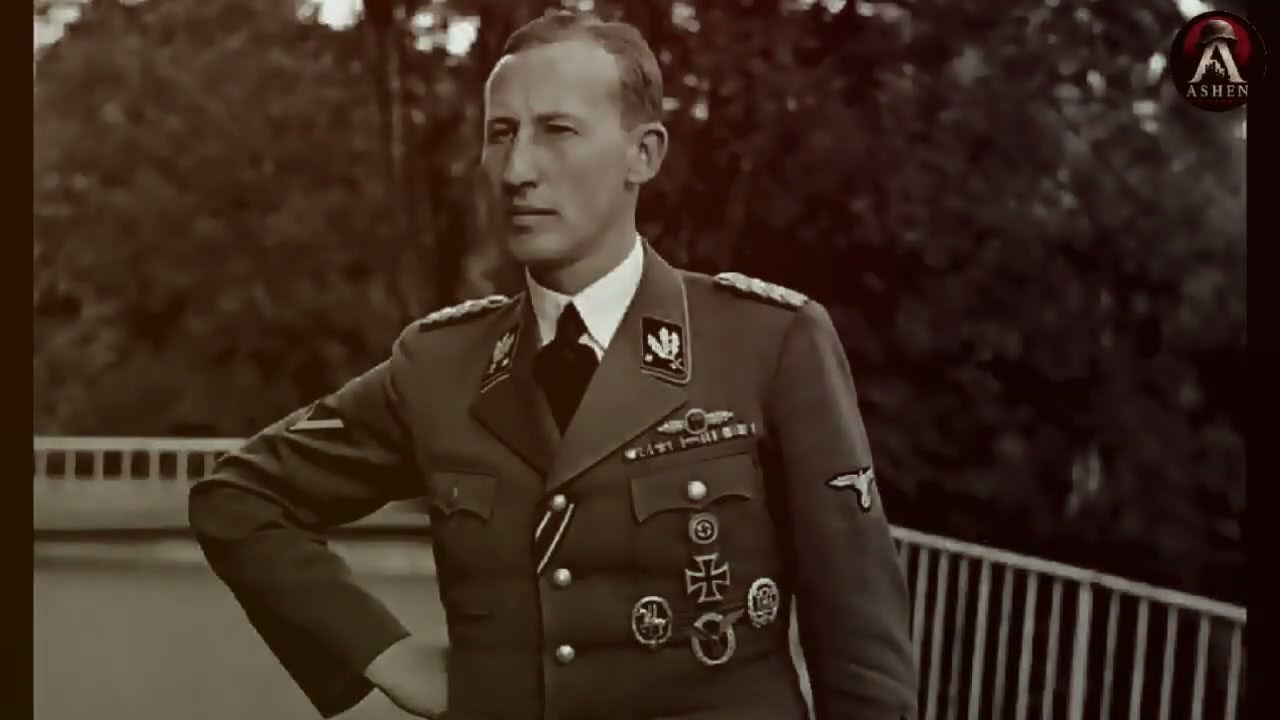
Reinhard Heydrich was born in 1904 and rose through the SS with a speed that alarmed even his own colleagues. He eventually became head of the Reich Main Security Office, overseeing the Gestapo, the SD intelligence service, and the entire security apparatus of Nazi Germany. He personally chaired the Wannsee Conference in January 1942, the meeting at which senior Nazi officials formally coordinated the logistics of the Final Solution, the systematic murder of European Jewry.
By the time he was appointed acting Reich Protector of Bohemia and Moravia in September 1941, effectively ruling occupied Czechoslovakia with brutal efficiency, Heydrich had already earned nicknames from his own colleagues that reflected genuine, widespread fear, including "Himmler's Brain" and "The Butcher of Prague." Hitler himself reportedly regarded Heydrich as one of his most capable subordinates and a genuine potential successor.
It was precisely this reputation for calculated brutality that made Heydrich a target for the Czechoslovak government in exile operating from London. In December 1941, British intelligence services helped train and parachute two Czechoslovak soldiers, Josef Gabčík and Jan Kubiš, into the Czech countryside as part of a mission code named Operation Anthropoid, tasked with assassinating Heydrich directly.
On the morning of May 27, 1942, the two agents positioned themselves along a road in Prague where Heydrich's car was known to slow considerably to navigate a sharp curve. He was traveling in a display of characteristic arrogance without any significant armed escort. As the car slowed, Gabčík stepped forward and aimed his Sten submachine gun directly at Heydrich, but the weapon jammed completely, failing to fire.
In the chaos of that moment, Heydrich, rather than ordering his driver to speed away, instead ordered the car stopped entirely so he could stand and shoot back at his attacker himself, a decision that would prove fatal. As Heydrich stood exposed, Kubiš threw a modified anti-tank grenade at the vehicle. It missed its direct target but exploded near the car's rear wheel, and shrapnel and fragments from the vehicle's own damaged bodywork tore into Heydrich's body.
Remarkably, Heydrich did not appear mortally wounded in the immediate aftermath. He was rushed to Bulovka Hospital in Prague, where surgeons operated to address his injuries, which included a ruptured diaphragm, damage to his spleen, and various fragments embedded in his abdomen and chest. The splenectomy and initial surgical repair appeared successful, and for several days Heydrich seemed to be recovering steadily, even sitting up and eating meals, leading his doctors and the wider Nazi leadership to believe he would survive.
Then, on June 3rd, while eating his midday meal, Heydrich suddenly collapsed. His condition deteriorated with alarming speed, and he slipped into a coma. He briefly regained partial consciousness in the early hours of June 4th, reportedly recognizing his wife Lina at his bedside before losing consciousness again. He died later that same day, June 4th, 1942, eight days after the attack that was supposed to have been a clean, immediate assassination.
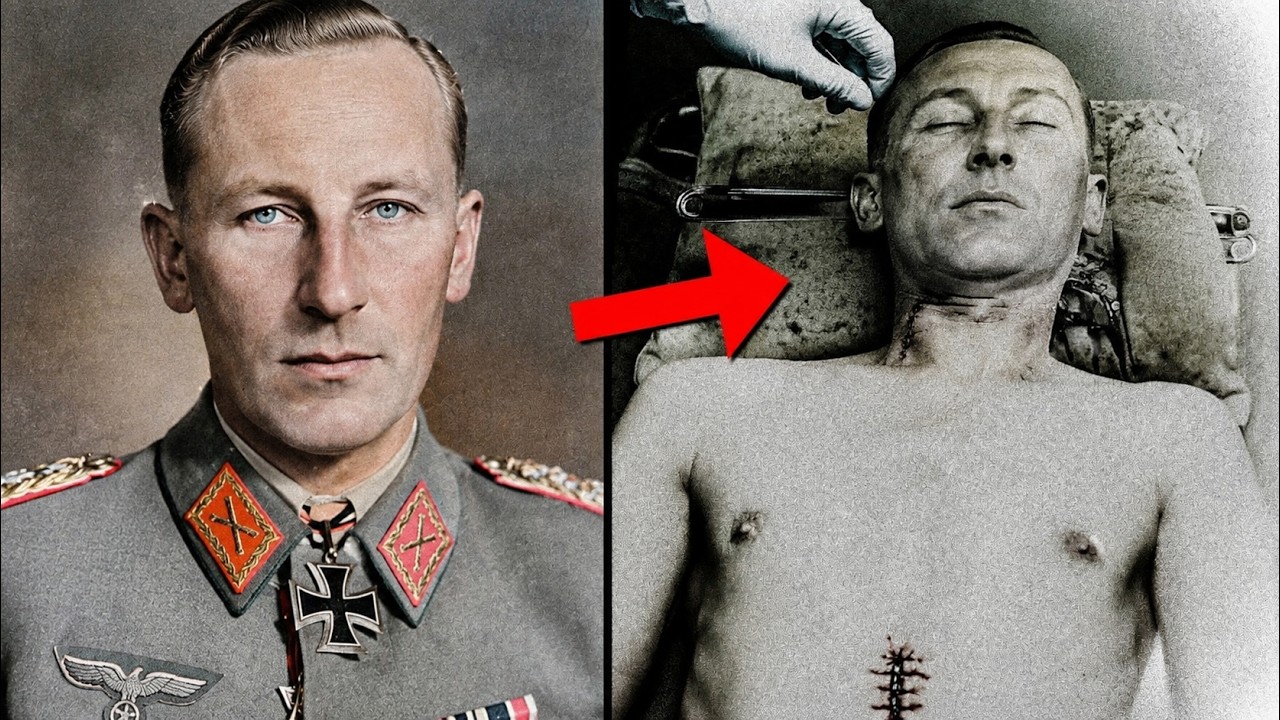
An autopsy was performed just hours after his death, but the circumstances surrounding that examination were, from the very beginning, genuinely unusual in ways that would fuel decades of subsequent historical debate. The autopsy was conducted not in a proper autopsy room, but in the hospital director's own office. It was only a partial examination, since the head and neck were never actually opened or examined at all.

The report itself lacked a description of the external examination, failed to record the weights of his organs, a standard component of any thorough forensic autopsy, and most strikingly of all, did not conclusively establish an official cause of death. For decades after the war, this original autopsy report was believed to be entirely lost, and it was only in 2003 and 2004 that the original German-language document finally resurfaced and became available for proper historical and medical analysis.
What the surviving report does describe is a body ravaged by severe internal infection. The preliminary findings recorded on the day of his death noted damage to Heydrich's heart, liver, and kidneys consistent with what the examining doctors described as a highly virulent infection, alongside significant accumulations of pus found within his chest and abdominal cavity. Modern pathologists who have subsequently reviewed the surviving report have generally concluded that Heydrich died from sepsis, an overwhelming body-wide inflammatory response to severe bacterial infection, a conclusion also supported by some researchers pointing specifically toward a probable pulmonary embolism combined with heart failure as his condition rapidly deteriorated in his final hours.
So where did this fatal infection actually come from? Historical investigation into the attack itself revealed that fragments from the exploded grenade had driven pieces of Heydrich's own car upholstery deep into his body alongside the metal shrapnel, including strands of horsehair that had been used as traditional stuffing material inside the vehicle's seats. This contaminated material lodged deep within his abdominal wounds is widely believed by many historians and medical researchers to have introduced the severe bacterial infection that ultimately overwhelmed his body's ability to recover, despite what had initially appeared to be a successful surgical intervention.
But this straightforward, if genuinely unlucky, medical explanation hasn't satisfied everyone who has studied this case over the decades. Beginning in the 1970s, a considerably more dramatic theory began circulating in British, American, and French historical literature. The idea was that British intelligence services had deliberately coated the grenade or its fragments with botulinum toxin, one of the most lethal biological substances known, specifically to ensure that even a survivable physical wound from the blast would still guarantee Heydrich's eventual death through poisoning, rather than relying purely on the explosive force itself.
This theory gained genuine traction for decades, appearing in numerous popular historical accounts of the assassination, and it offered a genuinely compelling explanation for why a man who initially appeared to be recovering from his wounds would suddenly, catastrophically, decline within a matter of days. However, more recent rigorous historical research, particularly work examining newly declassified British archives connected to both Operation Anthropoid itself and Britain's wartime chemical and biological weapons research facility at Porton Down, has significantly undermined this botulinum poisoning theory.
Researchers granted access to these declassified files found no credible evidence that Britain's Special Operations Executive ever actually possessed, developed, or deployed a functional botulinum toxin weapon suitable for this kind of operation during the relevant period. And the specific physical evidence contained within Heydrich's own surviving autopsy report, extensive generalized bacterial infection and pus formation consistent with ordinary wound contamination, is broadly considered by most specialists examining the case today to be more consistent with a conventional, if severe and ultimately fatal, bacterial sepsis than with the very different physiological pattern typically associated with botulinum poisoning specifically.
What makes Heydrich's autopsy genuinely significant beyond simply resolving this decades-long forensic debate is what happened as a direct consequence of his death. Hitler, enraged by the assassination of one of his most valued subordinates, ordered brutal, sweeping reprisals across occupied Czechoslovakia. In the most infamous of these reprisals, the village of Lidice was entirely destroyed on June 10th, 1942, its male population executed, its women deported to concentration camps, and its children largely sent to be forcibly Germanized or killed, part of a broader wave of retaliation that saw an estimated 5,000 Czechoslovak citizens executed and 13,000 arrested and interrogated in the weeks following Heydrich's death.
The two assassins themselves, Gabčík and Kubiš, along with several fellow resistance fighters, were ultimately tracked down by German forces to the Cathedral of Saints Cyril and Methodius in Prague, where they were killed in a prolonged firefight after taking refuge in the building's crypt, having chosen to take their own lives rather than be captured alive.
What remains genuinely fascinating about Heydrich's own medical case, examined purely as a forensic and historical puzzle separate from the broader tragedy of the reprisals that followed, is how a document as incomplete and methodologically unusual as his original autopsy report could generate such sustained historical debate for over 80 years. That debate has only been meaningfully resolved through the painstaking rediscovery of the original report itself decades after the war's end, combined with subsequent access to previously classified intelligence archives that most historians examining the case had no access to for much of the 20th century.
The most current well-supported historical and medical consensus holds that Reinhard Heydrich died from severe sepsis brought on by bacterial contamination introduced by fragments of his own car's upholstery driven into his body during the blast. It was an almost absurdly mundane, unglamorous cause of death for a man whose entire career had been built on calculated, deliberate brutality. He was killed not by poison, not by some elaborate secret weapon, but by horsehair stuffing from his own car seat and the ordinary, if catastrophic, bacterial infection that followed.