On September 3, 1939, the day Britain declared war on Germany, Unity Mitford walked into Munich’s English Garden, sat down on a park bench, and shot herself in the head. She survived, but the bullet remained lodged in her brain for the rest of her life—a life that ended nearly a decade later from meningitis caused by the wound. Unity was one of six sisters born into the English aristocracy, a family so divided by politics that its members ended up scattered across nearly the entire ideological spectrum of interwar Europe—from committed fascism to committed communism. The Mitford sisters were born between 1904 and 1920, the daughters of David Freeman-Mitford, later the second Baron Redesdale, and his wife, Sydney.
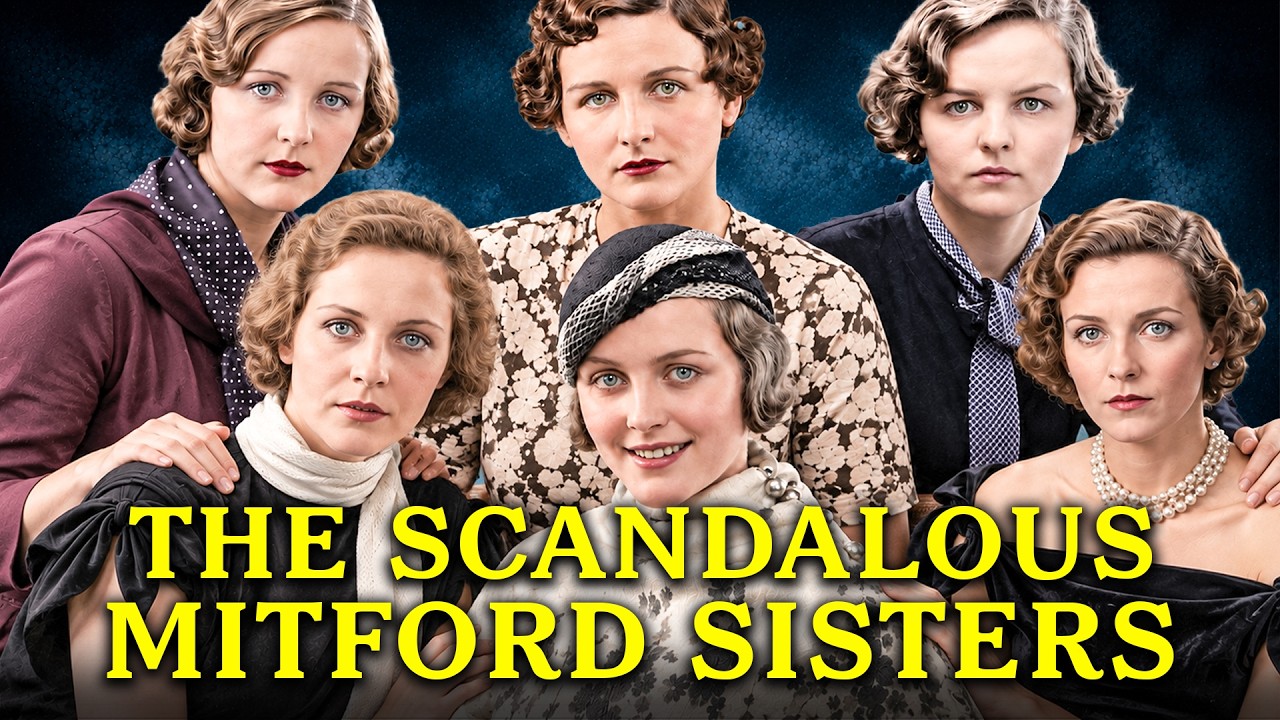
They were raised largely at two estates in Oxfordshire. Their father held unconventional views on education, believing formal schooling was unnecessary for girls destined to marry well, so most of the sisters were educated at home by governesses, leaving several with significant gaps in basic subjects. Despite that haphazard upbringing, each sister carved out a strikingly different path—one that would eventually place them on opposite sides of the 20th century’s greatest conflict. Nancy, the eldest, born in 1904, became a celebrated novelist.
Her books, including The Pursuit of Love (1945) and Love in a Cold Climate (1949), drew directly on her eccentric family, with characters so recognizable that relatives had little trouble identifying their real-life inspirations. Her personal life was far less successful. She married Peter Rodd in 1933, a union marked by his infidelity and financial recklessness. The couple divorced in 1958.
Nancy had already fallen deeply in love with Gaston Palewski, a French politician and associate of Charles de Gaulle, whom she met in London during the war. Palewski never fully returned her devotion, even as she moved to Paris to be near him. She died from Hodgkin lymphoma on June 30, 1973, at age 68. Pamela, born in 1907, was the quietest of the six.
She showed little interest in politics or public fame, instead devoting herself to country life, farming, and practical work. In 1936, she married Derek Jackson, a wealthy physicist and amateur jockey. The marriage was initially happy but ended in divorce in 1951 after his repeated infidelities. Pamela never remarried, instead sharing a long, private relationship with an Italian woman named Giuditta Tommasi.
She died on April 12, 1994, at age 86, having lived the most peaceful and least scrutinized life of all the sisters. Diana, born in 1910, was widely regarded as the most beautiful of the six. In 1929, at just 18, she married Bryan Guinness, heir to the brewing fortune, and the couple became fixtures in London’s literary and artistic circles. That life was upended in 1932 when she met Sir Oswald Mosley, the founder and leader of the British Union of Fascists.
Despite his reputation as a serial philanderer and the fact that he was already married, Diana left her husband and two young sons to become his mistress. Following the death of Mosley’s first wife in 1933, the couple married in October 1936. The ceremony was held not in England but in the Berlin home of Nazi propaganda minister Joseph Goebbels, with Adolf Hitler himself attending as guest of honor. Diana had developed a genuine personal relationship with Hitler during frequent visits to Germany in the mid-1930s.
The wedding remained a secret for nearly a year. Diana never fully renounced her political past. In interviews well into old age, she described Hitler as, in her own words, an extraordinarily easy and charming man to spend time with—a characterization that continued to draw criticism decades after the war. Unity, born in 1914, took that fascination to a far more extreme conclusion.
Captivated by Nazi ideology as a teenager, she moved to Munich in 1934 specifically to meet Hitler. She began frequenting a restaurant he favored, positioning herself at the same table for months until she was formally introduced to him in February 1935. The two developed what historians generally describe as a genuinely close friendship, with Unity becoming a regular presence in Hitler’s inner circle, attending rallies and private gatherings throughout the late 1930s. Rumors of a romantic relationship circulated, though most historians have concluded the bond was likely platonic, with Hitler viewing Unity as an idealized symbol of English aristocratic admiration for his regime.
Unity wrote openly antisemitic articles for German publications and spoke publicly in favor of a British-German alliance. The prospect of war between the two countries she loved most proved an emotional burden she could not bear, leading to her suicide attempt on the day war was declared. Hitler personally ordered that Unity receive the best medical care in Munich and covered her treatment costs. She was transported back to Britain via neutral Switzerland in January 1940, in a dramatically diminished state.
For the rest of her life, she required near-constant care, suffering cognitive impairment, partial paralysis, and periodic swelling around the lodged bullet. She died on May 28, 1948, at age 33, from meningitis caused by the bullet that had remained in her brain for nearly a decade. Jessica, born in 1917, developed political convictions in almost complete opposition to those of Diana and Unity. She gravitated toward communism from a young age and reportedly kept a savings account she labeled her “running away fund.
” In 1937, at just 19, she eloped with Esmond Romilly, a nephew of Winston Churchill and a committed communist who had fought against Franco’s forces in the Spanish Civil War. They traveled to Spain together before relocating to the United States. Esmond enlisted with the Royal Canadian Air Force during the Second World War and was killed in action in November 1941 when his aircraft went missing over the North Sea. Jessica, left a young widow with an infant daughter, remarried in 1943 to an American civil rights attorney named Robert Treuhaft.
She became an investigative journalist and a member of the American Communist Party before leaving the organization in disillusionment. Her most famous work, The American Way of Death (1963), was a scathing critique of the American funeral industry that prompted genuine regulatory reform. Her relationship with Diana remained permanently fractured, though she maintained warmer relationships with several other sisters. Jessica died on July 22, 1996, at age 78.
Deborah, born in 1920, was the youngest. In 1941, she married Andrew Cavendish, whose life changed dramatically in 1950 when the unexpected death of his older brother during the war meant Andrew inherited the title of Duke of Devonshire along with Chatsworth House, one of England’s largest stately homes—along with an enormous tax burden. Deborah, now Duchess of Devonshire, took on the challenge of restoring the estate, which had fallen into serious disrepair. Through careful management and commercial ventures, she transformed Chatsworth into one of the most financially self-sustaining and popularly visited stately homes in the country.
She outlived all her sisters, continuing to write about the estate and her family into her 90s. She died on September 24, 2014, at age 94. The war placed the family under additional strain. Diana and Mosley were both arrested and imprisoned in 1940 under wartime emergency legislation and detained without trial.
Their release in 1943 was ordered by Winston Churchill himself, despite considerable public outrage. Nancy reportedly provided information to British intelligence about her sister Diana’s activities, a revelation that added another painful layer of betrayal to the family’s history. The family’s only son, Thomas, was killed in action in Burma in March 1945, just months before the war ended. His death briefly united the surviving sisters in shared grief.
Their father, who had briefly entertained fascist sympathies in the mid-1930s, broke decisively with those views once the full scope of Nazi atrocities became apparent and supported the British war effort without reservation. Almost a century after the eldest sister was born, the Mitford sisters remain one of the most studied families in 20th-century history—six women raised in the same household who came to embody nearly every major political and cultural current of their era, from the rise of European fascism to the communist movements that opposed it, from literary triumph to personal tragedy.