Nina Cecilia Cavendish-Bentinck Bowes-Lyon is not a name most people know. She was not a queen, not a princess, and not a figure who appeared on commemorative plates or tea towels. Yet she was, by any honest measure, one of the most consequential women in twentieth-century Britain.
She was the mother of the Queen Mother, Elizabeth Bowes-Lyon, and the maternal grandmother of Queen Elizabeth II. She raised the woman who steadied the British monarchy through war and abdication, and she helped shape the woman who would reign longer than any monarch in British history.
She died quietly in a flat in Marylebone in June 1938. There was no scandal, no tell-all biography, and no public spectacle. History has largely forgotten her. That omission is a mistake.
Her story begins with the deep end of the English aristocracy. Her great-grandfather was William Cavendish-Bentinck, the third Duke of Portland, who served twice as Prime Minister of Great Britain, first in 1783 and again from 1807 to 1809. The Cavendish-Bentincks were Whigs, reform-minded aristocrats who believed themselves the moral backbone of the nation.
Her father was the Reverend Charles William Frederick Cavendish-Bentinck, born in 1817 and a grandson of that Prime Minister. As a younger son in a Victorian aristocratic family, the title and estate went to the eldest. He chose the pulpit and became a country vicar.
On 13 December 1859, he married Caroline Louisa Burnaby, known as Louisa. She came from Bagrave Hall in Leicestershire, into established gentry, which meant extremely rich but not titled enough to sneer at dukes. The Burnabys brought money, land, and a strain of English Protestant discipline that would later define her granddaughter.
On 11 September 1862, Louisa gave birth to a daughter in Belgravia, London. Civil registration records place the birth in the St George Hanover Square district. Some biographers point to 50 Eaton Place, her grandmother's house. Others argue for a different Belgravia address, perhaps 16 Grosvenor Gardens. The records are that casual about the birthplace of the woman who would become grandmother to a queen of England.
They named her Nina Cecilia. Three years later, her father died. The Reverend Charles Cavendish-Bentinck was gone by 1865, leaving a widow and young children with grief and a complicated social position.
Victorian widows, even rich ones, existed in a strange half-world. Louisa waited, ran her household, and in 1870 married again, to Henry Warren Scott, known as Harry, son of the sixth baronet of Ancrum. They moved into Forbes House at Ham in Surrey, which became the center of young Nina Cecilia's world.
As a young woman, Nina Cecilia did not chase the London season with desperate calculation. She did not throw herself into the glittering social calendar that consumed most Victorian aristocratic daughters. She did not cultivate a public personality or perform cleverness at dinner parties. By every account, she was a quiet girl.
Quiet is not the same as dull. Her education came through governesses, standard for a girl of her class. She received a broad Victorian finishing in literature, languages, needlework, and moral instruction. But one subject caught her and never let go: music.
She was, by all accounts from people who heard her play, a seriously gifted pianist. In a different life, in a different century, that talent might have become a career. Music was the one thing about her early life that she chose for herself, and she chose it fiercely.
Her childhood moved between the drawing rooms of London and country residences, Redbourne Hall in Lincolnshire for a time, and Forbes House in Surrey for most of it. Country life suited her: rural, religious, private, grounded in routine. Morning prayers, lessons, the piano, long walks across Surrey fields. No cameras, no public attention.
By the time she was 18, Nina Cecilia had become cultivated, devout, intelligent, modest, and extraordinarily marriageable. The modesty was real, not performed. The intelligence was the dangerous kind, the kind that noticed everything and said almost nothing.
Then, in the summer of 1881, a Scottish lord came calling. His name was Claude George Bowes-Lyon, Lord Glamis. He was 26, she was 18, and on 16 July 1881 they were married at St Peter's Church in Petersham, Surrey, a parish close to her mother's house at Ham.
The Bowes-Lyon family was Scottish nobility of the serious sort, with a name appearing in documents going back to the medieval period. The hyphenated surname was an oddity of its own. Claude's father, the 13th Earl, had inverted the old styling. The family had been Lyon-Bowes. He made it Bowes-Lyon.
Claude would eventually inherit the title of 14th Earl of Strathmore and Kinghorne when his father died in February 1904. That meant Nina Cecilia would become a countess. For the first 23 years of her marriage, she was Lady Glamis.
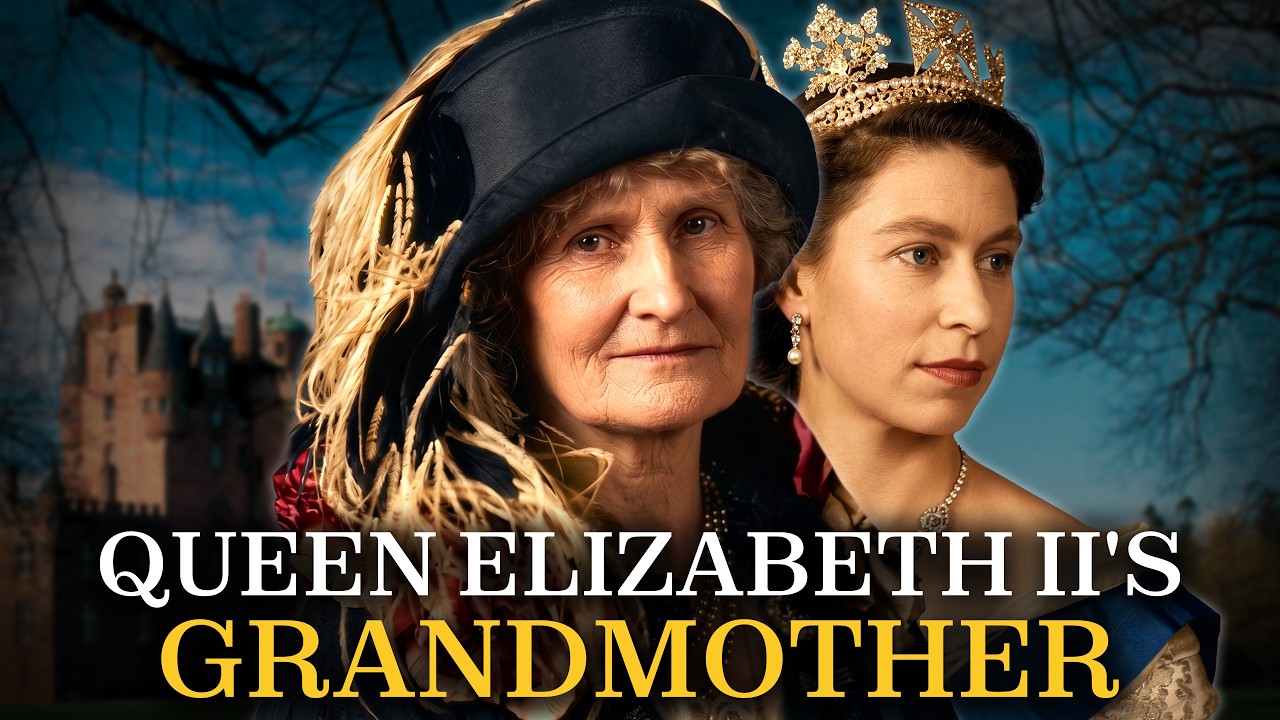
Her life divided itself among three places. Glamis Castle in Angus, Scotland, the ancestral family seat, a massive pinkish-gray fortress with turrets and a legitimately haunted reputation sitting in a valley north of Dundee. St Paul's Waldenbury in Hertfordshire, an elegant red-brick country house belonging to her father-in-law, intimate, warm, English to its marrow, with gardens, woodland, and a parish church down the road. And a rotating series of London townhouses for the social season, which she tolerated with the minimum required enthusiasm.
She did not throw herself into London society. She did not host glittering balls that a woman of her position could easily have commanded. She did not collect royal friendships or chase political influence. She turned her attention to something else entirely, something she was apparently born to do.
She started having children. Between 1882 and 1902, Nina Cecilia gave birth to 10 children across 20 years. In order, they were Violet Hyacinth, born 1882; Mary Frances, born 1883, who became Lady Elphinstone; Patrick, born 1884, heir to the earldom and eventual 15th Earl of Strathmore and Kinghorne; John Herbert, called Jock, born 1886; Alexander Frances, born 1887; Fergus, born 1889; Rose Constance, born 1890, who became Countess Granville; Michael Claude Hamilton, born 1893; then an eight-year pause, the longest gap in the sequence.
The final two arrived after that pause. Elizabeth Angela Marguerite was born in 1900, the future queen consort of King George VI, the future Queen Mother of Queen Elizabeth II, the future matriarch of the modern House of Windsor. She was born almost as an afterthought to a mother who was by then 38 years old. David was born in 1902, the baby, Elizabeth's constant childhood companion and co-conspirator.
In 2012, a writer named Lady Colin Campbell published a book claiming that Nina Cecilia did not give birth to Elizabeth and David at all. The claim was that Nina Cecilia, then in her late 30s and supposedly unable to conceive, had used her French cook, a woman named Marguerite Rodiere, as a surrogate. The theory was eagerly picked up by the tabloids.
Mainstream historians, including serious biographers like Hugo Vickers and the official royal biographer William Shawcross, categorically dismissed the entire thing. The documentary evidence for Nina Cecilia's pregnancies is solid. The claim survives mostly in gossip and speculation, but it exists because there is something unusual about those final two children: the age gap and the late age of the mother. Elizabeth and David grew up almost as a second, separate family from the older eight, raised in a different era with different expectations.
Then came the grief that would define the rest of Nina Cecilia's life. On 17 October 1893, Violet Hyacinth Bowes-Lyon died of diphtheria. She was 11 years old. She was Nina Cecilia's first child, her eldest daughter, the opening bloom of a family that had been growing steadily for a decade.
Diphtheria in the Victorian era was a catastrophic disease. There was no reliable treatment. The antitoxin that would eventually tame the disease was only beginning to be developed in European laboratories that same year. For the children who caught it, it was a death sentence with hours of conscious struggle attached.
Nina Cecilia was 31 years old. She was pregnant again with her next child, Rose. She had already given birth to six living children, and she watched her eldest daughter die. Biographers agree on what this did to her. She went into a mourning so deep that it reshaped the rest of her life.
The Scottish biographer Grania Forbes and the official biographer William Shawcross both identify Violet's death as the hinge point of Nina Cecilia's emotional life. A reserved, quiet, private young countess became a reserved, quiet, private, and permanently guarded mother. Every child after Violet would be watched with fierce protective intensity. Every fever would be terrifying. Every cough would be monitored.
From the outside, her life resumed. From the inside, a door closed that never reopened. A Victorian aristocratic woman could not collapse. There was no such option available. What she had was faith, duty, and the relentless mechanical churn of household management.
This is the woman the history books have ignored. This is the woman who would later be described as warm, humorous, and deeply kind by everyone who met her. They all met her on the other side of that door.
In February 1904, the 13th Earl of Strathmore died, and Claude inherited. Nina Cecilia, at the age of 41, became the Countess of Strathmore and Kinghorne. She ran the estates the way she ran her household, with a mixture of Victorian discipline, practical economy, and a total refusal to perform wealth.
Glamis Castle and St Paul's Waldenbury became her operational territory. She was not the sort of countess who drifted through drawing rooms being decorative. She was the sort who understood the accounts. She knew the staff by name and which tenants on the estate were struggling, which ones had sick children, which ones needed coal for the winter. The estates under her management did not become grander. They became better run.
Around 1910, she designed a garden. The Italian Garden at Glamis Castle is not a minor decorative feature. It is a substantial formal garden with yew hedges, geometric layouts, stone steps, and reflective pools, the whole Renaissance-inspired vocabulary sitting in the grounds of a medieval Scottish fortress. Architectural and estate histories credit the design definitively to Nina Cecilia.
Without hiring a famous landscape architect, she worked it out herself, drew it herself, and oversaw its planting herself. A countess with 10 children running two massive estates, doing local charity work, attending church three times on Sundays, and in her spare time quietly becoming enough of a garden designer to create one of the more beautiful features of Glamis Castle. The garden is still there today. The Queen Mother played in it as a small girl. Queen Elizabeth II walked through it as a teenager. It was her mother's garden in every sense.
Nina Cecilia also became what her position required her to be: a hostess, a local patron, a pillar of the Scottish Episcopal Church at Glamis and the Anglican Church at St Paul's Waldenbury. She supported the estate workers. She visited the rural poor. She organized local charity like a quartermaster running a military operation. This was Victorian aristocratic noblesse oblige at its most functional. She genuinely believed she was answerable to God for how she treated the people who lived on her land. So she treated them well.
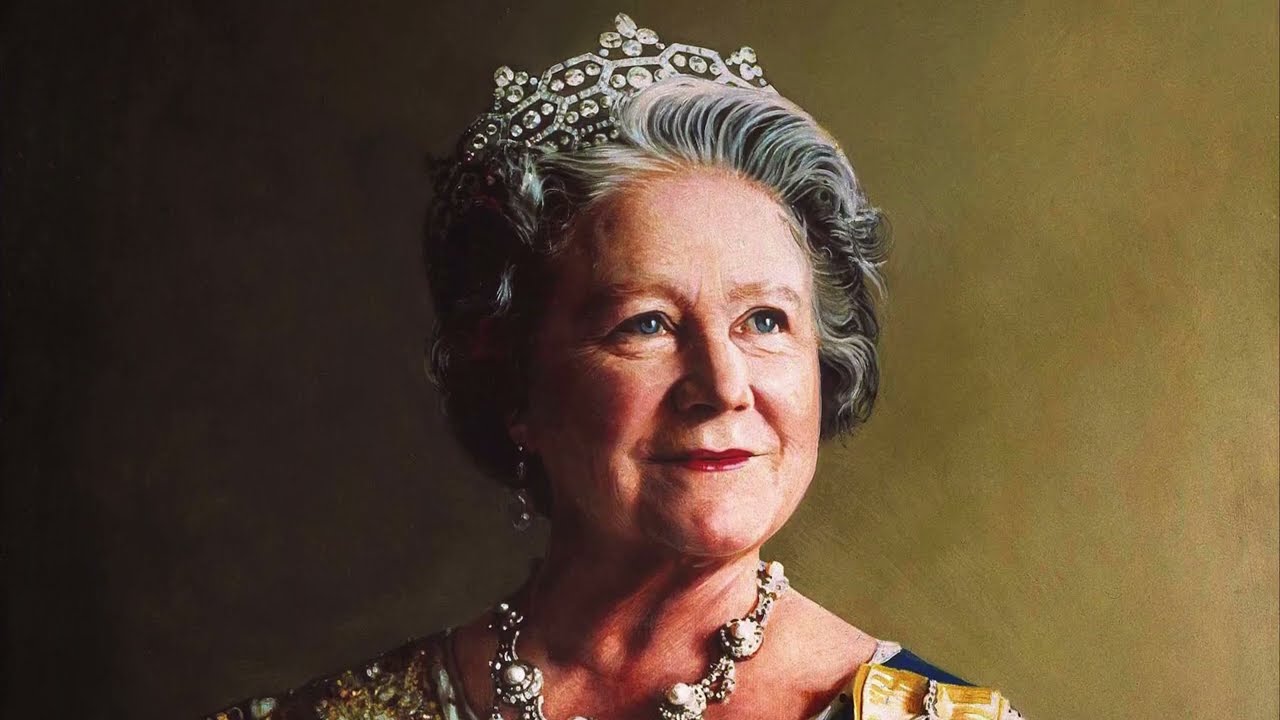
When her children started growing into their own lives, she channeled most of her available energy into the youngest two, Elizabeth and David, who became her closest companions in her later years.
Then, in 1914, somebody in Sarajevo shot an Archduke. Europe went to hell. The First World War arrived at Glamis Castle with the speed of a telegram. Nina Cecilia did not hesitate.
She walked into the grand dining room at Glamis, looked at the long polished table and the oil paintings and the candelabras, and had the place cleared out to become a hospital ward. The drawing rooms followed. What had been a Scottish aristocratic castle became within weeks a convalescent hospital for wounded British soldiers. Her 14-year-old daughter, Elizabeth, the future Queen Mother, worked alongside her.
This is the part the royal hagiographies always soften into something cozy. It was not cozy. The men arriving at Glamis had been shelled, shot, gassed, mutilated, blown up, burned, and shipped north on hospital trains to recover in a Scottish castle because there was nowhere else to put them. Nina Cecilia and her teenage daughter fed these men, wrote letters home for the ones who could not write, sat with the ones who could not sleep, and watched some of them die.
Then came 27 September 1915. Her son, Captain Fergus Bowes-Lyon, 26 years old, was leading an attack on the Hohenzollern Redoubt during the Battle of Loos. Loos was a slaughter: poison gas, barbed wire, machine guns, mud, British officers being mowed down by the hundred. Fergus was killed that day.
The news reached Glamis, and Nina Cecilia collapsed. This was her third child lost. Violet in 1893, an infant, Alexander Francis, had died in 1911. And now Fergus, cut down in France, body unrecovered at the time, another casualty of a war that was consuming the aristocratic families of Britain at a rate that would have been unthinkable before 1914. The woman who had held herself together through every previous loss finally gave way, and the household ran on the momentum she had built before she broke.
Then, in 1917, another telegram. Her son Michael, serving in France, was reported missing in action. Missing in 1917 almost always meant dead. The protocol was clear. The family should expect confirmation in due course.
Nina Cecilia refused to grieve. She told her family flatly that Michael was not dead. She said she could feel that he was still alive. Her other sons, including her heir, Patrick, believed Michael was gone. They wanted their mother to accept it. She would not. She insisted with the stubborn conviction of a woman who had already lost too much to accept another loss without proof.
Months later, the confirmation came. Michael had been captured. He was a prisoner of war in Germany, and he was alive. You can call it a mother's instinct, or a refusal to process another grief. Call it whatever you want, but she was right, and her family never forgot it. Michael came home when the war ended.
Nina Cecilia, now 56 years old, had survived the slaughter of a generation. Her daughter Elizabeth was a young woman who had spent her entire teenage years nursing wounded soldiers, and a shy, stammering prince of the realm was about to come calling.
Prince Albert, Duke of York, was the second son of King George V. Second sons of British kings were historically useful for one thing, existing as backup in case something happened to the heir, and otherwise largely left to their own devices. Albert, called Bertie by his family, was shy to the point of social paralysis, stammered so severely that public speaking was a physical ordeal, and suffered from a nervous stomach that had plagued him since childhood. His older brother Edward was the charming one, the one everybody was watching, and the future king.
Bertie wanted to marry Elizabeth Bowes-Lyon. He proposed in 1921. She turned him down. He proposed in 1922. She turned him down again. The British press turned this into a love story because the British press turns everything into a love story. The reality was more practical.
Elizabeth Bowes-Lyon, raised by Nina Cecilia in a household that valued privacy above almost everything else, was extremely reluctant to surrender her life to the performative grind of royal duty. She had watched her mother manage aristocratic responsibility with quiet grace. She understood exactly what saying yes to a prince would cost her: the freedom.
Nina Cecilia supported her daughter's hesitation completely. The official biographies are clear on this. There was no aristocratic mother pushing her daughter at a royal. There was a mother who had built her entire life around the value of private domesticity and who understood exactly what her youngest daughter was being asked to give up.
But Bertie did not give up. He proposed a third time in early 1923, and this time Elizabeth accepted. They married at Westminster Abbey on 26 April 1923. The British public, primed for a royal wedding by a press hungry for any distraction from post-war economic chaos, turned up in crowds. Elizabeth, 22 years old, walked into the Abbey as Lady Elizabeth Bowes-Lyon and walked out as the Duchess of York.
Nina Cecilia was now the mother-in-law of a royal duke. The press tried to make her a figure, but she refused. She stayed at Glamis and St Paul's Waldenbury and continued doing what she had always done: run her estates, play her piano, read her Bible, and tend to her remaining children and the grandchildren who began arriving with increasing frequency. She was about to become one of the most important grandmothers in British history, and she had no intention of being famous for it.
In 1926, Nina Cecilia's first royal granddaughter was born. Her name was Elizabeth Alexandra Mary. The world would eventually know her as Queen Elizabeth II. In 1930, a second royal granddaughter arrived, Margaret Rose.

The two princesses spent significant portions of their childhood summers at Glamis Castle and St Paul's Waldenbury, and what they found there was the woman who had made their mother. Nina Cecilia, by then in her 60s, gave her granddaughters exactly what she had given her own 10 children: piano lessons, long outdoor walks, Bible readings, a quiet and structured daily rhythm, and a total absence of the press attention that had already begun to smother the royal household in London.
Queen Elizabeth II would later speak about her maternal grandmother's influence on her. She credited Nina Cecilia with teaching her something about steady, unflashy dedication to duty. The phrase the Queen used, across decades of various reminiscences, kept coming back to the same idea: quiet duty. The kind of duty you perform when nobody is watching. It does not require applause to sustain itself.
This is the part of Nina Cecilia's legacy that historians miss because it is invisible. What she did was transmit a specific set of values: Anglican faith, emotional restraint, private domesticity, unshowy charity, and absolute loyalty to family. She transmitted them to her youngest daughter. That daughter transmitted them to her own daughter. And that daughter became the longest reigning monarch in British history.
The spine of the modern monarchy is Nina Cecilia Bowes-Lyon's spine. The House of Windsor inherited its emotional architecture from a Scottish countess who died in 1938 and whose name barely appears in the public record. When Queen Elizabeth II sat in Buckingham Palace in 2022, 96 years old, still answering letters, still meeting ambassadors, still doing the work, she was performing a version of womanhood that her grandmother had designed in a drawing room at Glamis Castle during the reign of Edward VII.
You cannot separate them. The three women, grandmother, mother, daughter, are a single continuous thread of stubborn, unglamorous, religiously motivated duty running through the twentieth century like a steel cable inside a concrete pillar. Without any of the three, the whole structure falls. And Nina Cecilia was the first one.
By 1938, she was 75 years old. She had lived through the reigns of Queen Victoria, Edward VII, George V, Edward VIII, briefly and scandalously in his 11-month appearance before he abdicated for Wallis Simpson, and her son-in-law George VI. She had watched her daughter Elizabeth become first a duchess, then, entirely unexpectedly, queen consort of the United Kingdom in December 1936, when Edward VIII walked away from the throne and dropped the crown into George VI's terrified, stammering hands.
Nina Cecilia's youngest daughter was now the queen of England. The social transformation for the Strathmore family was total. A daughter of a Scottish earl had become, through a sequence of historical accidents, the First World War, the death of older royals, the abdication crisis, the consort of a British monarch. The Bowes-Lyons were no longer just aristocrats. They were, by marriage, the in-laws of the crown.
Nina Cecilia's response to this elevation was exactly what you would expect by now. She refused to change. She did not move to London. She did not adopt royal mannerisms or seek audiences. She stayed in Scotland and the English countryside and continued stubbornly to be herself.
On 28 April 1938, her granddaughter Anne Bowes-Lyon, not the royal Elizabeth, a different granddaughter on the Strathmore side, married Thomas Anson, Viscount Anson. It was a family wedding, the sort of large aristocratic gathering the Strathmores had been hosting for generations. Nina Cecilia attended. During the wedding, she suffered a severe heart attack. She survived, but she never fully recovered.
The months that followed were a slow decline in London at 38 Cumberland Mansions, a flat in Marylebone that the Strathmores maintained as their London residence. She was cared for by family. Her daughter, the Queen, visited. Her grandchildren visited.
On 23 June 1938, Nina Cecilia Bowes-Lyon, Countess of Strathmore and Kinghorne, died at the age of 75. She was buried on 27 June 1938 in the family vault at the parish church of St Fergus, Glamis, the small country church that had been attached to the castle estate for centuries.
Senior members of the royal family attended the funeral. The Times published an obituary. The public tributes emphasized her quiet dignity, her wartime service, her devout faith. Nothing about her was made into a spectacle because she had spent 75 years refusing to let anything about her be made into a spectacle.
Her daughter, Queen Elizabeth, grieved privately and kept working. There was, by then, a war coming that would demand everything the Queen had, and the Queen had been raised by a woman who had taught her exactly what everything looked like. Within 15 months of Nina Cecilia's funeral, Britain was at war with Nazi Germany, and her daughter, Queen Elizabeth, was walking through the bombed-out streets of the East End of London, shaking hands with people who had lost everything, refusing to leave Buckingham Palace even under Luftwaffe attack, becoming the single most popular royal consort in British history. The woman who had built the Queen was already in the ground at Glamis.
History remembers the loud ones, the abdicating kings, the photogenic princesses, the ones who ran off with Americans or died in tunnels or gave dramatic interviews. History remembers them because history is shaped by the press, and the press is shaped by spectacle, and spectacle loves a big personality. Nina Cecilia had no interest in spectacle. She lived her entire life in the margins of the official record, and the official record has mostly forgotten her for it.
But look at what she did. She married a Scottish earl and raised 10 children. She buried three of them. She turned a castle into a hospital when a war needed one. She refused to believe her son was dead when everyone told her to accept it, and she turned out to be right. She designed a garden that is still there. She played the piano every day of her adult life. She supported her estate workers. She tended to the rural poor.
Nina Cecilia taught her youngest daughter how to be a queen, and she taught her granddaughter how to be a queen. Both of those women went on to become the two most important female monarchs of the twentieth century. Neither of them would have been who they were without her. She did all of this without a press officer. She did it quietly every single day for 75 years until her heart finally stopped at a granddaughter's wedding.
The modern British monarchy is a monument built by thousands of hands, but the foundation stones were laid by a woman whose name most people have never heard. When Queen Elizabeth II spent 70 years on the throne performing a version of duty so consistent that it became its own ideology, she was enacting her grandmother's religion. When the Queen Mother stood in the rubble of the Blitz and told the East End that she was glad Buckingham Palace had been bombed too, because now she could look them in the eye, she was channeling her mother.
There is no television drama about Nina Cecilia Bowes-Lyon. There will never be a Netflix series. She is not the kind of story that sells streaming subscriptions. She was a Victorian aristocrat who believed in God and duty and family and who quietly, relentlessly, for three quarters of a century, did the work.
The monarchy she left behind has had a rough century. It has survived abdications, divorces, deaths, scandals, Netflix documentaries, and the slow erosion of every tradition it was built on. And yet it is still there. Someone built that structure to withstand what was coming. Someone gave it the bones.
Her name was Nina Cecilia Cavendish-Bentinck Bowes-Lyon. She was a Scottish countess who died in a flat in Marylebone in June 1938. The House of Windsor is still walking on the foundation she laid. History has mostly forgotten her, and it is wrong.