Somewhere in America, an 86-year-old man is living under a name that is not his. His neighbors have no idea who lives next door. His mailbox carries a name he invented, and he travels with multiple forms of identification, none of them real.
He has armed security. He wears sunglasses in every public appearance. He has lived this way for 44 years.
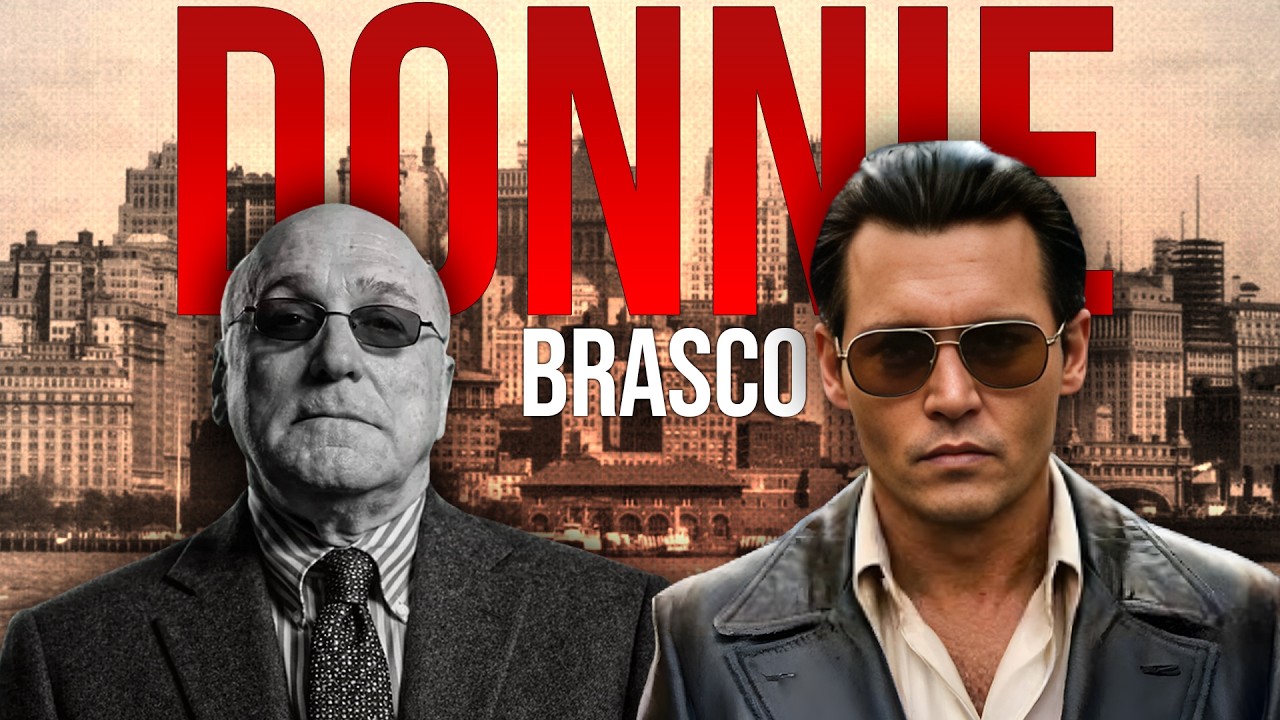
His name is Joseph Pistone, but the world knows him as Donnie Brasco.
The $500,000 contract the American Mafia placed on his head in 1981, according to Pistone himself, was never lifted. Most people know the movie — Johnny Depp, Al Pacino, the smoky bars, the paranoia, the betrayal.
What most people do not know is that the real Donnie Brasco spent six years so deep inside the Bonanno crime family that he came within four months of becoming a fully inducted made man. No federal agent had ever done that before, and none has done it since.
His operation produced over 200 indictments and more than 100 convictions. It also got an entire Mafia family expelled from the Commission for the first time in history.
But the price Joseph Pistone paid for all of that, he is still paying every single day.
Joseph Pistone was born on September 17, 1939, in Erie, Pennsylvania, to Italian immigrant parents. The family relocated to Paterson, New Jersey, where Pistone grew up in an all-Italian neighborhood soaked in Mafia influence.
His father ran a bar. La Cosa Nostra, wiseguys, cops, and judges all drank side by side. Young Pistone watched how these men talked, how they moved, how they carried themselves.
He absorbed the rhythms of that world — the greetings, the protocols, the unspoken rules about respect and territory. He did not know it at the time, but he was receiving the most important training of his life.
After high school and military academy, Pistone earned a degree and married his sweetheart Maggie in 1961. They would have three daughters.
After teaching elementary school, he spent three years at the Office of Naval Intelligence, sharpening an instinct the FBI would later exploit: the ability to operate inside someone else's world without being detected.
On July 7, 1969, Joseph Pistone was sworn in as a special agent of the Federal Bureau of Investigation. By 1974, he had transferred to the FBI New York office, landing on the truck and hijacking squad.
He went undercover inside a vehicle theft ring and pulled off over 30 arrests. He spoke fluent Italian, he had Sicilian heritage, and he understood mob culture from growing up inside it.
When the FBI decided to attempt something that had never been done — to put an agent inside the American Mafia itself — Joseph Pistone was the obvious choice.
In the late 1970s, New York's five families sat at the peak of their power. Among them, the Bonannos were the most chaotic, weakened by internal power struggles and vulnerable to infiltration.
Operation Sun Apple launched in September 1976 as a modest six-month assignment. The FBI wanted Pistone to infiltrate fences and truck hijacking rings, gather intelligence, and come home.
The cover identity was built with care. Pistone chose the name Donnie Brasco, a jewel thief based out of Miami. The Bureau enrolled him in gemology courses, taught him lock picking, and gave him fake identification and diamonds from the FBI evidence room.
He could not carry a wire. Mobsters greeted each other with hugs and kisses, and a recording device would have gotten him killed. Instead, he committed everything to memory.
Every night he would find a payphone, dial his handler, and replay everything he had seen and heard. For six months, Pistone worked bars and social clubs across Brooklyn and Manhattan, building his legend one handshake at a time.
Through Bonanno soldier Anthony Mirra, he gained entry to the family that would consume the next six years of his life. When Mirra went to prison, Pistone was taken under the wing of Benjamin "Lefty Guns" Ruggiero, a Bonanno soldier who had claimed 26 kills over a 30-year career.
Their bond became the operation's backbone. By early 1977, Ruggiero had formally vouched for Brasco as an associate of the Bonanno family.
In the Mafia, vouching for someone is a blood oath. If the man you vouch for turns out to be an informant, you die. Not him — you. Lefty staked his own life on Brasco's loyalty.
Pistone served as best man at Ruggiero's wedding. He advised him on his son's heroin addiction. He spent nearly every waking hour at his side for years, and all the while, he was building a case that would destroy the man who trusted him most.
He was living two lives simultaneously: Donnie Brasco, loyal associate, and Joseph Pistone, FBI agent, husband, and father of three girls growing up without him.
Daily operations meant truck hijacking, fencing stolen goods, loan sharking, extortion, and running illegal gambling. Pistone participated in all of it. In the Mafia, you show up, you earn, you kick money up the chain.
In July 1979, Bonanno boss Carmine Galante was assassinated. The killing reshuffled the family's power structure, and a new figure rose to the center of Pistone's world.
Dominick "Sonny Black" Napolitano was a rising captain. Where Ruggiero was a foot soldier who followed orders, Napolitano was a strategist who gave them.
Together, they ran the King's Court Bottle Club in Holiday, Florida. Pistone reported daily to Napolitano's headquarters, the Motion Lounge in Brooklyn.
The relationship gave Pistone access to conversations the FBI had never documented before — how territories were divided, how disputes were resolved, how money flowed upward.

But the deeper Pistone went, the more dangerous it became. The Mafia wanted him to kill. The FBI staged several murders, arresting the targets and keeping their names out of the papers so it appeared Brasco had done the job.
If any of those targets surfaced alive, the cover was blown and Pistone was dead.
By mid-1981, Pistone was closer to the inner workings of the American Mafia than any outsider in history. Napolitano had formally proposed him for induction as a made man. Pistone was approximately four months from the ceremony.
He fought bitterly to continue. He later said, "Can you imagine the devastation when it came out, an FBI agent becoming a made guy? It would have been the single most destructive blow to the Mafia's credibility in history."
But FBI headquarters set an immovable end date: July 26, 1981. On that day, Joseph Pistone boarded a plane to Milwaukee, and the identity of Donnie Brasco ceased to exist.
For six years, he had seen his wife and three daughters once every five to six months, a day or two at most. His daughters grew up without him.
FBI agents visited Napolitano and Ruggiero to deliver the news that Donnie Brasco was FBI special agent Joseph Pistone. Lefty lost his composure completely. He screamed, became incoherent, and stormed out.
The man he had staked his life on was a federal agent. Sonny Black never blinked. He showed no visible emotion. He said only, "You know I cannot do that." He understood what was coming.
The Mafia placed a $500,000 open contract on Pistone's life. Paul Castellano, head of the Gambino family, later ordered the contract dropped. Killing a federal agent would bring a firestorm of attention.
But Pistone has maintained for over four decades that the contract was never truly rescinded. "Where I reside, my neighbors don't know who I am," he said. "I reside under another name."
Sonny Black Napolitano knew what was coming. On August 17, 1981, he was summoned to a meeting. Before leaving, he gave his jewelry and apartment keys to his favorite bartender so someone would care for his pigeons. He knew he wasn't coming back.
At the house, Frank Coppa directed him to the basement. Robert Lino Sr. shot him. The gun jammed. Napolitano reportedly said, "Hit me one more time, and make it good." Ron Filocomo fired the fatal shot.
His hands were severed, the Mafia's symbolic punishment for letting an outsider in.
Anthony Mirra, the soldier who first introduced Brasco to the family, was murdered on February 18, 1982.
And Lefty? Lefty was saved by the FBI. On August 29, 1981, agents intercepted him heading to a meeting where he was almost certainly going to be killed. The arrest preserved his life.

Convicted of racketeering conspiracy, Ruggiero was sentenced to 15 years. He refused witness protection. He refused to cooperate. He refused to believe Brasco was FBI until the very end.
Released in April 1993 with terminal cancer, Benjamin "Lefty Guns" Ruggiero died on November 24, 1994, at age 68. His last known words about Pistone were, "I really love that kid."
Pistone's intelligence rippled outward for years. Beyond more than 200 direct Bonanno indictments, his information was cited in the 1985 to 1987 Pizza Connection Trial and the 1986 Mafia Commission Trial.
The Bonannos were expelled from the Commission, the first of the five families ever removed from the mob's governing body.
The Mafia itself rewrote its operating rules because of one man. New protocols required prospective members to commit a murder before induction. Double vouching became mandatory.
Joseph Massino personally required any prospect to be on record with a made man for at least eight years. One FBI agent from Paterson, New Jersey changed how the American Mafia did business.
Pistone began testifying publicly on August 2, 1982. He walked into courtrooms across New York, Milwaukee, Tampa, and Kansas City with detail prosecutors had never had before.
He resigned from the FBI in 1986 after 17 years. Then in 1992, at age 53, he requested reinstatement. The Bureau agreed, but only if he could pass the grueling training program at Quantico alongside recruits half his age. He passed.
He served until mandatory retirement at 57 in 1996. For everything he had done, the FBI gave him a $500 check and a medal.
The cost to his family was permanent. Maggie and their three daughters lived under assumed names, relocated five to six times, unable to tell neighbors who they really were.
Maggie died in 2025. She had spent more than half her life as someone else, and she had never chosen any of it.
Pistone's 1988 memoir became a New York Times bestseller. The 1997 film brought the story to the world. Johnny Depp played Joseph Pistone. Al Pacino played Lefty.
Made for $35 million, it earned $124.9 million worldwide and received an Academy Award nomination for Best Adapted Screenplay. Pistone rated the film 85% accurate. He was especially moved by Depp's performance. The two developed a genuine friendship that endures to this day.
In July 2025, Pistone appeared on The Joe Rogan Experience, appearing sharp and vigorous at 85. He told Rogan that where he resides now, his neighbors have no idea that they are living next to Donnie Brasco.
He maintains an active Instagram account and speaks at law enforcement conferences. He signs books. He gives interviews. All of it in plain sight.
And all of it performed by a man whose real address remains one of the best-kept secrets in American law enforcement. The name on his mailbox is still not his own.
Forty-four years later, the most famous undercover agent in American history is still undercover, still anonymous, still looking over his shoulder. And the $500,000 question, literally, is whether any of that will ever change.