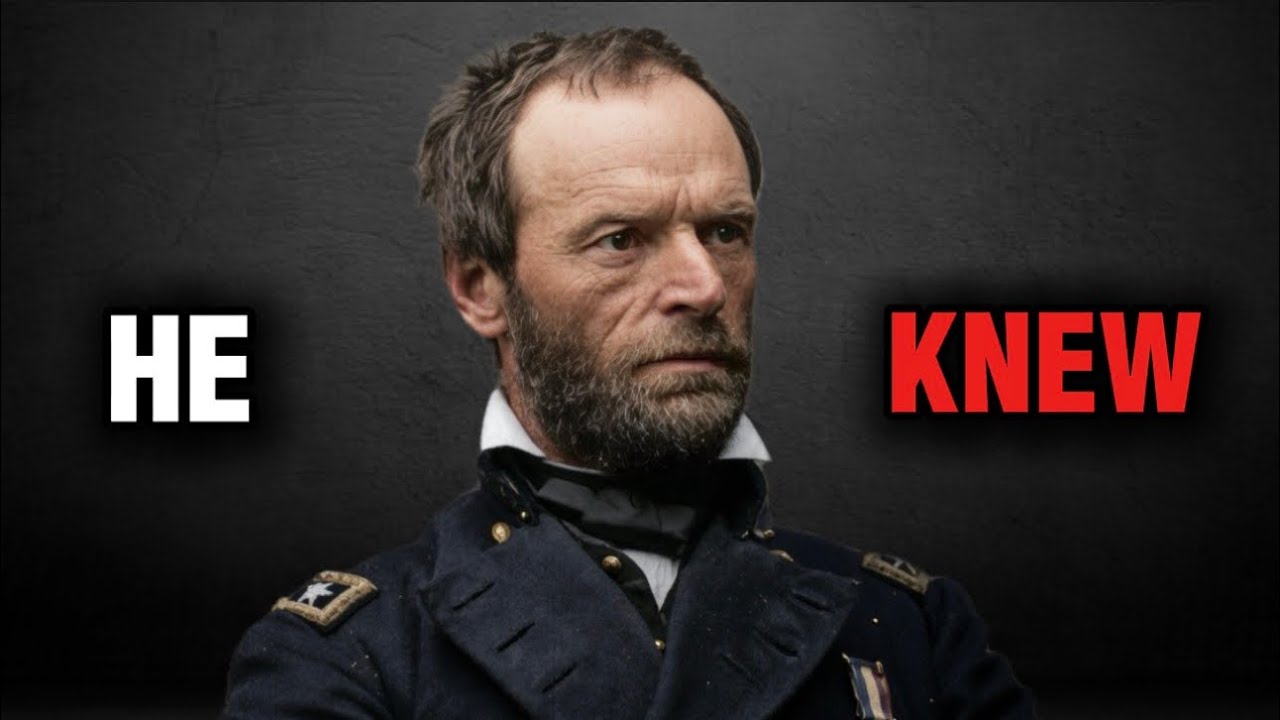
William Tecumseh Sherman lived in the South before the war, and he understood it from the inside in a way few Union generals did. He watched plantation owners speak to enslaved people with a quiet certainty that their arrangement was permanent and natural, an insight that would make him both dangerous to the Confederacy and unsettling to nearly everyone else. When he predicted the war would be long, brutal, and massive in scale—before almost anyone believed it—people called him insane. His own wife wrote letters filled with concern about his stability.
He was right, and the war burned across the continent exactly as he had described. But being right before the facts confirmed you is one of history’s loneliest positions. His early predictions were only the beginning of what nobody wanted to hear. Sherman’s deeper diagnosis was structural.
He saw a society so completely organized around a single institution that winning battles would never be enough to end it. The white southern population would remain dangerous long after the last gun fired unless the war was taken to them directly, unless the physical and psychological infrastructure of Confederate resistance was dismantled with the same thoroughness one would use to dismantle an army. He believed the war was only the first phase; what came after the fighting stopped was where he was most right, and where being ignored cost the country the most. He said with blunt clarity in letters, conversations, and later his memoirs that the white southern ruling class would never genuinely accept the outcome of the war without a sustained, serious, and probably lengthy transformation.
Grant spent the better part of two terms as president deploying federal troops to suppress Ku Klux Klan violence. He understood the problem, used federal power to address it, and then watched as northern political will evaporated. The particular cruelty of Reconstruction’s failure is that it didn’t happen because the project was tried and found impossible. It was abandoned before it could be completed.
The planters and their political allies reconstituted themselves under new names. Black men who had voted, held office, served in legislatures, built schools, negotiated labor contracts, and asserted legal personhood were driven back into a condition that borrowed every practice of slavery except the legal name. Sharecropping tied workers to land through debt instead of chains. Black codes restricted movement, criminalized unemployment, and funneled black men into convict leasing operations where they were worked to death on behalf of the same plantation economy that had preceded the war.
Sherman had not predicted every detail, but he had predicted the essential shape of it all. He argued that without a thoroughgoing transformation, the South would reconstitute itself in recognizable form. He was not optimistic about what he saw coming. The Southern Historical Society, founded in 1869, became the institutional engine of a rewriting project.
It found its most devoted champion in a man so committed to defending the Confederate legacy that he spent the rest of his life attacking any account of the war that didn’t conform to his version. A different story was told loudly and repeatedly in textbooks, monuments, novels, and films. D. W.
Griffith’s “Birth of a Nation,” released in 1915, represented the Lost Cause mythology’s most complete cultural conquest. Woodrow Wilson watched it in the White House and called it history written in lightning. It worked so completely that its version of events became the popular understanding of the Civil War and its aftermath for generations. The monuments followed the same logic.
Most Confederate monuments were not built immediately after the war in a first wave of grief. They were built in two distinct spikes. They were not memorials; they were statements of ongoing defiance, markers of contested territory, assertions that the Confederate project had not ended but had merely entered a different phase. Sherman had understood that the Confederate cause would not die quietly because it was never merely military.
He was a soldier, and the things that needed to happen after the war were not military problems. The Compromise of 1877, the deal that resolved the disputed presidential election between Rutherford Hayes and Samuel Tilden, is usually taught as a dry procedural matter, but its consequences were catastrophic. The men who had fought for black freedom were driven out by campaigns of terror that were barely concealed and entirely unpunished. The Red Shirts in South Carolina and the White League in Louisiana were paramilitary organizations whose purpose was the violent destruction of black political participation, and they operated in plain sight because no federal authority was inclined to stop them.
Grant, who had left office by then, watched from the outside. The system of racial subjugation constructed in the South after Reconstruction’s collapse lasted nearly a century, enforced by law, economic coercion, psychological terror, and periodic outbursts of spectacular violence. The Wilmington massacre of 1898, the Atlanta race riots of 1906, the Tulsa massacre of 1921, and hundreds of documented lynchings—ritualized public murders treated in some communities as entertainment and photographed for souvenir postcards—all of this was the South Sherman had been afraid the war would leave intact if Reconstruction wasn’t finished. The poverty of the sharecropping system was normalized.
The Lost Cause myth was so successfully installed in the cultural operating system that it wasn’t genuinely contested at the national level until the civil rights movement forced a confrontation in the middle of the twentieth century. Even then, the confrontation was only partial. The civil rights movement achieved historic legal and political victories, but the monuments were still standing. The textbooks in many southern states still taught the Lost Cause version of history.
The Confederate flag was still being flown from state capitals. This is where Sherman’s insight becomes genuinely unsettling. It forces a question that doesn’t have a comfortable answer. He believed the war had to be taken to the civilian population, not to kill them, but to destroy the material and psychological foundations of Confederate resistance.
That strategy succeeded brilliantly in the military theater, but it was never translated into a political project that could complete the destruction of the society that had produced the war. The civilian counterpart—the sustained political and institutional transformation of southern society—required a national will that simply did not exist in sustained form. Lincoln wanted reconciliation and was assassinated before the consequences of that instinct could play out. Andrew Johnson, who succeeded him, was a Tennessee Democrat who had remained in the Union but had no interest in black freedom as a positive good.
His interest was in preserving white supremacy under Union governance. But radicalism in American politics is never stable for long. The northern public grew tired of the southern question. The freedmen were far away, and the returns on continued engagement were invisible in the short term.
Sherman’s concern for Black Americans was not driven by any belief in their full equality; his views on race were, by any honest standard, not enlightened. But the essential dynamic he identified was that the Confederate project would reconstitute itself if not genuinely dismantled, and that former Confederates would never simply accept defeat in the deepest sense. The country grew exhausted and distracted and, in many cases, simply unwilling to do what the problem required, and so it moved on. The echoes are long.
The debate over Confederate monuments accelerated through the 2000s and came to a crisis point after the Charleston Church shooting in 2015, when Dylann Roof murdered nine Black parishioners, in part because he had absorbed Confederate mythology. The legal structure of American apartheid was dismantled. Black Americans have exercised political power at every level of American government. The culture has shifted incompletely and unevenly, but genuinely, on questions of racial hierarchy and Confederate mythology that were not even contested in mainstream discourse a century ago.
To say that Sherman was right is not to say the country is exactly what it was in 1870, because it isn’t. But the argument Sherman was making was not simply about policy outcomes. The war had solved the question of secession and the legal question of slavery, but the deeper habits of mind, the assumptions, the hierarchies, the determination to maintain power by whatever means were available—those had not been solved. He was not optimistic.
And the cost of that durability, paid most directly and most heavily by the people whose freedom and safety depended on whether the country was willing to finish what it had started, stretched across generations and is still being counted. Now is the time to save the article, and it just waits, accumulating interest until the reckoning arrives in a form that’s harder to look away from.