On October 1, 1946, in Nuremberg, Germany, the sentences were read out for 21 defendants who had been among the most important political, military, and economic leaders of Nazi Germany. After more than ten months of trial, these high-ranking representatives of the criminal Nazi regime were made to answer before an International Military Tribunal for unspeakable atrocities committed during the Second World War. It was only the first of many war crimes trials held after the war, and it became a warning to war criminals and dictators everywhere.
Once the true extent of the German atrocities, especially against Jews, was revealed, 12 of the 21 defendants were sentenced to death by hanging and seven were sent to serve their sentences at Spandau Prison. One of those sent to Spandau was Baldur von Schirach, leader of the Hitler Youth and Reich Governor and Nazi party Gauleiter in Vienna.
Baldur Benedikt von Schirach was born on May 9, 1907, in Berlin, then part of the German Empire. He was the youngest of four children of theatre director, grand ducal chamberlain and retired cavalry captain Carl Baily Norris von Schirach and his American wife Emma Middleton Lynah Tillou. She was a descendant of Arthur Middleton, one of the founding fathers of the United States and a signatory of the Declaration of Independence.
A member of the noble Schirach family, of Sorbian West Slavic origins, three of Baldur's four grandparents were from the United States, and English was the first language he learned at home. He did not learn to speak German until the age of five.
Baldur von Schirach was seven years old when the First World War began on July 28, 1914. After it ended on November 11, 1918, the victorious powers imposed a series of treaties on the defeated powers. Among them, the 1919 Treaty of Versailles held Germany responsible for starting the war and liable for massive material damages.
The treaty imposed harsh penalties on the Germans, including the loss of 13 percent of its prewar territories, extensive reparation payments and demilitarization of the Rhineland. The Reichswehr, the German Army, was restricted to 100,000 men. Baldur's brother Karl, seven years his senior, shot himself in 1919 out of grief over the Kaiser's abdication and the signing of the Treaty of Versailles.
On May 9, 1925, the day of his 18th birthday, Baldur von Schirach joined the Nazi Party. In 1929, he was selected as a national speaker and was active in Party propaganda activities. Two years later he was named National Youth Leader of the Nazi Party.
On March 31, 1932, Baldur von Schirach married 19-year-old Henriette Hoffmann, the daughter of Heinrich Hoffmann, Adolf Hitler's personal photographer. The marriage produced four children. Through this relationship, Schirach became part of Hitler's inner circle, and the young couple became welcome guests at the Berghof, Hitler's mountain residence on the Obersalzberg in the mountains of Bavaria.
On July 31, 1932, following the premature dissolution of the Reichstag, federal elections were held in Germany. Although they failed to win a majority, Hitler and the Nazis captured 37.3 percent of the vote and became the largest political party in Germany. Baldur von Schirach became a member of the Reichstag.
Adolf Hitler and the Nazi party came into power in January 1933. On June 17 of the same year, von Schirach was named Youth Leader of the German Reich with responsibility for all youth organizations in the nation. Schirach appeared frequently at rallies together with Hitler, rousing the Hitler Youth audience. The largest gathering usually took place annually at Nuremberg, where Hitler Youth members from all over Germany converged for the annual Nazi Party rally.
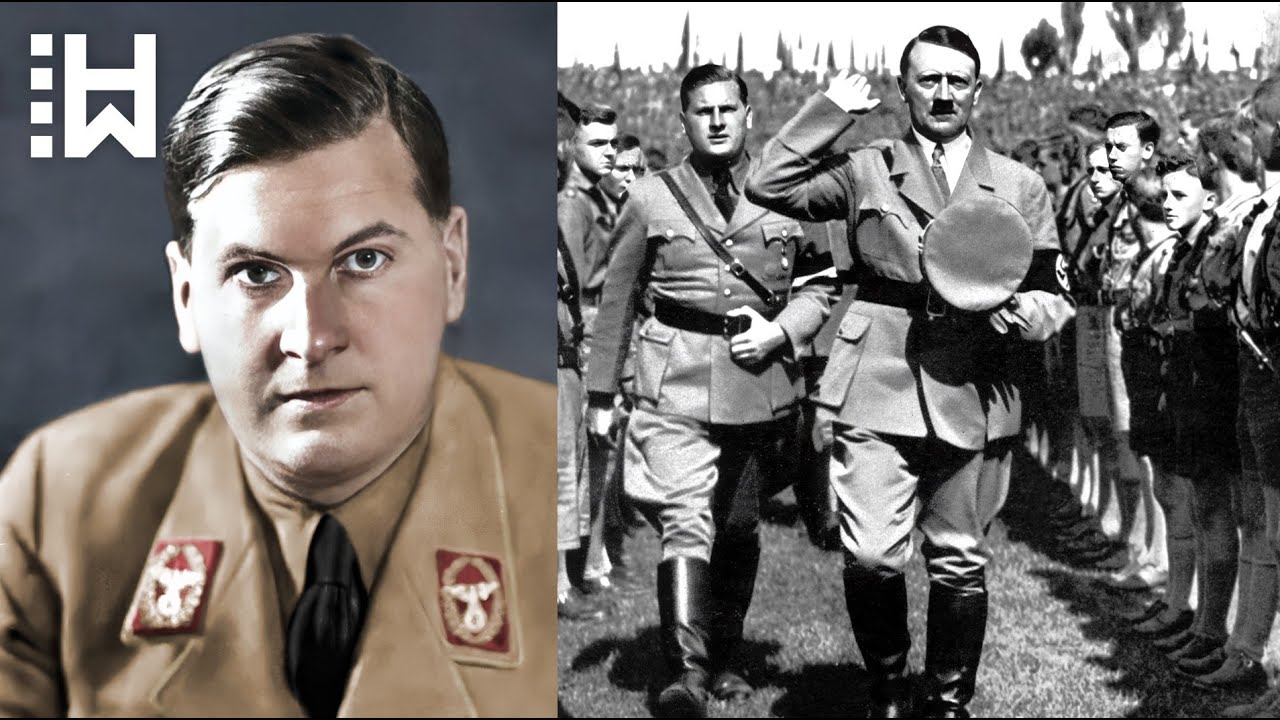
Since the Hitler Youth and its female section, the League of German Girls, were considered fully Aryan organizations by Nazi officials, premarital sex was encouraged in their ranks. At the 1936 Nuremberg Rally, where some 100,000 participants of youth organizations were present, 900 girls between 15 and 18 years of age returned home pregnant.
Both organizations were led by Baldur von Schirach and became the primary tools the Nazis used to indoctrinate young people with Nazi ideology, shaping the beliefs, thinking and actions of German youth. Boys and girls were taught to be both racially conscious and physically fit in order to build a new future for Germany, and were often present at Nazi Party rallies and marches.
While in January 1933 the Hitler Youth had approximately 100,000 members, by the end of the year this figure had increased to over two million. Jews were not allowed to join these organizations. Belonging to the organization was a significant time commitment that interfered with other priorities, such as church and school.
During these meetings, members were encouraged to abandon their individuality, wear the same uniforms, sing the same Nazi songs and participate in similar activities. This time commitment and regular exposure to Nazi ideology weakened the influence of parents, teachers, religious figures and other voices of authority. In fact, the Hitler Youth and League of German Girls even encouraged their members to report to their leaders about what was happening in their schools or churches, as well as whether their parents or neighbors were acting in line with the regime.
While girls prepared for their futures as wives and mothers, boys participated in military training. The Hitler Youth was a paramilitary organization designed to train boys as future fighters and soldiers for war. As an official organization of the Nazi state, it had a military structure at the local, regional and national levels.
Boys practiced military drills and learned how to handle weapons. They also worked on farms in the summer and participated in competitive sports. While some boys enjoyed the physical challenge, competition and camaraderie, others found the constant focus on preparing for war and sacrificing themselves for the fatherland overwhelming and alienating. It was Baldur von Schirach who set the militaristic tone of the youth organization.
In 1936, a law declared the Hitler Youth to be the only legally permitted youth organization in Germany, and stated that all of the German youth in the Reich was organized within the Hitler Youth. Compliance, however, was not universal. Members had to be ethnic Germans, German citizens, and free of hereditary diseases. By December 1936, Hitler Youth membership had reached over five million.
In March 1939, a new decree required all youth aged between 10 and 18 to join the Hitler Youth, even if the parents objected. Parents who refused to allow their children to join were subject to investigation by the authorities.
Schools too played an important role in spreading Nazi ideas to German youth. From their first days at school, German children were imbued with the cult of Adolf Hitler, and his portrait was a standard fixture in all classrooms. While censors removed some books from the classroom, German educators introduced new textbooks that taught students love for Hitler, obedience to state authority, militarism, racism and antisemitism.
By the outbreak of war in 1939, the Hitler Youth had already prepared a generation of young people to fight the war and occupy foreign territory. Those who had already turned eighteen used this knowledge to serve the German war effort, working as soldiers, policemen, secretaries, nurses and doctors.

World War II started on September 1, 1939, when Germany invaded Poland. By 1940, the Hitler Youth had eight million members. Schirach voluntarily joined the Wehrmacht, the German Army, as a reserve lieutenant and took part in the western campaign in 1940 as a member of a motorized infantry regiment. Before being recalled to Germany, he was decorated with the Iron Cross 2nd class for bravery.
During the Nazi era, Schirach was rumored to have homosexual tendencies. This might have been because of his soft facial features and rather unmasculine behavior. However, it was never proven.
On August 8, 1940, Baldur von Schirach became Reich Governor and Nazi party Gauleiter in Vienna, Austria. The same day Artur Axmann, Schirach's deputy from May 1940, replaced him as leader of the Hitler Youth. However, he retained his position as Reichsleiter for Youth Education. Reichsleiter, or Reich leader, was the second-highest political rank of the Nazi Party, next only to the office of Führer.
In Vienna, Schirach moved with his family to the Hofburg, the former principal imperial palace of the Habsburg dynasty. In the position of Vienna's district leader, which he retained until the end of the war in 1945, Schirach was responsible for the deportation of the Viennese Jews, which he described in a speech on September 14, 1942: "If you wanted to reproach me that I am deporting tens of thousands of Jews from this city to the eastern ghetto, I have to answer: I see it as an active contribution to European culture." During Schirach's tenure, 65,000 Jews were deported to concentration camps.
Schirach himself was a self-confessed anti-Semite, although he did occasionally voice cautious criticism of the Nazi persecution of the Jews. For example, it is believed that he had forbidden the unit leaders of the Hitler Youth to take part in Kristallnacht, the series of coordinated violent riots against the Jews throughout Nazi Germany and recently incorporated territories on November 9–10, 1938.
The Nazi SA and German civilians not only ransacked Jewish homes, businesses, synagogues, hospitals and schools, but the German SS and police sent almost 30,000 Jewish males to concentration camps, primarily Dachau, Buchenwald and Sachsenhausen. However, Schirach's order is controversial and has not yet been proven, as these pogroms engaged not only units of the SA but also the Hitler Youth.
In 1943, Henriette von Schirach was invited to the Netherlands by friends in the German occupation forces. She later claimed: "I heard screams outside the hotel late at night so went out to investigate. I saw Jewish women and children being bundled into transportation to be deported. I then asked a German soldier what they were doing, to which he replied, 'What Hitler is doing in Holland is wrong, we have turned the friendly Dutchmen into bitter enemies which is a big mistake, make sure you tell him this the next time you visit the Berghof.'"
And she did. Henriette broke off her visit to the Netherlands and telephoned the Berghof to make an appointment with Hitler. Years later, Henriette explained what had happened: "So I told him what I had seen. Hitler's reply was, 'You are sentimental.' He stood up, I stood up, and said, 'Herr Hitler, you ought not to be doing that.' I thought I could allow myself to say so because I had known him for so long. I have hurt him deeply, what's more in front of other men who were there. Then Hitler said: 'You're sentimental! In what way do the Jewesses in Holland concern you! This is nothing but sentimentality! Humanitarian nonsense! Every day 10,000 of my best soldiers die on the battlefield, while the others carry on living in the camps. That means the biological balance in Europe is not right anymore.'"
Henriette turned away, let him shout and ran down the staircase separating the big room from the hall. Henriette von Schirach and her husband were never invited again.
Later during the war, Baldur von Schirach pleaded for a moderate treatment of the eastern European peoples and criticized the conditions in which Jews were being deported. When he also demanded better treatment for East Europeans on June 24, 1943, he fell out of favor with Hitler, but Baldur did remain at his post in Vienna.

As it became clear that Nazi Germany was losing the war, the Nazi regime faced manpower shortages. Von Schirach's Hitler Youth was to help as well. From October 18, 1944, males aged between 16 and 60 were inducted into a new defensive militia called the Volkssturm, or the People's Storm. This militia joined the regular military in the last defensive battles against Allied troops.
The Volkssturm comprised one of the final components of the total war promulgated by Propaganda Minister Joseph Goebbels, part of a Nazi endeavor to overcome their enemies' military strength through sheer force of will. Poorly equipped and inadequately trained, thousands of youths fought and died for the German war effort even as defeat had become inevitable.
The city of Vienna in Austria was bombed 52 times during World War II. Due to the increasing lack of fuel, by autumn 1944, artillery on the ground was the only defence against air raids. Schirach, notoriously anxious about air raids, had the cellars of the Hofburg Palace in the Vienna city centre, where he lived with his family, refurbished and adapted as a bomb shelter. In addition, the lower level of the extensive subterranean Vienna air defence coordination centre in the forests to the west of Vienna held personal facilities for him. The Viennese promptly dubbed this command and control centre the "Schirach-Bunker."
On April 2, 1945, Vienna came under attack by the Red Army, which by April 9 was approaching the city centre. On that day, Schirach broadcast a final call for citizens to fight "to the last man." However, Baldur himself did not fight but instead departed his headquarters and fled westward with the 6th Panzer Army towards the Tyrol, where on May 2 he discarded his uniform and went underground under the assumed name of Richard Falk in the Austrian town of Schwaz.
On June 5, von Schirach unexpectedly revealed his true identity, as he was officially considered dead, and surrendered to the American town commandant. He was arrested by the 103rd Counterintelligence Corps.
Baldur von Schirach was then tried at the Nuremberg Trials, which were held against representatives of the defeated Nazi Germany. At the trial, Schirach was one of the only few defendants to denounce Hitler. Although he claimed he had not known about the extermination camps, the trial detailed his involvement in deportations of Jews and his speeches defending his actions.
He was originally indicted for crimes against peace for his role in building up the Hitler Youth, but was acquitted on that charge. However, on October 1, 1946, he was found guilty of crimes against humanity for his role in the deportation of the Viennese Jews to certain death in German concentration camps located in German-occupied Poland. He was sentenced to 20 years in Spandau Prison, Berlin.
Baldur von Schirach's wife and children paid the price for his crimes as well. According to her memoirs, Henriette von Schirach was imprisoned by the US Army for more than a year and was given the daily task of cleaning the prison's toilets. To do so, she was handed Hitler Youth flags by the prison guards. She recalled being mistreated and held in contempt by the white American guards, and that it was only the black soldiers who were decent to her.
Her father, Heinrich Hoffmann, was also arrested and imprisoned, so that the von Schirach children were left with no parents or grandparents to look after them. They were taken in for some years by farming families in Southern Bavaria and attended local schools. Henriette von Schirach divorced her husband while he was in prison, on July 20, 1949.
Baldur von Schirach was released from prison on September 30, 1966, after serving his full sentence. He was blind in one eye and suffering from thrombosis. He retired quietly to Southern Germany, and in an interview shortly after his release he said: "I visited one concentration camp. What I saw did not show any of the atrocities that happened and were later on disclosed. At that time I did not know of the atrocities which were being carried out. When I learned about them, I did what I could and that is my moral guilt before history. I did not do enough."
He was 67 years old when he died on August 8, 1974. "I was one of you" was the epitaph engraved on his tombstone. The grave was leveled in early 2015 after the rest period ended and the family waived an extension. There were no tears shed for Baldur von Schirach.