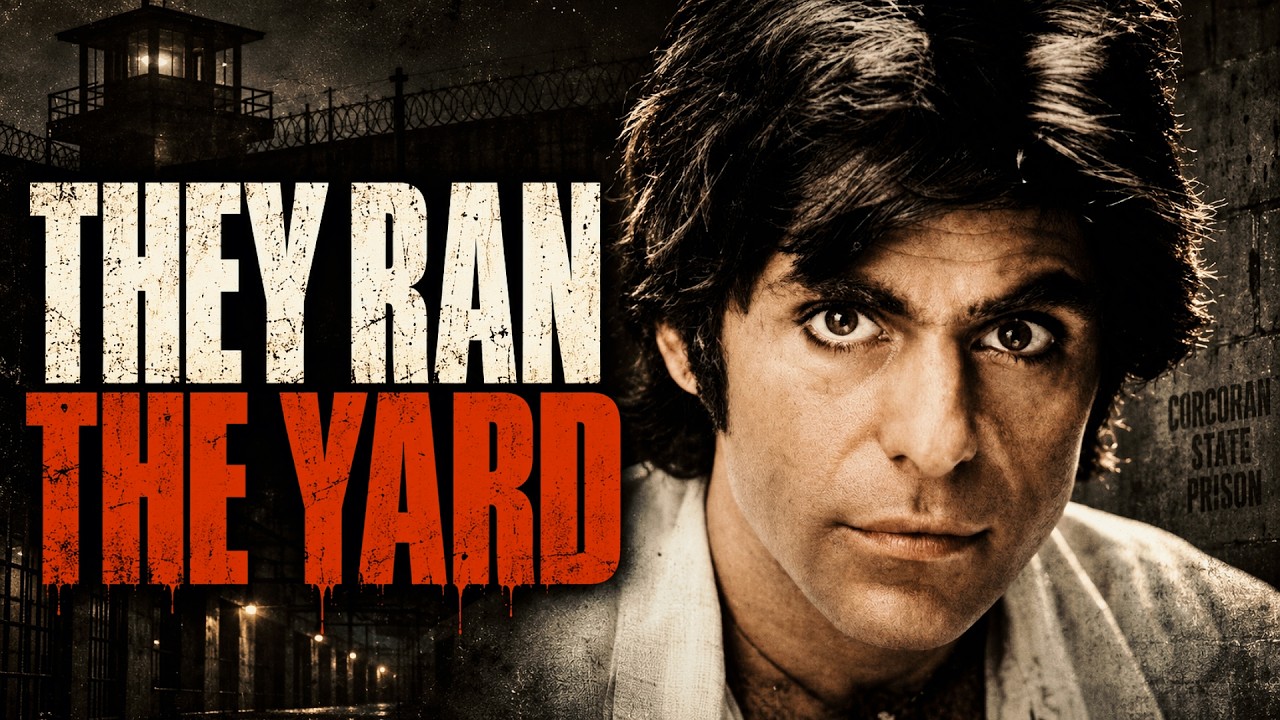
On April 2, 1994, inside the security housing unit at Corcoran State Prison in California, four inmates were released into a small, high-walled concrete exercise yard. Two belonged to one gang faction. Two belonged to a bitter rival faction. The correctional officers in the control booth knew this, because they controlled the yard lists and knew the gang affiliations intimately.
According to the federal indictments that eventually followed, the officers sent these four specific men into that enclosed space expecting exactly what happened next. Within seconds, the yard descended into a brutal fistfight. Above the concrete box, standing safely in an elevated gunpost, a correctional officer watched the violence unfold.
He moved through the escalation procedures written into department policy. First came a shouted verbal warning. Then a non-lethal round from a 37 mm gas gun echoed sharply against the concrete walls. Finally, the officer raised a 9mm rifle, tracked a young prisoner named Preston Tate, and fired a single lethal shot into his head. Tate died instantly.
Viewed through the standard lens of criminal justice, this was a tragedy of maximum security prison management, a violent riot suppressed by necessary force. But the structural behavior of the men running the Corcoran security housing unit tells a different story. What emerges is not a story of law enforcement struggling to maintain control. It is the story of a fully functional, highly organized criminal syndicate.
What happened to Preston Tate was not a riot. It was a sanctioned execution orchestrated by a cartel that operated with a level of impunity the American mafia could only dream of.
To understand how an American prison transformed into an underworld empire, you have to redefine your concept of organized crime. We are accustomed to defining cartels and mafia families by their illicit products: narcotics, illegal gambling, and extortion. But the purest currency of the underworld is not money. It is leverage, the absolute monopoly over life, death, and consequence within a given territory.
In the late 1980s and early 1990s, the California Department of Corrections experienced an unprecedented multi-billion dollar boom. The state was building massive institutions across the rural Central Valley, turning desperate farming communities into booming prison economies. In these towns, the correctional officer's badge was the most lucrative, stable job for 50 miles in any direction.
Corcoran was designed to be the crown jewel of this booming empire. It was built to be the end of the line, the absolute bottom of the abyss, specifically engineered to house the worst of the worst: the generals, lieutenants, and foot soldiers of the Mexican Mafia, the Aryan Brotherhood, and the Black Guerrilla Family. The state concentrated the most dangerous organized crime figures in America into a single hyper-controlled environment.
But in doing so, the state inadvertently created a secondary criminal organization. The officers guarding the security housing unit, the SHU, realized they held absolute unchecked power over the gang members. They controlled the food, the movement, the mail, and the yard time. Power when entirely isolated from outside oversight inevitably structures itself into a cartel.
The guards developed their own version of omertà, the mafia's sacred code of silence. They called it the Green Wall. It was a cultural absolute that dictated one unbreakable law: staff do not report staff. You do not talk to internal affairs. You do not question a colleague's actions. You unconditionally back the narrative of the uniform regardless of the truth.
It was enforced with the same mechanisms the mafia used: ostracism, intimidation, and the terrifying knowledge that if a riot broke out on the floor, your fellow officers might not come to your rescue if you were labeled a rat.
But the Green Wall possessed a structural advantage that traditional mafia families lacked. When a mafia hitman kills someone, he has to hide the body in a trunk or bury it in a shallow grave. When a Corcoran guard killed an inmate, he simply sat down and filled out the paperwork.
This was the true terrifying genius of the Corcoran machine. The officers involved in the Preston Tate shooting did not flee the scene. They returned to their desks and wrote official reports. They documented that the fight was spontaneous, that the verbal orders were ignored, and that the lethal shot was absolutely necessary to prevent severe bodily harm.
The paperwork closed over the killing like water. The state's internal reviews cleared the officers without a second glance. The machine rubber-stamped its own violence. Preston Tate became the seventh prisoner shot dead in the Corcoran SHU in five years, alongside roughly 50 more who were seriously wounded by gunfire.
The guards at Corcoran achieved the ultimate criminal evolution. They built a syndicate where the state provided the weapons, the taxpayers paid their salaries, the powerful officers union provided the political protection, and the victims were men society had already discarded. The officers did not need to hide in the shadows. They operated a killing floor in broad daylight, protected by a fortress built of bureaucracy and political influence.
To fully grasp the operation, you cannot simply look at the guards. You must look at the weapons they used. The Corcoran cartel did not need to hire hitmen to enforce their will. They looked at the intricate violent politics of the Mexican Mafia and the Aryan Brotherhood and realized they could weaponize the inmates' own gang rules against them.
The guards were not just shooting fish in a barrel. They were carefully managing a gladiator economy, and the rules of the arena were designed to ensure that no matter who won the fistfight, the house always kept the absolute power.
The security housing unit at Corcoran was not a standard penitentiary. It was an exercise in sensory deprivation and weaponized geography. Inside the SHU, a prisoner spent 22 and a half hours a day locked inside a windowless concrete and steel box. There were no educational programs, no vocational training, and no communal dining halls. There was only the suffocating, relentless silence of total isolation.
When you strip a human being of all external stimuli, when you remove the basic interactions of normal society, you do not rehabilitate them. You regress them down to their most primal, paranoid survival instincts. In this absolute vacuum, the only social structure that survived was the gang.
The California prison system was and remains a battleground dominated by highly organized paramilitary syndicates. The Mexican Mafia, their bitter Northern California rivals Nuestra Familia, the Aryan Brotherhood, and the Black Guerrilla Family were not loose collections of street thugs. They were formal organizations governed by strict constitutions, internal taxation systems, and lethal enforcement protocols.
By concentrating the generals, lieutenants, and enforcers of these warring factions into the Corcoran SHU, the state had essentially packed a powder keg with the most volatile explosives in the American underworld.
The spark designed to ignite this powder keg was a bureaucratic maneuver known as the integrated yard policy. On paper, the California Department of Corrections claimed the integrated yard policy was a progressive attempt to force rival gang members to learn how to coexist. Rather than segregating the warring factions and allowing them to run their own exercise yards, the state mandated that rival inmates be released into the tiny concrete recreation pens together.
In the sterile, air-conditioned offices of Sacramento politicians, this sounded like a tough but fair approach to prison management. In the brutal reality of the Corcoran SHU, it was a government-issued death warrant.
The correctional officers operating the control booths understood the internal laws of the prison gangs better than anyone. They knew the fundamental rule of the underworld: blood in, blood out. They knew these gangs were engaged in formal declared wars with one another. And crucially, they knew exactly how an individual soldier was required to act when confronted by an enemy.
If an Aryan Brotherhood soldier was placed in a confined space with a Black Guerrilla Family member, or if a Mexican Mafia enforcer was penned in with a Nuestra Familia rival, the rules of their respective organizations dictated immediate violent engagement. This was not a suggestion. It was a mandate of survival.
If a gang member refused to attack a rival, if he attempted to walk away, negotiate, or simply stand in the corner to avoid a fight, he was immediately branded a coward and a traitor by his own leadership. Treason inside a prison gang carries an automatic, non-negotiable death penalty. If a prisoner refused to fight in the yard, he might survive the afternoon, but he would inevitably be assassinated by his own cellmate or stabbed in the showers by his own brothers weeks later.
This is the psychological masterpiece of the Corcoran machine. The correctional officers did not have to go down into the cells and physically force the inmates to fight. They did not have to threaten them. They simply utilized their absolute control over the yard rosters. They would take two men from warring factions, open their cell doors simultaneously, and release them into a space roughly the size of a large dog run.
The prisoners walking out onto the concrete knew exactly what was happening. They were seasoned operators. They looked up at the elevated gunpost, saw the officer tracking them with the 9mm rifle, and understood instantly that they were being played for entertainment. They knew they were pawns in a rigged game, but they fought anyway. They fought because the officers had engineered a flawless, inescapable trap.
The prisoner was forced to calculate an impossible arithmetic of survival. If he refused to fight, his own gang would certainly execute him later. If he engaged in the fight, he risked taking a beating or worse, taking a bullet from the gun rail above. But the bullet was only a possibility, whereas the gang's retribution was an absolute certainty. Faced with the choice between a guaranteed death sentence from the underworld and a probable bullet from the state, the prisoners chose the yard fight every single time.
This mechanism is the defining trait of an advanced criminal syndicate. The most powerful mafia bosses in American history, men like Carlo Gambino or Tony Accardo, rarely committed acts of violence themselves. Their power was derived from their ability to manipulate the environment, forcing lower-level associates to carry out the bloodshed on their behalf. The boss remains clean, observing from a distance, while the street-level soldiers destroy each other in a desperate bid for survival.
The guards at the Corcoran SHU adopted this exact managerial philosophy. They outsourced the initiation of violence to the victims themselves. By weaponizing the gangs' own internal bylaws, the officers created a self-sustaining engine of brutality. They transformed the prison yard into a proxy war zone, operating the levers of life and death from the safety of a heavily armored control booth.
Once the officers realized they could reliably produce this violence on command with zero resistance from the inmates and absolute legal protection from the state, the integrated yard ceased to be a management policy. It evolved into a blood sport. The men in the gunposts were no longer just guards. They were the directors of a macabre theater, and they were about to build a booming economy on the backs of the gladiators they created.
In the architecture of any great criminal conspiracy, there is a midpoint where the true nature of the enterprise reveals itself. Up until this point, a casual observer might look at the bloodshed in the Corcoran security housing unit and see a tragically flawed system, a prison overwhelmed by gang violence, struggling to maintain order under impossible conditions. But the historical record demands a complete re-evaluation of that premise.
The violence at Corcoran was not a symptom of a system breaking down. The violence was the system functioning exactly as it was designed. To understand the pathology of the institution, you must stop looking at the SHU exercise yard as a recreational area and begin looking at it as a factory floor. The product being manufactured was violence, and the consumers were the men wearing the state badges.
They operated a highly organized five-step machine that transformed a taxpayer-funded penitentiary into a privately managed blood sport. The guards themselves had a name for this era, and the name they chose is a full unvarnished confession. They called them the Gladiator Days.
Step one of the machine was the mix. The violence was never random. The control booth officers acted as underworld promoters, carefully curating the yard lists. Federal indictments would later state in clinical terms that officers intentionally sent rival inmates out together, knowing exactly what the result would be. They paired specific enemies, managing the factions to guarantee an immediate explosion the second the heavy steel doors slid open.
Step two was the theater. Once the trap was set and the prisoners locked into the concrete box, the administrative veneer melted away. The tiny yards were walled, secure, and perfectly staged for observation. Multiple investigations, federal probes, and news accounts later described officers treating these life-or-death struggles as scheduled entertainment. The guards watched from above and, according to the testimony of their own colleagues, placed wages on the outcomes of the fights.
An FBI supervising agent would later remark that the brawls appeared entirely provoked for the amusement of the staff. A Corcoran prisoner speaking to a legal publication summarized the entire arrangement in five chilling words: shooting fish in a barrel.
Step three was the gun. This is where the cartel exerted its absolute leverage. Department policy mandated armed yard posts and authorized the use of lethal force to stop inmate fights. Consider the sheer disproportion of that legal framework. A fistfight anywhere else in America is a misdemeanor typically broken up with a baton or pepper spray. In the Corcoran SHU, a fistfight carried a potential death sentence administered on the spot without a trial by the very man who had engineered the confrontation. The lethal ending was built into the architecture of the game.
Step four was the paperwork. This is the bureaucratic camouflage that separates a street-level gang from a state-sponsored cartel. Every time a 9mm rifle cracked across the yard and an inmate bled out on the concrete, the machine automatically generated reports. According to later indictments, these reports were meticulously crafted to justify the unjustifiable. The paperwork always claimed the fight was spontaneous. It always claimed the verbal orders were ignored. It always claimed the lethal shot was a tragic, unavoidable necessity. The state's internal review boards accepted these reports without question, effectively rubber-stamping homicide.
Step five was the silence. The glue holding the entire machine together was the Green Wall. If an honest officer witnessed the theater, the wagers, and the unwarranted executions, the code of silence ensured their compliance. To speak out was to commit professional suicide and invite severe physical danger in an environment where your life depended entirely on your colleagues.
Policy, theater, gun, paperwork, silence. That was the machine. From 1989 to 1994, it operated with flawless efficiency, killing seven prisoners and severely wounding roughly 50 more. By the end of the decade, statistical reporting would reveal a staggering truth: California prison guards had shot and killed more inmates than every other state prison system in the United States combined. And Corcoran led California. It was the most dangerous prison in America precisely because it was dangerous by design.
But to truly grasp the depths of the syndicate's depravity, you have to look outside the yard. The Gladiator Days were not limited to the exercise pens. The cartel applied its mechanics to every aspect of SHU life. And no incident proves this more clearly than the case of Eddie Dillard.
In 1993, Eddie Dillard was a slight, young, and defiant inmate who had arrived in the SHU and immediately clashed with the guards. He was a disciplinary problem, a nuisance who refused to submit to the psychological domination of the control booth. But in the Corcoran cartel, you did not file a standard disciplinary report for a nuisance. You put a hit out on them.
The guards decided Dillard needed to be broken. But they did not enter his cell to beat him themselves. That would leave them legally vulnerable. Instead, they employed the classic mafia tactic of outsourcing the violence to an independent contractor. The officers deliberately housed Dillard in a cell with a feared, heavily built prisoner named Wayne Robertson, a man known throughout the institution as a violent sexual predator.
The guards knew exactly what Robertson was capable of, and they weaponized him. According to subsequent testimony, including the testimony of Robertson himself, who confirmed the setup, the guards placed Dillard in the cell and turned a blind eye as Robertson brutally assaulted the young man over a period of days.
This was the same gladiator machine simply moved into a different room. The institution was purposefully weaponizing its most dangerous inmates against the ones it wanted punished. It was a terrifying realization of absolute power. The guards at Corcoran were operating a system where they could order an assault or a murder and have the entire horrific transaction subsidized by the state budget.
They had built a perfect, impenetrable fortress of violence. They were backed by a powerful union, shielded by a corrupt bureaucracy, and protected by a code of silence that seemed unbreakable. The machine was flawless. But like every great criminal empire in American history, the Corcoran cartel failed to account for the one variable that always brings the architecture crashing down. They assumed the silence would last forever.
Every criminal syndicate in history, no matter how insulated or powerful, eventually discovers the same fatal flaw in its architecture. The code of silence is only as strong as the conscience of the men forced to uphold it. For the American mafia, omertà was broken by men like Joe Valachi and Tommaso Buscetta, insiders who realized the organization they bled for was actively trying to destroy them.
For the Corcoran cartel, the code of silence was known as the Green Wall, and it was broken because two men looked at a dead body on the concrete and decided they could no longer stomach the cost of doing business.

The killing of Preston Tate on April 2, 1994, was the seventh lethal shooting in the security housing unit. In the mechanical, blood-soaked routine of the Gladiator Days, it should have been just another piece of paperwork. The reports were filed. The officers were cleared. The incident was supposed to be buried.
But something fundamentally fractured inside two men watching from within the system: Officer Richard Caruso and Lieutenant Steve Rigg. To understand the magnitude of what Caruso and Rigg did next, you have to understand who they were. These were not liberal prison reform activists. They were not civil rights attorneys looking from the outside in. They were career corrections men.
Rigg was a lieutenant, a high-ranking supervisor who understood the absolute political machinery of the institution. Caruso was a veteran officer who walked the tiers and managed the yards. They were institutional insiders, members of the very tribe that operated the machine.
When a civilian reports a crime, it is an act of civic duty. When an insider reports a syndicate, it is an act of institutional treason. Caruso and Rigg decided to bypass the completely compromised internal affairs division of the California Department of Corrections. Instead, they walked out of the prison, crossed the invisible line of the underworld, and went directly to the FBI office in Fresno.
In the insular, hyper-dangerous world of maximum security corrections, breaking the Green Wall is a psychological and physical suicide mission. In a traditional mafia family, a rat is simply murdered. In a penitentiary, the retaliation is far more insidious. A correctional officer relies entirely on his colleagues to survive. If a riot breaks out, if an inmate slips his cuffs, or if a blind spot on the tier is compromised, your life depends on the officers guarding your back.
To inform on those officers is to guarantee that the next time you press your panic button, the response might be intentionally, fatally slow. Rigg and Caruso knew exactly what they were trading away. They knew they were effectively ending their careers and putting their own lives in jeopardy. They talked anyway.
But Caruso and Rigg did not just walk into the FBI with rumors and moral outrage. They understood how the cartel operated, and they knew the state's default defense mechanism was to claim that inmates lie. So they circumvented the firewall.
When Richard Caruso left Corcoran to meet with federal agents, he carried the organization's ledgers with him. Caruso had quietly and methodically smuggled out internal documentation. He provided the FBI with the actual yard rosters, proving that rival gang factions were repeatedly and deliberately paired together. He brought the internal shooting reviews that rubber-stamped every execution. He provided the exact paperwork the machine used to launder its violence.
In mafia terms, Caruso did not just confess to the authorities. He handed the FBI the commission's accounting books. The state could easily dismiss the testimony of a convicted felon, but it had absolutely no defense against its own handwritten bureaucratic paper trail.
The cartel's retaliation against the whistleblowers followed the classic syndicate playbook with chilling precision. From the moment the leak was suspected, Caruso and Rigg were marked. The historical record documents the immediate suffocating pressure applied to both men. They received the cold shoulder in the break rooms. They were subjected to sudden intense scrutiny of their own daily work, a bureaucratic harassment designed to force them out. They received threats carefully folded into friendly advice about the dangers of working in a prison without the trust of your fellow officers.
The Green Wall was flexing its muscle, sending an unmistakable message to every other guard in the system. This is what happens when you turn against the family.
However, the Green Wall was terrifying not merely because of the physical danger on the cell blocks, but because of the massive political architecture standing behind it. The Corcoran cartel was not a rogue, isolated street gang. It was the heavily armed enforcement wing of a massive political constituency.
You cannot analyze this era without acknowledging the absolute apex of this power structure: the California Correctional Peace Officers Association, the CCPOA. In the 1990s, the prison guards union was arguably the most powerful, heavily funded political force in the state of California.
As the state engaged in a historic prison building boom, turning the Central Valley into a penal economy, the union's membership and war chest exploded. The CCPOA was a donor heavyweight. Their money flowed in millions to the campaign coffers of state legislators and governors from both major political parties. They actively lobbied for the draconian sentencing laws that kept the prisons overcrowded and guaranteed the endless expansion of their industry.
And crucially, their formidable legal machinery stood firmly behind any member facing charges. When a Corcoran guard shot an inmate in the SHU, that guard knew he was not standing alone. He knew he was backed by a union that could paralyze a politician's career and deploy the most ruthless defense attorneys in the state.
This is what separated the Corcoran guards from the mobsters of Philadelphia or New York. When Nicodemo Scarfo or John Gotti went to trial, they had to fight the entire weight of the United States government from the outside. But the guards at Corcoran were the government. The syndicate was subsidized by the taxpayers, armed by the state, and protected by the politicians.
Richard Caruso and Steve Rigg had successfully dragged the machine into the daylight. The FBI was building its indictments, and investigative journalists were about to blow the story wide open. But as the case prepared to move from the shadows of the concrete yard into the blinding lights of a federal courtroom, the ultimate question of leverage remained. How do you convict a cartel when the cartel owns the courtroom?
By 1996, the internal documents smuggled out by Richard Caruso and Steve Rigg had metastasized from a quiet federal probe into a public relations apocalypse for the California Department of Corrections. The Green Wall had held for half a decade, burying the bodies and sanitizing the paperwork, but it could not withstand the sheer undeniable weight of its own administrative records.
The rupture began in August 1996. The Los Angeles Times published a massive front-page investigative report by journalist Mark Arax. Arax did not simply write a story about a troubled prison. He laid bare the entire mechanical anatomy of the Corcoran security housing unit. He exposed the curated mix of rival gangs, the staged theater of the integrated yards, the orchestrated shootings, and the horrifying body count. He officially designated Corcoran as the most violent, troubled prison in the state of California.
The investigative reporting shattered the department's standard defense mechanism. For years, the state had reflexively dismissed any allegations of guard brutality as the fabricated complaints of convicted felons. But the public was no longer listening to inmates. They were reading the accounts of the state's own high-ranking whistleblowers and looking at the state's own internal shooting reviews.
The media explosion rapidly escalated. The national news program 60 Minutes aired two separate segments bringing the brutal reality of the Corcoran SHU directly into millions of American living rooms. The California State Senate, facing intense public pressure, was forced to open official hearings.
But the moment that turned the scandal white hot, the moment that permanently seared the Gladiator Days into the historical record, was the release of a documentary titled Maximum Security University. The film was built entirely from the prison's own internal surveillance tapes. The state of California had meticulously recorded its own atrocities.
Anyone in America could now turn on their television and watch the unedited footage of four separate yard fights in the Corcoran SHU. They watched the heavy steel doors slide open. They watched the immediate frantic brawls. And they watched in chilling black and white as the fights abruptly ended when a correctional officer in the gunpost shot a combatant dead. The visual evidence was absolute. It was no longer a debate over policy. It was a nationally televised snuff film produced by the state government.
The federal government finally moved to dismantle the syndicate. In February 1998, federal prosecutors in Fresno unsealed a sprawling nine-count indictment. They charged eight Corcoran officials, including two sergeants, a lieutenant, and five officers, with conspiring to violate the civil rights of prisoners through the staging of the yard fights. The execution of Preston Tate was the absolute centerpiece of the government's case.
Simultaneously, a separate trial was moving forward regarding the brutal orchestrated assault on Eddie Dillard, pulling four more guards into the legal crosshairs. This was the moment of reckoning. The federal government was deploying the exact same legal tools it used to dismantle the five families of New York. But the Corcoran cartel was not an ordinary mafia family, and the resulting courtroom battle revealed a terrifying truth about the limits of American justice.

The trial for the Preston Tate shooting commenced in the spring of 2000 in a federal courtroom in Fresno, California. To understand the outcome of this trial, you must first understand the geography of the jury box. Fresno is the economic heart of the Central Valley. It is an agricultural hub that throughout the 1980s and 1990s had been completely economically revitalized by the California prison boom.
In these communities, the Department of Corrections was not an abstract government agency. It was the largest employer for miles. It was the institution that paid the mortgages, funded the schools, and provided the pensions. Attempting to convict eight correctional officers in Fresno was the structural equivalent of attempting to convict John Gotti with a jury entirely composed of his own neighborhood associates in Howard Beach, Queens.
The jury pool was inherently, inevitably sympathetic to the uniform. And standing behind those uniforms was the California Correctional Peace Officers Association. The union deployed a massive legal defense fund, hiring the most formidable, aggressive defense attorneys in the state. They did not enter the courtroom to apologize or to beg for leniency. They entered the courtroom to put the federal government on trial.
The defense strategy was a master stroke of institutional deflection. It was the bureaucratic equivalent of the Nuremberg defense. The attorneys did not deny that the fights happened. They did not deny that Preston Tate was shot in the head. Instead, they argued that the men in the gunposts were simply obedient employees operating a machine designed by their superiors.
The defense lawyers held up the California Department of Corrections official manual. They pointed to the integrated yard policy written and approved by high-ranking bureaucrats in Sacramento, which mandated that rival gang members be released together. They pointed to the state's deadly force policy, which explicitly authorized the use of 9mm rifles to stop those very fights.
We didn't invent the Gladiator Days, the defense argued. We just followed the rules you wrote. They brilliantly transformed the prosecution of eight individual men into an indictment of a massive, faceless state bureaucracy. By blaming Sacramento, the defense attorneys made the violence an abstract administrative failure rather than a personal, prosecutable homicide. They convinced the jury that the officers in the gunposts were just as trapped by the system as the inmates bleeding on the concrete. The guards were just doing their jobs.
The trial consumed nine grueling weeks. The federal prosecutors presented the smuggled yard rosters. They played the surveillance tapes. They put the whistleblowers Richard Caruso and Steve Rigg on the witness stand to testify against their former brothers. They laid the entire undeniable architecture of the cartel on the table.
On June 8, 2000, the case went to the jury. For a complex nine-week federal civil rights trial involving mountains of documentary evidence, surveillance footage, and deeply contested legal theories, a jury would typically deliberate for days, perhaps even weeks, to parse through the nuances of the law. The Fresno jury deliberated for exactly six hours. They returned to the courtroom and delivered a blanket acquittal. All eight men were found not guilty on all charges.
Combined with the previous acquittals in the Eddie Dillard assault case, the final legal scorecard of the Corcoran prosecutions was etched into history: 12 correctional officers tried, zero convictions. Not a single homicide charge was ever brought. Not a single officer spent a day in federal prison. The justice system had completely failed to penetrate the cartel's armor.
The union celebrated. The Green Wall held. And the state essentially legally validated the executions in the SHU.
But history rarely operates on the clean binary logic of a courtroom verdict. Because while the jury was acquitting the men who pulled the triggers, the exposure itself was quietly achieving what the federal prosecutors could not. The machine was about to die, and the way it died serves as the most damning, inescapable confession the state of California ever made.
The final tally of the federal prosecutions regarding the Corcoran security housing unit is one of the most chilling statistics in the history of American civil rights jurisprudence. Across multiple massive, highly publicized trials involving mountains of smuggled documentation, internal whistleblowers, and video evidence of actual homicides, the Department of Justice brought charges against 12 correctional officers. Zero convictions. Not a single man spent a day in federal prison.
The defense strategy had worked flawlessly by arguing that the officers were simply following the integrated yard and deadly force policies written by the state of California. The defense legally completely insulated the men who pulled the triggers. They proved that if a cartel is sponsored by the government and if its violence is authorized by bureaucratic manuals, the traditional mechanisms of justice are powerless against it. A corrupt man can be arrested, indicted, and imprisoned. But a corrupt design operating exactly as intended is legally untouchable.
Yet while the juries in Fresno were acquitting the guards, the Corcoran machine was quietly dying. And how it died serves as the most damning, inescapable confession the state of California ever made.
Under the crushing weight of the investigative journalism, the Senate hearings, the unsealed FBI indictments, and the televised surveillance tapes, the California Department of Corrections was forced to adjust its optics. The political heat had simply become too intense. In the late 1990s, the state quietly revised its deadly force policy. They officially ended the practice of answering yard fights with live 9mm rifle fire, mandating the use of non-lethal interventions instead.
The effect of this simple bureaucratic edit was immediate, absolute, and total. From the moment the scandal broke into the open and the policy was changed, the lethal shootings simply stopped. Not a single Corcoran prisoner was shot dead in a yard fight in the years that followed.
Sit with the psychological gravity of what that actually proves. For a decade, the Green Wall, the union, and the defense attorneys had vehemently insisted that the shootings were tragic, unavoidable necessities. They argued that firing live ammunition into the exercise yards was the only possible way to manage the worst, most violent gang members on Earth. They claimed the bullets were saving lives.
Then the cameras arrived, the policy changed, and the necessity evaporated overnight. The prison did not collapse into total anarchy. The guards did not lose control of the institution. Order was maintained without the body count, which means the seven dead men in the security housing unit, including Preston Tate, had never been necessary at all. They had simply been permitted.
Institutions of that magnitude rarely admit error. They do not issue apologies, and they do not voluntarily send their own executives to prison. They just quietly stop what they are doing, and they let the stopping speak for itself. The silence that fell over the Corcoran yards was the loudest confession the system ever made.
The Gladiator Days were over not because they were illegal, but because they were no longer politically convenient. The state quietly settled the financial liabilities. The families of the dead men were paid off with taxpayer money, including an $825,000 settlement paid to the family of Preston Tate, the young man whose death started the entire investigation and for whose murder no human being was ever held criminally responsible.
But if you want to measure the true terrifying power of the state cartel, you only have to look at the final balance sheet of the men involved. The officers who orchestrated the fights, the men who wagered on the bloodshed, and the men who fired the rifles into the yards were acquitted. They were transferred to other facilities. They were promoted through the ranks. And eventually they retired with full state-funded pensions, disappearing into comfortable anonymity.
The only two men inside the system whose lives were genuinely, permanently destroyed by the Corcoran scandal were Richard Caruso and Steve Rigg, the whistleblowers, the men who broke the Green Wall. The retaliation was absolute. They were ostracized, harassed, and subjected to such severe psychological pressure that both men eventually left the Department of Corrections on stress disability. They were branded as traitors and became entirely unemployable in the only industry they had ever known.
In the Corcoran machine, orchestrating a murder was just a matter of department policy. Telling the truth about it was the only unforgivable crime.
In 2008, Hollywood attempted to process this trauma with the film Felon. Director Ric Roman Waugh compressed the entire documented machine into a cinematic narrative, giving audiences the staged yard fights, the gun rail, and a corrupt lieutenant who runs his cell block like a private coliseum. The movie is visceral, and it earned its cult standing because it accurately captured the physical texture of the yards.
But movies are designed to provide moral catharsis. Felon frames prison violence as corruption, a good system hijacked by a few bad sadistic men. Because that is a narrative with an exit. It allows the audience to believe that if you just remove the bad apples, the system is saved. The movie ends the way movies must. The corrupt lieutenant is exposed, arrested, and the machine is dismantled.
The historical record of the American underworld offers no such comfort. The Gladiator Days were not a betrayal of policy. For half a decade, they were the policy. The integrated yards, the armed posts, the lethal force authorizations, they were all explicitly written in Sacramento, executed in Kings County, and defended in federal court so effectively that juries could not find a single guilty man in a machine that shot nearly 60 people.
We began by questioning the definition of organized crime. We are conditioned to fear the street bosses, the cartel lords, and the mafia dons. But the men running the Corcoran SHU achieved the ultimate criminal evolution. They built an empire that utilized the exact same tools as the mafia, a code of silence, territorial control, and lethal force. But they convinced the government to finance it and the law to protect it. They committed the perfect crime right out in the open and left nothing behind but the paperwork.