In eastern Kentucky, there is a road that forks where no road should fork. Both branches look the same. Both cut into the hills. If you take the wrong one and do not realize it immediately, you may walk for a full hour before it stops being a road at all.
The branch you do not want is called Gunt Fork. The man who lived at the end of it was worse than anything the movies ever put on a screen. He was not a monster out of folklore, and he was not a creature from a fairy tale. He was a man. A man with a name, a birth year, and a mother buried in a nearby Baptist church cemetery. That is what makes it worse.
The county in question is not the one you might expect. It sits between the headwaters of the Cumberland River and the West Virginia line. In the 1880s, two roads were cut through it to reach the timber. One ran south along the river. The other ran north over the hills. That second road is the one people called the county road. It is the one on the maps.
The other road split off three miles past the last farm on the left-hand climb. It never appeared on any map. It ran roughly five miles up into a hollow the county called Sorwood Bench. A wagon could pass it in summer if you were careful, and it led to a house.
Picture that house first. Not a horror scene, not a shape among the trees. A house. A small, plain house built into the side of the hill, half buried in the earth, roofed with slate the man had quarried himself. Its windows faced the road. Its door was on the uphill side.
The man who lived there was named Randle. He was 52 years old in October 1927. He had been born in the county and had never left it. His mother was a Randle. His father was a Randle. His grandparents were very close, the same man twice. The Randles had married inside that valley for nearly a hundred years, and by the time it mattered, only two people in the county still carried the name.
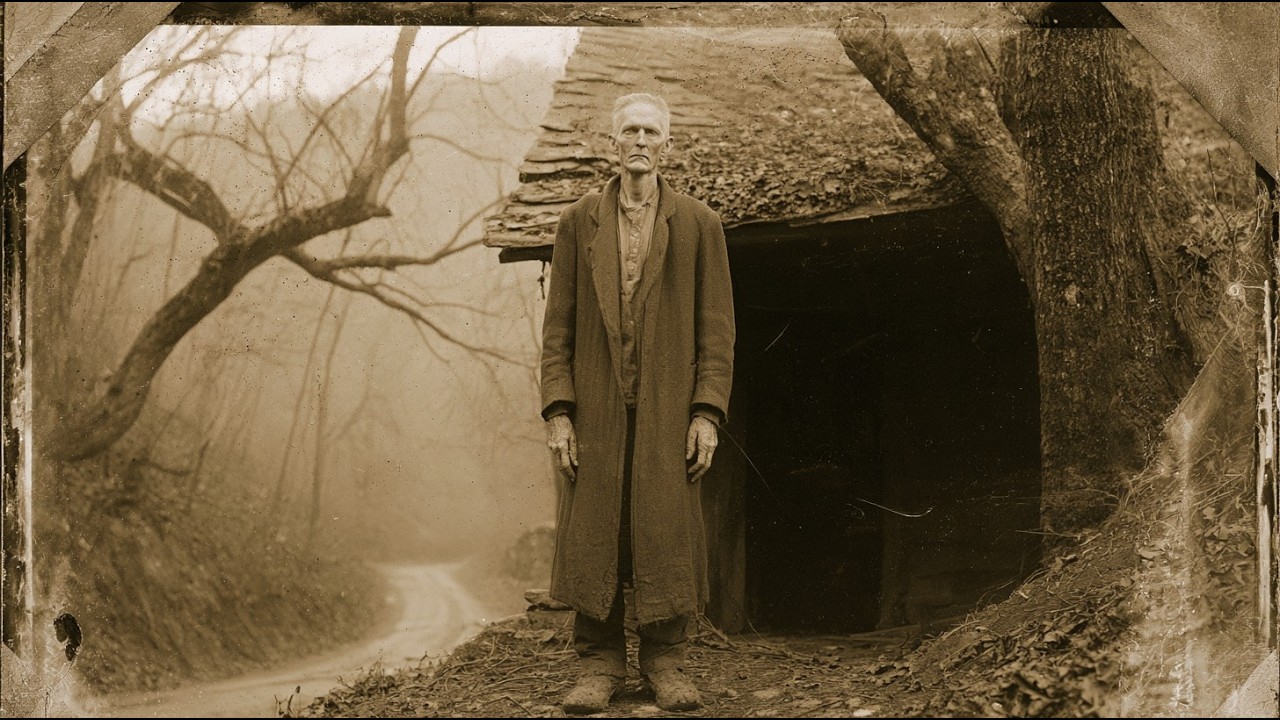
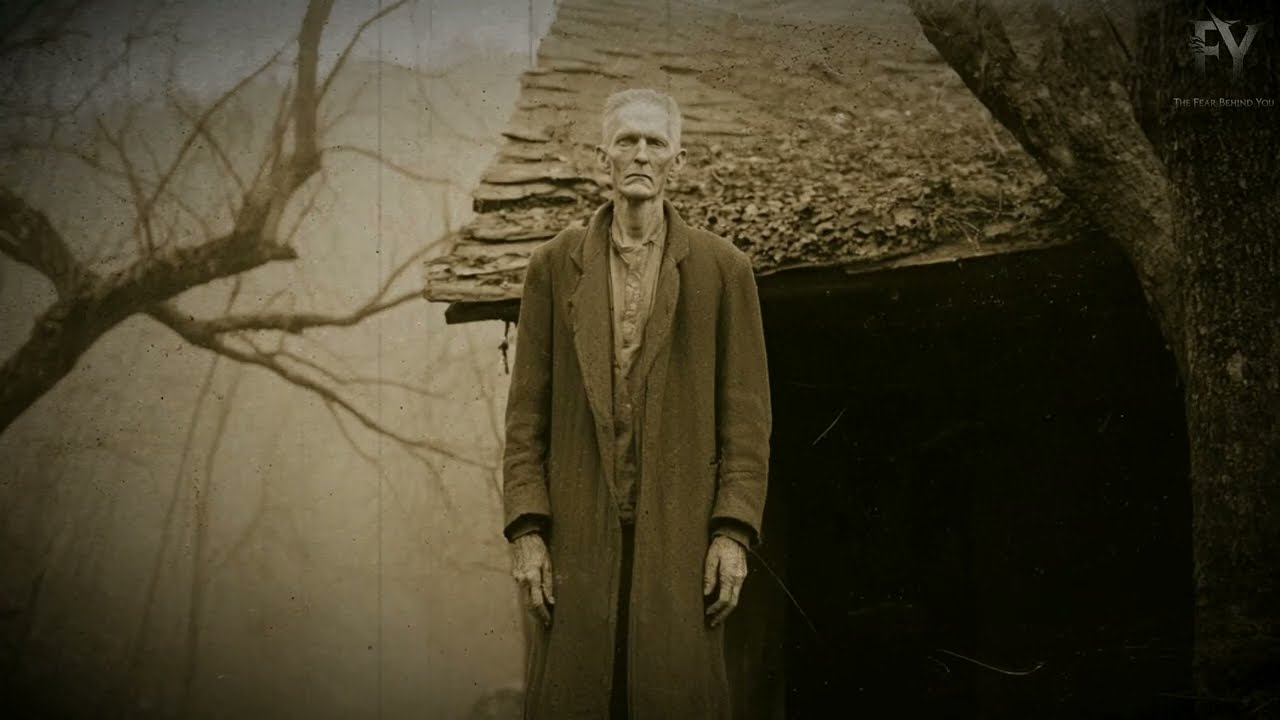
He was tall for the region, exactly six feet, thin as a fence post, with a long face, iron-colored hair, and hands so large they did not fit his wrists. He wore the same brown wool coat for nineteen straight years, according to a man who saw him twice a decade apart and recognized the coat before the man.
He came down from Sorwood Bench about once a year. Once a year to a store at the head of the county road, where he traded furs and honey for salt, coffee, black powder, and matches. He did not speak. He wrote what he needed on a scrap of paper, handed it across the counter, and paid in coin.
The storekeeper knew his name from the coin. He asked once, in 1912, and Stone wrote the answer for him. After that the storekeeper kept it on a paper card in a drawer, in case he ever needed to explain the tall man to someone. He never had to explain it, not to anyone who asked with authority, because no one ever asked.
That is where Delford Cliff enters the story. Cliff was a timber estimator. He was 41, from Louisville, married, with no children, and had worked for a Cincinnati lumber company for nearly a decade. His job was to survey stands of timber and estimate the board feet, so the company could decide what to buy and what to leave. He carried a compass, a measuring stick, a small notebook, and a rifle he had never fired at a living thing.
In the second week of October 1927, he was sent to survey Sorwood Bench. The lumber company had bought the cutting rights on a ridge above it and wanted a cost estimate before moving the mill camp. Cliff took the train to the town at the head of the county road on a Sunday evening.
He stayed at a boarding house run by a widow named Ferley Coras. He ate a supper of pork and cornbread in a room lit by a single oil lamp, and over his second cup of coffee he asked Mrs. Coras about the road up to Sorwood Bench.
She stopped what she was doing, coffee pot in hand, and looked at him for a moment as if checking whether he was serious. Then she said, in words she later remembered exactly because she wrote them down herself in a letter to the sheriff the following week: "There are two ways up to that bench, sir. The road keeps going up, and it forks left three miles past the last house you will see. Do not take the fork."
Cliff laughed. He was a city man who had spent a lot of time in the country, and he laughed the way a city man laughs at a warning that does not match his picture of the world. He said, "Ma'am, I have been in the woods since I was a boy. I appreciate it, but the fork is likely the shorter way, and if the company is paying by the day, I will take it."
She said nothing back. She just poured his coffee. In the morning, when he came down for breakfast at four, she was not in the kitchen. A young woman of about twenty was cooking. She gave him a tin of biscuits wrapped in newspaper and told him Mrs. Coras had gone to sit with her sick sister. The young woman also told him, without being asked: "Take the county road, sir, all the way. Do not take the fork."
Cliff thanked her, put the biscuits in his bag, went out to the stable, and rode the horse the company had sent ahead. He set off on the county road at dawn on Monday, the second of October, 1927.
Three people saw him between the boarding house and the last farm. All three later said the same thing: he was in no hurry. He studied his compass. He rode up the valley like a man who believed he knew what was in it.
The last farm on the county road belonged to a man named Ozro Webb. Ozro was 71 that October. He had been born on that farm in 1856 and would die on it in 1933. He was sitting on his porch when Cliff passed, and he raised his hand. Cliff raised his hand back.
Ozro watched him go on. He watched him reach the place where the road bent left up along the ridge, and he watched him stop. Cliff halted his horse, looked at his compass, looked at the county road climbing, looked at the fork going left, half hidden behind a stand of poplars, and took it.
Ozro watched him take it. Ozro did not run after him, and he did not call out. He did not shout, and he did not even get up from his porch chair. He would tell the sheriff later, when the sheriff finally came to ask: "I figured if a man was going to take that road, he was going to take it. It was not mine to change his mind."
That was the last time Delford Cliff was seen. Ozro Webb sat on his porch and watched him ride into a stand of poplars on the left side of a road that was on no map.
The lumber company expected a telegram from Cliff by Wednesday. No telegram came. On Thursday they wired the boarding house. Mrs. Coras went to the store and asked the storekeeper's son to walk two miles to the telegraph office in the county seat and send back the reply no one wanted. The man had left Monday morning and had not returned.
By Friday the company had wired the sheriff. Sheriff Alger was 53, with fourteen years in the office. He was a heavy man, not tall, with a face that looked unsurprised by almost anything. He read the telegram twice, then sat at his desk for a long minute doing nothing, because he remembered a peddler.
The peddler's name was Bascom Webb, no relation to Ozro. Webb was a common name in that county. Bascom was a traveling peddler who came through about twice a year with a wagon of tinware and cloth. In the summer of 1908 he had ridden up the county road toward Sorwood Bench and had not come back.
His wagon was found empty at the fork. Two weeks later his mule wandered down the road, half starved and missing its shoes. Monr was a deputy then. He had ridden with the old sheriff. They walked about half a mile up the fork. Then the old sheriff stopped, looked at the trees, and said: "Bascom Webb got lost. That is what we will write, and you and I are going home."
The old sheriff died in 1913. Monr inherited the office and the drawer of open cases. Bascom Webb was in that drawer. There was also a preacher named Ozias Vann, a circuit preacher who passed through in the summer of 1919 on his way to a revival in the next county. Vann asked the storekeeper for the shortest way, and was sent, as the storekeeper always insisted, to the county road. Vann did not come back either. His horse was found tied at the bottom of the fork three days later. No one went up.
Now Monr sat holding the wire in his hand, reading about a timber trader from Louisville named Delford Cliff. He knew where Cliff was. He had known it for eighteen years, somewhere in a part of his brain he preferred not to open.
He went up to Sorwood Bench on Saturday. He took one deputy, a man named Rafe Coldiron. Coldiron was 24, new to the office, raised on a farm at the mouth of another hollow ten miles east. He had heard about the dry fork at some point in his life. Everyone in that county had heard about it. No one could tell you exactly what they had heard.
They passed Ozro Webb's farm at midmorning. Ozro was sitting on the porch as before. Monr came up to his door and asked if he had seen the Louisville man. Ozro said he had passed on Monday and had taken the fork. Monr said, "You watched him take it." Ozro said, "Yes." Monr said, "And you did not call him back." Ozro looked at him and said, "Not out of shyness."
Monr said, "Exactly. And not without shyness either." Ozro said, "Now, Sheriff, there are customs here. I do not think I will teach them to you at 71, and I do not think you will teach them to me. That man took the fork according to his compass. That is what I will say if anyone forces me to swear."
Monr nodded under his hat and rode on. They reached the fork shortly after noon. The mare was there. Cliff's horse was tied to a post at the bottom of the fork, a post neither Monr nor Coldiron remembered. A single piece of poplar, split into two prongs driven into the ground. It looked new. It looked as if someone had put it there recently for the specific purpose of taking horses off travelers.
The mare had not been fed. Her water bucket was empty. She had drunk at some point from a pool at the base of a rock. She had not been beaten. No one had ridden her up. Someone had simply led her to the post, tied her, and left her.
Coldiron said, in a voice lower than his own: "Sheriff, somebody wanted us to find the horse." Monr looked at him. He said, "Somebody wanted us to know the man went up on foot." Coldiron did not answer that.
They untied the mare, and Coldiron led her about a hundred yards down to where she could reach grass. Then they went back to the fork, and Monr stood at its mouth for a long time, looking up. The fork was narrow, overgrown on both sides. But under the growth the road was solid, dirt packed over gravel, over what looked like old stone laid down about seventy years before.
Someone had built that road once, and someone had maintained it, and someone was still using it. Because in the mud at its mouth, Monr found a single boot print, pointing toward the county road, as if a man had come to the mouth of the fork and stood there and then turned around and gone back.
Coldiron saw it too. He said, "This is not a side road." Monr said, "No, son. It is not."
They followed the fork on foot. Monr told Coldiron to stay ten steps behind him. The road was not steep. That was the first thing that bothered Monr. The road was not steep, and it was not bad, and it was not the kind of road a town man would hesitate to take. It was easier than the county road. If you walked it, you would think for a long while that you had made the right decision.
They walked about a mile, and then the trees closed in. At about the mile mark, Monr saw the first strange thing: a wagon wheel. Just a wheel. An iron rim, oak spokes, and a hub the size of a man's fist, leaning against a tree ten feet off the road. No wagon, no axle, no wreckage. Just the wheel, set carefully as if it had been put aside for a reason.
Coldiron said, "That is Bascom Webb's wheel." Monr said, "You do not know that." Coldiron said, "Sheriff, nobody drives a wagon on this road. That is a peddler's wagon wheel, and it was set there against that tree like somebody wanted it seen."
Monr did not answer him. But he thought, and he did not write this down, though he told his wife about it twenty years later on a night he could not sleep. He thought: whoever put that wheel there put it there to be seen by a lawman, not a lost traveler. A lawman. As if to say: I know you. I know why you are here, and I want you to know that I remember.
They went on. At a mile and a half, Monr saw the second thing. A shoe. Left foot, size 10, badly worn, laces still in it. Set upright on a tree stump beside the road. Coldiron did not identify that shoe out loud. He looked at it for a long time. Then he looked at Monr. Monr said quietly, "Keep walking."
At a mile and three quarters, the smell started. It is worth being careful here. The smell was not of anything fresh. It was the smell of something old, something that had been fed in the same place for a long time. Coldiron said, "Sheriff, I do not want to be here." Monr said, "I know." Coldiron said, "I want to go back." Monr said, "Then go back to the horses. Wait at the fork. Do not come up."
Coldiron did not go back. He stayed ten steps behind Monr, and they kept walking.
At a little over two miles, the road bent hard right around a rock outcrop and opened onto a flat. A small grassy meadow, maybe an acre, set into the side of the hill, with a spring at its far end. A garden. A small, tended garden along the near side, with corn stubble, a patch of pumpkins, and dozens of apple trees, old, heavy with unpicked fruit. And at the back of the meadow, dug into the hill, the house.
The house was low, not tall enough for a man of Stone Randle's height to stand in without stooping, at least not near the door. Which meant, and Monr did not think of this at the time but Coldiron did later, that a man of Randle's height standing at his own door would already be bent, already closer to the ground than a stranger coming in.
It had a slate roof. Monr recognized the slate. It came from an outcrop on the north side of the hill, two acres wide. Someone had carried it. Someone had carried a great deal of slate across rough ground for many years.
There was no smoke. The door was shut but not locked. There was no lock, just a wooden latch on a wooden peg. Monr called out first. He said, in a voice he tried to keep level: "Mr. Randle, this is Sheriff Monr from the county seat. I am here about a man from Louisville. I would like to talk with you."
No one answered. He called again. Nothing. He looked at Coldiron. Coldiron was pale. Monr had known him since the day he was born, almost. He knew his father and his grandfather, and he had never seen him pale. Monr said, "Stay outside. Watch the tree line." Coldiron nodded.
Monr lifted the latch. He pushed the door open. The inside of the house was cleaner than he expected. That was the first thing he noticed. Not a woman's clean, but a barn clean, the kind a man is proud of. A swept dirt floor, a stove made from a barrel piped to a vent in the roof, a bed along one wall, a table, two chairs.
He noticed the two chairs and did not know how to read them, because, as far as anyone living in that county knew, Stone Randle had lived alone since his mother died in 1902.
On the table was a book. Monr went to it. He did not sit down. He opened it. It was a ledger, the kind a country storekeeper keeps. Leather-bound, ruled in blue and red, with column headings at the top of each page in a hand that was not practiced but was exact, as if the writer had learned to write late in life.
The column headings were: Name, Date, Road. And under Name, going back to the first entry dated 1893, there were names. The first name was written in a different hand from the rest, an older, shakier hand. It read: Edmond Randle, November 1893, Edmond County. Not Edmund. Edmond. Monr did not know who Edmond Randle was, but he could guess. Stone's father or grandfather. One of them.
The second name, lower on the page, in the hand that already filled the rest of the book, was: Unknown man, April 1896, Fork. The third: Unknown woman, August 1898, Fork. The fourth: Peddler, miles, 19 September 1908, Fork.
Monr's throat went dry. He turned the page. There were 41 names in the book. Forty-one. Not all of them were people Randle had known. Some were descriptions. A driver. A boy from the mill. A woman with a black horse. A man in a red coat. Two men walking together, June 1922.

Some were known. Monr recognized the names. Bascom Webb, misspelled, which almost made Monr laugh a sour laugh. Ozias Vann, spelled correctly, which meant Randle had gone through the man's pockets to find a paper with his name on it.
The last name in the book. In an entry dated the Monday of the previous week, in ink still wet enough that it had not fully dried on the outer edge of the D. A man from Louisville.
Monr stood perfectly still with the book open. He did not hear the door. He meant that literally. He did not hear the door open. He heard, at some point, a sound behind him, a light dry sound like a man's coat brushing a frame. He turned, and Randle was standing in the doorway.
Randle was tall. Monr knew he was tall. Everyone in the county who had seen him knew he was tall. But the doorway of the house was low, so Randle stooped to enter. And he stayed stooped in the doorway, and he stooped further. He filled the doorway the way air fills a doorway. His shoulders touched the frame on both sides.
He was not carrying a rifle. That was the first thing Monr noticed. Randle was not carrying a rifle. He was not carrying an axe. He was not carrying anything at all in his hands. His hands were at his sides. They were, as noted, very large.
He looked at Monr. Not angry, not surprised, not afraid. He looked at him the way a man looks at another man who has walked into his kitchen without being asked.
Monr said, "Mr. Randle." Randle nodded slightly. Monr said, "I have read your book." Randle looked past him at the book on the table. He stared at it for a long moment, as if confirming that this was the book Monr had read. Then he looked at Monr again and spoke.
His voice was quieter than Monr expected. Not soft, not gentle, but quiet and exact. The voice of a man who had not used his voice much in many years and had become careful not to waste it. He said: "The county road runs up. It reaches the fork."
Monr said, "Yes." Randle said: "I did not put the fork there. It was there before I was born. It was there before my father was born. My grandfather cut the last mile of it, and my father widened it, and I have kept it up. But I did not put it there."
Monr said, "I understand." Randle said, "People come up here." Monr said, "Yes." Randle said, "They come up here because they think it is the road. It is not the road. The road runs up."
Anyone in the county could have told them the road ran up. If they took the fork, it was either because no one had told them or because they had not listened. Monr said, "The man you wrote in your book on Monday. Delford Cliff." Randle waited. Monr said, "Mrs. Coras told him." Randle nodded once, very slowly. He said, "Then he did not listen."
Monr did not raise his voice. He said, "Mr. Randle, you are going to tell me what you did with him." Randle did not answer at once. He turned his head slightly to the left and looked past Monr again, almost through him, at the wall behind him, where a shelf ran the length of the house at about shoulder height.
Monr followed his gaze. The shelf was full of things. There is no need to describe everything on that shelf. You can imagine, better than it can be described, what might be found on a shelf in the house of a man who had written 41 names in a ledger over the course of his life.
There were personal items. A wedding ring, dark with rust. A pair of silver-rimmed spectacles, bent. A fountain pen. A small leather wallet, unopened. A Bible with a name written inside the front cover. Monr did not check the name, but he could see from where he stood that it was a small Bible, the kind a preacher carries in his coat pocket. And that was the kind of Bible Ozias Vann was known to carry.
There was a Biltmore stick, a timber cruiser's stick, leaning against the wall at the end of the shelf. Monr looked at it. Then he looked at Randle.
Randle said, without any change in his voice: "I keep what they leave. I do not take what they carry. I do not take what they wear. I only keep what they leave. That is the agreement."
Monr asked, "The agreement with who?" Randle said: "With whoever comes up the fork." He said it as if it were obvious, as if any grown man would understand it. Then he said the part Monr wrote down that night in his own hand on a piece of paper he kept the rest of his life in the inside pocket of his coat.
He said: "I do not come down. That is the other side of the agreement. I do not come down from Sorwood Bench, not to your county seat, not to your church, not to your store, not to get the mail, not for anything. My mother is buried down there. I did not come down for her funeral. I did not come down to get her headstone. I have not come down since I was 19 years old. I did not come down for the Louisville man. He came up. That is how it works. I do not go to them. They come to me."
"And if you take me down there, Sheriff, and put me in your jail, the agreement is broken. And if the agreement is broken," he paused. He looked at Monr very carefully. He said, "then someone else takes it up, and you will not know who, and you will not know where, and the fork will still be there, and the road will still run up, and no one will tell them."
Monr did not answer. Randle said, "I have never touched a Christian man in my life, Sheriff. Not with my hands. I have only kept the book. Anything else you found in that record or in what I keep is between them and this county, and not between me and them."
Monr stood perfectly still. The book was still open on the table beside him. The Biltmore stick was still leaning against the wall. Outside, he could hear Coldiron's footsteps moving on the grass, very faint.
What happened next was not what should have happened. What should have happened is that Sheriff Alger Monr arrested Randle. He should have brought him down under arms. He should have put him in a wagon and taken him to the county seat. He should have opened a case. He should have sworn in men and come back up with shovels. He should have looked for the meaning of the 41 names in the book, whether in the dirt of that bench or in the woods above it or in the spring at the far end of the meadow. He should have written a report. He should have wired the Louisville lumber company. He should have wired the peddler's widow, if she was still alive. He should have declared the truth from the courthouse steps if he had to.
What happened instead was this. Monr took the book. He took the Biltmore stick. He took the wedding ring, the fountain pen, and the small Bible with Ozias Vann's name in it. He put them in a cloth sack he had brought for evidence. He did not touch Randle.
He walked to the door. He looked at Randle, and Randle stepped aside, and Monr went out. He passed Coldiron without looking at him. Coldiron followed. They walked back down the fork in silence. It took an hour and forty minutes. Monr did not say a word the whole way.
At the fork, they untied the mare from the post someone had built there. Coldiron said, barely audible: "Sheriff, what are you going to do?" Monr said, "Nothing." Coldiron said, "Sheriff." Monr said, "I mean it. Nothing. And you are not going to do anything either. And if I ever hear that you told any human being what you saw in that house on that bench, I will know you told someone, and I will run you out of this county. Rafe Coldiron, do you hear me?"
Coldiron looked at him. Coldiron was pale. Coldiron stayed pale for two hours. Coldiron would stay pale for the rest of his life. Coldiron said, "Yes sir."
Monr said: "Delford Cliff went up the hill on Monday. He did not come down. That is what you write. That is what I write. That is what the record says. Lost in the hills. Presumed lost. There is a widow in Louisville, Rafe. She will get an envelope from the county in the next two weeks. The envelope will say her husband was lost while surveying. That is all she will get, because if she gets anything else, Randle comes down off Sorwood Bench. And if Randle comes down—"
Monr stopped. He did not finish the sentence. Coldiron did not ask him to. They rode back past Ozro Webb's farm at dusk. Ozro was sitting on his porch. Ozro raised his hand. Monr raised his hand back. No one said a word.
That is the story of the Louisville man. That is what happened, as far as the events of the second week of October 1927 could be recovered.
Alger signed the file the following month. The words in his own hand are still preserved in the county archive. I have not seen them myself, but a man I trust has, and he read them to me over a bad phone connection three years ago. I wrote them down word for word, and they contained only this: Delford Cliff, timber cruiser, Louisville, Kentucky, presumed lost in the hills. Survey canceled. Case closed.
He wrote a letter to the widow. He wired the lumber company. He put the ledger, the Biltmore stick, the wedding ring, the fountain pen, and the small Bible in a strongbox in a closet in his house. He did not take them to court. He did not enter them as evidence. He kept them.
Rafe Coldiron stayed a deputy for four more years. Then he moved out of the county. He moved his family to Tennessee, then to Missouri, then west. He never spoke about the dry fork to anyone, as far as is known. He died in 1968 in a hospital in Kansas City of an ordinary illness. His grandchildren know nothing.
Stone Randle stayed at Sorwood Bench. He came down once a year, as he always had, to the store at the head of the county road. He wrote what he needed on a scrap of paper, paid in cash, and said nothing. Then two more people took the road.
The first was a man named Webster Purdo in the spring of 1931, a whiskey runner out of Tennessee. He had a stolen truck and a vague map. His brother reported him missing that June. This time Monr went up alone, without a deputy, and came back with the truck, which he drove to the county impound. He did not go up the road. He never told anyone whether he discussed anything with Randle. The Purdo file in the county archive says: "Presumed lost in the hills. Vehicle recovered. Case closed."
The second was a woman named Neola Trilby in the fall of 1937. She was 38, unmarried, traveling from Ohio to visit her sister in Tennessee. She had a Ford roadster and a road map that showed the main road but not the fork. She stopped at Ferley Coras's boarding house. Mrs. Coras was still alive then, still running the house, in her seventies. Mrs. Coras told her plainly, twice: "Do not take the fork."
Miss Trilby thanked her. She was a polite woman. According to Mrs. Coras, she drove off in the morning. A farmer at the last farm saw her. Ozro Webb had died by then. The farm belonged to his nephew, and the nephew watched her stop at the fork, look at her map, look at the fork, look at the map again, and take it.
Monr did not go up. Monr was 63 and tired, and he sent a replacement, a deputy named Manford Kitteridge, to the fork to bring back the roadster. Kitteridge brought back the roadster. He did not go up the fork. He was told not to go up, and he complied. Neola Trilby was logged out. Presumed lost in the hills. Vehicle recovered. Case closed.
That was the pattern. That was the arrangement.
Monr retired in the spring of 1939. He died in the spring of 1941 in his bed of a stroke, at 67. His widow, whose name was Emerillus Monr, lived 31 years after him. She found the strongbox in the closet three days after the funeral. She looked at it once. She wrote a note. The note said: "Do not open it until I am gone too." She closed it again. She left it to her only son.
He was 24 when his father died, and 32 when his mother died, and when he opened the strongbox in the spring of 1972 and read the record, he did what his father should have done in 1927. He took it to the state police.
By then Randle had been dead for eleven years. Randle died in the winter of 1961. His death is recorded in the county records. And for the only time in his life, he came down to the ground, or rather, he was brought down to it.
A hunter found him. The hunter was a man in his forties from the Louisville area who had gotten permission to hunt the hills from the lumber company that still held the cutting rights above Sorwood Bench. He was not looking for the fork. He was following a wounded deer off the county road and up toward the ridge. He came out of the woods behind the small, plain house at the back of the meadow, found its door open, called out, got no answer, and went in.
He found Stone Randle on the bed. He had been dead about three days. It was cold, and yet the body was well preserved. He was fully dressed, his hands folded on his chest. He had died in his sleep. He was 86 years old.
The hunter came out of the meadow and down to the fork, and did not stop until he reached the main road. Then he flagged down the first car he saw, and it took him back to the town at the head of the road. He told the sheriff, a new sheriff, not Monr's successor but the one after that, a man named Delford Radcliff, no relation to any name earlier in this story, what he had found.
Radcliff went up to the fork. He was the first sheriff in the county's history to go up it officially and come back with a report identifying the man at the top. He brought Randle down to the fork, placed him in the county morgue, and arranged at county expense for him to be buried according to Baptist rites in the church cemetery down the road, next to Randle's mother.
He did not look at the shelf. That is known because he wrote a report, a brief report describing the house, the floor, the bed, the stove, the table, and the chairs, and not describing the shelf. Whether Radcliff overlooked it or saw it and chose not to describe it is not known. There is an opinion about it, but it will not be shared here, because there is no wish for Delford Radcliff, a man who by all accounts was a good mayor, a churchgoing man, and the father of four grown sons and daughters, to be thought about the way Alger Monr has sometimes been thought about.
The house is gone. The lumber company cut that ridge in the summer of 1966. They took the meadow, the apple trees, and the spring, and they leveled the ground. There is now a logging road running across the top of it, and it is not the same road that leads to the fork, which comes from a different direction. There is nothing at Sorwood Bench today that a visitor would notice.
The fork is still there. The road at the fork is still there. This is worth hearing twice. That road is not on state road maps, not on local road maps, not on any GPS or satellite map that could be checked, but it is there.
If you drive the county road that runs between the headwaters of the Cumberland River and the West Virginia line, and no one will say which one, and no one will say where, you will pass a place three miles past the last farm where the road bends left along the ridge. If you look carefully to your left at the bend, you will see a stand of poplars. Old poplars, older than they should be in that country. And behind the poplars, if you stop your car and get out and walk to them, you will see a road. It can be walked. No one will stop you from walking it.
Randle is buried in a Baptist church cemetery on the road. His headstone is small and gray and carries only his name and the years of his birth and death. No one living visits it. His mother's headstone next to his has cracked from frost and has not been replaced.
The record is in a box in the state police archive in Frankfort. It holds 41 names, 31 of which matched no missing-person report. The reason is that most of them are not names but descriptions. The Biltmore stick, the wedding ring, the fountain pen, and the small Bible are in the same box.
The wedding ring was matched. It belonged to a man named Coleman Ashby of Ohio, who disappeared while traveling to a coal-buying meeting in 1924. His widow lived until 1959, and no one ever told her what became of him. The fountain pen was never matched. A copy of the Bible was found. The name Jose Fu was written inside the cover. His congregation dissolved when he did not return. His widow married a man in Alabama. No one in his family who could be reached was ever told what had happened to him.
The arrangement has been thought about a great deal. The words Randle said to Monr at the door of the house have been thought about. The line: "Someone else takes it up, and you will not know who, and you will not know where."
Whether that is true is not known. Whether Randle was the only man in that country in 1893, or 1927, or 1961 who kept a ledger is not known. How his grandfather learned the arrangement is not known. Who taught his grandfather is not known. What the agreement is, is not known.
All that is known is this: Gunt Fork existed before any road was on any state map. It leads to a bench. On that bench there was a small, poor house. In that house there was a shelf. On that shelf were things people had left behind without meaning to. When Randle died, the house was already old. When the lumber company leveled the bench, the fork was already there. And when the movie came out decades later, its writers said they had once heard a story from a man in a Louisville bar about a road in the mountains that people did not come back from.
The movie takes what it can carry. The movie needs a monster. The movie needs a face. The real thing was a man. A tall, thin man in a brown wool coat who did not come down from Sorwood Bench for 67 years, who kept a notebook, and who told a sheriff in a quiet voice at the door of his house that he had never touched a Christian man in his life.
That is worse than the film, because the man did not have to do anything to keep people coming up the fork. The fork did the work. And it is still there.