Columbia, South Carolina, was a city of elegance, but it was also overcrowded. Few expected the war to reach Columbia, so it had become a refuge for civilians fleeing the advancing Union armies. Within two years, the city’s population had swelled from roughly 8,000 to about 20,000 people. Columbia was not only the state capital but also a major railroad and manufacturing hub, making it a significant military target for General William T.
Sherman. Confederate cavalry under General Wade Hampton entered the city on Thursday, February 16. Their mission was to defend it. Instead, as one Southerner recalled, they proceeded to break into shops along the main street and loot their contents.
After skirmishing with Sherman’s advance forces on the outskirts, the Confederate horsemen withdrew from the city, many of them carrying stolen goods. The following day, Friday, February 17, the men in blue entered Columbia. Mayor Thomas J. Goodwin met Sherman that morning and received assurances that citizens and their property would be respected.
That promise was not kept. What followed became one of the most hotly debated episodes of the Civil War. One of the first Union units to arrive was the entire Iowa Brigade of the Fifteenth Corps, commanded by Colonel George A. Stone.
Exhausted, hungry, and thirsty after a 24-hour march, they were ordered to serve as the military discipline guard. One of their officers described what happened. Some foolish people, thinking they would please the soldiers, brought out whiskey by the bucketful, and before senior officers could react, a large number of Stone’s brigade were drunk. The unit was quickly replaced and the intoxicated men arrested, but more whiskey was found.
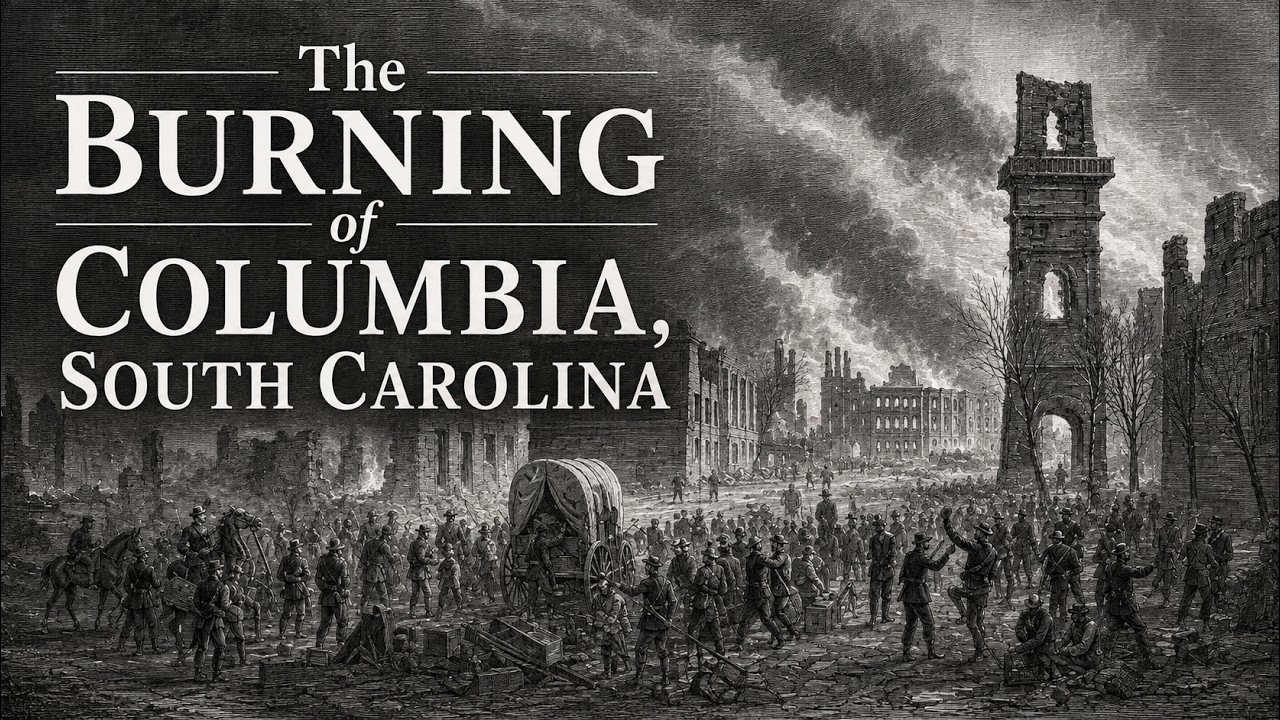
By nightfall, as Fifteenth Corps commander John Logan noted, the citizens had made his men so drunk that it was impossible to control them. Wing commander Slocum added that a drunken soldier carrying a rifle in one hand and a match in the other is not a welcome visitor in a home on a dark and stormy night. Unsurprisingly, fires broke out. Some men worked to extinguish them, while others fueled them.
Seventeen-year-old Emma Bickett wrote of the scene: “By the red glow, we could watch these ruffians staggering back and forth from camp to town, yelling and cheering and cursing South Carolina, swearing and blaspheming, singing obscene songs, and using language so foul that we had to go into our homes. ” The fires that erupted that night remain a subject of intense dispute. Confederates blamed Sherman and his army for a lack of discipline and control. Wade Hampton was certain that Sherman had, in his words, “deliberately, systematically, and barbarously burned the city to the ground.
” Sherman, in turn, claimed the fires were already burning when his men arrived and placed responsibility on Hampton and his troops. He asserted that Hampton’s men had set fire to cotton bales to keep them out of Federal hands, and the flames spread due to strong winds. One of the most comprehensive studies of that night can be found in Marion Lucas’s book “Sherman and the Burning of Columbia. ” Lucas concluded that there were multiple factors at play and that it was not a single fire but a series of fires.
His research led him to believe the fires began with cotton bales ignited by Hampton’s men as they evacuated the city. Despite efforts by the city’s firemen and some Union troops to contain the flames, strong winds hampered their work. The wind carried burning cotton to other parts of the business district, starting new fires. Additional fires were then set by released prisoners, jubilant African Americans, and irresponsible Federal soldiers lacking leadership.
As another prominent Civil War historian, Bell Irvin Wiley, put it, “the principal devils in that drama were cotton, whiskey, and wind. ” A horrified Captain Orlando M. Poe, Sherman’s chief engineer, wrote: “The burning houses illuminating the faces of shrieking women, terrified children, and raging drunken men formed a spectacle no man of any sensibility would wish to see twice. ” It was, he said, like looking through the very gates of hell.
There is evidence that Federal authorities tried to regain control. A brigade rushed into the city with orders to arrest all disorderly soldiers. Sherman ordered primitive fire brigades onto rooftops, but the fires raged through the night and into the morning until the wind died down. Columbia lay in widespread ruin.
According to one count, 458 buildings burned, and thousands of Columbia’s residents, mostly women and children, were left homeless. Mayor Goodwin said two-thirds of the city had been turned to ashes. This was before Sherman ordered the destruction of remaining buildings with military value. Over the next two days, his men intensified the hellish scene by demolishing warehouses, public buildings, and railroad property.
Sherman later offered a final comment on the disaster when he wrote: “War, I never ordered it and never wished it. I shed no tear over this event because I believe it hastened what we were all fighting for, the end of the war. ” Today, traces of that night of February 17 and 18 remain. Six bronze stars are set into the walls of the South Carolina State House where artillery shells struck the building.
They are still there, as if to say, “Never forget. “