When Edward VIII died in the spring of 1972, much of the world assumed a famous love story had simply reached its final page. The truth was messier. The story continued inside a shuttered house on the edge of a Paris forest, with an aging widow in an upstairs bedroom, a lawyer guarding the front door, and a fortune in diamonds waiting to deliver one last, glittering verdict.
Wallis Simpson had already lived the abbreviated version everyone knows. A sharp-jawed Baltimore girl with a sharp tongue, twice divorced, she navigated London high society and, somewhere between cocktail parties and country weekends, captivated the Prince of Wales so completely that he lost his bearings. He became king in January 1936. By December of that same year, he gave up the throne for her.
The British government, the Church of England, and his family treated the whole affair like a five-alarm fire. Once the smoke cleared, the couple received a consolation prize wrapped in barbed wire: the titles Duke and Duchess of Windsor, a comfortable residence in France, and one small, unforgivable insult buried in the paperwork. Edward remained His Royal Highness. Wallis did not become Her Royal Highness. The king's brother, then King George VI, signed letters patent denying her the title every other duchess in the family held without question.
So the Windsors drifted. Paris, the Bahamas during the war, then Paris again. They threw dinner parties, kept pugs, and shopped as other people breathe. Two beautiful, idle, faintly sad people circling a country that wished they would quietly disappear. For 35 years they lived what has been called the world's longest mourning, and Wallis stayed beside him throughout, because her entire existence, in the eyes of the press and the public, had been reduced to a single role: the woman for whom he sacrificed everything.
Then, in the spring of 1972, the man she had defended herself against losing was gone for good. Edward died on May 28, 1972, at their Paris home, undone by the smoking he could never quit and then by cancer. He was 77. The young king who had thrown away an empire spent his final days propped in a chair by a window, a tube in his neck, watching the garden. Wallis sat with him in his last moments. Whatever one believes about her, and the British public believed a great deal, she did not leave.
Then came the summons from London, and Wallis prepared to return to the one place designed to make her feel like an intruder. Queen Elizabeth II extended the invitation personally, a genuinely gracious gesture. The Duchess would stay at Buckingham Palace for the funeral. The woman the royal family had ignored for 36 years, whose image had been absent from Christmas cards, would now occupy a guest suite in the family's principal home, sleeping under the roof of the institution that had loathed her.
She was a guest of her niece by marriage, who treated her, at least publicly, with impeccable courtesy. Privately, matters were far worse. The Queen behaved flawlessly, while her mother refused even to pretend. The Queen Mother, born Elizabeth Bowes-Lyon, blamed Wallis for every disaster that had befallen the family, beginning with her unwanted husband's promotion to the throne and his early death. Her hostility toward the Duchess never softened across four decades. Two widows now sat in the same building, one mourning her husband, the other mourning the throne that had been taken from her. No one needed to raise a voice. Silence ruled.
Cameras caught Wallis at St George's Chapel in Windsor, and the footage still unsettles people today. She looked tiny inside her black coat, lost, her composure, unshaken through 50 years of scandal, dissolving minute by minute. Some of it was grief. Some of it was the illness beginning to creep into her mind, though few understood that at the time. At one point during the service, she seemed not to know where she stood or why all these uniformed strangers surrounded her late husband's coffin.
To be fair, the royal family surrounded her as kindly as protocol allowed. She rode in a carriage and stood with them at the coffin for a few short hours. The Duchess of Windsor was, for a moment, part of the family. She spent the second chapter of her life denied that belonging, entering it only because the man who connected her to it lay dead in a box at the front of the church.
She barely outlasted the funeral. Within days, Wallis fled back to France, across the Channel, back to the only walls that had never judged her. The British press noted the speed of her departure, royal diaries recorded it too, and interpretations split as expected. Some called her cold. Others called her rational. A frightened, frail, newly widowed woman who wanted to grieve in her own home rather than perform grief inside the family headquarters that had never opened its doors to her during her husband's lifetime.
The cameras withdrew, the newspapers moved on to fresher disasters, and the same woman returned to the walls of a villa in the Bois de Boulogne, where the ugliest part of her story, the part no camera captured, was about to begin.
One myth needs dismantling before it corrupts the rest of the story. Cheap biographies and shallow documentaries will tell you the Duchess of Windsor spent her widowhood as a pitiable charity case living on handouts from a generous royal family. It is an elegant narrative, and it is entirely false. The truth was the opposite, and the numbers prove it.
Yes, after Edward's death, Queen Elizabeth II continued paying the Duke's annual allowance, roughly £25,000 a year from the royal purse, to his widow. The gesture looked kind, and the tabloids loved framing it as a merciful crown supporting a destitute duchess. Pure fantasy. Twenty-five thousand pounds was pocket money to Wallis Simpson. She could have misplaced it in a sofa cushion without noticing, because the Duke of Windsor died a millionaire.
He left her everything: international investments, properties, cash, and above all the jewels, a treasure of diamonds, emeralds, and rubies accumulated over 40 years of excessive giving, loaded with love and admiration. Edward courted Wallis the way one courts a dragon with a cave. Every reconciliation, every anniversary, every apology for dragging her into exile carried a Cartier or Van Cleef stamp. When he died, all of it, every glittering particle, became hers alone.
Picture the arithmetic, then. A frail widow moving through a Paris mansion. In her vault lay a collection that would later sell at a single Geneva auction for more than $50 million. The royal allowance, supposedly a symbol of generosity, was negligible compared to what she already owned. Why does the myth refuse to die? Partly because it flatters the monarchy, recasting decades of cold cruelty as quiet benevolence. Partly because the world prefers its fallen women humbled, and a destitute Wallis suits the moral of the tale far better than her defiant wealth. The truth denied everyone that satisfaction. She never needed their money, and she never once asked for it. The woman the institution wanted painted as a beggar at the gate owned a jewel fortune that would one day outshine anything in the royal collection at public auction.
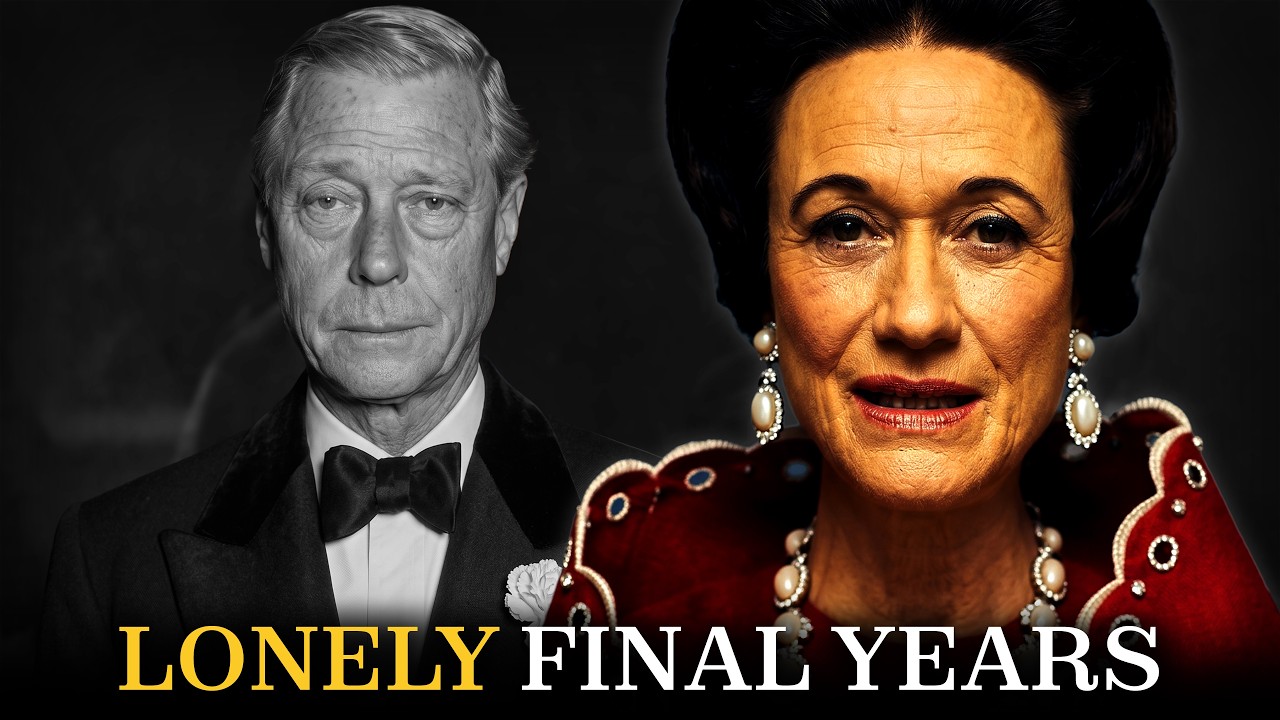
Her home during the last 14 years of her life sat on a quiet street called Route du Champ d'Entraînement on the western edge of the Bois de Boulogne, where Paris stops being a city and dissolves into forest. The city of Paris leased the mansion to the Windsors for a nominal rent, a thank-you note made of real estate. The French capital was paying tribute to exiled celebrities who had chosen France over the homeland that ignored them.
The villa matched its occupants' expectations: a small palace behind iron gates, teeming with pugs, liveried servants, gilded furniture, and enough flowers to bankrupt a smaller household. The house displayed its wealth the way the Windsors always had, loudly and without apology. For a while after Edward's death, the place still pulsed with life, as if its master might return at any moment. His clothes stayed in the closets, his chair in place. Wallis kept the rooms as a museum to a marriage the world had spent decades trying to forget.
At first, she resisted the silence. The Duchess reached for her old weapon, the dinner party, and tried to keep her social life alive. Friends from the golden decades still came when invited, and for a season or two the villa gradually returned to form. Candles were lit, the table was set, and Wallis presided in her elegant dress, thinner and slower, but still performing the role she had perfected over half a century.
Her participation dwindled quickly. Diana Mosley, her neighbor and friend, who left one of the few firsthand accounts of those final years, watched the Duchess fold further into herself with each passing season. The guest list shrank, invitations stopped. The hostess whose dinner parties once ignited quiet wars across Parisian society retreated behind her walls and answered fewer and fewer invitations.
Part of it was loneliness, the particular loneliness of losing one's entire world. The friends of 1936 died off one by one. The journalists who once competed for access aged or lost interest. Wallis belonged to a vanished era, the last guest at a party that had ended years earlier, and the city outside her gates filled with people who knew her only as an old scandal from their grandparents' time.
Underneath all of it, though, a deeper problem crept into her body and her mind, and it frightened her far more than any empty chair at the dinner table. Something inside Wallis Simpson began to fade. Her sharp tongue dulled. Confusion she first noticed as a flicker in the early 1970s became permanent. Memory loss, disorientation, long stretches of blankness in which she no longer recognized the year, the room, or the people leaning over her bed.
For a woman whose entire power rested on control, poise, and never losing the thread for a moment, the first tremors of that collapse terrified her more than death could. So she closed the doors, not all at once, not as a single decision, but gradually, the way a house goes dark window by window.
Bodies keep their own grim schedules, and Wallis Simpson chose 1972 for her decline to begin in earnest. Late that year, months after burying her husband, she fell and broke her hip. For anyone in their late seventies, a broken hip is among the most dangerous things that can happen. One fracture ends mobility and independence, and often life itself, within a year or two. Wallis survived the break, but she never walked freely again, and the fall dislodged something in her body that would never return to place.
From that moment, her deterioration accelerated, and her list of ailments read like a medical textbook emptying its entire index into one elderly woman. Her arteries were hit first, and her arteries did the cruelest work. Severe arteriosclerosis, the hardening and narrowing of blood vessels, progressively choked the flow of blood to her brain. It starved the brain gradually, and her mind gradually with it.
That is exactly what happened to Wallis. A fog that began as a forgotten name or a lost afternoon thickened year by year until it became irreversible. She forgot which decade she lived in. She mistook nurses for friends who had died 50 years earlier. She lost entire conversations between one sentence and the next, the way a radio loses signal when a car leaves coverage. The woman who once read a dinner table the way a poker player reads faces watched her mind dissolve beneath her.
Her intestines joined the rebellion. Crohn's disease, a severe inflammatory bowel condition, tormented her digestive system. In 1975, a perforated ulcer nearly killed her, forcing hospitalization and weakening an already exhausted body. Then came the strokes, one after another, each nibbling away a little more speech, a little more movement, a little more of whatever remained of the old Wallis.
Amid this bleak decline lies a strange, sad story that must be handled carefully. Many biographers repeat a small, painful scene. The Duchess, deep in her dementia, is said to have tried to dance for her nurses. One day the ghost of the glittering hostess surfaced through the fog, and in the attempt she fell and broke her second hip. Picture the scene for a moment, then notice how almost perfectly agonizing the image is. The woman who dazzled ballrooms for 50 years, the captivating dancer, reduced to a confused old woman performing an imaginary waltz for hospital staff before collapsing to the floor.
Beautiful and tragic, and possibly invented, because her medical records were under heavy guard at the time, and all that survives are accounts passed down from feuding friends and former servants. Details like this grow more splendid with each retelling. Perhaps it happened. Perhaps someone polished a small fact into a perfect tragedy. Either way, do not cling to it too tightly. What no one disputes is simpler and clearer than any anecdote. By the late 1970s, the woman whose image had been sold in newspapers on five continents lived in stillness, drifting between consciousness and unconsciousness in a darkened bedroom, tended by nurses, visited by almost no one. Her brilliant, ruined mind wandered at random through the rubble of a life that had toppled a throne.
Wallis Simpson spent her days unable to finish a single sentence. And as her body and mind collapsed hour by hour, the question of who controlled everything around her, the house, the money, the staff, the diamonds, and even the front door, narrowed to one name. A name that still splits historians in two today.
Every Gothic tale needs a keeper, and Wallis found hers in a brilliant, formidable Parisian lawyer in her eighties named Maître Suzanne Blum. Blum belonged to a rare class, even by the standards of the French legal aristocracy. Razor-sharp, fiercely loyal to her clients, accustomed to power, she had spent a long career representing the rich and famous. By the mid-1970s, she represented no one quite so completely as the Duchess of Windsor. As Wallis lost control of her world, Blum tightened her grip. The power of attorney passed to the lawyer. With it went control of finances, household affairs, medical decisions, and most controversially, the authority to decide who came through the front door and who left through the gate.

From here, the story splits into two entirely different accounts, and which one you believe depends on which book you read. In the first, written by biographers Hugo Vickers and Caroline Blackwood, Suzanne Blum is portrayed as a villain out of a horror film. There, Blum descends on a helpless, ailing woman and isolates her. Loyal servants who adored the Duchess find themselves dismissed, replaced by people the lawyer chose herself. Friends of 40 years discover the doors bolted in their faces, leaving the dying woman alone among paid strangers. Blum also rummages through the Windsor possessions, the accusation goes, selling pieces from the estate to her inner circle at bargain prices.
Caroline Blackwood's book, "The Last of the Duchess," reads like a feverish thriller. The author circles the sealed Paris villa, resisting Blum's stonewalling, convinced to some degree that something horrifying is unfolding behind closed doors. Blackwood wrote the book around 1980, and Blum's lawyers buried it under legal threats until the lawyer herself died, after which its pages finally appeared.
Then comes the betrayal that enraged critics most. In 1986, the world received the private love letters between Edward and Wallis. The explicit, intimate correspondence of the affair that toppled a king, edited by a young man named Michael Bloch, was published for all to read. Blum had authorized it. The Windsors had kept those letters as their most precious possession, the unedited proof of the passion they had paid for with an empire. Within months of Wallis losing the last of her awareness, those letters were on bookstore tables for anyone with a few pounds to take a look.
To Vickers and Blackwood, this act crowned everything else. A helpless woman stripped of her dignity, her secrets, and her control, all under the cover of legal protection. It looks airtight. A wicked lawyer, a helpless woman, a locked mansion, and a plundered fortune.
The second account, however, refuses to cooperate with this horror story, and honesty requires confronting it. Start with the accusation that looks worst, that Blum looted the Windsor fortune for herself. That charge collapses against the facts. Once matters settled, the bulk of the estate, including the jewel fortune, did not go to Suzanne Blum's pockets but to a medical charity, exactly as the legal papers specified. Whatever Blum did, she did not run off with the diamonds. The jackpot in this case went to funding scientific research, not a lawyer's retirement. Blum herself, no shrinking figure, fought her accusers to the end.
Her defense ran like this. Imagine an old woman worth tens of millions, famous in every capital, utterly unable to defend herself, her mind fading, surrounded by exactly the kind of people such wealth attracts. Opportunistic biographers hunting a scoop. Old acquaintances suddenly remembering their deep affection. Journalists, dealers, hangers-on, every variety of vulture circling a dying celebrity with a vast fortune. Someone, Blum argued, had to stand between that woman and the crowd around her, and she placed herself in precisely that role, the iron gate protecting a helpless client from a world that wanted to plunder her. The cruelty critics saw, Blum insisted, was nothing but fierce protection without sentiment.
Which account is true? The honest answer frustratingly refuses to settle, and the reason goes straight back to Blum. She controlled the archives as tightly as she controlled the gate. Records that might prove or disprove the worst allegations stayed locked inside the same walls that held the Duchess, and conclusive evidence of financial wrongdoing in those final years remains legally murky to this day, precisely because the only person who knew everything guarded every door.
There is another view. Michael Bloch, the young editor of those controversial letters, worked as Blum's assistant and, across several books, presented a documented and sympathetic case for his former employer. It was a steady rebuttal to the lurid portrait painted by Vickers and Blackwood. Critics dismiss him as Blum's spokesman, while defenders treat him as the only writer who actually stood inside that house and witnessed the truth. Take your pick. Even the sources split into warring camps.
What remains behind all the argument satisfies no one. A proud, hard, indomitable woman who once bent the British monarchy to her will ended her life as a prize in a struggle over her unconscious body. Whether Suzanne Blum was guarding Wallis or imprisoning her, the result looked the same from the street. The woman whose appearances once filled society pages vanished behind a wall of lawyers, and the public never saw her face again.
By 1980, the woman who once out-talked everyone in Europe could no longer speak at all. The strokes and the cut-off blood flow finished their work. Wallis lost the ability to speak entirely, then lost movement, until nothing remained of the great performer but a frail body in an upstairs bed, rotated by nurses who fed it, turned it, and cleaned it. She no longer entertained anyone, because entertaining requires a mind, and her mind had dissolved. She no longer recognized old friends on the rare occasions someone tried to slip past the gate.
In the final stage of her life, measured in years rather than months, the Duchess of Windsor was little more than a rumor breathing inside a beautiful house. The isolation was nearly total. Only medical staff and Suzanne Blum entered her bedroom. Old friends who called by telephone were told, politely and firmly, that the Duchess received no visitors. Journalists who came eagerly found only the gate and the lawyer, nothing more. The villa closed its doors to the world so completely that biographers, decades later, still wonder how little reliable information survives about those years. The one woman who held the keys allowed almost nothing to leak.
Somewhere in central Paris, behind iron gates and drawn curtains, the Duchess of Windsor spent nearly a decade dying, and the world simply lost any connection to her. People assumed she was alive, but few could be certain. The villa kept her like a secret it refused to tell.
The lockdown can be explained two ways, and we have already met the lawyer. Perhaps Blum sealed the house out of genuine mercy, sparing a broken woman humiliation before the prying eyes of strangers. Perhaps the silence protected other interests, keeping awkward questions and curious eyes out of whatever was happening inside. Most likely the motives overlapped, because human beings rarely act from one pure impulse, and a fading fortune attracts every kind of intention at once.
Whatever the truth behind those curtains, the practical result never changed. Wallis Simpson spent her final years forgotten by public life while technically still alive. A living ghost in a gilded cage, kept breathing by medicine, cared for by people she no longer knew, in the city she loved precisely because it had chosen her over the country that rejected her. The cage kept her silent for six years before finally releasing her on an April morning.
On April 24, 1986, Wallis Simpson died in her bed at the villa on the edge of the Bois de Boulogne. She was 89, roughly two months short of her ninetieth birthday. No crowd, no cameras, no deathbed reconciliation with the family that had cast her out, no last words worth quoting, because the woman had lost her words years earlier and never found them again. She simply stopped. The affair that had cost Britain its king ended not with fanfare or headlines but with a nurse's note that an elderly woman in an upstairs room had stopped breathing.

Then Wallis Simpson crossed the Channel one last time. Her body was flown home, to the country that had never wanted her alive. On April 29, 1986, five days after her death, the funeral of the Duchess of Windsor was held at St George's Chapel in Windsor, the same church where the world had watched Edward buried 14 years earlier. Members of the royal family attended. The service lasted exactly 28 minutes, according to her prior instructions. No one delivered a eulogy, and so the woman who had turned the monarchy upside down departed without a single word spoken in her praise. A final, deliberate silence from someone who had once commanded every conversation in any room she entered.
One rumor clings to that funeral, and you will hear it everywhere, so let us deal with it honestly. The story claims the Queen wept at Wallis's coffin. A late tear of reconciliation for the aunt by marriage her family had cut off for 50 years. A lovely image, and probably untrue. The story traces, as far as anyone knows, to Princess Diana's interviews with royal biographers years later, and most serious historians dismiss it, pointing to the Queen's well-known composure and her complicated, cool relationship with the Duchess. A fine tale for storytellers, and probably not fact.
The more important detail lies at the level of the coffin itself, on a small silver plaque fixed to English oak. It read, in full: Wallis, Duchess of Windsor, 1896 to 1986. Read it again and notice what the palace omitted. No HRH. Even in death, on the lid of her coffin, the palace withheld the three letters it had spent the past 50 years refusing her at every turn. The British monarchy looked at a dead 89-year-old woman and decided she did not deserve three letters.
Yet the same monarchy, in the same moment, bent toward something close to kindness. Despite the harsh omission of the HRH, Queen Elizabeth II granted Wallis the one thing she had truly wanted in death. They buried her beside Edward. At Frogmore, in the royal burial ground near Windsor Castle, on the private patch of land where Britain buries its royal family, the Duchess of Windsor was laid in the earth next to the king who had abdicated for her. Forty years of exile undone by one grave. The institution that denied her the title, denied her the Christmas cards, and denied her welcome for half a century opened its most exclusive ground and let the outsider rest forever among the family that never claimed her.
Edward and Wallis, side by side at last, two graves beneath the same English trees, the scandal finally buried safely underground where it could embarrass no one. So let us settle the final account. They gave her the grave but withheld the letters. They opened the burial ground but closed the deed. Even in the inscription on her coffin, the British monarchy treated Wallis Simpson exactly as it had in life, one hand extending a measured courtesy, the other quietly refusing her full entry.
That almost ends the human story. But the story of the things she left behind, the diamonds in the vault we opened earlier, still owed the world one last, glittering act of revenge. About a year after Wallis died, the vault was finally opened, and the diamonds had the last word.
The bulk of her estate passed, according to her will, not to any relative and not to the Crown that had ignored her, but to the Pasteur Institute in Paris, France's great center for medical research. A precise and fitting choice. The country that had received the Windsors, leased them their villa, and honored the exiles while ignoring its greatest neighbor now inherited the largest share of the Windsor millions. Wallis thanked France with the greatest wealth she possessed.
The jewels themselves, that private mountain of gemstones Edward had given her across 40 years of devotion, passed to Sotheby's, and on April 2 and 3, 1987, the auction house opened the sale in Geneva. What followed exceeded every cautious expectation in the room. The initial probate papers had conservatively valued the entire estate at roughly £5 million. A polite, reasonable estimate, and astonishingly wrong. When the Geneva auction ended, the jewels alone had fetched £50.3 million, close to $31 million at the time, a sum that surpassed every pre-sale estimate and rewrote jewelry auction records.
Bidders from around the world competed for a brooch or a bracelet. The Duchess had worn her jewels without hesitation, paying not only for the diamonds but for the story carved into each piece. The panther bracelet, the flamingo brooch, every glittering apology from a king to the woman for whom he ruined himself. A year after her death, the sales from her jewelry box exceeded all expectations. She had been called an intruder, a gold digger, a stain on the monarchy, yet her final sale crowned her the owner of the most expensive jewelry collection ever offered at public auction up to that time, a collection so lavish it stunned members of the royal family.
Better still, trace where the money went. All those millions, the proceeds of that guilty royal love, flowed into the Pasteur Institute and its laboratories, funding research into disease, into vaccines, and into unglamorous, life-saving cures. Diamonds bought by a king to soothe a scandal ended up financing medicine. Whatever you think of Wallis Simpson, consider that fact. A fortune born of a king's reckless devotion ended its journey funding the fight against death itself.
In the end, the vault kept its promise. The two stones the palace never forgave let out a thunderous roar in a Geneva auction room, then scattered across the wrists and necks of the world. Each stone carries a shard of the strangest royal love story Britain ever produced, and a shard of the woman who refused, to her last silent breath, to apologize for any of it.
We began with a claim: history loves kings and forgets the women who caused their thrones to fall. Wallis Simpson spent her strange life disproving the second half of that sentence, and the 14 years after her husband's death did not merely confirm the correction, they made it louder. The rules demanded she disappear. By every measure, the institution wrote her off: the American divorcee who broke Edward VIII deserved only a footnote, a cautionary tale, a name whispered once and then ignored. The palace clearly wanted her removed, erased from the family portrait, stripped of the title, isolated from the world. In the end she was locked behind the curtains of a Paris villa where the world could forget she had ever breathed.
During her final six years she barely existed, silent, bedridden, and erased from memory, and yet the story never left. Look at what survived her. A marriage the British Crown spent decades trying to disown is now bound forever to the earth at Frogmore, memorialized by two royal gravestones. The monarchy itself eventually, quietly, allowed it. A fortune the palace wished it had never lost exploded through a Geneva auction hall to become the biggest jewelry sale anyone alive could remember. Her private letters, published against her will, now reveal a relationship strong enough to break an empire to anyone curious enough to read.
The more the institution pressed Wallis toward silence, the more her wreckage echoed. Weigh the whole picture and the record is full of defiance. They refused her three letters, and her diamonds answered with $50 million. Behind a wall of lawyers, they confined her, and the wall only deepened her mystery. For half a century they tried to reduce her to a warning about the price of ambition, yet she remained present, the one outsider the British monarchy could not bury, disprove, or forget.
None of this excuses her, and none of it sanctifies her. Wallis Simpson lived a scandalous, proud, often selfish life, and her final years became a genuine tragedy. A glittering woman dismantled cell by cell and locked away from daylight. No diamond auction softens that ending. The cage remained a cage until the morning of her last day.
For 50 years the palace asked one question: could it truly be rid of Wallis Simpson? The answer, carved into the ground at Frogmore, scattered across Geneva auction floors, and printed in every biography that still fights over her memory, comes back to us as no. Wallis gave them no comparable challenge in life. She took their king and kept their attention, and the Crown that spent a lifetime trying to forget her never managed it once.