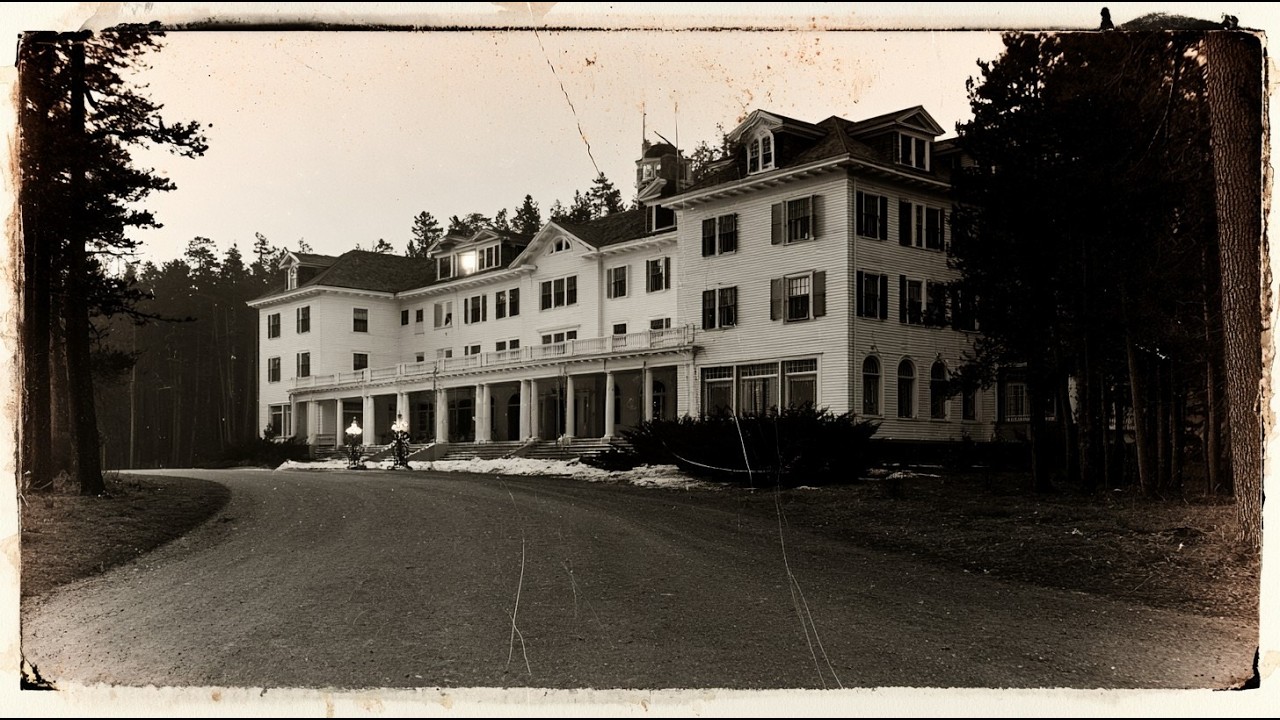
There is a hotel in the Rocky Mountains of Colorado that most people know from a single night in 1974. White walls, a red roof, and a long porch facing Longs Peak. It opened in the summer of 1909, when mountain roads were difficult and any guest who reached it had to be determined.
A famous novelist checked in on the last day of the season in 1974. He and his wife spent one night in a room at the end of the second-floor hallway. He heard a fire hose slam in an empty corridor. He heard music coming from an empty ballroom. He wrote a book, and that book sold more copies than most books sell in a lifetime.
But the novelist arrived late. He arrived at the end of the story. The hotel already had a long, patient history, and 1974 was only a footnote in it. That longer story, kept by the mountain for 65 years before the writer came, is worse than the legend that grew around it. Not louder. Not bloodier. Worse in the quiet way things go wrong when records are closed and causes do not match.
Most of what follows comes from a man named Barnaby Keswick. He was born in Loveland, Colorado, in 1889. He was broad-shouldered and short-legged, with hair that went white before he turned forty, and hands that opened and closed the hotel's front door roughly ninety thousand times.
He counted everything. He took a job as night porter in the fall of 1912, three years after the hotel opened, and did not leave it until the summer of 1948. Thirty-six winters. Thirty-six seasons of guests who did not want anyone looking into their eyes.
He kept a cloth-bound notebook with a black cover in the top drawer of the porter's desk. In small, patient handwriting, he recorded what people told him at three in the morning when they came down to the lobby in their coats and refused to go back upstairs.
Barnaby Keswick did not believe in ghosts. He was very careful with me about that. He believed in rooms. He believed the hotel was one room. He believed that what happens in a room stays between its walls, the way smoke stays inside a barn after the fire is out. And that the room does not forget, even when people do.
The story begins in the summer of 1911, before Barnaby ever set foot in the place. The hotel was in its second season. Electric lighting was new and constantly argued about. The owner was an inventor by trade and a hotelier by temperament, and he had wired the building himself using a private generator powered by a stream on the property.
When the weather was clear, the current ran smoothly. When a storm came, the lamps in guest rooms sometimes dimmed, and the maids were instructed to place oil lamps in every closet before dusk, in case the power failed and someone needed to find their way in the dark.
On June 10, 1911, a storm came in stronger than expected. The generator failed. The wind blew out the boiler flame. In the west wing of the second floor, in the room that would later carry the number 217, a housekeeper named Otillie Fenwick lit a gas lamp on the writing desk without noticing that the gas line, cracked that spring by a settling floorboard, was already leaking.
The explosion did not kill her. That is the strange fact of it. The floor collapsed beneath her and she fell into the dining room below, landing on a table set for twenty-four people that happened, fortunately, to be empty. She broke both ankles, three ribs, and her left wrist. She was thirty-nine years old.
She had come from a small farm outside Cheyenne. She had a husband who worked as a railroad switchman for Union Pacific, and no other relatives. The official county report attributed the incident to the storm, the cracked line, and the housekeeper's use of an open flame. The report was signed, filed, and forgotten for sixty years.
What the report did not include was what Otillie Fenwick said from her hospital bed in Denver three days later. She said someone had been in the room with her. She said she had entered to light the lamp, and when she struck the match, she saw in the flare a woman standing in the corner beside the wardrobe, wearing an evening coat, watching her.
She said the woman did not move and did not speak, but she smiled. She said that smile was the last thing she saw before the floor gave way. She said, and this is the sentence Barnaby underlined twice in his notebook, that she believed the woman knew the floor was going to collapse and was waiting for it.
Otillie Fenwick never returned to the hotel. She lived another thirty-one years and never entered a hotel of any kind again, not even to visit. The owner rebuilt the room. The floor was replaced. The gas lines were pulled and the room was rewired. Room 217 was back in service by the end of the following summer, and the incident faded into the kind of story a manager tells at the front desk when a guest asks whether anything interesting ever happened here.
Nothing more was written about it for six years. In the fall of 1917, a widow from Philadelphia named Elspeth Ravensdale arrived by train and was driven up from the Lyons depot in one of the hotel's cars. She was forty-four. Her husband, an official with the Pennsylvania Railroad, had died eighteen months earlier, and she had come west for what her doctor described in a referral letter as a change of air.
She was assigned a room on the second floor on the west side. Barnaby remembered her, five years into the job by then, because she gave him a full dollar tip the night she arrived and asked him whether the room she was staying in had ever had a fire. He told her the truth. He told her the story of Otillie Fenwick briefly, because he was a man who did not like lying to people when they asked him something directly.
Elspeth Ravensdale did not seem disturbed. She said she had thought so. She said she only wanted to be sure. That was September 22. On the 23rd, she asked to change rooms. She said she could not sleep. The room was colder than the hallway. She said there was a smell in the wardrobe she could not identify and did not like.
Cornelius Halliard, the manager, was a patient man and moved her without argument to the third floor. On the 24th, she asked to change again. Halliard moved her once more, this time to the east wing. On the 25th, she did not come down for breakfast. Barnaby was sent up to the third floor to check the room.
He found Mrs. Ravensdale sitting on the edge of the bed in her traveling clothes and hat, staring at the far wall. She had not slept. She told Barnaby calmly, without any of the enthusiasm people put into a story they want to be believed, that the wallpaper in her room had moved during the night.
Not the way a curtain moves, she said, but the way a face moves when it is trying to avoid looking at you. She said the pattern, a repeating shape of birds and roses, had rearranged itself at the edges of her vision, and that whenever she turned to look at it directly, it went back to what it had been. She said she had watched it for four hours.
At the end of the fourth hour, she said, one of the birds turned its head and looked at her. Barnaby wrote in his notebook that Mrs. Ravensdale did not cry when she told him this. He wrote that she was extremely composed. He wrote that she asked him whether he thought she had lost her mind. He wrote that he told her he did not think so.
She left the hotel that morning on the eleven o'clock car. Six weeks later she wrote to Cornelius Halliard, a polite letter from Philadelphia thanking him for his kindness. She added a note at the end. She said she had not slept a full night since. She said she was writing at three in the morning. She said she hoped he would understand.
That was the second entry in the black notebook. There is a temptation, when a story like this begins, to jump straight to the loud parts. The party in the ballroom. The piano that plays by itself. The winter caretaker who walked out of the mountain and was not the same man. I promise we will get there. But the hotel did not work that way.
The hotel worked slowly, and in the way it worked, the years mattered. It waited whole seasons between incidents. It allowed staff to turn over. It allowed the manager to retire and a new manager to arrive. It allowed the wallpaper to be replaced, the carpets to be replaced, the wiring to be replaced. Then, when no one was thinking about it anymore, it did something else.
Six years passed after the Elspeth Ravensdale incident. In those six years, Barnaby Keswick recorded in his neat small hand seven guest complaints about sounds they could not account for. Four complaints about the smell of pipe tobacco in rooms that had been aired for a week. Three complaints about water temperature in the west wing baths. Two complaints about music.
Those last were the beginning of what became, in the summer of 1923, the Isadora Merryweather incident. Isadora Merryweather was thirty-one. She was a concert pianist from Boston, the daughter of a violin maker, and she had been contracted to give three evening performances in the ballroom during the second week of July.
She arrived on a Sunday evening. She was small, dark-haired, and according to Barnaby's notes, unfailingly polite. She had asked that the Steinway in the ballroom be tuned twice before her arrival, and it was. She asked that the room be aired, and it was. She asked the manager whether she could have the ballroom to herself between two and four in the morning to practice, and after some discussion, he agreed.
He did not tell her that no one played the ballroom piano at that hour. He did not tell her that the last two evening pianists had asked to move their late rehearsals to the parlor instead. He simply said the ballroom would be hers. She played Sunday night. Barnaby was on duty. He heard the piano through the closed ballroom doors from the bell desk in the lobby.
He wrote in his notebook that he had never heard anyone play with such precision. He wrote that she practiced for nearly two hours, and that when she came out of the ballroom at four minutes past four, she looked at him and smiled and said goodnight in a voice that suggested she had enjoyed herself.
She played Monday night. Barnaby heard the piano again. He wrote that at ten past three, the character of the sound changed. He wrote that the piano was suddenly playing something he did not recognize, a piece that seemed to have no shape, no key, and no clear direction. He wrote that the piece went on for perhaps twenty minutes and then stopped.
After it stopped, the ballroom doors opened and Isadora Merryweather came out wearing her coat. She was carrying her music bag. She was walking quickly. Barnaby rose from behind the desk and asked whether she needed anything.
She stopped at the desk and looked at him and said quietly that the Steinway in the ballroom had answered her. He asked what she meant. She said she had been practicing a Chopin piece and had stopped in the middle of a measure to mark a fingering in her score, and during the silence, the piano had continued playing the passage in a variation she did not know.
She said the variation was beautiful. She said it went on for eight measures. She said, and Barnaby recorded this in the exact words she used, that she would not sit at that instrument again because whoever was on the other end of it wanted to get acquainted. And she did not intend to get acquainted.
She left the hotel at seven in the morning. She canceled the remaining performances. She wrote to the manager two weeks later from New York saying only that she had been unwell. Barnaby wrote one sentence under her name in his notebook. He wrote that he sometimes heard it from the desk in winter, a note or two, when no one had been in the ballroom for a week.
The next entry is short. It is five lines, and Barnaby did not want to talk to me about it beyond what was written. In August 1929, a traveling salesman named Percival Strow checked into the hotel on a Tuesday evening. He was fifty-six. He sold cast-iron cookstoves for a Cincinnati company.
He had a large sample case, which the day porter carried up to his room and left there. He asked the front desk what time breakfast was served. He was told between seven and nine. He said he would come down at seven exactly. He signed the register in a clear, strong hand. He went up to his room.
He did not come down at seven. He did not come down at any other time. When the housekeeper knocked at ten, there was no answer. When the manager entered with the master key, the room was empty. No one had slept in the bed. The window was closed. The wardrobe was empty. His hat and coat were gone. His sample case was still there, in the middle of the room.
The county was notified. It came to nothing. His wife in Cincinnati was contacted. She said she had heard nothing from him. She said she was not surprised. She did not come to collect the case. It stayed in the room for six weeks, then was moved to the basement, where it sat untouched on a shelf in the cold room for the next twenty-five years.
In 1954, while the hotel was preparing for the summer season, a new porter opened the case to see what was inside. He found samples of cookstoves. He found an order book. He found a photograph of Percival Strow's wife and a photograph of Percival Strow himself standing in front of a storefront in Ohio. He found no clothing, no personal effects, and no answer.
The case went to the dump. That was the last that was seen of Percival Strow in any form. Barnaby wrote one word at the end of that entry, in parentheses. He wrote: walked. I asked him, when I was gathering this account, what he meant by that. He said that Percival Strow walked out of the room. That the hotel walked him somewhere else. And that was all anyone would ever know about it.
That was the first time I heard him speak about the hotel as though it had done something. Cornelius Halliard was the manager for most of those years. He was appointed in 1914 and held the position without interruption until 1938. Twenty-four years.
He had come to the hotel from a resort chain in California, where he had been considered a rising man. He had come, according to Barnaby, because he wanted a mountain and because his wife wanted quiet. His wife, Winifred, was a plain, quiet woman about his own age who liked to sit on the west porch in the afternoons reading novels, and the staff liked her.
They had no children, and they lived in the manager's apartment on the ground floor of the east wing, where the offices are. For seventeen years, they lived in that apartment together. In the summer of 1931, Winifred Halliard asked her husband whether she could move into the staff quarters instead. She did not give a reason.
She did not seem angry with him. She continued to take her meals with him in the manager's dining room. She continued to attend ballroom occasions on his arm. She simply, and quietly, moved her clothes and her books and her bedding to a small room in the staff wing at the far end of the third floor, above the kitchens. She slept there every night from that summer on until she and her husband left the hotel in 1938.
Barnaby asked her once, in 1933, on a night when he helped her carry a stack of books up the back stairs, whether she was all right. She was kind to him. She thanked him for asking. She said she was fine. She said only that the ground-floor apartment, in her view, contained more people than were on the payroll. And that she was tired of pretending not to notice.
That is what she said. Barnaby wrote her words down exactly. He did not press her. He did not ask her to explain. She never mentioned it again, and neither did he. When the Halliards left the hotel in the spring of 1938, Cornelius took a position at a hotel on the Oregon coast. Winifred went with him. She died in 1942 of pneumonia.
Barnaby wrote to Cornelius when he heard, and Cornelius replied with a one-page letter. He thanked Barnaby for writing. In the last line, without preamble, he wrote that she had slept through the night at her end for the first time in many years. He told Barnaby to take care of himself. He told him to keep the west wing lit.
Barnaby kept the letter at the back of his notebook. The paper was folded to the size of a train ticket, and it stayed there for the rest of his life. Dr. Thaddeus Ainsworth arrived at the hotel in the fall of 1937. He was a psychologist by profession, the word people used then before the field was renamed.
He worked at a clinic in Denver, and he had acquired, over the previous decade, a small reputation for what he called environmental neurasthenia. The idea, as he explained it in a letter to Cornelius Halliard, was that certain buildings, by virtue of their construction or their history or their situation, could provoke in healthy adults a set of nervous symptoms that appeared to be hauntings.
He said he wanted to spend one month at the hotel at his own expense to interview any staff or long-term guests who had experienced such symptoms. He wanted to classify them. In short, he wanted to explain the hotel. Cornelius agreed, being in his final year on the property and having quietly begun to believe that his own explanations had run out.
Ainsworth arrived on October 4. He stayed until November 2. He interviewed sixteen staff members and four long-term guests. He filled two notebooks. According to Barnaby, he never slept in a guest room. He slept in a service room beside the back stairs on the first floor near the kitchens. He said guest rooms would not keep clean data, as he put it.
After his death in 1951, his daughter donated his two notebooks to the medical library at the University of Colorado, and they can still be read today if you know how to ask for them. I have read them. I want to be honest with you about what they contain and what they do not. They are not sensational.
Ainsworth was not, by any measure, a credulous man. Most of what he recorded was cool and logical. He believed, at the start of his stay, that the hotel's difficulties could be explained by three factors: the altitude of 7,500 feet, which he wrote was known to cause hallucinations in susceptible individuals; the isolation, which he believed contributed to a form of what he called collective suggestion; and the building itself, which he described as poorly soundproofed, meaning that sounds traveled from one part of it to another in a way that made staff and guests think they were hearing things closer than they were.
He held that view for about ten days. On the eleventh day, during an interview with a chambermaid named Lavday Bryan, who also worked the evening telephone board at the hotel, he made a note in the margin of his book. The note is brief. It is written in a different pen, which suggests he wrote it later. The note says that he did not understand what she meant, but that he did not think she was lying.
Mrs. Bryan told him that she had received, on three occasions during the previous winter, telephone calls at the switchboard from rooms that were empty at the time. She said the calls came from the room telephone, which meant that someone had lifted the receiver inside the room. She said there was no voice on the line, but there was breathing, and once she thought she heard the sound of someone adjusting a lamp shade.

She went up herself each time with a master key, and each time she found the room empty and the receiver in its cradle. Ainsworth wrote more notes like the first, and then more after that. By the end of his stay, the tone of the notebooks had changed. He stopped offering explanations. He simply recorded.
The last three pages of the second notebook consist of a list of forty-six incidents, arranged by date, room number, and a one-line description. He did not attempt to classify them. He did not draw a conclusion. The final entry in the hotel notebook, dated November 2, 1937, the morning of his departure, says in full that he had been a doctor for twenty-nine years, that he had seen many things he could not explain, that he had never before been in a building that felt it did not want him there, that he would not return, that he would not publish anything, and that he did not believe publishing would help anyone.
He did not publish. The notebooks were put in a drawer, and after his death they were transferred to the library. If you want to see them, you can. But they are, at the same time, useless as an explanation. They are the notes of a man who came to explain something and left, in his own words, unable to.
I asked Barnaby, when we spoke, what he believed Ainsworth had heard or seen to change his mind. Barnaby said Ainsworth came to the front desk on the last night of his stay at two in the morning and asked him whether the hotel had an attic. Barnaby said yes. Ainsworth asked whether it was in use. Barnaby said it was not, except for storage.
Ainsworth asked whether it could be walked through. Barnaby said yes, along its length, but you had to duck at the beams. Ainsworth asked him whether he had ever heard footsteps in the attic during his time at the hotel. Barnaby said he had. Ainsworth asked whether he had ever gone up to see. Barnaby said once, in 1920. Ainsworth asked what he found. Barnaby said, in the note to me, that it was not something he wished to write down.
Ainsworth nodded. Ainsworth wished him goodnight. Ainsworth left in the morning. I have laid these people out slowly on purpose. Otillie Fenwick and her explosion. Elspeth Ravensdale and her wallpaper. Isadora Merryweather and her instrument. Percival Strow and his empty room. Cornelius and Winifred Halliard and the manager's apartment they could not sleep in together. Dr. Thaddeus Ainsworth and his cautious, halting conclusion.
They were all adults, sober, competent, and unremarkable in the ways that matter to a witness. They all left the hotel and went on with their lives, more or less, and did not come back. They all told, at the time, one clear person one clear thing. And in every case, the paper record said something less.
The county said it was a storm and a gas leak. The manager said it was the altitude. The doctor said his patients were suggestible. The hotel said, we have no vacancies at present, but do come back in the spring. And behind all of it, the mountain sat and waited the way mountains do.
I have brought you up to 1937. From here, the story tightens. From here, it stops being a collection of tales and begins to be one story with one man and one winter and one door at the end of a long hallway that does not stay closed. His name was Alaric Quest. He was thirty-eight in the fall of 1942.
He was born in Minnesota to Swedish parents and had come to Colorado in his twenties looking for work in the mountains. He had been a lineman for the Colorado telephone company. He had worked on the Big Thompson project. He had spent a season as a groom at a small racing stable outside Boulder.
He came to the hotel in the spring of 1940 as a general maintenance man, and he impressed the new manager, a man named Wenzel, with his quiet way of working. He was not much of a talker. He was tall and thin and pale in the way northern country people can be. He kept himself very clean. He carried a Bible with him, but he did not press it on anyone. He was, by all accounts, a solid and reliable man.
The hotel at that time closed between mid-October and the end of May. The season was very short and the mountain passes were too difficult in the years before four-wheel drive and modern snowplows to keep a resort open through the winter. But someone had to be on the property to keep the pipes from freezing, to run the boiler once a day, and to clear snow off the roof before it collapsed under its own weight.
To walk the hallways and check the windows and keep a light on now and then so that the place, from the road below, did not look entirely abandoned. That job was called winter caretaker. In the years I am telling you about, it was almost always given to one man alone.
Alaric Quest took the winter caretaker job for the 1942 to 1943 season. He signed the contract in the second week of October. He drove up in his own truck. He waved goodbye to the last of the summer staff on October 18. And from that day, he was the only person in the building.
His wife had died two years earlier of fever in Minnesota. He had no other family in Colorado. He had been offered the job the previous winter and had turned it down. He accepted it this time because, as he told the manager, he needed a stretch of quiet.
He wrote letters. That is why we know what we know about him. The road to the hotel was passable for the mail truck until mid-December, and then in most years, again in mid-March. In between, mail accumulated at a post office in Estes Park, twenty-two miles down the mountain, and the caretaker was expected to collect it and send his own letters on his monthly trip down, weather permitting.
Alaric Quest made two such trips that winter. The first was in early December. The letters he sent from it were cheerful, ordinary, and well written. Five of them, to friends in Boulder and to his sister in Minnesota. He wrote about the sunlight on the peaks. He wrote about the elk that came to the meadow behind the hotel at dusk.
He wrote about the smell of the pines when he opened the door at dawn. He wrote about being lonely, but in a contented way, like a man who wanted to be. The second trip was in mid-March. It was late. The weather that winter had been worse than usual, and the pass had been closed since the first week of December. There had been no way down for three months.
When he walked into the post office in Estes Park on March 18, the postal clerk, a woman named Iona Grieve, noticed that he had lost about twenty pounds. She noticed that his hands were shaking. She noticed that he had buttoned his shirt wrong. When she pointed this out gently, he looked down at his shirt for a long time before he seemed to understand what she was saying.
He had four letters with him. Three were to his sister. One was to Cornelius Halliard, the old manager in Oregon. The letters to his sister survived because his sister kept them. She turned them over, decades later, to the county historical society archive. I have read them.
They are, in chronological order, dated January 12, February 9, and March 4. All three were carried in his coat pocket on March 18 for lack of mail service between those dates. All three are written in Alaric's own hand, signed by him, and correctly addressed to his sister at her home in Duluth. But they do not read like his letters used to.
The January 12 letter is the mildest. It is two pages long. It describes the winter as harsh. It describes the sound of the wind in the chimneys as the sound of a person clearing his throat. It describes a party. Alaric writes, without preamble, that a party was held in the ballroom on the evening of January 10 and that he attended it.
He writes that he went down to check the boiler at eleven at night and heard music from the direction of the ballroom and went to see what was going on. He writes that the ballroom was full of people in evening dress and that a small band was playing at the far end, and that the tables along the sides were covered with white cloths and candles.
He writes that the guests were very welcoming. They welcomed him. They asked him to join them. He writes that he spoke with a man in a long gray coat who told him the party was in honor of the opening of the mountain road. Alaric thought at the time that this was strange, because the mountain road had opened in 1905. But he did not say so out loud, because it did not seem worth correcting.
He writes that he left the party after an hour and went back to his room, which is the winter caretaker's room on the ground floor near the kitchens. He writes that in the morning, when he went back to the ballroom, the tables were bare and the room was empty and there was no sign that anyone had been there.
He writes at the end of the letter that he is fine, that his sister should not worry about him, that the mountain plays tricks, and he asks her to give his love to the children. The February 9 letter is longer and worse. It describes the party again.
Alaric writes that the party was held again on February 7. He writes that the man in the gray coat asked him this time for his name, and Alaric told him. The man asked him where he lived, and Alaric told him. The man asked him what year he believed it was, and Alaric answered 1943, and the man laughed kindly and said Alaric was mistaken, but that it did not matter because they had many years to sort it out.
The man introduced him to a woman in a long green dress. Alaric writes that she was very beautiful, and that he thought about his age, and that she was the one who asked him to dance. He danced with her. He writes that he had not danced since his wife was alive.

He writes that when he danced with her, the music seemed to slow down and the room seemed much larger and he could not see the walls for a while. He writes that he felt very light. He writes that he thought if he let go of her hand, he would rise toward the ceiling.
He writes that when the dance ended, she asked him whether he would come back. He said he would. He writes that he does not know why he said that. He writes that he thought about it all night afterward, and still cannot tell his sister why. He writes that he thinks he meant it. He writes that he is telling her this because he has no one else to tell.
The March 4 letter is the shortest, and it is the one I had to set aside and come back to several times. It is one page. It mentions in parts that the parties are now held every night. That he is not required to go down to the ballroom. That if he stays in his room and closes the door, they come up the stairs and pass in front of the door, and he can hear the woman's voice.
She was calling him by name. She had begun to know things about him she should not have known. She knew about a horse he had owned in Boulder. She knew about the fever his wife had died of. She knew about a man he had fought with when he was a young laborer in Duluth.
He had not told anyone about that fight in thirty years. He had not thought about it in twenty. The night before, she had stood outside the door and said the man's name to him, and asked him why he still felt bad about it after all this time. He did not answer her. He put the pillow over his head and lay in his bed until dawn, and when the light came through the window, he got up and burned the pillow in the boiler.
He was writing to his sister at seven in the morning. The sun was on the peaks. The view was very beautiful. He intended to come down to Estes Park in two weeks to mail this letter. He would be fine. She should not come. She should not send anyone. Whatever this was, it was his to finish. Alaric.
That was the letter he carried in his coat pocket to Iona Grieve at the post office on March 18. Iona Grieve, who was a sharp woman and had known Alaric a little over the summers, watched him walk out of the post office and back to his truck. After some thought, she picked up the telephone and called the sheriff.
The sheriff was Fenton Merrick. He was about sixty at the time. He had been county sheriff for nineteen years, and in that time he had been up to the hotel off-season twice. Once to check on a burst pipe, and once to respond to a report of a poacher in the meadow.
He went up on March 19 in a state car with his deputy and the county doctor, at the request of the postal clerk. The road was passable but bad. It took them four hours from Estes Park. When they reached the hotel, they found Alaric Quest standing on the front porch in his coat, waiting for them.
No one had called him. He would have had no way of knowing they were coming. He greeted them by name. He greeted the deputy, whom he had never met, by name. He asked the county doctor, whom he had never met, about his sister, whom the doctor had not seen in fifteen years.
He said, in the silence that followed, that he had been asked to invite them to dinner but that he would not, because he did not want them to stay. He said this gently. He said this in a normal voice. He said he was ready to come down with them if that was why they had come up here. He said his bag was already packed. And it was.
Fenton Merrick wrote a report on the incident. He filed it. The report went, as such things do, into a drawer. Then later into a box. And the box is now in the county archive. I have read it. In the one-page report, the sheriff describes Alaric Quest as thin and tired and lucid.
He describes the hotel as untouched, clean, and in good condition. He describes the trip down the mountain as uneventful. He closes the incident officially as mental exhaustion consistent with prolonged isolation. That was the word the record used. Mental exhaustion. It was the right word. It was the wrong word. And Fenton Merrick knew it was the wrong word.
Because in the last line of the report, which reads more like a personal note than a police entry, he writes for the file that he will not send another man up there alone in winter. That this is his recommendation and that he will make it in person to the manager the next time he sees him.
Alaric Quest was admitted to a rest home in Denver for eight weeks. He was released in mid-May. He did not return to the hotel. He did not return to any hotel. He moved to a small property he owned in New Mexico, near a town called Cimarron, and lived there quietly for another nineteen years.
He wrote to his sister every month. His letters from that point on were short and plain and unremarkable. He mentioned the hotel only once, in 1949, in the middle of a letter about a new fence he was building. He wrote that he still dreamed about her sometimes. That she had not aged. That she was very patient. And that he did not think she was angry that he had not come back.
He thought she believed he would, eventually. He never wrote about her again. He died in his sleep in 1962 at the age of fifty-eight. Barnaby Keswick was still at the front desk of the hotel the day Alaric came down that March in 1943. He was the one who checked Alaric's room in the caretaker's quarters after the sheriff took him away.
He recorded in his notebook, in an entry dated March 21, that the room was clean. The bed had been stripped and folded, the floor swept, the boiler warm, the provisions orderly. Everything he wrote down was fine except for one thing. On the small desk under the window where Alaric wrote his letters, a table had been set for two.
A cloth, two plates, two glasses, two knives, two forks. The plates were empty. The glasses were empty. There was no food. There was no sign that a meal had been eaten, but the table was set. It had been set carefully. And when Barnaby lifted the cloth to see whether the wood beneath it was clean, he found a folded sheet of the hotel's lobby stationery under one of the plates.
On that sheet, in a woman's handwriting he did not recognize, was one line. The line said that he was welcome to come back whenever he was ready. And that they would keep the room for him. Barnaby did not put the note in his notebook. He put it in the fire. And he wrote beside that entry that he did not want to keep it.
He did not want it in the drawer. He did not want it in the building at all. He also wrote, and this is the last entry from that year, that the hotel would open again in June, that he would be at the front desk when it did, and that he did not know what else he could do. He stayed at the front desk for five more summer seasons.
He retired in the summer of 1948. He was fifty-nine. He lived afterward in a small house outside Loveland, alone, with a dog. He talked about the hotel in his later years, only to people who asked him plainly. He did not talk about it to anyone who came looking for a thrill or a scare. He died in 1968 at the age of seventy-nine, of a stroke, in his kitchen.
I asked him once, in the last year I saw him, what he believed the hotel was. He was slow to answer. He was in the middle of feeding the dog. He finished feeding the dog. He sat down at the table. He said, and this is my answer to you, and I do not have a better one, that the hotel is a building that got used to people coming and going.
He said the ordinary business of a hotel is that a stranger comes in the front door, spends a night or two in a room, and goes out the front door and never comes back. He said that in the ordinary business, the hotel forgets those strangers, because there are so many of them, and because a hotel is built to forget.
He said that this particular hotel had stopped forgetting at some point during its first ten years. He did not know why. He did not know whether it was the altitude, or the man who built it, or the ground beneath it, or something older that was there before any building. He said he did not think it was evil. He said it was patient.
He said it was patient in the way a very old dog is patient. It was waiting. It had all the time in the world. And when the right person comes and stays long enough and is ready to talk to it, it talks. I asked him whether he had ever had a conversation with it. He said once.
In the winter of 1936, alone in the lobby at four in the morning, a woman came down the main staircase in a long green dress and walked past the desk and into the ballroom without turning her head. He did not see her face. He smelled her perfume. He followed her into the ballroom, and the ballroom was empty and the doors on the other side were closed and bolted.
He went back to the desk. He sat down. He did not write down what happened that night. He wrote it two years later, when he was ready. He said that afterward he was careful, at four in the morning, to keep his eyes on the desk. That is the story.
I told you at the beginning that it was long. I told you at the beginning that the mountain kept it. I told you at the beginning that the famous novelist who came to the hotel in October 1974 and heard, in one night, a fire hose slamming in a corridor and music in an empty ballroom, came late. He came at the end of a very long story.
I believe he heard only its surface. He heard only the loud parts of it. He heard the parts a stranger on a single night might hear. He wrote them into a book, and the book is remarkable, and I am not here to diminish it. But the parts you do not hear in one night, the parts beneath the noise, the slow patient parts that took Otillie Fenwick's floor, and Elspeth Ravensdale's sleep, and Isadora Merryweather's piano, and Percival Strow's entire body, and Winifred Halliard's bedroom, and Dr. Ainsworth's certainty, and Alaric Quest's winter, and Barnaby Keswick's long last look across the ballroom lobby, those parts the mountain still keeps.
And whenever a guest checks in during the summer season and asks the man at the front desk whether there are any stories about this place, the man smiles the way he has been trained to smile. And he says, oh, a few. Would you like a tour before dinner?