During the winter of 1864, a Confederate agent placed a hollow iron casting into a shipment of coal bound for Union naval vessels. The object was shaped and painted to look like an ordinary lump of coal, but it was packed with explosives. When a stoker threw it into a boiler, it detonated. Depending on the account, the damage ranged from serious to catastrophic.
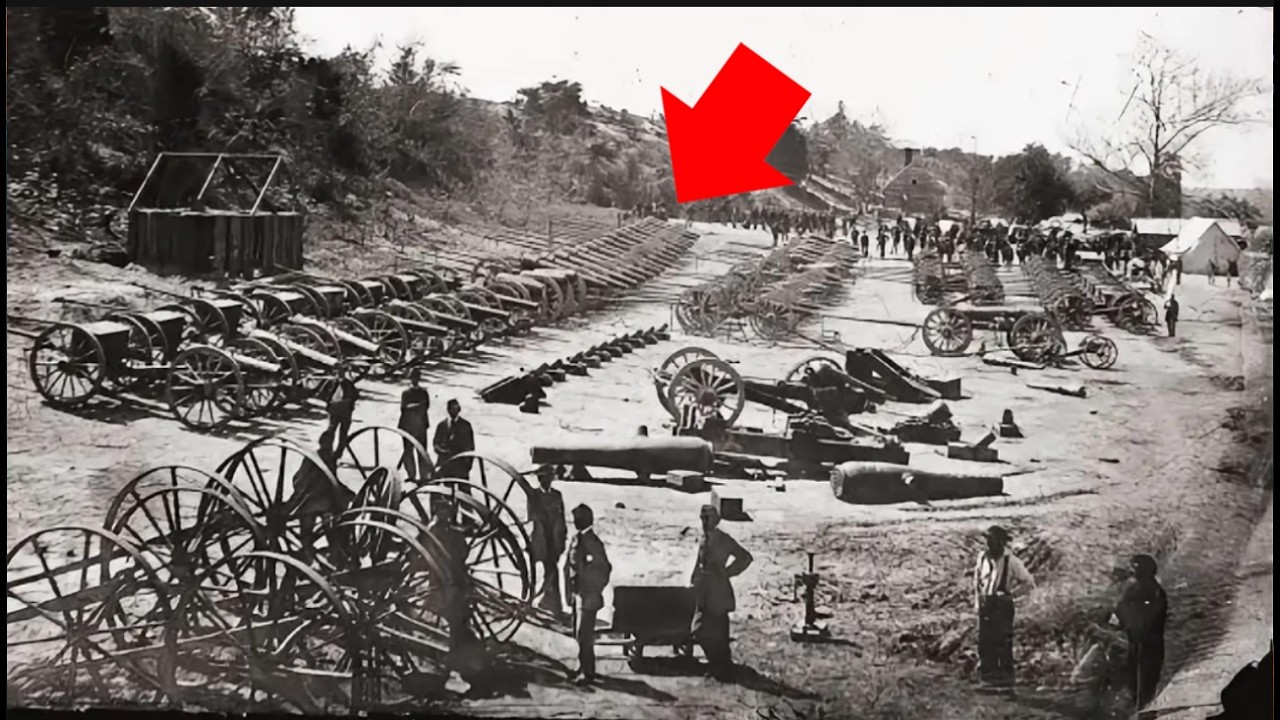
Historians later gave the device a name: the coal torpedo. That weapon was not the strangest innovation of the American Civil War. It was not even close. Between 1861 and 1865, two desperate nations threw untested and often bizarre technologies at each other, producing a list of weapons that range from ingenious to terrifying.
Some changed warfare permanently. Some killed the people they were meant to protect. Some worked once and vanished for a generation. These are the weapons that standard history books tend to leave out.
Gabriel Rains was a Confederate brigadier general who spent years before the war thinking about what he called “subterra shells,” explosive devices buried just beneath the surface of the ground and triggered by pressure. When a soldier stepped on one, it exploded. Today we call them landmines, and they are banned by treaty in most of the world. In 1862, they did not even have a fixed name.
Rains first deployed these mines during the Confederate retreat across the Virginia Peninsula in the spring of 1862. As McClellan’s Army of the Potomac advanced toward Yorktown, Union soldiers began dying from explosions that came out of the ground itself, with no visible cause. The psychological effect was immediate. Men trained to read a battlefield for cover and firing angles suddenly found themselves on ground they could not trust.
Every step became a calculated risk. The protests were nearly universal. Confederate General James Longstreet ordered Rains to stop. Union General George McClellan called the practice barbaric and contrary to the laws of war.
The arguments raised at the time were that landmines do not distinguish between combatants and non-combatants, and that they kill without warning, giving the victim no chance to respond. These are the same arguments that would justify the 1997 Ottawa Treaty banning landmines more than 130 years later. Rains kept using them. The Confederate government eventually gave him formal approval to develop them more systematically.
By the later stages of the war, he had planted landmines around the defenses of Richmond and deployed underwater charges in rivers and harbors that he called torpedoes. His devices killed Union soldiers and sailors through the final years of the conflict. The concept he pioneered in 1862 became, over the following century, one of the most widespread and deadly categories of weapons in human history. The underwater torpedo, or naval mine, also made the Confederate submarine program possible.
That leads to the H. L. Hunley. In 1863, the Confederate Navy commissioned the construction of a submarine, a vessel designed to travel below the surface and attack enemy ships, at a time when no navy in the world had successfully used one in combat.
The theoretical concept was not new. David Bushnell had built a one-man submarine called the Turtle during the American Revolution and tried to attach a mine to a British warship in New York Harbor. It failed. The Hunley was attempting something with a dismal record of failure.
The vessel was 40 feet long and built from a modified iron boiler. Eight men sat inside in a row, each turning a crank that drove the propeller. A ninth man at the front handled steering. To dive, the crew filled ballast tanks with water.
To surface, they manually pumped the water out. The depth gauge was mercury inside a glass column. The compass, needed for navigation in total darkness below the surface, was a standard ship’s compass that behaved unpredictably when surrounded by iron. There was no light source suited to the enclosed space and limited oxygen, so the crew worked by touch and by the sounds of the machinery they operated.
The Hunley sank twice during training, killing its crew both times, including Horace Hunley himself, the civilian engineer who financed the project and was aboard during the second fatal dive. The Confederate Navy raised the vessel both times, buried the dead, and placed new crews inside. On the night of February 17, 1864, the Hunley approached the USS Housatonic in Charleston Harbor. The weapon mounted at the front was a spar torpedo, an explosive charge fixed to the end of a long iron pole protruding from the bow.
The Hunley drove the pole into the Housatonic’s hull and detonated the charge. The Housatonic sank within five minutes, becoming the first warship in history sunk by submarine attack. Afterward, the Hunley signaled to shore with a blue light and disappeared. It was never seen again.
When the wreck was located in 1995 and raised in 2000, archaeologists found the crew at their stations, with no clear cause of death and no explanation for why the submarine sank after its successful attack. The mystery remains unsolved. The Hunley proved that submarine warfare was possible. The Confederacy failed to deploy another submarine, but the navies that developed submarines in the decades after the Civil War were building on a proven concept established in Charleston Harbor.
On land, the Army of the Potomac faced a problem common to siege warfare: how to strike a position protected by earthworks so deep that conventional artillery fire had little effect on the men inside. During the siege of Petersburg in 1864, the Union solution was a 13-inch coastal mortar mounted on a reinforced railroad car. The weapon was officially designated the 13-inch seacoast mortar, but the soldiers who operated it called it the Dictator. The name fit.
It weighed 17,000 pounds and fired an explosive shell weighing 218 pounds in a high-arc trajectory that could clear the earthen fortifications protecting Confederate positions and land directly inside the trenches on the other side. No practical amount of overhead cover in a battle trench could stop a 218-pound shell falling almost vertically. The Dictator fired from a curved section of railway track that allowed the crew to adjust the weapon’s angle relative to the Confederate lines. When fired, the recoil was strong enough to push the entire carriage backward along the track, and the crew then manually moved it back into position to reload.
The shell had a time fuse, and its flight arc was so long that Confederate soldiers in the target area sometimes had a few seconds of warning. They could hear the distinctive sound of the shell as it reached the top of its arc before it began to descend. The warning did not help much. The Dictator fired 218 rounds during the siege of Petersburg, causing heavy damage and casualties.
It also proved a principle that became central to artillery development over the following decades: high-angle fire that drops shells into fortified positions could achieve effects that flat-trajectory direct fire could not. Mortars as a concept were ancient, but siege warfare in the Civil War created conditions where the specific advantages of high-angle plunging fire became undeniable. The size and mobility of weapons like the Dictator pushed technology in directions that directly influenced heavy artillery development in later wars. The Requa battery occupied a different point on the spectrum of Civil War innovation.
It achieved its effect not through a single overwhelming projectile but through the sheer volume of fire. Invented by William Billinghurst and James Requa, the weapon consisted of 25 rifle barrels mounted horizontally on a single wheeled carriage, all connected to a single loading mechanism that could charge all 25 chambers at once. When fired, all 25 barrels discharged simultaneously. A trained crew could fire seven volleys per minute, meaning a single Requa battery could put 175 rifle bullets per minute into a concentrated stream.
Nothing in the traditional infantry arsenal of 1861 came close to that rate of fire. The Union Army deployed Requa batteries at various points during the war, most notably at Cold Harbor and in the defense of several river crossings. The weapon had real limitations. It required open fields of fire, was vulnerable to flank attacks, and frequently jammed when the ammunition supply became disrupted.
But the principle it embodied, that mechanical systems could multiply the rate of fire of individual weapons to the point of changing the tactical calculations of anyone trying to advance across open ground, was not a dead end. It was a preview of the future. The Requa battery and similar weapons were transitional technology between the single-shot rifles of the Civil War and the water-cooled machine guns that defined the battlefields of World War I fifty years later. The Ketchum grenade was unusual for a different reason.
It was an attempt to solve a problem no one had adequately solved before: how to make a hand grenade that would land nose-first consistently enough to detonate reliably. Standard grenades of the era were metal balls filled with gunpowder and fitted with a fuse. They worked reasonably well when thrown into confined spaces or onto flat surfaces, but the fuse had to be lit before throwing, which required the thrower to handle burning explosives while taking aim. The tendency of the ball to roll on uneven ground also meant the direction of the blast was unpredictable.
William Ketchum’s solution was elegant in concept and strange in appearance. His grenade featured a forward cone containing a percussion cap, a cylindrical metal body holding the explosive charge, and a tail made of cardboard fins, resembling the tail of an arrow or a small bomb. When thrown correctly, the fins stabilized the grenade in flight and caused it to land nose-first, driving the percussion cap against any hard surface. The system worked better than the traditional fuse grenade under controlled conditions.
The problem was how to throw it. Ketchum grenades were issued to Union forces defending Fort Wagner and other fortified positions during the Charleston campaign. Confederate soldiers soon discovered that the cardboard fins could be caught with a blanket or piece of cloth, absorbing enough of the impact to prevent the percussion cap from detonating. There are accounts of Confederate soldiers inside the shelters of Fort Wagner catching Union Ketchum grenades in canvas covers and throwing them back.
Whether those accounts are entirely accurate is a matter of historical debate, but the image they produce, of men in a Civil War fort playing catch with live grenades, captures something essential about what experimental wartime weapons look like to the men actually handling them. Greek fire, or what nineteenth-century chemists could produce as a substitute for it, appeared in the Civil War in the context of the Union’s long siege of Charleston, South Carolina. Confederate officials declared they would never surrender, and Union forces had been trying to break the city through naval bombardment and land attack since the summer of 1863 with limited success. In August of that year, Union artillery began firing incendiary shells designed to start fires inside the city.
These were shells filled with a compound of phosphorus and other chemicals that ignited on impact and were difficult to extinguish with water. The military and moral controversy over the incendiary bombardment of Charleston was significant at the time, although it has received little attention in later histories of the war. Confederate officials described it as an act of terrorism against the civilian population. Union leaders argued that Charleston was a military target, and that the presence of Confederate military installations in and around the city made it a legitimate objective.
That exchange, in essence, rehearsed the argument that would later be made about strategic bombing in World War II, over the definition of a military target and the acceptable cost of achieving military objectives in terms of civilian harm. The incendiary shells fired at Charleston were not the only chemical innovation of the Civil War. A New York schoolteacher named John Doughty submitted a proposal to the Union Army in 1862 to use artillery shells filled with chlorine gas against Confederate forces in enclosed positions. The proposal was rejected, not primarily on humanitarian grounds, but because the Army Ordnance Bureau concluded that the delivery mechanism was impractical and that the gas concentration achievable with Civil War shells would be insufficient to inflict significant casualties.
The rejection was based on practical military judgment, not moral objection. Chemical weapons were not outside the conceptual vocabulary of the Civil War. They were, at that moment, outside its technical capabilities. The Union Balloon Corps of Thaddeus Lowe occupied a different category from these weapons.
It was not a weapon in any direct sense, but it was military technology so new and significant that it belongs in any serious account of Civil War innovation. Lowe was a civilian aeronaut planning to cross the Atlantic in a balloon when the war began. He demonstrated the military utility of observation balloons to Lincoln himself in June 1861 by sending a telegraph message from a balloon to the White House while flying over Washington. Lincoln was convinced.
The Union Army established the Balloon Corps and appointed Lowe chief aeronaut. At its peak, Lowe and his team operated a fleet of seven balloons, used to observe Confederate troop positions and direct artillery fire from altitudes of up to one thousand feet. The effect on artillery effectiveness was significant. An observer in a balloon could see where shells landed and correct the aim of the guns in real time, something ground observers could not do with the same accuracy.
Confederate commanders found the balloons extremely frustrating and repeatedly tried to destroy them with artillery fire and cavalry raids on their ground crews. The balloons proved difficult to hit at altitude, and Confederate attempts to develop their own observation balloons, hampered by shortages of silk and gas, were not as effective or systematic as Lowe’s operations. The Union Balloon Corps was eventually disbanded in 1863, partly due to bureaucratic friction between Lowe and military officers, and partly because the army did not effectively integrate the intelligence the balloons provided into its operational planning well enough to justify the expense.
But the principle Lowe demonstrated, that altitude provides a decisive intelligence advantage in warfare, was never forgotten.