A late-night phone call in November 1978 permanently reshaped the life of Paul Newman, then one of the most famous faces on Earth. The death of his eldest son, Scott, at age 28 would quietly define the actor’s final three decades and set his descendants on dramatically different paths. Scott Newman was born in 1950 in Cleveland, Ohio, when his father was an unknown 25-year-old working in the family sporting goods store. Paul Newman had married actress Jacqueline Witte in 1949, and after Scott came two more children: Susan in 1953 and Stephanie in 1954.
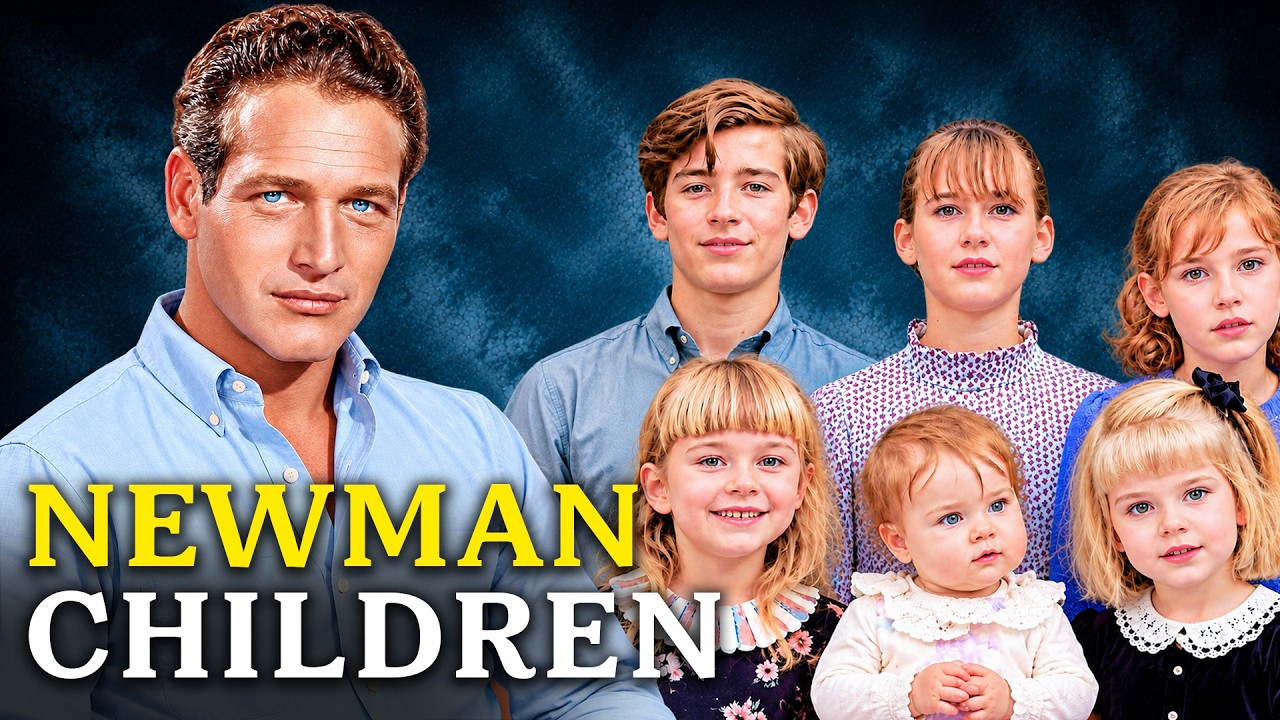
The marriage ended in divorce in January 1958, and Newman married Joanne Woodward that same month in Las Vegas. Scott was just seven years old. Newman’s career went vertical exactly as his first three children were growing up. The first family lived largely in California while the second family grew up in Connecticut, nearly a continent apart.
Visits required scheduled flights and arranged weeks; nothing was casual. By all accounts, including his own, Newman was an absent parent to his first three children. Not cruel, but frequently elsewhere and emotionally hard to reach. Scott bore the heaviest burden.
He was the only son of one of the most famous men in the world, carried the same jaw, the same coloring, and the same ambition to act. He tried college and didn’t finish. By his early twenties, he was drinking heavily, with arrests for bar fights and an altercation with a police officer. He did get work, appearing in The Towering Inferno in 1974, Breakheart Pass in 1975, and Fraternity Row in 1977.
He also did stunt work, which suited his fearless nature. But casting directors saw the name before they saw him, and reviewers mentioned his father in the first sentence. His father was in the middle of an extraordinary run of films—Butch Cassidy and the Sundance Kid, The Sting, The Towering Inferno. Comparison was unavoidable, and the two were not close enough to talk about it honestly.
Those who knew Newman well testified that he found emotional conversation almost physically difficult. He deflected with jokes and went to the garage to work on cars. His son needed honest conversation and could not get it from him. Newman tried to help.
He paid for treatment and arranged for Scott to work with psychologist William Bartman, who became a full-time companion in 1978. There were long, difficult conversations and periods when it seemed to be holding. On the night of November 19, 1978, Scott Newman was at a hotel in Los Angeles. He had been in physical pain from an earlier injury and was taking prescribed medication.
Alongside the prescriptions, he had been drinking. The combination stopped his breathing. He was found in the early hours of November 20 and could not be revived. He was 28.
The coroner recorded it as an accidental death. His father was in New York and took the call in the middle of the night. What Newman did afterward is the part most people don’t know. He was almost totally silent on the subject in public for the rest of his life.
Those around him said the guilt was constant and immovable. He believed he had been a bad father to that boy, and he said so to his family at length in taped interviews he commissioned in the mid-1980s, which stayed locked away for decades. In 1980, he founded the Scott Newman Center, an organization devoted to drug abuse prevention through education, run out of the University of Southern California. It produced films and materials for schools and parents, treating substance abuse as something to be understood rather than shouted at.
There is a second thing harder to prove and harder to dismiss. Newman’s Own, the food company that has now given away more than $600 million, began four years after Scott died. So did the summer camps for seriously ill children, which opened in 1988. The eldest daughter, Susan Kendall Newman, born in 1953, went into acting.
She worked on and off Broadway, had a small role in Slap Shot in 1977, and appeared in Robert Altman’s A Wedding in 1978. That same year, she got the role people still recognize her for: one of six New Jersey teenagers in I Want to Hold Your Hand, the directing debut of a young Robert Zemeckis. It was released the same year her brother died. She then moved behind the camera, producing a television version of The Shadow Box, directed by her father with her stepmother in the cast.
It won a Golden Globe and was nominated for an Emmy, a Peabody, and a Grammy. She was in her late twenties. Then she changed direction entirely. Susan spent the rest of her working life in prevention and philanthropy, becoming a genuine expert in drug abuse prevention.
She consulted for the California Department of Education, developed materials for parents, and founded her own consulting firm advising government agencies and nonprofits. She was recognized by two former first ladies. She put down a promising acting career at the height of the 1980s to work on the specific problem that had killed her brother—as a professional, not a celebrity spokeswoman. In 2015, she described her father’s dislike of what he called “noisy philanthropy,” noting he got a kick out of the fact that the company’s boardroom table was a ping-pong table.
Paul Newman died in September 2008 at age 83. He had set up an arrangement under which his daughters would each direct a substantial sum every year to charities of their own choosing. Starting in 2020, according to a lawsuit filed in Connecticut in August 2022, that annual sum was cut in half from $400,000 per daughter to $200,000. Susan and her half-sister Nell sued the foundation for $1.
6 million in damages to be paid to charity and for an order requiring it to follow their father’s instructions. The complaint said the foundation had drifted from its mission. The foundation rejected the claims, saying a charity cannot legally guarantee anyone a permanent annual allotment. The case ran for years.
In 2024, the sisters obtained a court order temporarily blocking the foundation from licensing their father’s image for products unrelated to food—specifically, a hairbrush. In March 2025, the dispute ended abruptly in a settlement. The terms were not made public. On August 2, 2025, Susan Kendall Newman died at age 72 from complications of long-standing health problems.
Her family published the notice that October, describing her sharp wit, her generosity, and her devotion to the people around her. Stephanie Kendall Newman, born in 1954, is the hardest to write about because she has managed something almost nobody born into that family has managed: staying out of it entirely. She was three when her parents separated. She did not go into acting or the family businesses.
She has given no interviews. There are almost no photographs of her as an adult in circulation. She was named in her sister’s obituary in 2025 as one of the survivors. Beyond that, she has kept an entire life to herself.
The fourth child, Nell Newman, was born on April 8, 1959, the first daughter of Newman’s second marriage. She was on screen young, appearing in her father’s films Rachel, Rachel in 1968 and The Effect of Gamma Rays on Man-in-the-Moon Marigolds in 1972, playing opposite her mother under the name Nell Potts. Then she stopped completely. What Nell actually loved was birds.
She took up falconry as a girl and later worked on peregrine falcon restoration in California. She went to the College of the Atlantic in Maine and took a degree in human ecology. In the early 1990s, she had an idea to create an organic line inside Newman’s Own. Her father was skeptical—organic food in 1992 was a health shop category, not a supermarket one.
She convinced him by cooking him an entire Thanksgiving dinner made exclusively from organic ingredients and asking what he had thought of it afterward. Newman’s Own Organics launched in 1993. Nell ran it with her business partner for around two decades. In 2014, her license was not renewed, and the organics brand was folded back into Newman’s Own.
Today, Nell Newman is in her sixties, living in California, married since 2005 to Gary Irving, and working on environmental and food causes. The artist Melissa Stewart Newman, known as Lissy, was born on September 27, 1961. She appeared as a child in Rachel, Rachel, and in 1990 she appeared in Mr. and Mrs.
Bridge, the last major film her parents made together. That was effectively the end of her acting. Instead, she built two quiet careers. For decades she has been a working jazz singer in Connecticut, playing local halls for rooms of a few dozen people.
From the early 2000s, she built a serious practice as a visual artist working mainly in porcelain and stoneware. In October 2025, her porcelain work was shown in a group exhibition in Norwalk, Connecticut. She has lived for most of her adult life about a mile from where she grew up, married to a middle school teacher with two children. In 2023, she published Head Over Heels, a collection of her parents’ letters, photographs, and keepsakes.
It was affectionate, selective, and deliberately not a tell-all. That same year in which the family opened its archives, 2022, Paul Newman’s own memoir was published, assembled from the taped interviews he had commissioned in the 1980s. Ethan Hawke made a six-part documentary series about Newman and Woodward from the same transcripts. The youngest, Clea Olivia Newman, was born on April 21, 1965.
She has never had a period of trying to be something other than a Newman. She was 23 when the Hole in the Wall Gang Camp opened in Ashford, Connecticut, in 1988. The idea was simple: children with serious illnesses could do everything an ordinary child does at summer camp, with a full medical facility hidden in the middle so nobody had to sit anything out. It was free, and it has always been free.
The organization that grew out of it now serves hundreds of thousands of children and families around the world. Clea has spent essentially her entire adult life inside it. She is the network’s director of special initiatives, the sibling most often seen in public hosting galas, and the one who gives interviews about her parents that the others largely avoid. She is also the sibling who has spoken most warmly about their father, describing a man who was much sillier at home than his screen image suggested.
Joanne Woodward was diagnosed with Alzheimer’s disease in 2007, days before her husband’s own cancer diagnosis. She is 96 years old and has not appeared in public since 2013. Her daughters have said this was why they agreed to open the archive when they did: they wanted the documentary finished and the book published while she was still able to see them. Paul Newman had destroyed the tapes from the 1980s interviews; only the typed transcripts survived, sitting in a box for roughly 25 years until his daughters found them and decided to let them out.
A man tried to tell the truth about himself, changed his mind, burned the recordings, and was published anyway by his children 14 years after his death. The company is still there, having given away more than $600 million, all of it to charity. It started in 1982 as a joke, with Newman and his neighbor mixing salad dressing in a bathtub and handing it out in wine bottles at Christmas. Newman thought putting his own face on a bottle was absurd, which is precisely why he agreed to it—the money might as well go somewhere useful.
Four sisters are left of the six children. Two of them spent three years suing an organization the other two are publicly associated with. They have all, in their own ways, spent their lives dealing with the same inheritance.
Not the money—the face on the jar.