On May 19, 1875, Mary Todd Lincoln was led through a side door of a Chicago courthouse with no warning and no lawyer by her side. When she entered the room, she found 17 witnesses already seated, along with her only surviving son, Robert. By the end of the day, a jury had deliberated for just ten minutes before declaring her insane and sending her to an asylum. She was the widow of President Abraham Lincoln, the woman who had believed in his political future before almost anyone else did.
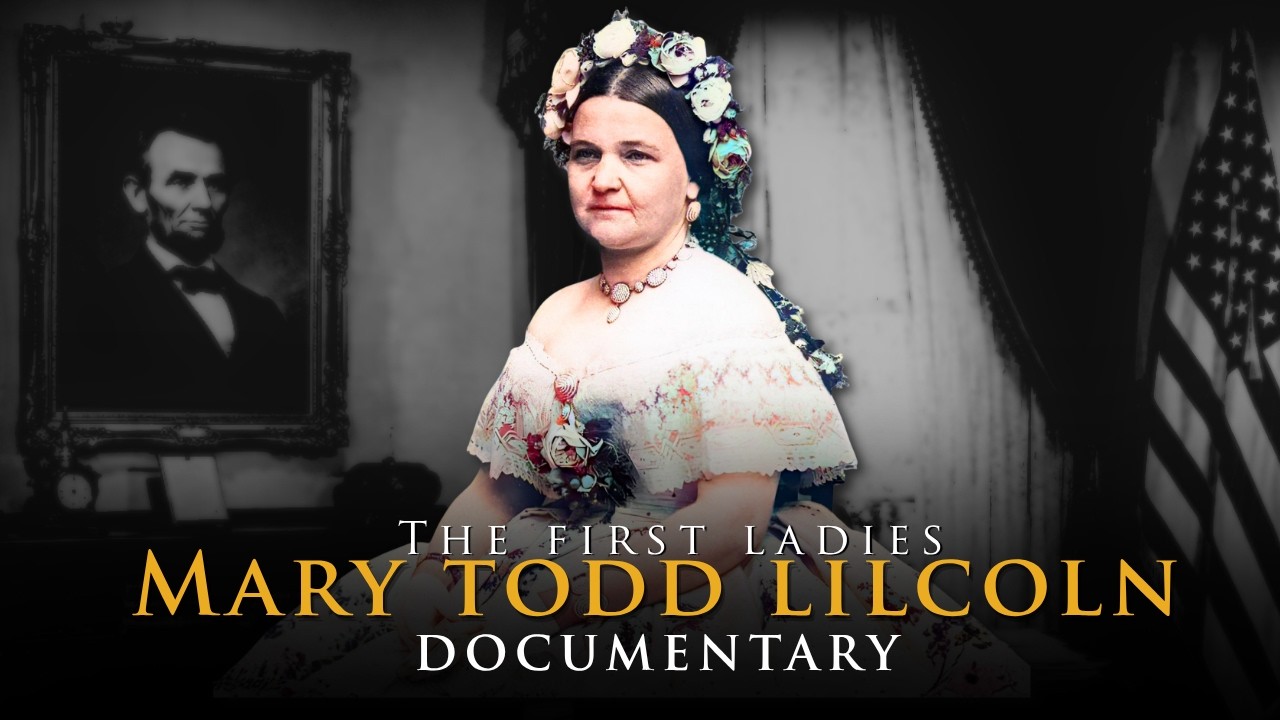
For 23 years she stood beside him, and by the time of her own trial, she had already buried three of their four sons and witnessed her husband’s assassination at Ford’s Theater. Mary Todd was born into a prosperous Lexington, Kentucky, family in 1818. Her mother died when she was six years old, a loss she would later describe as leaving her childhood desolate. Her father remarried within a year, and the household expanded with nine more children from his second marriage.
Despite the instability at home, Mary received an unusually thorough education, studying grammar, literature, and French at a time when most American women received almost no formal schooling. In 1839, she moved to Springfield, Illinois, to live with her married sister. There she met Abraham Lincoln, a circuit lawyer with rough edges and little social standing. While Springfield society raised its eyebrows at the match, Mary told friends with complete conviction that he would one day become president.
They smiled politely; some laughed. She was right. The couple married on November 4, 1842, in a hastily arranged ceremony at her sister’s home. Inside the gold wedding band Abraham placed on her finger that day were three engraved words: “Love is eternal.
” She wore that ring for the rest of her life. Their early years in Springfield were modest but happy. They had four sons: Robert, Edward, William, and Thomas. Abraham later said of his wife, watching her move through a White House reception, that she was as handsome as when she was a girl, and that he had never fallen out of love with her.
When Lincoln won the presidency in November 1860, Mary had been living in the certainty of that moment for two decades. The White House she arrived in was not the grand stage she had imagined. It was drafty and badly furnished, with worn carpets and moth-eaten curtains. Congress gave her $20,000 for renovations; she spent more.
The press noticed and rarely gave her a charitable reading. She was too southern, with half-brothers fighting for the Confederacy, and too extravagant, spending on gowns and jewelry during wartime. A fabricated letter falsely claiming she had passed military information to Confederate agents circulated in newspapers that reached hundreds of thousands of homes. For all the public attacks, her deepest blow came from within the White House walls.
In January 1862, her 11-year-old son Willie fell ill with typhoid. He died on February 20. Mary could not bring herself to enter the room where his body lay. Abraham Lincoln, a man who rarely cried in public, went alone to his son’s room and wept openly, then visited the crypt where Willie’s body was temporarily held several times at night.
Mary wore black every day for nearly three years. She consulted spiritualists and held séances in the White House, searching for her son in the only places she knew to look. Lincoln, watching with concern, told a doctor he worried that if she did not moderate her grief, he would have to send her to the government hospital for the insane. She never forgot those words.
The war ended on April 9, 1865, and Washington celebrated for five days. On the evening of April 14, Mary arranged for them to attend a performance of “Our American Cousin” at Ford’s Theater. Lincoln, exhausted, had not especially wanted to go. They arrived late and sat in the presidential box.
Mary would later say she had been happy that night, that they had been laughing, that she had taken his hand. At 10:13 p. m. , a single shot was fired from behind them.
The bullet entered the back of Abraham Lincoln’s head. Mary caught him as he slumped forward. John Wilkes Booth slashed an army major with a knife before leaping to the stage. Lincoln was carried across the street to the Petersen House, where attendants laid him diagonally on a bed too short for him.
Mary sat in the parlor for nine hours, listening to him breathe through the wall. At 7:22 the next morning, he died. Mary was 46 years old, a widow with three dead sons and one surviving child who kept a careful emotional distance. Congress initially offered her almost nothing.
There was no pension for three more years. She left the White House five weeks after the assassination and moved with her youngest son, Tad, to Chicago, drifting through hotels and rented rooms. In 1867, two years after her husband’s murder, Mary made a decision she believed was practical. She traveled to New York under the false name Mrs.
Clark to sell her White House wardrobe through brokers on Broadway, intending to clear her debts. Within days, the brokers leaked her identity to the press. Newspapers across the country ran the story on the front page: the widow of the martyr president was selling off her dresses in a secondhand shop. The coverage was brutal.
The Chicago Journal printed that the most charitable construction her friends could put on her strange course was that she was insane. It was the first time the word was used about her publicly. The sale largely failed. She returned to Chicago having lost far more than she had hoped to gain.
She also lost her closest friend. Elizabeth Keckley, a formerly enslaved woman who had purchased her own freedom and become a celebrated dressmaker in Washington, had been at Mary’s side throughout the White House years and in the hours after Lincoln died. In 1868, Keckley published a memoir titled “Behind the Scenes,” written, in her own words, to place her friend in a better light before the world. Robert Lincoln moved swiftly to suppress the book.
It disappeared from shelves within months, and Keckley’s reputation suffered damage from which it never recovered in her lifetime. In 1871, Tad Lincoln died at age 18 of a respiratory illness, with his mother beside him. Mary had now outlived her husband and three of her four sons. She had one surviving child left: Robert.
Robert Todd Lincoln was a prosperous Chicago attorney, meticulous and fiercely protective of his father’s legacy. Beginning in the early 1870s, he had his mother watched. Mary had become increasingly erratic, moving constantly from hotel to hotel, spending in patterns with no identifiable logic, convinced at times that strangers meant her harm. In 1873, she told her doctor that an Indian spirit was pulling wires from her eyes and bones from her cheeks.
Robert hired Pinkerton detectives to follow her and spent the better part of two years quietly building a case. He told almost no one what he was planning. In the spring of 1875, Mary was in Florida when she became convinced her son was ill and rushed back to Chicago. Robert was fine, but he had been waiting for her.
On the morning of May 19, Leonard Swett, a close friend of her late husband’s, arrived at Mary’s hotel. He told her she needed to accompany him but did not say where. When she resisted, he told her police officers were waiting outside and would take her by force, using handcuffs if necessary. She went.
The carriage took her to the Cook County Courthouse. Swett led her through a side door into a courtroom where a judge, a jury of twelve men, and 17 witnesses were already waiting. Robert was in the room. A defense attorney named Isaac Arnold, another man who had known Abraham Lincoln, had been arranged for her by Robert, not to protect her but to manage her.
His instructions, according to accounts that emerged from the trial record, were to offer no rebuttal and no cross-examination. The proceedings lasted less than three hours. Seventeen witnesses testified to her instability, her spending, her fears, her strange statements about spirits and wires and bones. None were challenged.
The jury deliberated for ten minutes and returned a verdict of insanity. Robert was appointed conservator of her estate. Her money, bonds, and property were taken from her control immediately. Within hours of the verdict, Mary went alone to a pharmacy and asked for laudanum, an opium-based tincture that was lethal in sufficient quantities.
She consumed what she was given but did not die; according to historian Jason Emerson, the druggist had recognized her and given her a placebo. She was admitted to Bellevue Place Sanitarium in Batavia, Illinois, the day after the trial. The institution was well-appointed and run by a doctor who practiced gentle, progressive care. Mary immediately began writing letters to lawyers, friends, and anyone who might help her make a case for her own sanity.
A reporter from the Chicago Post and Mail interviewed her during her stay and left convinced she was entirely rational, writing as much in his newspaper. Two people read that article and began working on her behalf: lawyer James Bradwell and his wife Myra, one of the first women admitted to the Illinois bar. They visited her, wrote letters, and pressed Robert through channels he found difficult to ignore. On September 10, 1875, Mary walked out of Bellevue Place after less than four months inside.
A second trial the following year formally overturned the insanity verdict and restored her legal independence. Robert had kept everything from the case: the letters, the trial records, the private correspondence with lawyers and doctors. He labeled the folder in his own handwriting with a name that revealed how he understood what he had done: the “MTL insanity file. ” He put it in a cabinet and closed the drawer.
For decades, historians believed the file had been destroyed, along with much of the family correspondence Robert spent his later years burning. It had not. In 2005, historian Jason Emerson found it in a collection of papers belonging to Robert’s lawyer, stored in a trunk in an attic for 40 years. Inside were 25 letters, 20 of them in Mary’s handwriting, most written from inside the asylum.
She had been writing to the people she trusted, asking them to understand what had happened to her and help her get out. Mary spent three years in France after her release, living quietly in the town of Pau at the foot of the Pyrenees, where no one stopped her in the street. She returned to the United States in 1880, her health failing. She went to her sister’s house in Springfield, the same house from which she had walked as a bride nearly four decades earlier.
She arrived with dozens of trunks that filled her room so completely there was barely space to stand. She kept the curtains drawn. Children in the street called her the crazy lady on the hill. She did not go outside.
In those final years, she and Robert reached something that could not quite be called reconciliation, but was at least the absence of open war. He visited occasionally, and she did not turn him away. She died on July 16, 1882, at age 63. The cause was listed as a stroke.
She was buried beside her husband at Lincoln’s tomb in Oak Ridge Cemetery, beside Abraham, Eddie, Willie, and Tad. The ring was still on her finger when she was laid down. She had worn it for 40 years, through the White House, the war, the assassination, the trial she did not know was coming, the asylum, and the room with the curtains always drawn. After her death, history spent the next century and a half deciding what to make of her: whether she was unstable or misunderstood, whether her grief was illness or the accurate response of a human being to an inhuman amount of loss, whether Robert had been a frightened son or something colder than that.
These questions do not have clean answers. What remains in no question is that she was the girl from Lexington who believed in Abraham Lincoln before the world knew his name, and she was exactly right about who he was and what he would become.