The guard at the gate wouldn’t meet my eyes. That was the first sign that something was off. I’d driven forty minutes from our house in Fayetteville, Jimmy buckled in his seat, still in the navy polo I’d ironed that morning. He had a little dinosaur tucked under his arm, and he kept asking me the whole way whether his dad would take us to see the tanks.
On the passenger seat beside me, I had a covered container of beef stew I’d made at home, short ribs and root vegetables, lightly salted because my husband had been complaining about his stomach for two weeks, and a doctor friend had told me exactly what to cook for him. I’d started it the night before. That was my nature. I was cooking for a man who didn’t deserve it.
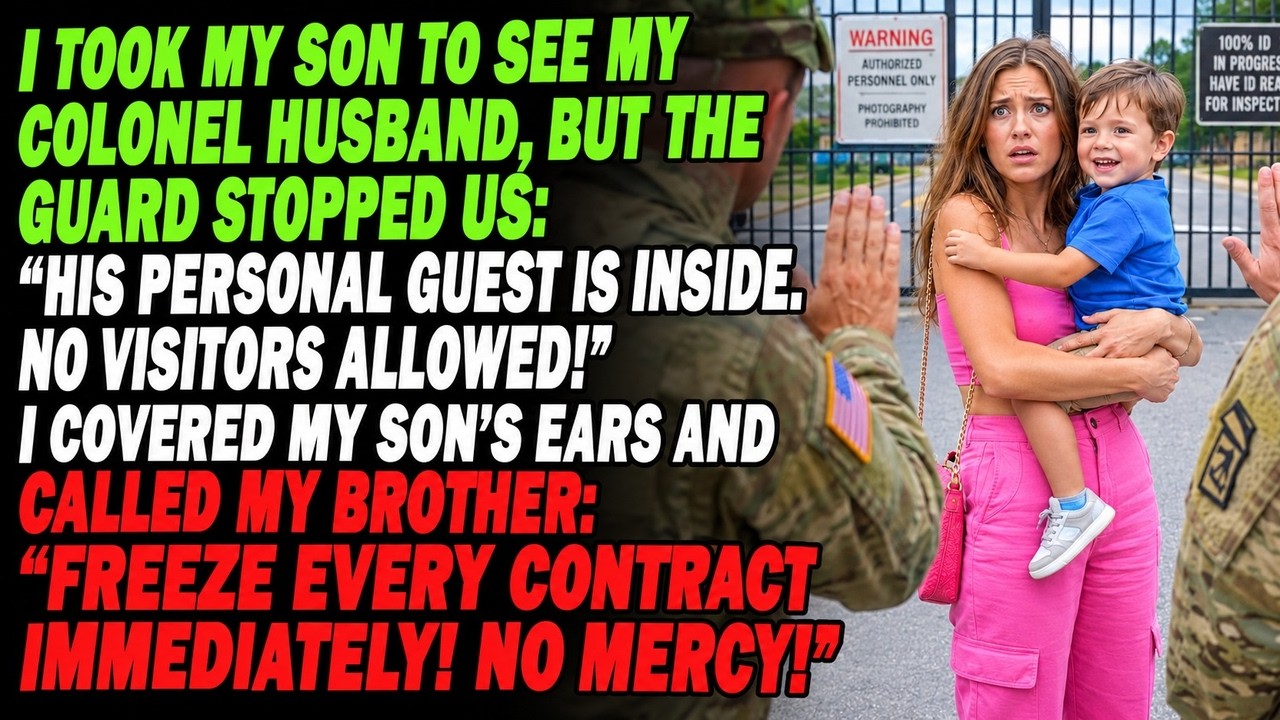
The young soldier at the main checkpoint looked like he had drawn the worst assignment of his career. He picked up the phone receiver the moment I gave my name. I only caught fragments through the small speaker on his side of the booth. Something about the commander’s wife.
Something about the main gate. He set the receiver down and looked somewhere over my shoulder. Ma’am, the colonel is not available for visitors at this time. I told him, I’m not a visitor.
I’m his wife. Just call him and tell him I’m here. His posture shifted with unease. His jaw moved like the words were stuck in his throat.
Ma’am, he has a special guest on the base. Colonel Hill has issued strict orders. No unscheduled visits today. A special guest.
The August heat sat on my skin like a wool blanket. I remember registering that fact in a cold, clinical way. The temperature, the smell of asphalt, the low hum of the base behind those gates. While the meaning of what he’d just said seeped into me like cold water through a crack in concrete.
I looked down at Jimmy. He was watching us with those wide, steady eyes. The way little kids watch adults when they sense something has changed. I leaned down and pressed both palms gently over his ears.
He let me. He always lets me. I looked back up at the soldier. Who gave the order?
Sergeant Pruitt, ma’am. The colonel’s adjutant. I straightened up, keeping one hand steady on Jimmy’s head. I reached into my bag with the other and pulled out my phone.
I called my middle brother. Lennox answered on the second ring. He always does. Hey, little sister.
I told him, I’m standing at the front gate of Camp Cormac. I kept my voice low and even. He’s given orders to turn me away. Says he has a special guest on site.
The silence on Lennox’s end was the kind I grew up with. He was the second oldest of the four Aldridge kids and a two-star general. When he truly got angry, he went completely silent, and men in the room instinctively took a step back. I’ve seen hardened men go pale in the shadow of that silence.
Who’s the guest? I don’t know yet. I’ll make some calls. His voice dropped half an octave.
Go home. Don’t wait there. I ended the call. Jimmy was looking at me, the dinosaur under his chin.
Mom, aren’t we going in? Not today, sweetheart. I lifted him, set him on my hip, and walked over to the insulated carrier I’d placed by the guard shack. I’d started that stew at eight the night before.
I’d skimmed the fat twice. I’d driven forty minutes through traffic. I picked it up, walked to the edge of the curb, and dumped it into the drainage ditch along the outer fence. The specialist made a sound like he’d taken a light blow to the chest.
I hope you have a good afternoon, I told him. I carried Jimmy back to the car, buckled him in, and drove home without turning on the radio. His name was Cormac Hill. We’d been married for five years.
I was thirty-one, he was thirty-eight, and he commanded a military facility sixty miles from Fayetteville with a staff of over four hundred. We met at a charity fundraiser my older brother Merritt hosted for a veterans’ organization. Cormac showed up in his dress uniform and was handsome in a way that felt like a mild concussion. You don’t realize how off-balance you are until you’re already driving.
My family had money, the old, quiet kind. The Aldridge company had been run for over sixty years, with Merritt at the helm, carrying on our father’s careful precision. Lennox had gone into the service. My sister Olivia handled the company’s legal affairs, and I married Cormac Hill and dedicated myself to being what I thought was a good, useful, stable, present wife.
That afternoon, while Jimmy watched cartoons in the living room, I walked into the bedroom and opened the bottom drawer of my husband’s closet, the one I’d learned years ago not to touch because he said it held his deployment documents. I’d never looked inside. I opened it now. Under a folder that did contain actual employment records, there was an unsealed envelope.
Inside was a life insurance policy dated eight months prior. Cormac Hill, policyholder. Cormac Hill, insured. Two million dollars.
The beneficiary, Natasha Devereaux. Relationship to insured, close friend. He had a wife. He had a four-year-old son.
His beneficiary was a close friend. I read it three times. I photographed every page. I put it back exactly as I found it.
Then I called my sister. Olivia is two years older than me, the type who processes information the way a computer processes code. Fast, unemotional, precise. She listened to everything I said without interrupting.
When I finished, she went quiet for about four seconds. She said, Okay. Merritt should know tonight. And Hadley, don’t tell Cormac you found it.
Not yet. My phone buzzed twenty minutes later. It was Lennox. He’d made his calls.
The person I’d been making that stew for was a woman named Natasha Devereaux. She’d grown up on a military base in Georgia. Her father had served under Cormac’s father. She and Cormac had known each other since they were teenagers.
She’d gone overseas after college to work in materials research, and had come back to the States earlier that year, taking a position at a private tech company whose primary contract was with my husband’s facility. An eighty-million-dollar technology partnership. She was the project manager. I sat with that information for a long time.
Jimmy had fallen asleep on the couch, his dinosaur still tucked under his arm. I pulled a blanket over him and went back to the bedroom. I opened the drawer again, took out the policy, and read it one more time. Then I put it back and sat on the edge of the bed with my hands folded in my lap.
The phone rang at nine that night. It was Merritt. I’d been expecting him. He had the kind of calm, measured voice that made everyone in the family feel like everything would be handled.
I hear you had an interesting drive today. You could say that. I want to come over tomorrow. Just the two of us.
He paused. I said, Fine. Come for lunch. Bring the documents.
I’ll have them ready. I didn’t sleep that night. I lay awake next to the warm, breathing weight of my husband, listening to him breathe, watching the ceiling. In the morning, I made breakfast like nothing was wrong.
I made eggs and toast and poured him coffee, and he kissed me on the forehead and told me he’d be late, there was a joint training exercise. He didn’t mention the gate. He didn’t mention the woman. I let him go.
Merritt came at noon. I’d put out sandwiches and iced tea, but neither of us ate much. He sat at the kitchen table, reading the policy front to back, page by page. Then he set it down and looked at me.
You’re sure you want to do this. I’m sure. He nodded slowly. The company’s legal team can drag this out.
I know. But there’s also the fact that he committed adultery while in the military. That’s a criminal offense under the UCMJ. And he listed another woman as his beneficiary on a two-million-dollar policy while married to you.
That’s a clear violation of the Uniformed Services Former Spouses’ Protection Act when it comes to division of marital assets, and it’s going to look terrible for him. Merritt poured himself more iced tea, slowly, deliberately. He was always the calmest person in any room. And this Natasha Devereaux.
The company she works for has a contract with the base. An eighty-million-dollar contract. You think that’s a coincidence? I don’t think anything is a coincidence anymore.
Merritt finished his glass and set it down. Then I’ll have the lawyers draft the papers. Divorce, asset division, custody. You want full custody of Jimmy.
Yes. He nodded. I’ll have them include the policy. You get half of the death benefit as part of the marital property, or he can keep it and lose the house.
Either way, he pays. He stood up, squeezed my shoulder, and walked to the door. At the door, he turned. Hadley, I’m sorry.
I looked at him. Don’t be. You always said I married him too fast. He had the decency to look embarrassed.
I didn’t say it to be right. I know. But you are. Right.
I walked him out and watched him drive away. Then I closed the door and leaned my forehead against the cool wood for a long moment. I waited until Jimmy was in bed that night. Then I called Natasha Devereaux’s office.
The receptionist put me through with a bored efficiency. When she answered, her voice was smooth, professional. This is Natasha. I kept my own voice steady.
Ms. Devereaux. My name is Hadley Hill. I’m Cormac’s wife.
There was a pause. A long one. Then, carefully, she said, I don’t think there’s anything for us to discuss. I think there is.
I have your name on an insurance policy. Two million dollars. And you’re the project manager on an eighty-million-dollar contract at my husband’s base. She said nothing.
I want to meet you. In person. Tomorrow. No.
You will meet me tomorrow, or I will take this to the company that holds your contract, and I will tell them exactly what kind of relationship their project manager has with the commanding officer of the facility she does business with. You’ll be looking for a job by the end of the week. Another pause. Then, quietly, she said, Fine.
Where? There’s a diner off Route 9, about twenty miles from the base. Ten in the morning. I’ll be there.
I hung up. The diner was the kind of place with cracked vinyl booths and coffee that had been sitting too long. I got there early, took a booth in the back, and ordered water. She walked in at ten on the dot.
She was pretty, in a sharp, polished way. Blonde hair pulled back, tailored blouse, heels that cost more than my monthly grocery budget. She spotted me immediately and walked over without hesitation. She sat down across from me and folded her hands on the table.
Her eyes were careful, unreadable. You wanted to talk. I want you to understand something. I don’t love him.
She said it flatly, like she was reciting a fact. I didn’t ask if you loved him. I’m telling you this so you don’t think you’re breaking anything. There’s nothing to break.
I know about the policy. I know about the contract. And I know he’s been with you longer than he’s been faithful to me. She blinked.
Then she let out a small, humorless laugh. He told me you were simple. That you were a housewife who wouldn’t notice anything. I felt a hot flash of anger, but I kept my voice level.
He underestimated me. That’s his mistake. She leaned back, studying me. So what do you want?
I want you to know that I’m not going anywhere quietly. I’m taking him for everything he’s worth. And I want you to know that if you ever come near my son, I will destroy you. I don’t care how many generals’ daughters you know.
She looked at me for a long moment. Then she nodded slowly. I believe you. Good.
I slid out of the booth and tossed a ten on the table for the water. I stood up, then paused. You can have him. She said nothing.
I walked out without looking back. The divorce was finalized four months later. I got the house, full custody of Jimmy, and a settlement that let me raise my son without ever worrying about money. Cormac kept his position for another year before the Army quietly reassigned him to a desk job in the Midwest.
He saw Jimmy every other weekend, but the visits grew shorter and less frequent until they stopped altogether. I heard he remarried, a younger woman, some aide-de-camp’s sister. I didn’t care. I took my share of the insurance policy and put it in a trust for Jimmy.
I kept the rest and invested it carefully. I went back to school and got my degree in finance. It took three years, but I did it. The day I graduated, my whole family came.
Merritt, Olivia, Lennox, and Jimmy, who was seven by then and too cool for hugs, but he gave me one anyway. As I stood there in my gown, holding the diploma, I thought about all the things I’d done that summer. The stew I’d cooked for a man who didn’t deserve it. The drawer I’d opened when I shouldn’t have.
The phone calls. The quiet, careful planning. And I thought about how I’d spent five years being a good, useful, stable, present wife. And how I’d spent five minutes deciding I was never going to be that again.
Jimmy tugged my sleeve. Mom, can we get ice cream? I looked down at him, his dark hair sticking up in the wind, and I smiled. Sure, sweetheart.
Anything you want. And I meant it.