Dolly Parton’s life and career are defined by a single, consequential decision she made as a young woman: to refuse Elvis Presley’s demand for half the publishing rights to “I Will Always Love You. ” At the time, the song was her artistic statement about leaving her professional partnership with Porter Wagoner, a relationship that had made her famous but had become painful. Presley wanted to record the song, but his manager, Colonel Tom Parker, insisted on a standard arrangement that would have stripped Parton of her ownership. She walked away from the offer, a choice that cost her immediate financial gain but preserved a copyright that would later become one of the most valuable in music history.
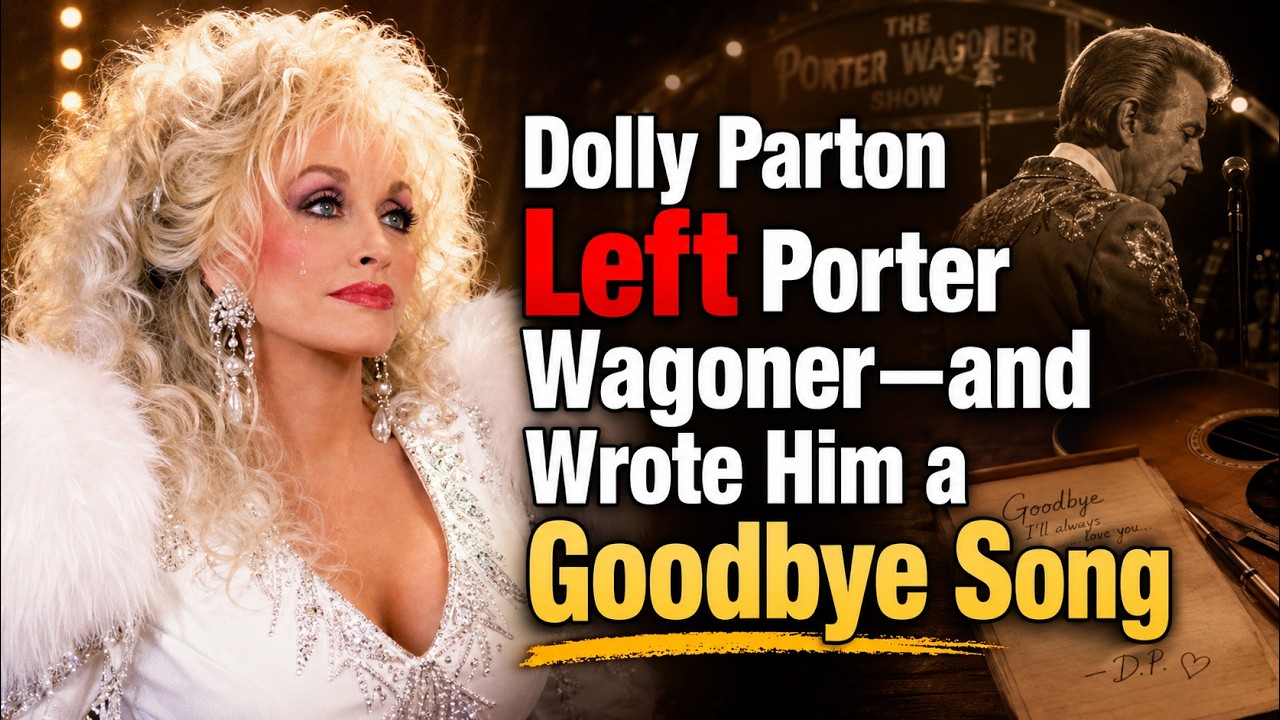
That decision was not made because she knew Whitney Houston would one day transform the song into a global anthem; it was made because she understood that a songwriter’s power lies in the words she owns. The song, which she had written as a farewell that carried gratitude rather than bitterness, eventually became the marker of her departure from Wagoner, and its emotional depth came from its refusal to dramatize a simple goodbye. The speaker leaves while still expressing love, a nuance that allowed the song to speak to anyone who has had to walk away from something valuable. Parton’s public identity was a carefully constructed persona, built from towering hair, rhinestones, bright colors, and jokes she often told before anyone else could.
Beneath the exaggerated exterior was a disciplined writer who understood that the costume protected the person inside it. She grew up in a crowded household in the Smoky Mountains, where music entered as naturally as work, and where a child’s early words were treated as worth saving long before any publisher or contract existed. That early validation shaped her understanding that a song could survive without machinery. Her family’s hardship did not automatically produce ambition, but it did produce a deep need to write, not just to escape poverty but to make sense of it.
As a young woman trying to enter the music industry, she had to knock on doors, face rejection, and learn the language of contracts, all while deciding which parts of herself to reveal and which to keep hidden. The persona she developed was not a lie; it was a tool. It allowed her to control the narrative of her own life, to make the joke before anyone else could, and to keep a private space where she could hear a line before it vanished. The public laughed at the hair and the heels, but she was often the one telling the joke, and the laughter never diminished the reality of the person making it.
Her marriage to Carl Dean, who worked in asphalt paving and avoided the celebrity culture around his wife, was a testament to the distinction between privacy and mystery. The marriage existed, but it was not offered as entertainment. Dean rarely appeared at ceremonies, and the public made jokes about the husband who was never seen, but Parton protected that part of her life fiercely. She did not need to turn private affection into content.
That boundary was not a contradiction of her public persona but a necessary condition of it. The same discipline extended to her professional relationships. When she recorded with other artists, she was never so protective of her identity as a songwriter that she refused a great song written by someone else, but she understood that collaboration no longer meant standing inside someone else’s framework. The harmonies worked because each singer was recognizable and each was willing to disappear into the group for a few seconds.
That ability to share a microphone without losing her own voice became a signature strength. By the 1980s, that strength extended into the business side of her career with the development of Dollywood, a theme park built on the site of an existing tourist attraction. She could have used her home county only as scenery in interviews and specials, but Dollywood made the relationship material, selling a version of regional identity while producing real economic effects for people living nearby. She protected the things only she could supply, then looked for partners who could do what she could not.
The emotional range of Parton’s work was wider than her visual brand. Songs like “9 to 5” became everyday language for working life, while “Coat of Many Colors” named an object to explore poverty and love. Her best titles often contained the architecture of the story before the listener knew it. She had a gift for constructing small human worlds in a few verses, establishing a person, a conflict, a place, and an ending before the record was over.
That skill was not accidental; it was the result of decades of ordinary professional labor. Between the famous scenes of her life were years of writing, recording, touring, and business meetings that never made the cover stories. The public saw the persona, but the work was in the writing. She protected that private space because it was where the songs came from.
Even as age became part of the public conversation, she kept appearing as Dolly because the persona was designed to be recognizable, not natural. The body carrying the costume changed while the public symbol remained the same. She did not defeat time; she simply refused to pretend that the character had ever depended on appearing untouched by artifice. Parton’s later years were marked by a continuation of her most personal work.
The Imagination Library, which she founded in 1995, grew to deliver more than a million books each month to children, a program that used her celebrity to draw attention to the people doing the technical work of literacy. It was not the only charitable effort, but it was the clearest example of her method: use the name to create attention, then point toward the work. She did not treat the trust as magical, and neither did the public. Instead, they had watched a public persona remain broadly consistent with visible actions over a very long time.
Her Christian faith, rooted in her childhood, remained part of her public language, but she answered questions about faith in personal rather than theological terms, allowing her to remain meaningful to audiences who did not share her beliefs. She decided again and again how much of herself to put directly into an argument and how much to leave inside songs, philanthropy, and personal language. When she did engage, her response was practical. Celebrity attention was useful because it could bring donations and news coverage.
That was not political neutrality in a perfect sense; it was a calculated choice about how to use influence. The Whitney Houston version of “I Will Always Love You” became one of the most famous recordings in modern popular music, but Parton did not know that would happen when she refused Parker’s demands. She only knew that giving away the copyright was not a price she was willing to pay, even for Elvis Presley. That decision, made in the moment, later became the foundation of a financial empire and a lasting lesson about the value of artistic ownership.
The song itself carried the scale of the loss, the idea that the speaker was not simply saying she missed someone but that she would always love them even as she left. The song held both truths from the beginning. Parton was not converting autobiography into rhyme so much as she was constructing small human worlds that could hold the complexity of real life. That is why the project of understanding her resists the lone celebrity story.
She was not just a singer, a songwriter, an actress, a businesswoman, or a philanthropist. She was all of those things, and the categories did not exhaust her. A song could be both art and intellectual property, and a life could be both a public performance and a private search for meaning. The biographer’s challenge is not to throw away the stories she told but to see the labor between the famous scenes.
Tributes at her death came from musicians, actors, institutions, fans, and public figures, not only because she was a singer but because she had represented continuity. She had moved between past and present with ease, and that ability made her one of her own most effective biographers. Through songs, interviews, books, and documentaries, she selected the stories that would explain her, and those stories were vivid, compact, and repeatable. That did not make them false.
It made them a form of hospitality. She could laugh at the size of the hair or the cost of the rhinestones without sounding as if she regretted any of it. The relationship between memory and commerce was not pure, but it was honest. A song could return people to a kitchen radio, a long drive, a first apartment, or a television set glowing in a room that no longer exists.
The milestones of her life located whole sections of her audience’s own lives. She was still developing a stage musical based on her own story, with plans pointing toward Broadway, when she died. She was an older woman returning to language written by her younger self about emerging from darkness. Grief did not produce retirement.
The work continued until the end, a final composition that turned her life back into songs and her songs back into a life.