When Lillie Langtry died in 1929, she was living in a villa on a cliff in Monaco, attended by a paid nurse and two poodles barking in the next room. Yet when the news reached London, the newspapers gave her columns usually reserved for royalty. This was the woman who had once stopped traffic on Piccadilly simply by walking down the street. Born in 1853, Lillie was the daughter of a rector on the island of Jersey, a place that belonged fully to neither England nor France, governed by its own ancient laws and surrounded by tides that could strand a traveler for hours.
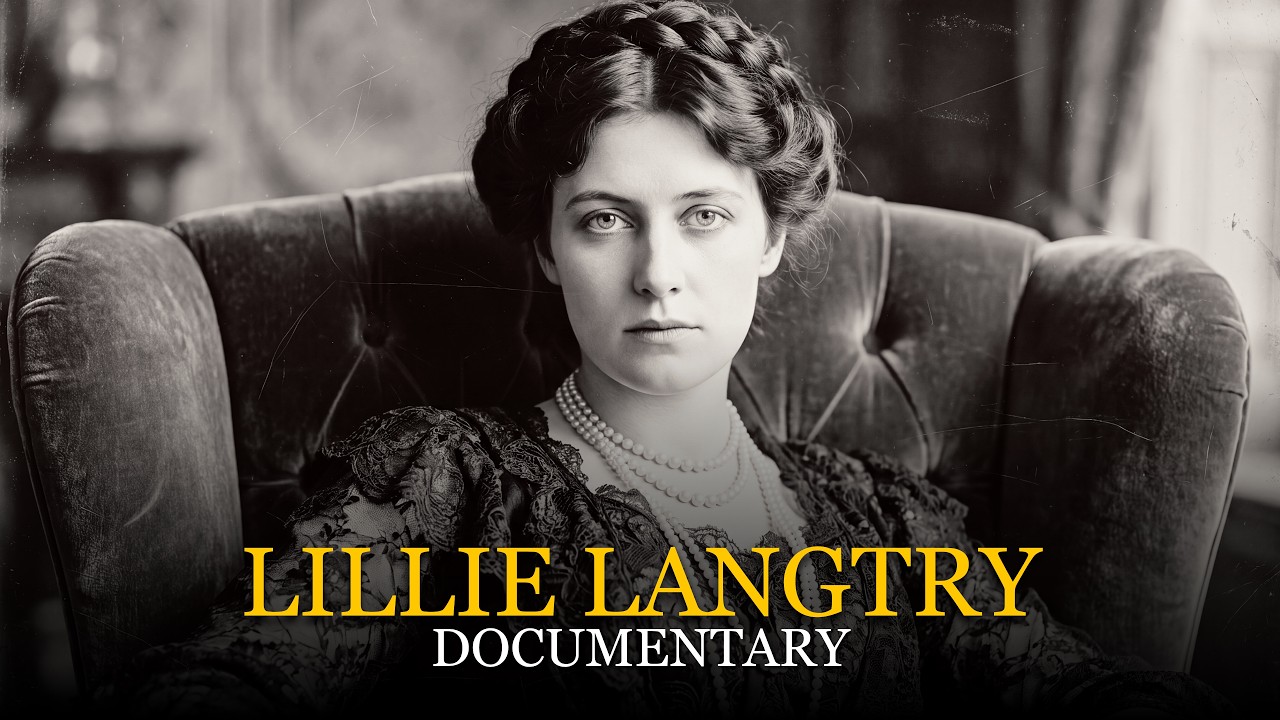
She had eyes described as a shade of blue that people compared to violets or the sea, a beauty so striking that the way people looked at her became a form of power. The question was what a beautiful woman was supposed to do with herself on a rock in the English Channel, where the most exciting event of the year was the Battle of Flowers Parade. She could not yet name it, but the wanting was so fierce it would carry her off the island, out of her class, beyond every rule her world had written for women, and into a life so extraordinary that it would become legendary. She married a man named Edward Langtry, who was not ambitious but owned a yacht called the Red Gauntlet that could take a woman anywhere in the world.
Their first year was invisible. Then came the evening that changed everything. She had become what the Victorians called a professional beauty, made possible by a technology that had nothing to do with beauty at all: the mass-produced photograph. Crowds gathered outside theaters and restaurants where she was expected to appear.
When the Prince of Wales displayed his preference, society responded with acceptance, not inquiry. The princess invited her to events, and once the princess accepted Mrs. Langtry, the rest of society followed. The royal favor gave her a reflected glow worth more than money because it could be converted into money by anyone clever enough to understand the exchange rate.
But a royal affair has a natural lifespan. Lillie Langtry, at 26, was about to discover what happens when the most powerful man in England stops returning your letters. Dressmakers, milliners, florists, wine merchants, and her landlord all presented their bills within weeks of each other. The furniture went first, then the horses, then the jewelry that was hers to sell.
On the 15th of December, 1881, Lily Langtry walked onto the stage of the Haymarket Theatre and delivered her first lines as Kate Hardcastle in She Stoops to Conquer. She was the first society woman in living memory to become a professional actress. Society women certainly did not display themselves on a public stage for money. The distinction between a woman admired in a private home and a woman applauded in a public theater was the distinction between a lady and something else entirely.
The reviews were mixed, but her talent was being Lily Langtry in public, and a theater was simply the most efficient venue for converting that talent into cash. She played a short season in London. Then she made the decision that would transform her from a disgraced society beauty into one of the wealthiest women of her generation. The American press, already developing its genius for celebrity, could not resist the narrative of the Jersey Lily.
Lillie grasped something about the American appetite for spectacle that most European performers never understood. She invested $100,000 in Fifth Avenue real estate during her first American visit. It became the foundational moment of modern celebrity endorsement, the first time a famous face was attached to a consumer product with the explicit purpose of selling more of it. She had taken beauty, the most fleeting currency a Victorian woman possessed, and converted it into wealth that did not depend on any man’s continued affection.
If your face is your capital, then damage to your face is a business expense, and business expenses can be compensated. But violence was not the only cost of the patronage economy. She eventually became involved with a man who wanted the one thing Lillie had never given any man: genuine control. She could not escape the patronage system without sacrificing the wealth she had accumulated within it.
The most inflexible rule was that no woman could own a racehorse. They simply assumed it was unthinkable. The fiction was maintained, and Lillie was free to spend her money, train her horses, and collect her winnings without anyone having to acknowledge that a woman was competing in the most masculine arena in British public life. Under the turquoise and fawn silks, one of her horses became one of the most successful long-distance runners in English racing.
The result sent shockwaves through the betting world. She stood in the owners’ enclosure accepting congratulations from the same aristocrats who had cut her from their guest lists when the prince grew tired of her. Her personal life during this period produced its most peculiar chapter. She discovered that she had a daughter, Jeanne Marie, from an earlier relationship.
The circumstances of the discovery had the terrible banality of most life-changing revelations. Perhaps she simply never had the opportunity to develop the maternal bond. In the days and weeks that followed, she began the process of withdrawal that would last for the rest of her mother’s life. The door between mother and daughter did not close with a slam.
She never acknowledged her daughter in any public statement. She never corrected the official version of events, which continued to maintain the fiction that Jeanne Marie was her niece. Whether this was shame, pride, self-protection, or simply habit is impossible to determine. Lillie had been performing so long that the boundary between strategy and emotion had dissolved.
As the new century approached, she discovered that she could not command time itself. It was not dying suddenly in a single dramatic collapse, but fading gradually like a photograph left too long in sunlight. The professional beauty had been a product of specific conditions. The human body displayed in a drawing room or on a stage was the primary medium of visual culture.
But the world was developing an appetite for entertainment that was mechanical, reproducible, and cheap. In 1913, she made a single motion picture, a short silent film that has been largely lost. It could not capture the quality that had stopped traffic on Piccadilly, the luminous presence that required proximity. The yacht she had married was long gone, sold years before to pay debts.
Still, Lillie continued to perform. The venues grew less grand, the audiences grew smaller, and the reviews began to include the word “still,” as in she still has presence, she still commands attention. The Manchester Guardian published a verdict that captured the shift in a single sentence. They did not know that the entire machinery of modern celebrity, the endorsements, the personal branding, the conversion of fame into fortune, had been invented by a rector’s daughter from Jersey who had figured it all out.
She married Hugo de Bathe, a man she did not love, and the title came from that husband. The marriage settled into the comfortable irrelevance that both parties preferred. She danced at social events, sometimes with professional dancing partners, with the unapologetic pleasure of a woman who had never pretended to be anything other than what she was. She was still witty, still sharp, but she had simply contracted her life to a size that she could manage alone.
She spent 60 years performing for the world, and now faced the one audience she could not charm. The Jersey Museum holds artifacts from her life: photographs, playbills, the material residue of a career that spanned four decades and two continents. In Langtry, Texas, a town named for her by a man she may never have met, Judge Roy Bean’s saloon still stands as a tourist attraction. At Goodwood Racecourse, the Lily Langtry Stakes is run each year.
These fragments are the scattered evidence of a life that was, above all, a sustained act of conversion. Lillie Langtry took the most ephemeral thing a woman of her era could possess, her physical beauty, and converted it into the most durable thing: money. She took the most dangerous position a woman could occupy, a royal mistress, and converted it into the most liberating one: independence. She took a system designed to consume women, to use their beauty and discard them when it faded, and she reversed its current.
Hugo de Bathe outlived her and inherited a title that came with the memory of a wife who had never needed him. Every celebrity endorsement, every personal brand, every beautiful woman who looks in the mirror and sees not just a face but a business plan, Lillie Langtry was there first. The system was designed to consume women, but she found a way to make it consume itself.