In September 1942, a 29-year-old man walked into the gymnasium of St. Cecilia High School in Englewood, New Jersey, to meet the football team he would coach for the first time. His name was Vince Lombardi. That same month, American men his age were shipping off to military service across the country, with the draft already two years in effect.
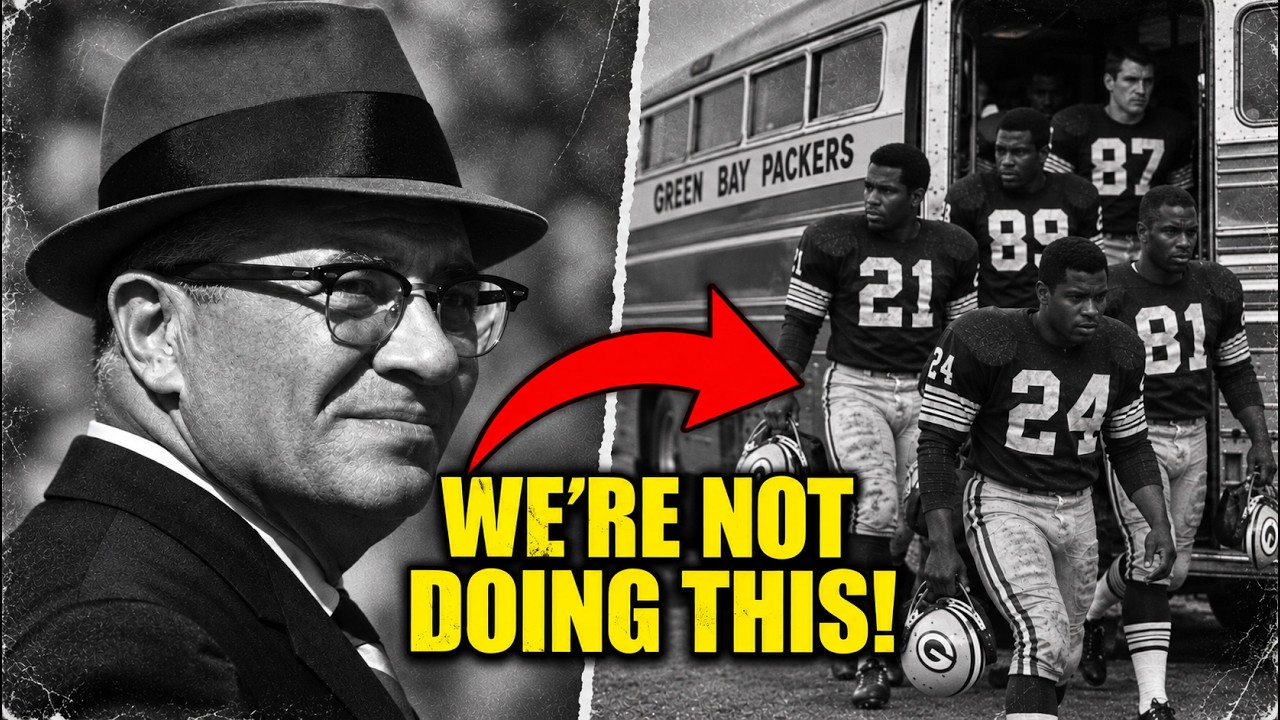
Lombardi had a wife, two young children, and a classroom of teenagers to teach Latin, chemistry, and physics. The NFL did not know his name. That would not change for another twelve years. What the war took from Lombardi was not his life.
It took something quieter—his prime years, the stretch between 29 and 41, the period in which most coaches either make their name or fade into obscurity. To understand what those years cost him, you have to understand who Lombardi was before the war began. He grew up in Brooklyn as the oldest of five children of an Italian immigrant butcher. He played football at Fordham University, standing just 5’8″ and weighing 175 pounds, with an intensity that made opponents hesitate.
He was part of the line that newspapers called the “Seven Blocks of Granite. ” He graduated cum laude in 1937. In 1939, he took an assistant coaching position at St. Cecilia High School, teaching Latin and physics for less than a thousand dollars a year.
He did not take the job because it was a stepping stone. He took it because football was the only thing that made as much sense to him as the priesthood had when he was twelve years old. In 1942, the head coach left for Fordham, and Lombardi became head coach at St. Cecilia at age 29.
Over the next five years, while the world rebuilt itself, he coached high school football in New Jersey. In 1943, St. Cecilia was named the best high school football team in the country. Lombardi’s teams went on to win 32 games in a row and captured six New Jersey private school championships.
The NFL still did not know his name. In 1947, he left St. Cecilia for Fordham University. In 1949, he moved from Fordham to the United States Military Academy at West Point, working under the legendary Colonel Red Blake.
Blake ran his program like a general leading a battalion: execution over inspiration, preparation over talent, the system over the individual. Lombardi absorbed every word of it. He stayed at West Point for five years, watching game film until two in the morning, reducing every problem to its smallest component and solving it from the ground up. He was 41 years old when the New York Giants finally called.
On January 28, 1959, in Green Bay, Wisconsin, the Packers held a press conference to introduce their new head coach. Vince Lombardi was 45, and his only professional head coaching experience consisted of exactly zero games. The team he took over had finished the previous season with a 1-10-1 record, the worst in the NFL. They had not had a winning season in eleven years.
The franchise was losing money at a rate that threatened its survival. Six future Hall of Fame players sat in that locker room, playing for a team that had forgotten how to win. During his first team meeting, Lombardi walked in and stood before men who had lost for years—men who had developed the internal belief that losing was simply part of who they were. Lombardi looked at them and said: “I have never played on a losing team, gentlemen, and I don’t intend to start now.
”
What happened next is in the record books: five NFL championships, two Super Bowls, a regular season record of 96 wins, 34 losses, and six ties. A playoff record of nine wins and one loss. Three consecutive championships from 1965 to 1967, something no NFL team has accomplished since. But the record books do not tell where it came from.
Quarterback Bart Starr arrived in Green Bay so uncertain of his own ability that he nearly quit football altogether. Under Lombardi, he became MVP of the first two Super Bowls. Starr said: “Coach Lombardi had an incredible gift for making you believe that you were actually capable of doing what he demanded of you. ” Guard Jerry Kramer said: “He made you believe in him, in the team, and most importantly, in yourself.
”
That gift was not born in Green Bay. It was not born at West Point or with the New York Giants. It was forged in a high school gymnasium in Englewood, New Jersey, during years when no one outside that building cared what Vince Lombardi was doing. He arrived in Green Bay as a complete, already-forged figure.
December 31, 1967. Green Bay, Wisconsin. Minus 13 degrees Celsius at kickoff—the coldest NFL final ever played. The Dallas Cowboys had come to Lambeau Field to take the title the Packers had held for two years.
Sixteen seconds remained. The Packers trailed by three points. The ball sat on the one-yard line. The frozen field had caused footing problems all afternoon.
The Cowboys knew a run was coming and positioned themselves to stop it. Lombardi called for a quarterback sneak. Starr surged forward behind center Ken Bowman and guard Jerry Kramer. The hole opened for less than a second.
Starr found it and fell into the end zone. Touchdown. Green Bay 21, Dallas 17. Asked afterward why he called a running play on a frozen field, with the championship on the line, against a defense prepared for exactly that, Lombardi said: “Because I knew we could execute it better than they could stop it.
” That was not arrogance. It was the culmination of 17 years of late-night film sessions in Englewood, West Point, and New York City, compressed into four seconds on a frozen field in Wisconsin. Vince Lombardi died on September 3, 1970. He was 57 years old.
Colon cancer, diagnosed that summer, progressed faster than anyone expected. He had coached the Green Bay Packers for nine seasons. He never had a losing season in the NFL, not once. The Super Bowl trophy is named for him—not because of the trophies he won, but because of what he represented about how they were won.
There is a footnote in every Lombardi biography that most people overlook: he did not become an NFL head coach until age 45. He spent the years between 29 and 41 at a New Jersey high school and a military academy while the NFL existed somewhere else without him. History describes it as a delay, a detour. But the men who played for him in Green Bay knew better.
They understood that those 17 years, spent in rooms where no one was watching, were not the prelude to the story. They were the story itself.