One of the most storied small-unit actions of World War II was recounted in vivid detail by the man who led it, as Major Richard “Dick” Winters described the assault on a German artillery battery at Brécourt Manor on D-Day, an operation that has become a case study in military tactics and the subject of the acclaimed television series “Band of Brothers.”
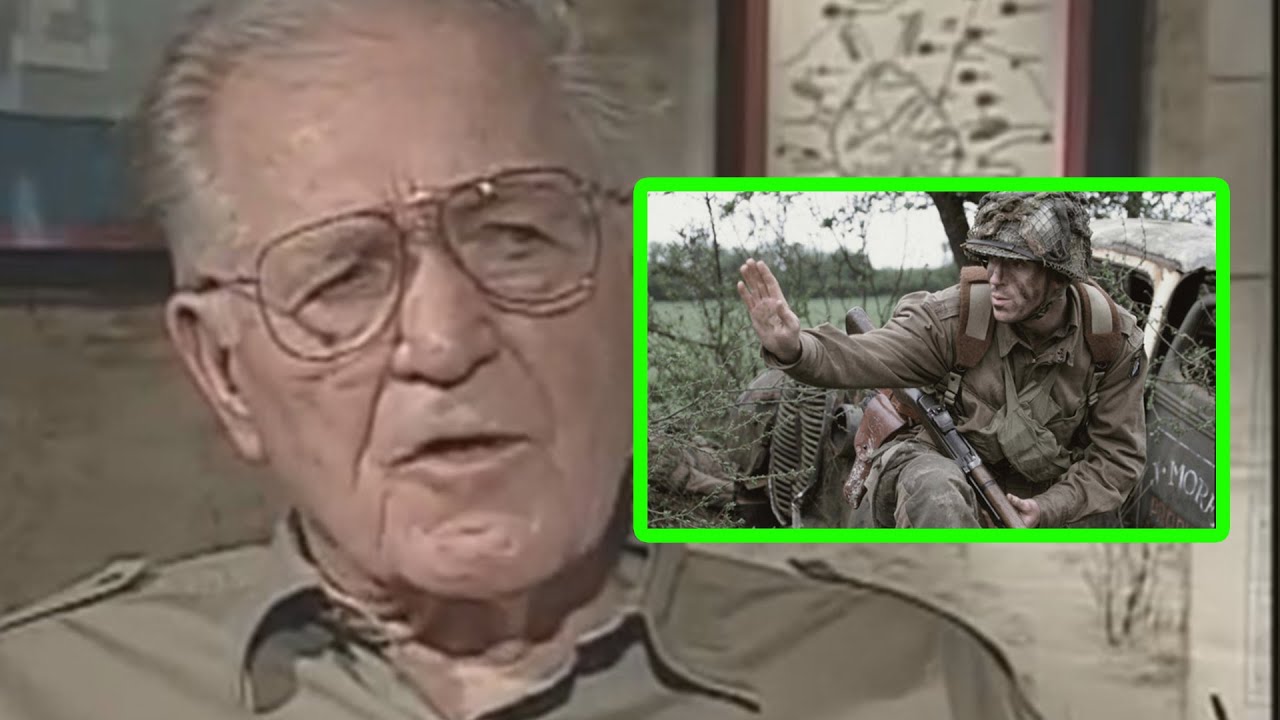
Winters, then a first lieutenant with Easy Company, 506th Parachute Infantry Regiment, 101st Airborne Division, explained that the mission began with a simple but urgent imperative: American troops landing on Utah Beach were being pounded by a battery of 105mm howitzers, and someone had to silence those guns.
“We had a battery of 105s that was shelling our men on the beach unmercifully,” Winters recounted. “You take a handful of men and go up and knock out the 105s.”
That handful amounted to seven men. Seven American paratroopers against a fortified German position that included four 105mm guns, machine gun emplacements and entrenched defenders. By Winters’ own estimate, the odds were staggering.
“It was almost equivalent to 7 or 8 or 9 or 10 enemies for each one of our men,” he said. “It was hard to estimate. They were in trenches, and it was a little difficult to tell how many men you were facing.”
What Winters and his men did not know until after the war, he acknowledged, was the full scope of the enemy unit they were engaging. A German table of organization for a 105mm battery, he noted, called for roughly 130 men.
“I’m not saying we faced 130 men, because there were men in support positions, ammunition handlers and rear-echelon personnel,” Winters said. “But the men we faced on the line, yes, there were about seven or eight or nine men for each of our men.”
The critical decision that made the assault possible, Winters explained, was not a flash of genius in the heat of combat but the product of rigorous training. Before launching the attack, he crawled forward alone to reconnoiter the German position.
“I went by myself and crawled up there far enough to scout the position,” he said. “I thought I found the trench, and I knew from training that the attack should come from the flank. That’s part of your training.
It’s not something you dream up or invent in a spontaneous moment.”
That flanking approach proved decisive. Rather than charging head-on into the teeth of German defenses, Winters attacked the position from the side, engaging one gun emplacement at a time.

“I attacked them from the flank,” he said. “That means I was facing them position by position. By doing that, I was able to use the few weapons I had to create superior firepower.
Then rush each position individually. That’s how it went.”
The contrast with earlier efforts was stark. Winters noted that D Company had previously attempted to deal with the same position but had tried a frontal assault.
“It didn’t work out very well,” he said simply.
The success at Brécourt Manor came at remarkably low cost to the American attackers, a fact that still seems to astonish Winters when measured against the enemy force they engaged. The operation resulted in the destruction of the artillery pieces that had been raining shells on Utah Beach, and it was this action that led to Winters being recommended for the Medal of Honor.
He did not receive it. According to Winters’ understanding, the reason was a matter of policy: only one Medal of Honor was to be awarded per division. He received the Distinguished Service Cross instead, while the action itself became one of the most studied small-unit engagements in American military history.
Winters, however, consistently deflected credit away from himself and toward the training that prepared him and the men who fought beside him. He described a level of unit cohesion in which orders did not require lengthy explanation.
“After going through that training over and over again for that period of time, we didn’t have to stop and explain what we wanted,” he said. “You’d tell them what you wanted and they knew immediately what you were driving at and what the mission required. That’s where the training pays off.”
He emphasized that the operation was never a one-man effort. The men of Easy Company functioned as a team, each man knowing his role and executing it without hesitation.
 “Working together as one team. Working together. Harmony,” Winters said.
“Everybody knows what’s expected of them, what has to be done. Everybody does his job. I like that part.
You don’t do it by yourself. It takes everybody doing their duty to accomplish the mission.”
The interview also touched on the role of one soldier in particular, First Lieutenant Carwood Lipton, who climbed a tree to protect the right flank during the assault. Winters sent Lipton and another man, Rane, to guard that flank, and Lipton ended up in the branches, 𝓮𝔁𝓹𝓸𝓼𝓮𝓭 to enemy observation.
“He was supposed to protect the right flank,” Winters recalled. “I sent him and Rane up there to protect the right flank and he ended up climbing that tree.”
Winters noted that the tree, which was small and had weak branches at the time of the war, is now more than 60 years old and dead, a silent witness to the action that unfolded beneath it. Climbing it during the battle was no easy task, he said, with the branches bending under Lipton’s weight as he struggled to reach a position that would give him a view of the field.
The interviewer pressed Winters on the planning that went into the assault, suggesting that the veteran was not giving himself enough credit and that the television portrayal had not fully captured the fact that Winters personally reconnoitered the area before the attack.
“A lot of the credit for the successful capture of those guns goes to your prior planning, to your good sense, your initiative and your ability to lead troops,” the interviewer said.
Winters acknowledged the reconnaissance but returned repeatedly to the theme of training. The decision to flank the position, he insisted, was not improvisation. It was doctrine, drilled into him and his men through months of preparation.
“I give credit to the training we received to prepare us for that,” he said. “And to the men who were with me. The same goes for the men.
They were ready, and there was that close bond we were talking about. That cohesion. Important.”
 Historians and military analysts have long cited the Brécourt Manor assault as a textbook example of how a small, well-trained force can defeat a larger, entrenched enemy through superior tactics, initiative and unit cohesion. The action is still taught at military institutions, a point the interviewer raised.
“It’s still being taught today,” the interviewer noted.
“It is,” Winters replied.
“So it must have been, in my view, a brilliant plan, brilliantly executed and well done,” the interviewer said.
Winters did not dispute the assessment, but his focus remained on the men and the preparation that made the plan possible. He described a battlefield where everyone knew what was expected and did their job, where the bonds forged in training held firm under fire, and where the outcome was never about individual brilliance but about collective discipline.
The assault on Brécourt Manor stands as one of the defining actions of the 101st Airborne Division on D-Day, a day when paratroopers dropped behind enemy lines in the darkness and fought scattered, often isolated battles against a determined and well-armed enemy. That seven men could silence a battery of artillery pieces that was inflicting casualties on the beachhead remains a testament to the value of training, leadership and teamwork.
Winters’ account, delivered in measured tones decades after the fact, offers no self-congratulation. Instead, it offers a lesson that he repeated throughout the interview: that extraordinary results in combat come not from moments of inspiration but from preparation, from knowing one’s craft, and from men who trust one another enough to do their duty without being told twice.
“You don’t do it by yourself,” Winters said. “It takes everybody doing their duty to accomplish the mission. The team.”
That team, and the action it carried out on June 6, 1944, has become part of the enduring legacy of Easy Company, a unit whose story has been told in books, in television and in military classrooms around the world. And at the center of that story remains a young lieutenant who crawled forward alone, saw the ground, made a decision, and led seven men against a fortified position that outnumbered them many times over.
The guns fell silent. The beach was spared further bombardment. And the training, as Winters said, paid off.