Don Knotts’ career almost didn’t happen the way television history remembers it. He wasn’t supposed to be the comic lead of The Andy Griffith Show. Andy Griffith was. But by the second episode, Griffith realized something crucial: Knotts, as Deputy Barney Fife, was funnier trying to look important than Griffith was telling jokes.
Griffith later recalled, “I knew by that episode that Don should be the comic and I should play straight for him. ” That single adjustment turned a minor sitcom into Mayberry and redefined both men’s careers. Knotts was born Jesse Donald Knotts in Morgantown, West Virginia, on July 21, 1924. He was the youngest of four sons.
His father, Jesse, suffered from serious illness and couldn’t work steadily, and the household dealt with financial strain and instability. Biographer Daniel de Visé later described a home that could be frightening—Knotts’ father drank and could become threatening, and an older brother struggled with alcohol too. But Knotts’ mother, Elsie, held the family together. She rented rooms to students, cooked, sewed, and kept the household moving.
She also loved movies and took young Don to Morgantown’s Metropolitan Theater, where he became fascinated by performers who could make an audience react on command. Knotts studied comedians like Laurel and Hardy and Jack Benny, noticing that the pause mattered as much as the punchline. At home, his older brother William Earl, known as “Shadow,” had a gift for turning ordinary moments into comedy, breaking the tension in the room. Don adored him.
Shadow died in 1941, when Don was still a teenager, but by then Don had already begun making comedy of his own. At Morgantown High School, he wrote humor, performed, and became senior class president. He learned ventriloquism, influenced by Edgar Bergen, and developed an act with a dummy he called Danny. He also formed a performing partnership with a school friend, Richie Ferrara, who later summed up their chemistry in three words: “We blended together.
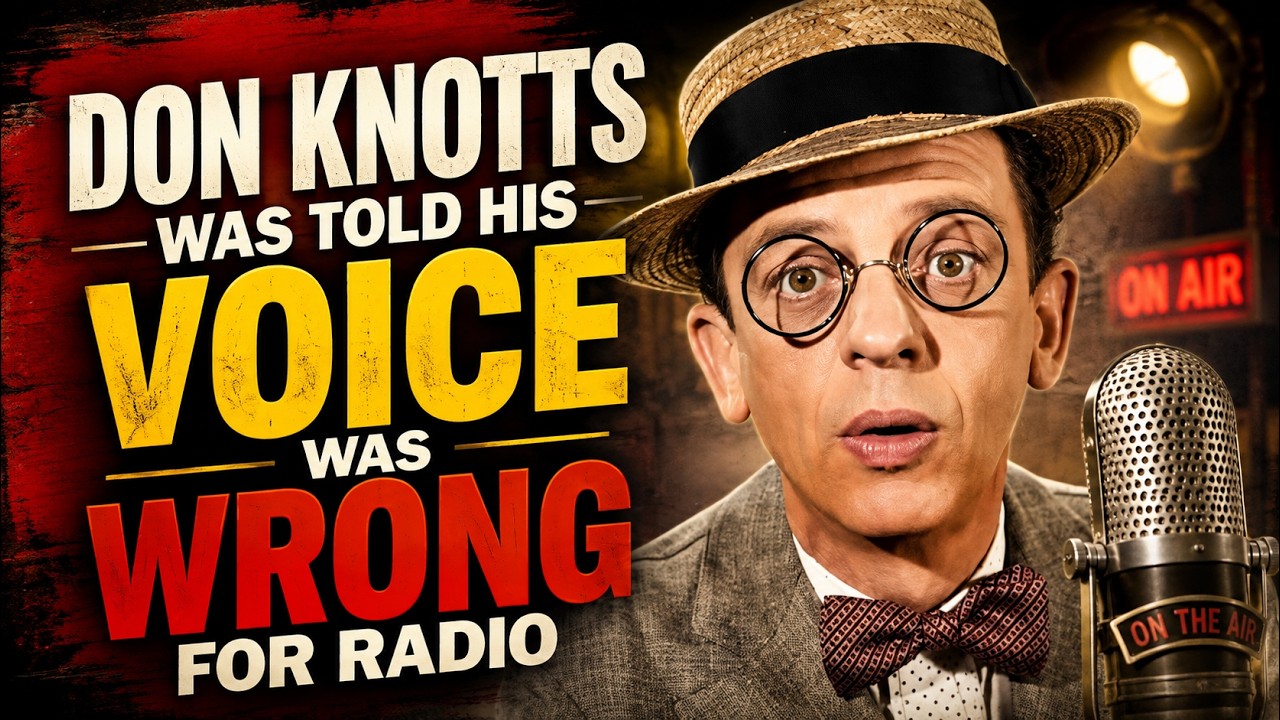
” It was an early preview of the pattern of Knotts’ entire career—the laughs came from what passed between performers, not from one man alone. After high school, Knotts tried New York and failed. He returned to Morgantown, took ordinary work, and enrolled at West Virginia University. The university radio station turned him down for an announcing job because his voice was considered unsuitable for radio—a rejection that became almost perfectly ironic, since that narrow, tense, instantly recognizable voice later became priceless.
In 1943, Knotts was drafted into the army and served in special services entertainment in the South Pacific, performing for troops. He was still using his ventriloquist dummy, but he was growing tired of it. He later said he left the dummy on an island because he no longer wanted to be a ventriloquist. He wanted to be part of a comedy act.
Abandoning the dummy meant Don himself had to become the visible nervous system of the performance—his face, shoulders, hands, eyes, and voice would now carry what the wooden partner had once organized. After the war, he completed his studies at West Virginia University and married Katherine Mets, known as Kay, on December 27, 1947. The question of whether he could make a living performing wasn’t immediately answered. He worked outside show business for a while—including a stint as a department store Santa Claus—before returning to New York with more experience and discipline.
He found work in radio, appearing on programs associated with Arthur Godfrey and Garry Moore, and became a regular voice on the children’s western adventure *Bobby Benson and the B-Bar-B Riders*. In the early 1950s, he joined the live daytime television serial *Search for Tomorrow* as Wilbur Peterson, a serious, neurotic young man. Live TV taught him discipline: when a fellow actor lost his place in the script, Knotts saw how performers had to listen, adjust, and protect one another while the broadcast continued. Around the same time, he began shaping a character that would make national audiences remember his face before Barney Fife ever existed: the “nervous man.
” Knotts had noticed a speaker at a banquet who seemed barely able to control himself, and he turned that observation into a comic persona—a man insisting he was fine while every part of his body announced the opposite. The character appeared on programs hosted by Garry Moore and Steve Allen, especially Allen’s “Man on the Street” sketches. The joke wasn’t merely that the man was nervous; it was that he desperately wanted to appear normal. Steve Allen was an ideal partner because his controlled, reasonable presence gave Knotts a stable line to push against.
Decades later, Knotts described comedy in practical terms: “I think it requires being conscious of timing and conscious of your straight man. ” The laugh could belong to one actor while being built by two. In 1955, Knotts joined the Broadway cast of *No Time for Sergeants*, the military comedy starring Andy Griffith. Knotts played smaller roles, including the famously exasperated Manual Dexterity Examiner.
Griffith was the star; Knotts supported him. But the relationship that mattered most was beginning offstage. The production ran for hundreds of performances, teaching Knotts that precision has to look accidental. They appeared together again in the film version, and neither could have known that the decisive collaboration was still ahead.
In 1960, Knotts saw the pilot for a new series built around Griffith as a small-town sheriff. Knotts was finishing his run with Steve Allen and understood his next job was uncertain. Watching the pilot, he had a practical thought: wouldn’t a sheriff need a deputy? He contacted Griffith, and the idea made its way into the developing series.
There was no guarantee Deputy Barney Fife would become central. But Knotts arrived with a fully formed character: Barney believed in procedure, rank, discipline, and his own importance—his certainty rising in direct proportion to his lack of control. Put beside a calm sheriff, the character became a machine for generating trouble without becoming a villain. Griffith recognized it during the second episode, “Manhunt.
” He later said that he understood then that Don should be the comic and he should play straight. The decision was more than generosity—Griffith was changing his own performance so another actor’s strengths could reorganize the series. Mayberry became increasingly character-driven. The sheriff watched, studied, and sometimes quietly enjoyed the behavior around him.
Barney could puff himself up because Andy didn’t have to puncture him immediately; the audience was allowed to see the inflation before the release. Barney’s body was full of sharp signals—chin lifted, chest tightened, eyes widened, voice climbing toward official importance. Yet some of the funniest moments arrived when he did almost nothing. A look toward Andy could show the instant Barney realized his certainty had outrun reality.
The character was also more vulnerable than a simple fool. Barney wanted respect, usefulness, romance, competence, and the dignity of his office. His single bullet, often kept apart from his revolver, became a perfect comic object, reducing the distance between Barney’s self-image and the caution everyone else understood was necessary. Andy Taylor usually protected Barney’s dignity even while seeing through him, giving Knotts room to play failure without making the character disposable.
The arrangement depended on trust. Knotts could take Barney further because Griffith would hold the center. Griffith could underplay because Knotts supplied motion. Writers Jim Fritzell and Everett Greenbaum became especially important to the texture of Barney’s stories, and director Bob Sweeney understood that a funny take wasn’t always the loudest one.
The ensemble widened the range of behavior: Ron Howard’s Opie could look at Barney without adult concern for his pride; Frances Bavier’s Aunt Bee brought another social reality; Howard McNear, Betty Lynn, Hal Smith, Jim Nabors, and recurring players gave Mayberry different temperatures. Barney could be officious in the courthouse, romantic with Thelma, competitive with another man, terrified by imagined danger, or suddenly tender when his confidence was no longer useful. Knotts supplied the recognizable habits, but the relationships kept those habits from becoming a single sketch stretched across years. Knotts won five Emmy Awards for playing Barney Fife—three as a regular cast member and two more after returning as a guest.
The character remained potent even without weekly exposure. After leaving the regular cast, Knotts didn’t disown the role that made him famous. He knew the danger of typecasting, but he continued to speak of Barney with affection. The problem wasn’t Barney himself; the problem was whether Barney would be the only thing he was allowed to do.
Knotts didn’t leave Mayberry in embarrassment. He was trying to enlarge the professional space around a success he valued. During the show’s fifth season, Griffith said he didn’t intend to continue beyond five seasons, so Knotts began looking for what came next. Universal offered him a picture contract.
Then Griffith changed his mind and decided to continue the series. By that point, Knotts had already committed himself elsewhere. In a CNN interview years later, he explained the sequence without pretending it had been a dramatic break: he looked for a job because he believed the fifth season would be the last, obtained a Universal film contract, and then learned Griffith would stay. Griffith said in the same interview that he loved Don and felt there would be a hole both in the show and in his life.
Knotts’ first major Universal vehicle after leaving the series was *The Ghost and Mr. Chicken*. It placed Knotts at the center as Luther Hegs, a timid typesetter drawn toward a supposedly haunted house. For a performer trying to prove he could stand alone, the production was anything but solitary.
Alan Rafkin, who had directed episodes of *The Andy Griffith Show*, directed the film. Jim Fritzell and Everett Greenbaum wrote it. Griffith himself was drawn into discussions about the story when Knotts asked for help. The old partnership hadn’t been erased—it had changed form.
Knotts was the star now, but he surrounded the role with people who understood his rhythm. His daughter Karen later remembered how much pressure he felt while preparing the film, describing him as excited and overwhelmed, aware he no longer had the familiar protection of the weekly Mayberry ensemble. The film succeeded in establishing a durable Don Knotts movie persona: an ordinary, physically slight man thrust into situations demanding heroic confidence he didn’t possess. *The Reluctant Astronaut* and *The Shakiest Gun in the West* continued variations on that idea.
Knotts’ heroes often moved forward while frightened, and the comedy came from the visible argument between intention and instinct. By the late 1960s, conditions favoring his feature persona were changing. *The Don Knotts Show*, a weekly NBC variety series, began in 1970. It gave him his own name above the title, but the series lasted a single season.
His son Thomas later remembered that period as one of the hardest he ever saw his father work. The pressure ran through days and nights. Viewers saw panic as a comic effect, but the performer creating it was methodical and exacting. A nervous character might appear to be falling apart, while the actor had spent hours finding precisely where the collapse should begin.
The variety format demanded hosting, transitions, sketches, guest chemistry, and a consistent tone—versatility and ideal fit are not the same. Knotts kept moving. He guest-starred, returned to films, worked on stage, and accepted projects that didn’t carry the prestige of Mayberry. In the mid-1970s, he found a new kind of partner in Tim Conway.
*The Apple Dumpling Gang*, released by Disney in 1975, paired them as two inept outlaws. Conway later remembered the pairing with obvious affection: “It just blossomed into a great comedic romance. ” They trusted one another’s instincts and shared a preference for clean, family comedy. Unlike Griffith, who often served as the settled surface against which Barney bounced, Conway could be just as foolish as Knotts, meaning the straight man role could pass back and forth.
Their scenes became a relay race in which responsibility itself was the object nobody wanted to hold for long. The partnership with Conway also let Knotts reveal a quality that could be obscured when he was the sole frightened hero: he could play restraint. In 1979, Knotts joined *Three’s Company* as Ralph Furley. The landlords Stanley and Helen Roper were leaving for a spin-off, and the series needed a new figure in the building.
Knotts wanted the job. He was tied to CBS, but according to his Television Academy interview, he called executive Fred Silverman’s office to get released so he could join the show. Ralph Furley wasn’t Barney Fife in a leisure suit. Furley imagined himself worldly and attractive, dressed with alarming confidence, and misunderstood much of what happened around him.
The role required adaptation: *The Andy Griffith Show* had been made in a single-camera style, while *Three’s Company* used a multi-camera sitcom rhythm in front of an audience, with different pressure on timing and memory. Knotts recalled struggling with his lines when he first entered that system. For a man with decades of experience, the admission was valuable—mastery in one format hadn’t made him immune to difficulty in another. He learned the pace, and John Ritter, Joyce DeWitt, and the rest of the company gave him new partners and new tempos.
Ritter was a fearless physical comedian; Knotts no longer had to supply every odd angle in the room. The role ran from 1979 until the series ended in 1984. Karen Knotts later emphasized that *Three’s Company* introduced her father to another generation. Knotts was willing to make himself physically unattractive in pursuit of a laugh—eyes bulging, neck stiffening, mouth collapsing into worry.
Yet he never presented himself as a human punching bag. The character always retained some claim on dignity. That balance was part of his technical intelligence: if a character has no dignity, embarrassment has little force; if he has too much dignity, the actor may refuse the humiliating gesture. Knotts stood in the unstable middle where a man could be ridiculous and still deserve a place at the table.
In 1986, *Return to Mayberry* brought the old community together in a television movie. Knotts returned as Barney Fife. The reunion wasn’t a permanent restoration. Griffith soon had another long-running series, *Matlock*, playing an Atlanta defense attorney, and Knotts later joined him in a recurring role as Les Calhoun.
Knotts himself noticed the difference: on *Matlock*, he didn’t have the same amount of comedy to play off that he had enjoyed with Griffith on their earlier series. The remark separates friendship from comic structure. Two actors can love working together and still need the right scene. Knotts’ work continued through the 1990s.
He toured in stage productions, took guest roles, and appeared in films. *Pleasantville*, released in 1998, gave him a small but memorable part as a mysterious television repairman helping send two modern teenagers into the black-and-white world of an old sitcom. The casting carried obvious resonance—few actors were more strongly associated with the emotional geography of classic television. But Knotts wasn’t playing Barney.
He was functioning as a gatekeeper between an idealized television past and a more complicated present. By then, he had become part of the very nostalgia his earlier work helped create. Mayberry could represent simplicity to viewers who remembered its front porches and unhurried conversations. But Knotts’ own life was a reminder that the performer behind that comfort had come from a childhood that was not simple at all.
The connection shouldn’t be pushed too far—Mayberry was not therapy disguised as a sitcom, and Barney Fife was not a clinical self-portrait. What can be said is that Knotts had firsthand knowledge of what it meant for a room to change when tension gave way to laughter, and his adult craft was built around creating that release with precision. When he spoke about comedy, he spoke about work, timing, straight men, writers, directors, characters, and what happened in a scene. In 1999, the Television Academy recorded a long oral history interview with him in Los Angeles.
He moved through decades of memory—radio, live television, Steve Allen, Griffith, feature films, Disney, *Three’s Company*, *Matlock*. The record is valuable because it preserves not only the milestones but the way he organized his own professional past. Again and again, other people enter the memory. The story of his success is crowded with names, which doesn’t diminish Knotts—it enlarges the picture of what comic achievement is.
Audiences attach a laugh to the face they see when it happens, but performers know the laugh may have begun several seconds earlier with somebody else’s pause. In 2003, Larry King asked Knotts why he kept acting when he could have retired. Knotts answered, “I guess actors never quit, do they? ” Griffith immediately joked that Don didn’t know how to do anything else.
Knotts agreed. In that same interview, Knotts mentioned he had recently torn an Achilles tendon while working on stage and was walking in a brace. He was nearing 80 and still accepting the physical consequences of performing before an audience. The stage offered no edit and no second camera angle—it returned him to one of the oldest conditions of his career: a room, another performer, and the immediate judgment of laughter.
His connection to Morgantown remained visible. The city named a boulevard for him in the late 1990s, and West Virginia University—the institution that had once rejected his voice for radio—became a keeper of his professional memory. In January 2006, only weeks before his death, Knotts sent a group of working scripts from his film career to the university libraries. They carried signatures and handwritten notes, preserving evidence of the labor the finished performances had hidden.
On the page was planning; on the screen was panic. The distance between those two things was the craft. That same winter, he was still known to audiences. *Chicken Little* had placed his voice in theaters only months earlier.
In that film, released in 2005, he voiced Turkey Lurky, the town’s mayor. The distinctive nervous sound that had once failed an announcing test was still earning laughs more than half a century later. He continued to appear in live comedy with Tim Conway and to take television work. In his final months, lung cancer and serious respiratory problems narrowed what was possible.
His longtime manager identified lung cancer, while the Television Academy reported pulmonary and respiratory complications. Don Knotts died at UCLA Medical Center on February 24, 2006. He was 81. Andy Griffith was among his final visitors.
Griffith’s earlier words about Don’s departure helped give the visit its proper scale—he had said that when Knotts left Mayberry, he knew there would be a hole in the show and a hole in his life. Four decades later, their association no longer depended on a sheriff’s desk, a camera mark, or a laugh cue. After his death, the most fitting route back to Don Knotts led to Morgantown. His widow, Francey Yarborough, gave West Virginia University materials including his typed autobiographical manuscript, awards, scripts, and more than a dozen audio cassettes on which Knotts had recorded memories in his own voice, especially memories of growing up there.
The university library set out to preserve and digitize the recordings. The university where a young Don Knotts had once been told his voice wasn’t right for radio now held that same voice as part of its historical record. The characters changed—the nervous man, Barney Fife, Luther Hegs, Ralph Furley—but the deeper action remained remarkably consistent: a man tries to establish control while the world quietly measures the distance between his claim and the truth. Yet Don Knotts the professional was often doing the opposite.
He was measuring reality carefully, watching formats, partners, scripts, audiences, and opportunities. Barney panicked because he couldn’t read the situation accurately. Knotts survived because he usually could. The central question of his career has an answer, though not a slogan.
A man famous for characters obsessed with being in charge became funniest in partnership because control was the subject of his comedy, not the method of making it. The character could strain for command. The actor had to listen.
That’s the difference between Barney Fife and Don Knotts.