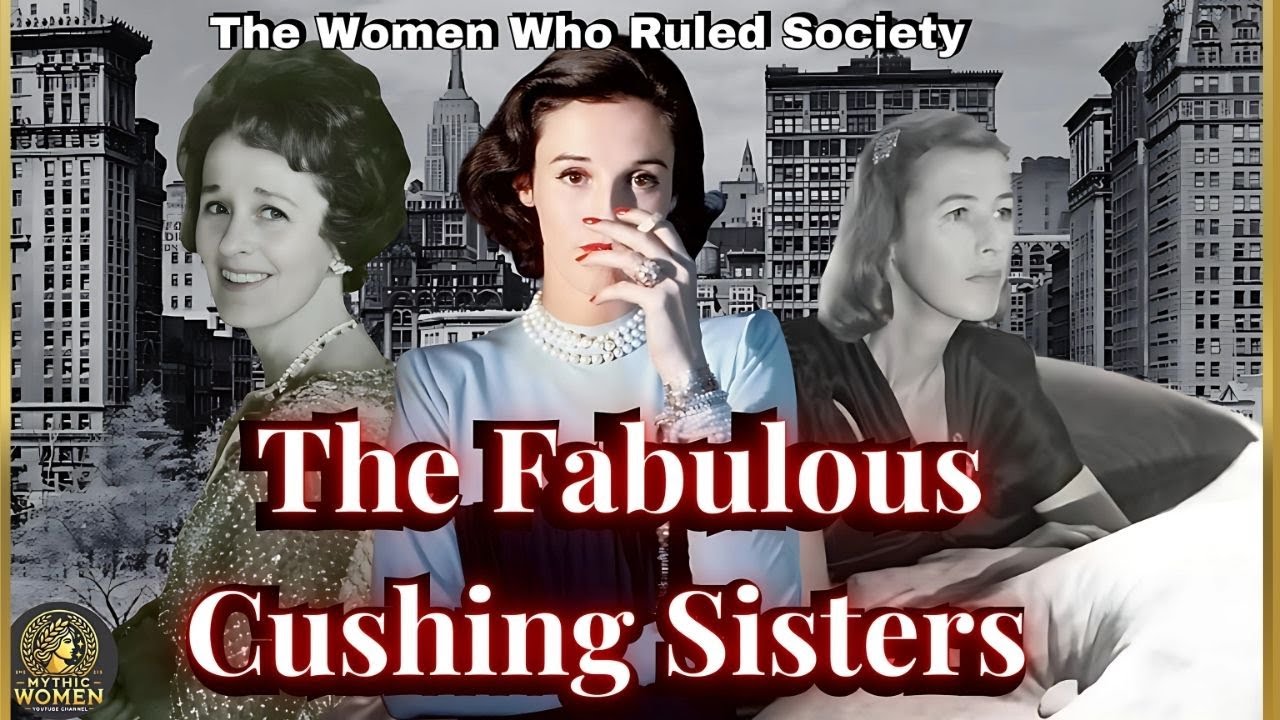
The Cushing sisters moved through the twentieth century like figures from a novel, dining with kings and queens, marrying into dynasties, and shaping American fashion and power. Yet behind the diamonds and designer gowns lay scandal, betrayal, and secrets that shook the nation's elite to its core.
Minnie, Betsy, and Babe Cushing were raised to conquer society, not merely to join it. Their parents, Kate and Harvey Cushing, built a household where ambition was elemental and where every polished detail served a purpose.
Kate was the architect of the family's social world. To her, a starched blouse, gleaming silver, or a perfectly arranged bouquet of garden roses were not trivial matters but essential tools of refinement.
Harvey was a towering figure in neurosurgery, a man whose name became synonymous with groundbreaking advancement. He was consumed by his work and rarely home for long.
Their marriage was a study in contrasts. Kate's warmth and intuition balanced Harvey's relentless focus, and their union, though not born of passion, was a calculated partnership built for excellence.
Their first child, William Harvey, arrived in 1903 in Baltimore. By 1906, Harvey's rising reputation took the family to Boston, where they settled into a stately yellow colonial house.
There the family grew. Minnie was born in 1906, Betsy in 1908, Henry in 1910, and finally Barbara, known forever as Babe, in 1915.
Kate orchestrated her children's lives with precision. The daughters attended Miss May's School in starched blouses and pleated skirts, their appearances as polished as their manners.
Summer teas and fireside winter gatherings were less leisure than training grounds for social diplomacy. Even Harvey's unannounced guests taught the girls adaptability under pressure.
When Harvey left for France in 1917 to serve on the front lines of World War I, Kate managed the household alone. She shielded her children from the uncertainties of war while maintaining their disciplined routines.
Harvey returned in 1919 celebrated for his service but more distant than ever. For Babe, his rare presence was precious, as shown in a letter she wrote at age eight, offering her father her pennies and her shiny buckle if he would only stay home.
On June 12, 1926, tragedy struck. Harvey, performing surgery that morning, was interrupted by news that their eldest son Bill had been killed in a car accident. Stunned but stoic, Harvey completed his operation before calling Kate.
Bill's death marked the end of the family's innocence. Kate channeled her grief into renewed focus on her daughters, determined that they would wear coronets and wed the elite.
Minnie, the eldest daughter, was fiercely independent, inheriting Harvey's sharp mind and Kate's resolve. She preferred art and literature to society's rituals, valuing intellect over convention.
Betsy, born with her mother's poise and her father's determination, embraced society's structure and thrived within its rules. She became Kate's trusted ally in their shared ambitions.
Babe, the youngest and most striking, idolized Minnie. The two shared whispered conversations and a love of books, but Babe's innate charm set her apart.
While her sisters approached life with intensity, Babe moved through the world with a lightness that captivated everyone she met. Her beauty, paired with Kate's training, made her a natural in the social sphere.
Despite their differences, the sisters were bound by an unshakable bond. Kate, ever the strategist, allowed small rebellions, knowing these deviations would ultimately strengthen their character.
By the time the sisters made their debuts, Kate's vision had come to fruition. The Cushing sisters were reflections of their mother's tireless effort and their father's relentless brilliance.
As a friend observed, Kate drilled into each of her girls that they were wonderful. Babe especially entered the world convinced she was among the most attractive young women alive, combining beauty and brains.
Betsy, the most dutiful of her mother's daughters, was the first to marry. Her choice of James Roosevelt raised eyebrows, for though steeped in the prestige of his family name, Jimmy lacked the wealth Kate had hoped for in a match.
Yet Betsy saw beyond material considerations. Jimmy's charm, ambition, and unwavering devotion won her over. A Harvard man, he exuded charisma, and his boyhood charm made him a favorite in elite social circles.
With her Bostonian elegance, chestnut hair, luminous eyes, and graceful composure, Betsy captivated him completely. Within months of their meeting, they announced their engagement.
The path to the altar was not without drama. When Jimmy fell gravely ill with pneumonia, Betsy rushed to his bedside at the governor's mansion, where Franklin and Eleanor Roosevelt received her warmly.
The reception from his formidable grandmother, Sarah Roosevelt, was less kind. Like Eleanor before her, Betsy was seen as a rival for Sarah's control over the Roosevelt men.
Their wedding in 1930 was a grand affair blending political prestige with social glamour. After a European honeymoon steeped in opulence, the newlyweds returned to Boston, where Jimmy began law school.
They lived temporarily with the Cushings, an arrangement that quickly suffocated Jimmy, who longed for independence. When a Boston insurance agent crossed his path, Jimmy seized the opportunity, abandoning law school despite his father's disapproval.
FDR, ever the strategist, worried that a career in insurance might appear unseemly for a Roosevelt. Jimmy was undeterred and threw himself into the business, reaping success almost immediately.
Within two years, his commissions totaled an astonishing sixty-seven thousand dollars, making him one of the wealthiest members of the Roosevelt family, surpassed only by his grandmother.
Flush with newfound wealth, the young couple moved into a sprawling 140-acre estate in Framingham, Massachusetts. Betsy soon gave birth to their first child, a daughter named Sarah, a nod to Jimmy's indomitable grandmother.
FDR's inauguration on March 4, 1933, opened gilded doors for Jimmy and Betsy. Jimmy capitalized on his position as the president's favored son, navigating the corridors of power with calculated ambition.
Betsy charmed Boston's elite social circles, hosting and attending coveted events that solidified her place in the city's Brahman society. She even orchestrated Babe's grand debut with a lavish dinner dance for 500 guests at the Ritz-Carlton.
When Jimmy took a position in Washington, officially tasked with streamlining government agencies, the family moved into a modest home in Georgetown. In practice, he served as his father's aide while quietly sustaining his profitable insurance business.
Many evenings concluded at the White House, where Jimmy and Betsy shared intimate moments with Franklin and Eleanor in the cozy second-floor study. In 1935, Betsy hosted a dazzling tea dance at the White House to mark Babe's second coming out.
At one of her Georgetown gatherings, Betsy introduced her sister Minnie to Vincent Astor, a wealthy businessman trapped in a cold, loveless marriage. Astor was immediately captivated by Minnie's vivacious personality and intelligence.
Though Minnie was initially indifferent, Betsy believed she had set the stage for a match that would fulfill their mother's grand ambitions. Betsy gave birth to her second daughter, Kate, in 1936.
As Eleanor's frequent travels left a void in the White House, FDR turned to Betsy to step in as hostess. Immaculately groomed and graciously poised, she had an innate ability to make even the most powerful figures feel at ease.
Yet as Jimmy and Betsy's influence grew, so did the strain on their marriage. The relentless pressures of public life and the constant glare of press scrutiny eroded their private bond.
As Eleanor's absences grew longer, Betsy became an indispensable figure in the White House. She poured FDR's tea, accompanied him on therapeutic swims, and assisted with daily tasks like propping his feet during evening films.
Their bond was cemented over late-afternoon cocktails, where Betsy's charm and attentiveness made her FDR's preferred confidante. Jimmy increasingly resented his father's favoritism toward his wife.
Eleanor's coldness toward Betsy deepened when FDR arranged for her to accompany him to Warm Springs without consulting Eleanor. What had once been cordial soured into controlled animosity.
Jimmy and Betsy's bickering became a spectacle, and even trivial arguments fueled the widening rift. His bitter remarks, including describing pregnant women as repulsive, hurt her deeply.
As the storm clouds of war gathered over Europe, Betsy's role in the White House became even more vital. She organized critical fundraising events for FDR's third-term campaign and hosted gatherings to secure political support for the Lend-Lease program.
In June 1939, during the historic visit of Britain's King George VI and Queen Elizabeth, Betsy stood out as the first family's most visible and gracious figure. Her warmth and poise charmed the royal couple, particularly Queen Elizabeth, with whom she forged a lifelong friendship.
The visit's most celebrated moment was the Hyde Park picnic, featuring hot dogs and beer. The unpretentious scene delighted Americans, especially when King George spilled mustard on his waistcoat.
During a drive around the Roosevelt estate, when Betsy's hat blew off, the king himself stopped the car to retrieve it, further cementing his popularity.
Soon after, while undergoing surgery at the Mayo Clinic, Jimmy grew close to his nurse, Romelle Schneider. By the time he recovered, he had fallen in love with her, declared the marriage over, and moved to California.
On October 7, 1939, tragedy struck again with the sudden death of Harvey Cushing. Betsy rushed to her mother's side, joining her family in mourning the man who, though often absent, had profoundly shaped their lives.
In an attempt to save her marriage, Betsy followed Jimmy to California, but her efforts to reconcile were met with his request for a divorce. The decision sent shock waves through the Roosevelt family.
FDR feared the public scandal, though he remained staunchly supportive of Betsy, assigning his personal attorney to represent her. Eleanor and Anna sided with Jimmy, resenting what they saw as Betsy's deliberate efforts to win FDR's favor.
The divorce proceedings became front-page news, with only Newsweek, owned by the man Minnie would soon marry, refusing to cover the story. By March 3, 1940, a settlement was reached.
Betsy was awarded custody of their daughters, Sarah and Kate, along with a lump sum of sixty-five thousand dollars and additional support for the children. Jimmy relocated to Hollywood, took up the presidency of Globe Pictures, and married Romelle Schneider in 1941.
Returning to New York, Betsy reunited with her sisters and her widowed mother, Kate, now affectionately known as Gogsy. Betsy sought solace and reinvention.
Ever the strategist, Kate ensured her daughter would find a new path among New York's upper crust, where the possibility of a coronet still loomed.
The summer of 1940 unfolded as an oddly quiet interlude for the Cushing sisters. For five months between Betsy's divorce and the dazzling marriages that awaited them, not one of the sisters had a husband.
Gogsy's ambitions now shifted to Babe, the youngest and undeniably the most captivating of her three daughters. After graduating from the Westover School in 1933, Babe debuted the following year, enchanting Boston society.
Her first season was an unmitigated triumph, marking her as the crown jewel of her generation. But in early 1934, tragedy struck when Babe was involved in a devastating car accident returning from a Long Island party.
Her face, her most celebrated feature, was nearly destroyed. Most of her teeth were knocked out, and reconstructive surgery became a grueling necessity. Under her father's meticulous oversight, she endured months of procedures that restored her beauty to an almost miraculous degree.
Despite her triumphant recovery and two successful social seasons, Babe defied expectation. Instead of marrying one of the charming bachelors vying for her hand, she moved to New York and launched a career in fashion.
Starting at Glamour magazine, she quickly rose to become a fashion editor at Vogue. Her colleagues admired her not just for her beauty but for her warmth and generosity.
Babe's reconstructed face and ethereal beauty made her a favorite of photographers, while her unpretentious charm set her apart. Alexander Liberman, Condé Nast's editorial director, described her as the most beautiful woman of his time.
Yet for all her success, Gogsy remained unsatisfied. A career, no matter how glamorous, was no substitute for a marriage that would elevate the family's status.
To Gogsy, the Cushing sisters were more than daughters; they were her life's work. A friend once remarked that the Cushings were like a small business, with every decision discussed, debated, and voted on, and Gogsy holding veto power.
At the heart of this enterprise was Gogsy's unmatched ability to cultivate and leverage relationships with the influential figures of her day. Among her key allies was Jerome Zerbe, the premier society photographer, whose connections to Time and Life magazines ensured the Cushing sisters a steady stream of favorable publicity.
Gogsy also forged alliances with legendary society figures such as Mrs. Charles Dana Gibson, the original Gibson Girl, and Lady Nancy Astor, the formidable member of Parliament and doyenne of the British Astor family.
Through these relationships, Gogsy orchestrated a masterful publicity campaign that elevated her daughters from mere debutantes to cultural phenomena.
On September 6, 1940, Babe announced her engagement to Stanley Grafton Mortimer Jr., a dashing New York and Tuxedo Park socialite. Stan was the grandson of a Standard Oil founder and a direct descendant of John Jay, the first Chief Justice of the United States.
Their wedding, held on September 21, 1940, was a model of understated elegance at St. Luke's Protestant Episcopal Church. Babe walked down the aisle on the arm of her brother Henry, the last surviving male of her immediate family.
She wore a white silk jersey gown with a high V-neckline, her tulle veil anchored by a rhinestone coronet. The intimate reception was held at Heather Dune, Gogsy's summer home in East Hampton.
Vincent Astor himself attended, using the occasion to inform his longtime mistress, Minnie Cushing, that she could finally plan their wedding. When Babe tossed her bouquet, Minnie caught it, adding fuel to society gossip.
After their wedding, Babe and Stan settled into an apartment on East 51st Street. Despite the pressures of her social obligations, Babe continued her work at Vogue, balancing her role as a fashion editor with her duties as a society wife.
The outbreak of World War II in December 1941 brought sweeping changes. Stan enlisted in the Navy Air Force and was stationed in Pensacola, Florida, a far cry from the refined elegance of Manhattan.
Pregnant with their first child, Babe briefly joined him but quickly returned to New York, finding the environment intolerable. She gave birth to their son Stanley, known as Tony, in 1942, followed by a daughter, Amanda Jay, in 1943.
Stan's return from the South Pacific in 1945 marked the beginning of the end. The war had left him heavier, grayer, and prone to mood swings. Alcohol became his solace, and his once-charming demeanor gave way to volatility.
Babe, accustomed to her independence and the glittering energy of Manhattan, struggled to reconcile the man Stan had become with the husband she had married. The emotional and physical distance created by the war proved insurmountable.
In May 1946, their marriage was officially dissolved. Stan provided a generous settlement for their children, and Babe retained custody. Freed from a strained union, she returned to New York, focusing on her children and her career at Vogue.
For Gogsy, Babe's divorce was merely a setback. She immediately set to work finding a new match for her youngest daughter, her ambition undiminished. After all, there was still that coronet to chase.
On September 27, 1940, Mary Benedict Cushing achieved what many considered the ultimate matrimonial triumph. She married Vincent Astor, one of the wealthiest and most eligible bachelors in America.
Their whirlwind romance captivated New York's elite, trailing whispers of intrigue from Georgetown to East Hampton. Minnie had charmed Vincent with her vivacious wit from the moment they met at her sister Betsy's party.
The real architect of Minnie's ascent was Gogsy. She recognized the potential in Vincent's tentative affections and ensured her daughter's place in his world.
Minnie, who perhaps would have been content to remain Vincent's mistress, found herself caught in her mother's relentless drive to secure the match. While many waited for Helen Huntington Astor, Vincent's first wife, to finalize her Wyoming divorce, Gogsy applied subtle but decisive pressure.
She discovered Helen's plans to remarry and ensured that Vincent committed to Minnie before he had time to reconsider. The wedding was a discreet affair at Heather Dune.
Minnie wore a plum-colored Arthur Falkenstein dress she had previously donned at Babe's wedding, paired with matching shoes and a fringed felt hat. A modest press announcement belied the moment's significance.
After the ceremony, Vincent whisked Minnie away aboard his prized yacht for a ten-day honeymoon. The yacht, a floating palace with eleven staterooms, a walnut-paneled dining room, and even an operating room, epitomized Astor wealth.
Yet their voyages revealed the cracks in their relationship. One escapade took the couple to Cocos Island off Costa Rica, a rumored pirate haven. Vincent, ever the historian and adventurer, relished the drama.
As rival treasure hunters provoked tensions, the Costa Rican president sent troops to defuse the situation. Minnie, however, found little joy in these nautical adventures, retreating to her cabin to stitch needlepoint patterns that never seemed to hold her attention.
New York City was Minnie's true home, where she flourished among artists, writers, and intellectuals. She hosted gatherings with icons like Clark Gable, Vivien Leigh, and Dorothy Parker, becoming a magnetic hostess with an artistic flair.
In contrast, Vincent preferred quiet evenings with aristocratic companions or tinkering with his beloved electric trains. Their marriage was sustained more by his love than by hers.
Rumors swirled that their marriage, like Vincent's first, was never consummated. It was a union defined by companionship rather than passion, with Vincent assuming a paternal role and Minnie growing restless.
For Gogsy, Minnie's personal happiness was secondary to the power her marriage brought. Almost immediately, Minnie ascended to new social heights, becoming a trustee of the Metropolitan Museum of Art, joining the board of Newsweek, and spearheading war-related charities.
By the early 1940s, Minnie had become a tireless figure in Manhattan's charity circuit, attending up to six events in a single evening. Her biting wit and unflappable demeanor became legendary.
In one famous clash with Wallis Simpson over a reserved table, Minnie's sharp retort, "My good woman, why don't you act your age?" showcased her ability to hold her own even against royalty.

Even their homes reflected their incompatibility. Minnie transformed their Manhattan apartment into a vibrant retreat, filling it with bold chintz patterns, overflowing vases of fresh flowers, and playful touches like scattered jigsaw puzzles.
Yet at Ferncliff, Vincent's family estate, her indifference was evident. Viewing the sprawling Victorian Gothic mansion as a relic of a bygone era, Minnie ordered it demolished to Vincent's dismay.
As World War II ended, Vincent shifted his focus to philanthropy, establishing the Vincent Astor Foundation in 1948 to alleviate human misery. His decision to dedicate half his estate to charity angered his half-brother, John Jacob, who bitterly remarked that it was not the way their great-great-grandfather would have wanted it.
Meanwhile, Minnie immersed herself in Manhattan's cultural elite, hosting soirees with Broadway luminaries like Noël Coward and photographers like Jerome Zerbe. As she surrounded herself with youthful companions, Vincent retreated further into his routines.
Their union, held together by expectation rather than affection, was a stark reminder of the limits of ambition-driven marriages. As one columnist wrote, their marriage was like a gilded frame without a painting, beautiful to behold but hollow within.
Gogsy's vision for her daughters was unrelenting, a march toward influence and security through impeccably orchestrated marriages. Her efforts had already guided Minnie into the Astor dynasty and Babe into the arms of Stanley Mortimer.
Now her ambitions rested on Betsy. For Betsy, Gogsy dreamed of a match that would not simply rival her sisters' but surpass them, a union that would solidify her daughter's place at the apex of American society.
As one biographer remarked, Mrs. Harvey Cushing orchestrated the lives of her daughters with the precision of a symphony conductor. She taught them early that beauty fades but wealth and the power it wields endure.
Jock Whitney seemed the ideal choice. As heir to one of the country's largest fortunes, Jock embodied privilege, but his accomplishments extended far beyond his bank account. He was a Broadway backer of iconic productions, including Gone with the Wind.
Beneath his golden-boy image lay a man whose personal life had faltered. His first marriage to Philadelphia debutante Liz Altemus ended in divorce, marked by clashing priorities and Liz's aversion to motherhood.
Restless and bound by the shadow of his formidable mother, Helen Hay Whitney, a pioneer in horse racing, art patronage, and philanthropy, Jock yearned for a partnership that could balance his world.
Betsy, recently divorced, was similarly seeking a fresh chapter. Their meeting, masterfully arranged by Gogsy, was no coincidence. Gogsy recognized immediately that Jock's fortune and cultural prominence made him the ultimate match for her daughter.
The connection between Jock and Betsy was instant, a quiet harmony of mutual respect and curiosity. While Helen Whitney's initial doubts loomed, Betsy's polished demeanor and impeccable upbringing soon won her favor.
On March 1, 1942, the couple wed in an intimate ceremony at Gogsy's East 86th Street apartment. The setting was modest yet deliberate, a reflection of Gogsy's desire to emphasize familial intimacy over ostentation.
Betsy wore a tailored slate blue suit that spoke to her understated style, while Jock's best man, William Harding Jackson, brought camaraderie to the affair. White lilies and soft candlelight adorned the apartment.
The simplicity of the event belied its significance. Gogsy's vision had been realized, with all three daughters now seated among the pinnacles of American high society.
Their honeymoon began at Greenwood Plantation, the Whitney family's historic Georgian estate, where the couple reveled in tranquil days and shared hopes for the future. Their respite was brief.
Upon returning to Washington, D.C., the realities of wartime awaited. Jock assumed a prominent role under Nelson Rockefeller, directing the motion picture division of the Office of the Coordinator of Inter-American Affairs.
The Whitneys settled into the stately Admiral Cary Grayson mansion, where their soirees became a gathering place for the era's luminaries, including Franklin Delano Roosevelt himself, a poignant reminder of Betsy's enduring connection to her former father-in-law.
Jock, invigorated by his role, soon grew restless, yearning for active service on the front lines. Betsy, ever supportive, encouraged his ambitions, even as it meant enduring long separations.
By June 1942, Jock enlisted in the U.S. Army, leaving Betsy to embrace her new role as a military wife. Though the separation was difficult, Betsy adapted with quiet resilience.
Guided by Helen Hay Whitney, who took her under her wing, Betsy learned the intricacies of philanthropy and financial management. Helen instilled in her a belief that immense wealth should serve a greater purpose.
Under Helen's tutelage, Betsy blossomed. No longer defined solely by her role as a Roosevelt ex-wife, she emerged as a key player in preserving and expanding the Whitney legacy.
As Jock served overseas, Betsy's independence deepened. She skillfully managed the Whitney properties and raised her daughters, all while maintaining her composure amid the upheaval of wartime.
In London, Jock sidestepped the austerity of barracks life, settling into an elegant flat on Grosvenor Square shared with his friend and polo champion Tommy Hitchcock. Their residence became a glittering haven amid the shadows of war.
These gatherings, rich with laughter and champagne, sparkled with defiant joy, a testament to seeking beauty in the midst of chaos. Jock, with his boundless charm and energy, was a radiant figure at the center of it all.
Betsy had hoped to join Jock in London, offering her efforts to the Red Cross, yet President Roosevelt himself denied her request, deeming it unwise. Disappointed but pragmatic, Betsy turned her energy toward war work at home.
She poured countless hours into the Red Cross, Minnie's National War Fund, and American Relief for France, while also offering quiet support to Helen Hay Whitney, whose health was faltering amid whispers of alcoholism.
This relative calm was shattered in August 1944 when news arrived that Jock had been captured by German forces on a covert OSS mission to coordinate with the French Resistance. His convoy had been ambushed.
Ever resourceful, Jock destroyed incriminating documents linking him to intelligence work before being taken prisoner. At Green Tree Farms, Betsy braced herself for the worst.
A friend from the races delivered the grim news, prompting her eight-year-old daughter Kate to hide under a bed in fear. "I remember thinking, good Lord, we've just gotten a new father and now it seems we've lost him again," Kate later recalled.
President Roosevelt urged Betsy to maintain absolute silence. Jock's prominence as a wealthy heir and intelligence officer made him a high-value target for German forces.
Ten days later, Jock orchestrated a daring escape. As his transport train rattled toward the German border, he and ten others pried open a boxcar door under the cover of darkness.
Jock leapt, tumbling down an embankment, and spent days evading patrols with the help of the French Resistance. He disguised himself as a peasant and eventually reconnected with American forces. On September 11, Jock returned to safety.
Betsy's relief at Jock's escape was tempered by tragedy. Two weeks later, Helen Hay Whitney passed away. Jock, inheriting his mother's vast fortune and estates, returned home burdened by grief.
Reflecting on his captivity, he admitted a painful truth: rarely did he hear a GI say what he was fighting for. It wasn't their fault, he concluded; they simply hadn't been taught.
This realization drove him to establish the John Hay Whitney Foundation, dedicated to education and opportunity. Over the years, the foundation funded scholarships, supported small enterprises, and became a pillar of Jock's philanthropic vision.
As Jock and Betsy rebuilt their lives, they focused on providing stability for Sarah and Kate. Jock planned to formally adopt the girls, though the proceedings were delayed out of respect for President Roosevelt.
The girls even attended Roosevelt's fourth inauguration in January 1945, a final poignant celebration of their connection to a towering historical figure. Just months later, the nation and the Whitneys mourned his passing.
In the days following Roosevelt's death, Betsy withdrew into quiet reflection. Her memories of Washington, filled with FDR's warmth and steadfast friendship, must have felt especially poignant. He had been more than a historical icon; he had been her anchor in turbulent times.
With Jock now back home, the Whitneys turned to Greentree, ready to shape their future. Their first task was restoring the family's Long Island estate, which had been neglected during Helen's final illness.
Betsy approached the restoration with care, mindful of Jock's deep attachment to his childhood home. Even small adjustments, like decluttering the overwhelming array of photographs in the drawing room, became comical negotiations.
Jock agreed only to remove pictures of unidentified individuals; the rest, he insisted, would stay. Despite their immense wealth, Jock and Betsy opted for a quieter life, distancing themselves from the glittering post-war jet set.
When the Social Register requested their updated listing, Jock, with Betsy's agreement, declined. "It wasn't reverse snobbery," he later explained. "We just felt it didn't align with mainstream American values."
This retreat reflected a broader shift in their priorities, less about inherited privilege, more about meaningful purpose.
Although Gogsy had mastered the art of marrying off her daughters, keeping them married proved a far more elusive ambition. When Babe announced she wanted a divorce, Gogsy saw it not as a failure but as an opportunity.

Even within her first marriage, Babe had already distinguished herself as a paragon of style. By 1945, she had claimed the top spot on the Ten Best Dressed list, eclipsing icons like Wallis Simpson.
Gogsy, ever the strategist, turned to her powerful connections to secure Babe's next chapter. At one point, Prince Serge Obolensky, the dashing ex-husband of Alice Astor, seemed promising, but the romance fizzled.
Babe remained one of New York's most eligible women, omnipresent in social pages and reigning as a queen of Manhattan's elite. Encouraged by Gogsy, she sought publicity with precision, transforming benefits, soirees, and galas into stages for her poise.
No longer content to be admired, she aspired to cultural immortality, determined to carve a legacy on her own terms. Her tenure at Vogue provided the perfect platform.
Under Condé Nast's discerning eye, Babe epitomized the socialite editor, a rare breed whose connections unlocked exclusive doors in both Manhattan and Paris. Photographers like Cecil Beaton and Horst P. Horst immortalized her, capturing her timeless style.
For Babe, Vogue was more than a career; it was a gateway to a world of unparalleled luxury and influence. Her sisters' glittering multi-million-dollar marriages served as both inspiration and provocation.
Determined to find a second husband who matched her lofty aspirations, Babe turned her focus to self-made men whose fortunes rivaled those of the Astors and Whitneys. Her calculated ambitions soon led her to William S. Paley.
Paley, the son of a Russian Jewish immigrant, had none of the aristocratic lineage Gogsy prized, yet his immense wealth and vision were undeniable. By his late twenties, he had transformed a struggling radio network into CBS, a media empire.
At the time, Paley was married to Dorothy Hart Hearst, who had played a critical role in his rise. Yet their marriage, strained by Paley's infidelities, unraveled under the weight of scandal.
In 1940, aspiring actress Geraldine Kenyon leapt to her death, leaving behind a note addressed to Paley. Though he denied any deeper connection, the incident fractured his marriage.
As Dorothy receded into philanthropy, Paley's focus shifted to Babe. In his autobiography, Paley recalled their introduction: "One night I was introduced to Barbara, Babe to all her friends. That evening I was struck by her extraordinary beauty, character, and charm."
Paley's pursuit of Babe intensified after purchasing an estate adjacent to the Whitneys' Greentree. He collaborated with Jock Whitney to build a connecting road.
"Ah, how can I describe this marvel woman?" Paley later wrote. "Babe was one of the loveliest women in the world. Her beauty was matched only by her inner grace, poised, shy yet direct, with flashing brown eyes that seemed to look into your very soul."
For Paley, Babe offered the social legitimacy he craved. For Babe, Paley represented modern ambition, a self-made mogul whose wealth aligned with her aspirations.
Yet she did not fall into his arms immediately. In the summer of 1946, she traveled to Europe for Vogue, captivating aristocrats like Baron Guy de Rothschild.
Babe had a way of being a presence, recalled a companion. She flirted endlessly but never seemed tired. Returning to New York, Babe found Paley waiting.
Still legally married, he went to great lengths to win her favor, securing her an elegant apartment and devoting himself to her care during a month-long illness. Each night, Paley wrote, he would visit one of his favorite restaurants and have the chef prepare a special dinner for two.
"I'd then take the meal to her hospital room and we would delight in the surprise together," he recalled. "Those evenings made it clear we belong together."
Despite Paley's devotion, Gogsy initially resisted his immigrant roots, and the scent of new money marked him as unsuitable in her eyes. Only after Minnie and Betsy illuminated the scale of his wealth did Gogsy relent.
For her, such staggering riches outweighed concerns about lineage or tradition. On July 23, 1947, Paley finalized his divorce, and just five days later, he and Babe married in an intimate ceremony at Greentree.
It was a union of ambition and glamour, marking the beginning of Babe's ascent into a world where her name would become synonymous with power, influence, and style.
With Babe's marriage, Gogsy had achieved her life's ultimate ambition. By hook or by crook, she had secured for her three daughters not just wealthy husbands but titans of power and influence.
Tex McCrary, a prominent media figure, wrote of her that Mrs. Cushing was clearly a wise and forceful part of New England's intellectual royalty. She had a large measure of what the English call a touch of class, and she raised her daughters to the same summit standards.
The Cushing sisters, already captivating in their beauty, became veritable celebrities. Flashbulbs popped wherever they appeared, and the fashion press eagerly chronicled their every move.
Babe, in particular, embraced the limelight, cultivating a warm relationship with the media, which crowned her the high priestess of American style.
Gogsy's influence did not wane after her daughters' weddings. She remained the central figure in their lives, consulted on everything from child-rearing to marital challenges.
As society chronicler Jerome Zerbe noted, no decision was too personal or too small for Gogsy's involvement. The sisters never openly challenged her rulings; once made, a decision was committed to without question.
Through sheer persistence, vision, and an unflinching willingness to bend the rules, Gogsy had orchestrated one of the most remarkable ascents in American social history. Her daughters may have been the stars, but Gogsy was the director, guiding every scene from behind the curtain.
The Cushing name would forever be synonymous with beauty, wealth, and unparalleled social success. Yet what was the cost of this success?
In her relentless pursuit of brilliant and profitable marriages for her daughters, Gogsy overlooked the emotional toll such unions might exact. Shaped by her late Victorian mindset and her own experiences securing Dr. Harvey Cushing, she saw marriage as the ultimate achievement for a woman.
For Gogsy, happiness was cultivated through attending to a husband's needs and raising children. Her own marriage, though devoid of romantic passion, had satisfied her, and she assumed the same would hold true for her daughters, particularly with limitless wealth at their disposal.
The changes these marriages brought to Gogsy's own life were undeniable. Indulged by her three immensely wealthy sons-in-law, she lived a life of genteel grandeur.
She occupied a spacious cottage on Jock Whitney's Greentree estate, maintained a Manhattan apartment owned by Vincent Astor, and enjoyed access to the Paley Kalorama farm. At her beck and call were the limousines of all three men.
More significantly, Gogsy's role as mother-in-law to three of America's richest men secured her place in New York's elite social circles. She rarely missed a charity gala or cultural event her daughters supported.
Of her three sons-in-law, Jock was her favorite. Beyond financial support and a home at Greentree, Jock and Betsy's warm partnership endeared them to Gogsy, who cherished her first two grandchildren.
By contrast, her relationship with Bill Paley was far more distant. As Jerome Zerbe confided, she told him that Paley may love Babe, but her Whitney and Astor connections were very much part of his strategy.
Paley's brash personality further alienated her. She found his boldness unsettling and struggled to understand him, though she maintained a cordial public front for appearances.
Vincent Astor, meanwhile, won Gogsy's approval by virtue of his name alone. The Astor fortune's international prestige overshadowed Vincent's excessive drinking and reserved demeanor.
However, whispers of their marriage being in name only deeply troubled her. The absence of an heir jeopardized the financial security she envisioned for Minnie, a practical concern that loomed larger than her private disapproval of Vincent's flaws.
To her dying day, Gogsy unabashedly reminded her daughters how wonderful they were. Her confidence in their brilliance and beauty never wavered, and her legacy of ambition and social mastery became the foundation on which the Cushing dynasty built its enduring renown.
By early spring of 1949, the matriarch's health began to fail. Hospitalized for a heart condition, she was cared for by her daughters, who maintained a round-the-clock vigil during her final six weeks.
On May 8, 1949, Gogsy passed away quietly in the pristine simplicity of a white hospital room at New York Hospital, far removed from the wealth and privilege that had defined her later years.
After a modest service at Holy Trinity Church, she was laid to rest beside her husband in a quiet New Haven cemetery.
With Gogsy gone, the sisters began to step out from under her shadow, each navigating her own path. For Minnie Astor, her mother's absence marked the beginning of a personal reckoning.
For Betsy, it was an escape from her mother's grasp, a chance to seize power in her own right. And for Babe, the woman who embodied perfection yet lived in a gilded cage, it marked the beginning of her slow, agonizing fall.
They were beautiful. They were powerful. But in the end, even the Cushing sisters could not outmaneuver fate.