Reinhard Heydrich was one of the most feared and powerful figures in the Nazi apparatus. When assassins struck him down in the streets of Prague in the spring of 1942, he left behind a wife, four young children, a mother, a brother, and a sister.
All of them would spend the rest of their lives navigating the shadow cast by one of history's most notorious criminals. Their story is not a simple tale of justice or redemption. It is a story of defiance and denial, of struggle and survival, and of a widow who fought for decades to preserve a legacy the world was desperate to bury.
Reinhard Tristan Eugen Heydrich was born on March 7, 1904, in Halle an der Saale, then part of the German Empire. He came from a cultured bourgeois background. His father, Bruno Richard Heydrich, was a composer and founder of the Halle Conservatory of Music. His mother, Elisabeth Maria Anna Krantz, was an accomplished pianist.
The family was steeped in the arts, and Reinhard himself was a gifted violinist. He was also athletic, fiercely competitive, and possessed of a predatory intelligence. He spoke fluent French, was an excellent fencer, and showed an aptitude for languages and strategy.
His path to the upper echelons of Nazi power was not straightforward. After serving in the German Navy during the Weimar Republic years, he was dismissed in 1931 following a personal scandal involving a young woman and allegations of dishonorable conduct. That humiliation redirected his ambitions rather than ending them.
Heinrich Himmler interviewed the disgraced naval officer in 1931 and was immediately impressed. Drawing on his naval intelligence background, Heydrich outlined a vision for a security and intelligence apparatus. Within months he was in charge of the SD, the intelligence service of the SS.
By the time World War II began, Heydrich was head of the RSHA, the Reich Main Security Office, which brought the Gestapo, the SD, and the criminal police under one umbrella. He was Himmler's direct deputy and widely regarded as a primary architect of the Holocaust.
It was Heydrich who chaired the Wannsee Conference on January 20, 1942, where senior Nazi officials coordinated the systematic murder of 11 million Jews across Europe. The meeting lasted only 90 minutes, yet the decisions made there would result in the murder of 6 million Jewish people.
In September 1941, Hitler appointed Heydrich acting Reich Protector of Bohemia and Moravia. He arrived in Prague with a reputation that preceded him. The Czechs called him the Butcher of Prague, the Blonde Beast, the Hangman.
His methods in the protectorate were swift and savage. He executed resistance leaders, deported Jews to death camps, and crushed dissent with exemplary terror. He also used a combination of economic incentives and fear to stabilize Czech industrial production for the German war machine.
Hitler was delighted. There was growing talk within the Nazi high command that Heydrich was being groomed for even greater responsibilities after the war, potentially to replace Himmler entirely or to be given responsibility for the occupation of France.
It was this combination of his importance to the regime and the terror he had inflicted that made Heydrich a target for the Czech government in exile, operating from London under President Edvard Beneš. In the autumn of 1941, the Czech and Slovak governments in exile, with British Special Operations Executive support, began planning Operation Anthropoid.
The men chosen for the assassination attempt were Jozef Gabčík, a Slovak, and Jan Kubiš, a Czech. They trained in Britain, parachuted into Czechoslovakia on December 29, 1941, and spent months preparing, hiding with local resistance families in Prague.
The opportunity came on the morning of May 27, 1942. Heydrich had taken to traveling through Prague in an open-topped Mercedes-Benz staff car, a demonstration that he feared no one. He commuted daily between the Panenské Břežany estate north of Prague, where his family lived, and Prague Castle.
On that morning, his car slowed to negotiate a hairpin bend on a street in the Prague suburb of Libeň. Gabčík stepped forward and raised his Sten submachine gun. It jammed.
Heydrich, who might have ordered his driver to accelerate away, instead stood up in the car and drew his pistol, apparently unwilling to flee from a lone attacker. In that moment, Kubiš threw a modified anti-tank grenade. It exploded under the rear wheel, sending fragments of metal and horsehair from the upholstery tearing into Heydrich's body.
His spleen was ruptured and pieces of the car's upholstery were driven into his back and side. He staggered into the road, gun in hand, and tried to pursue his attackers before collapsing from blood loss. He was rushed to the Bulovka hospital in Prague.
For eight days, Heydrich hovered between life and death. His wounds were treated by German doctors flown in from Berlin, and for a time it seemed he might survive. Hitler himself was kept closely informed of every development. Himmler visited the hospital.
On June 4, 1942, Reinhard Heydrich died. He was 38 years old. The cause of death was sepsis, almost certainly aggravated by the horsehair from the car's upholstery that had been driven deep into his body cavity and which surgeons were unable to fully remove.
The reaction in Berlin was one of shock and fury. Hitler ordered a massive reprisal operation in Czechoslovakia. And in the grand estate at Panenské Břežany north of Prague, Lina Heydrich received the news that would reshape every remaining day of her life.
Lina Mathilde Heydrich, born von Osten, had been born on June 14, 1911, in Fehmarn, a small island in the Baltic Sea off the coast of what is now northern Germany. She came from a family with conservative nationalist leanings.
Her encounter with Reinhard Heydrich occurred at a naval dance in Kiel in December 1930 and was immediate and intense. Their courtship was swift and their engagement even swifter, though it was complicated by the fact that Heydrich was at the time involved with another woman.
That earlier relationship and his failure to handle it honorably contributed directly to his dismissal from the Navy in April 1931 after a naval honor court ruled his conduct improper. Lina, far from distancing herself from him after the scandal, stood by him. She had been introduced to National Socialism by her brother and was already a convinced believer in the ideology.
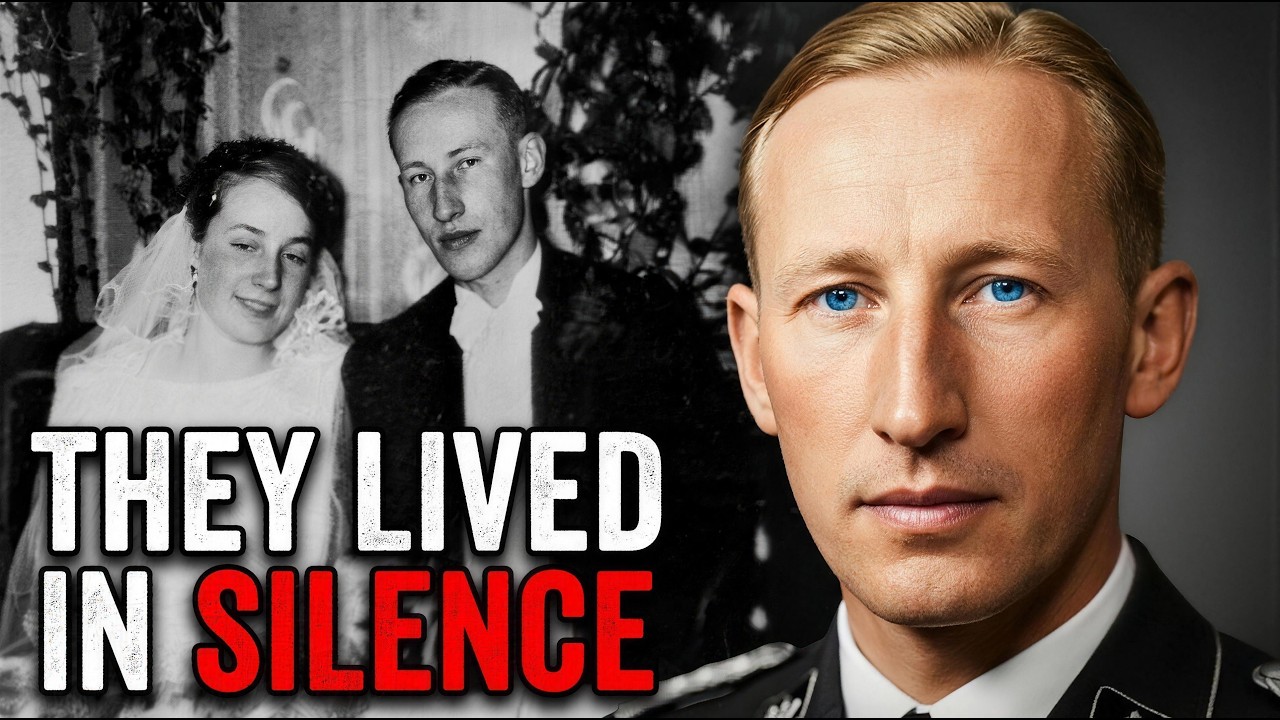
She and Reinhard married on December 26, 1931, in a ceremony attended by Heinrich Himmler. Over the years that followed, as Heydrich's power grew, Lina moved within the highest circles of the Third Reich. She met Hitler, Himmler, Göring, Goebbels, and virtually every other senior figure in the Nazi hierarchy.
She was a formidable personality in her own right, strong-willed, opinionated, and not easily intimidated even by her husband's fearsome reputation. She was also, by most accounts, genuinely devoted to him. Contemporary accounts describe her as a woman of considerable personal presence, not merely a passive appendage to her husband's career.
They had four children together during the years of the Third Reich. The eldest, Klaus, was born on July 17, 1933. The second, Heider, arrived on December 23, 1934. A daughter, Silke, was born on April 9, 1939, just months before the outbreak of the Second World War.
The youngest, another daughter named Marte, came into the world on July 23, 1942, more than six weeks after her father had already died from his wounds in the Prague hospital. Marte was in the most literal sense a child born into the aftermath of her father's death, a child who would never know him except through the accounts of others.
When the news of Heydrich's death reached Lina, she was heavily pregnant with Marte. She had known that the attack had taken place on May 27 and had known for eight days that her husband was fighting for his life. When the news came on June 4 that he had died, she was 30 years old, pregnant with her fourth child, and a widow.
The Nazi state gave Heydrich a state funeral of enormous pomp and spectacle. His coffin lay in state in Prague Castle, and tens of thousands of Czechs, many compelled to attend, filed past it. The cortège then moved to Berlin by special train, where another ceremony was held at the Reich Chancellery.
Hitler himself delivered a lengthy and emotional eulogy praising Heydrich as one of the finest men the German race had produced. Heydrich was buried with full military honors in Berlin's Invalidenfriedhof, the resting place of some of Germany's greatest military figures. Lina stood at the graveside, widowed, pregnant, surrounded by the most powerful men in Germany.
Even as the Third Reich mourned, the reprisals for Heydrich's death were already underway. The Nazis were not content with hunting down the specific individuals responsible. They wanted to inflict collective punishment on the Czech population as a whole.
On June 10, 1942, six days after Heydrich's death, the entire village of Lidice, located near Kladno in Bohemia, was destroyed. The SS and German police units surrounded the village before dawn, acting on false and fabricated intelligence that the village had connections to the British agents responsible for the assassination.
Every man and boy in Lidice over the age of 15, 173 people in total, was taken out and shot against the walls of a local farm that same morning. The women of the village, 184 in total, were loaded onto trucks and transported to Ravensbrück concentration camp, where many subsequently died from the brutal conditions.
Ninety children were taken into German custody. Most were deemed unsuitable for Germanization and were killed by carbon monoxide poisoning at the Chełmno extermination camp. The village itself was burned to the ground, the ash bulldozed into the earth, and the very wells filled in with rubble. The Nazis literally attempted to erase Lidice from the face of the earth.
A second village, Ležáky, where a radio transmitter used by a resistance network connected to the paratroopers had been discovered, was similarly destroyed on June 24, 1942. The entire adult population of Ležáky was executed. Two children were taken for possible Germanization and the village was razed.
In all, the reprisals for the assassination of Heydrich resulted in the deaths of approximately 5,000 Czech people, including those killed at Lidice and Ležáky, those executed in mass shootings across the protectorate, and those who died in subsequent arrests and deportations.
The assassins themselves were eventually tracked down to the Church of Saints Cyril and Methodius in the Resslova Street of Prague's New Town, which had sheltered them along with several other paratroopers. On June 18, 1942, after being betrayed by a fellow paratrooper named Karel Čurda, the church was surrounded by hundreds of SS troops supported by armored vehicles.
The battle that followed lasted for several hours. The paratroopers in the nave held out with extraordinary courage before being killed or choosing to die. The three paratroopers in the crypt, including Gabčík and Kubiš, fought until their ammunition was exhausted. Water was pumped into the crypt in an attempt to flood them out. They took their own lives rather than surrender.
For Lina Heydrich, the immediate years following her husband's death were, in a cruel paradox, years of relative comfort even as the wider world burned around her. The Nazi state, honoring its fallen hero, continued to support his widow generously.
She remained at Panenské Břežany, the grand estate that Heydrich had essentially requisitioned from a Jewish family who had been deported to the camps. The estate, known in German as Jungfern Breschan, was a magnificent property set in the Bohemian countryside north of Prague, with a large manor house, extensive agricultural land, outbuildings, and grounds.
The family who had owned it before the war, the Bloch-Bauer family, were prominent Jewish industrialists. They had been forced to flee or were deported by the Nazi occupation regime, and their property had been seized. Lina organized the estate as a functional household and working farm.
She gave birth to Marte in July 1942, a child who would never know her father at all. She organized the agricultural work, oversaw the household, and in the years remaining to the war attempted to create some kind of normal family life for her children amidst the surrounding catastrophe.
But even within this relative security, tragedy struck with devastating force. On October 24, 1943, while riding his bicycle near the estate, Klaus Heydrich, the eldest son, just 10 years old, rode into the path of a German military truck. He was killed instantly.
The accident happened on a road that Klaus would have known well, near the home he had lived in for the years of the protectorate. The truck driver could not stop in time. Klaus, who had been born on July 17, 1933, was dead at 10 years old.
He had known his father during the years of Heydrich's greatest power and had presumably worshiped him in the uncritical way that small boys worship their fathers. He had been just 9 years old when his father was assassinated, old enough perhaps to dimly understand that something terrible and irreversible had happened, but young enough that the full meaning of it was beyond his comprehension.
His death on that Bohemian road in October 1943 was a grief upon grief for Lina Heydrich, who now had lost both her husband and her firstborn son within the space of 17 months. She had two surviving sons, Heider, who was 8 years old at the time of his brother's death, and the daughters, Silke, who was four, and the infant, Marte, just over a year old.
These were the children who would carry the Heydrich name into the post-war world. Given everything known about Lina's subsequent public positions, it is not difficult to imagine the version of Reinhard Heydrich that she presented to her children. He would have been presented as a hero, a warrior for Germany, a man who had given his life for his country.
The ideology he had served, the crimes he had committed, the horror that the historical record would subsequently reveal in such overwhelming detail, none of these would have featured in Lina's domestic narrative. She would have given her children a father to be proud of. That was, after all, what she herself believed.
The collapse of the Third Reich in the spring of 1945 shattered the world that had sustained Lina and her children at Panenské Břežany. As Soviet and Allied forces closed in on Germany and the Nazi state disintegrated around her, Lina faced a future that was suddenly terrifyingly uncertain.
She was the widow of a man who had been one of the most senior architects of genocide in human history. She was living in occupied Czech territory that would shortly be liberated and reclaimed by the Czechoslovak people who had suffered under her husband's rule. And she had three young children in her care.
When the war ended in May 1945 and the Czechs reasserted control over their country, the consequences for Lina were immediate and dramatic. She was expelled from Czechoslovakia along with the millions of Sudeten Germans and Reich Germans who had flooded into the country during the occupation.
This expulsion was part of the enormous post-war population transfer that moved an estimated 12 to 14 million ethnic Germans out of Eastern Europe, an operation sanctioned by the Allied powers and carried out with varying degrees of order and brutality across different regions.
Lina was stripped of the Panenské Břežany estate, which was returned to the Czech state and in due course became the property of the Czechoslovak government. She and her children were essentially pushed westward with whatever they could carry. The estate that she had managed with such determination passed out of her hands forever.
She left behind the grave of Klaus, the agricultural enterprise she had built, and the last physical connection to the years of her husband's greatest power. They ended up in Bavaria, in a country that was ruined, occupied, and slowly trying to come to terms with the magnitude of what it had done.
For Lina Heydrich, these early post-war years were a severe material and psychological shock. The wealth, the status, the comfortable estate, the support of the Nazi state, all of it was gone. She found herself a widow in reduced circumstances with three children to feed and educate in an occupied country.
The Allied occupation authorities were running denazification proceedings across all four zones of occupied Germany, and anyone with Lina's profile was certain to attract attention. She was interrogated extensively by Allied investigators and called to give testimony in various proceedings connected to the trials of her husband's former subordinates and colleagues.
The question of whether Lina could be directly implicated in criminal activities, rather than simply being the widow of a war criminal, was examined and ultimately resolved against prosecution. The evidence available to investigators at the time was insufficient to support specific criminal charges against her personally.
However, Lina did face denazification proceedings under the Allied Control Council's directives. She was ultimately classified at a level that carried financial penalties and various restrictions, but did not involve imprisonment. The specific classification applied to her varied over time and was subject to appeals and revisions.
What the denazification proceedings made clear was that Lina was considered an active participant in the Nazi world rather than a passive bystander, but that the threshold for criminal prosecution was not met in her case. This outcome set the stage for the decades of legal and financial battles that followed.
Rather than retreating into obscurity, rather than adopting a posture of shame or silence, Lina Heydrich spent the decades after the war fighting back. She fought for her widow's pension with relentless determination. She fought to recover whatever assets could be recovered. She fought against what she consistently described as the unfair historical treatment of her husband and herself.
She maintained contact with networks of former SS members and their families. And ultimately she wrote a book that encapsulated her worldview and her defiance in the most public possible way.
The pension battle was the most prolonged and, in terms of its broader implications, the most significant of Lina's post-war legal struggles. In the Federal Republic of Germany, founded in 1949, the pension laws were a complex and often contradictory legacy of both the Weimar Republic's civil service provisions and the practical necessities of rebuilding a functioning state.
Heydrich had held some of the most senior positions in the Nazi state, with ranks and salaries to match. In purely formal terms, this should have entitled his widow to a substantial pension. But there were complicating factors that the courts would spend years trying to resolve.
The fundamental legal question was whether the criminality of the activities conducted in the official positions should disqualify the entitlement. If Heydrich's role as head of the RSHA constituted participation in criminal organizations and criminal activities, which the Nuremberg tribunals had definitively established to be the case, should the widow of such an individual be able to claim a pension based on that criminal role?
Different courts gave different answers to this question at different times, and the proceedings became a kind of running commentary on West Germany's ongoing agonized relationship with its Nazi past. In the 1950s, there was considerable political pressure to simply resolve these pension questions in a way that would allow former Nazi families to settle down.
Lina's specific pension case went through multiple rounds of the German court system over a period of more than two decades, from the late 1940s into the 1970s. At various points she received partial awards. At other points those awards were challenged by the state or by intervening parties.
The proceedings generated substantial press coverage, which Lina found both useful and maddening. Useful because publicity kept her cause in the public eye. Maddening because the press coverage invariably framed the issue in terms of her husband's crimes, connecting any discussion of her pension entitlement to the Holocaust.
The eventual outcome of Lina's pension proceedings, which came in the early 1970s after more than two decades of litigation, was a compromise that satisfied no one entirely. She received some pension entitlement, though at a level that critics regarded as inappropriately generous given the source of her husband's official rank.
The proceedings left a bitter taste in German public opinion and contributed to subsequent changes in German law that made it harder for the families of Nazi perpetrators to claim pension benefits based on criminal official roles. In this ironic way, Lina Heydrich's persistent legal battles actually contributed to the eventual strengthening of legal provisions that other perpetrator families might have hoped to exploit.
Throughout all of this, Lina Heydrich was also engaged in what might be called the cultural battle for her husband's memory. She gave interviews to journalists, speaking with remarkable candor about her views and her refusal to accept the historical consensus on her husband's role.
She maintained her network of contacts with former SS members and their families, participating in the social world of the unrepentant Nazi survivor community that existed largely below the surface of respectable West German society throughout the post-war decades. This community had its own publications, its own meeting places, its own rituals of commemoration, and its own persistent counternarrative about the war.
Published in 1976, Lina Heydrich's memoir was titled in German "Leben mit einem Kriegsverbrecher," which translates as "Life with a War Criminal." The title was not Lina's choice. It had been imposed by the publisher, Grabert Verlag, as a condition of publication, apparently in an attempt to give the book a veneer of critical engagement that its actual content did not support.
Lina was furious about the title and said so openly in subsequent interviews. In her view, the title was a lie against her husband because she did not accept that he had been a war criminal in any meaningful sense. The title was, she insisted, a commercial concession designed to sell books.
The contents of the book were a vigorous and essentially unapologetic defense of Reinhard Heydrich and a challenge to the historical record that had convicted him posthumously in the court of history. The book caused enormous controversy in West Germany and internationally. Historians were outraged by its revisionism and its dismissal of documented evidence.
Reviews in major German newspapers were withering. Survivor organizations condemned it. But the book found its audience among the community of people who wanted to believe that the accepted historical account of the Nazi leadership was distorted or exaggerated, and it sold well enough to provide Lina with some financial benefit.
In the 1960s, Lina was identified as one of the participants in a network that provided financial and logistical support to former SS members who were facing legal proceedings in West Germany. This network overlapped with, but was not identical to, Stille Hilfe, drawing on the social connections of the Nazi elite and their families to channel assistance to individuals who might otherwise have been left to face justice alone.
Lina's involvement in these activities was documented by German investigative journalists and by government agencies monitoring neo-Nazi and revanchist organizations in the Federal Republic. The activities did not result in criminal charges against her, but they added to the picture of a woman who was not simply a widow trying to live a quiet life.
Heider Heydrich was born on December 23, 1934, making him one of the group of children who were old enough to have some genuine memories of their father and of life in the Nazi state, but young enough that those memories were the memories of a small child.
He was 7 years old when his father was appointed acting Reich Protector of Bohemia and Moravia. He was seven and a half when his father was assassinated. He was nine when his older brother Klaus was killed in the road accident. And he was 10 when Germany collapsed entirely and his entire world came crashing down.
Growing up in post-war Bavaria with his mother and sisters, Heider came of age in a society that was systematically, if imperfectly, grappling with the crimes of the regime his father had helped lead. He bore a name that was increasingly associated not just with the general horror of Nazism, but with specific documented catastrophic crimes.
Heider Heydrich became, by all available accounts, a man who tried to lead an ordinary life while carrying an extraordinary burden. He went into business and worked as an entrepreneur, spending much of his working life in the food industry in Germany. He settled in the Federal Republic, married, had children of his own, and built what appears to have been a private and relatively unremarkable bourgeois existence.
But the question of his father was never far from the surface. In the 1960s, as broader German society engaged in increasingly painful public debates about the Nazi past, individuals with the kind of direct family connection that Heider had could not easily remain invisible. His name appeared in books and newspaper articles about his father.

In various interviews and public statements over the decades, Heider Heydrich occupied an unusual and in some ways uncomfortable position. He did not, like Gudrun Himmler, become a public defender of his father's ideology and memory. But he also did not, like Niklas Frank, the son of Hans Frank, become a fierce and unsparing public denouncer.
His position was more ambivalent, more personal, more centered on the complexity of being a child who had loved a parent without knowing that parent as the world came to know him. In some interviews, he spoke with apparent sincerity about the difficulty of reconciling the father he remembered as a small child with a historical figure that the records revealed.
He expressed what seemed to be genuine discomfort with the magnitude of his father's crimes. He acknowledged the historical reality of the Holocaust and did not attempt to minimize it in the way his mother had. But he was also protective of certain aspects of his personal memory.
Heider lived to a remarkably advanced age. He was 86 years old when he died on December 24, 2020, dying on Christmas Eve, just one day after what would have been his 86th birthday on December 23. He had outlived his mother by 35 years and his brother Klaus by 77 years.
He had lived long enough to see Reinhard Heydrich become one of the most studied and written about figures of the entire Nazi era, the subject of multiple full-length biographies, hundreds of academic papers, and numerous film and television productions.
The news of Heider Heydrich's death was noted in the German press with brief factual reports. He was identified as the son of the assassinated Reich Protector. There was no great outpouring of public grief, no lengthy obituaries assessing his contribution to the public reckoning with the Nazi past.
Of all Heydrich's children, Silke is the one about whom the public record is the sparest, because she made the choice, more consistently than her brother Heider, to live entirely outside the public eye. Silke Heydrich was born on April 9, 1939, in the months before the outbreak of World War II.
She was therefore just three years old when her father was assassinated in 1942 and just 6 years old when the war ended. After the war, she largely disappeared from the public record. She grew up in the Federal Republic, raised by Lina in the difficult post-war years.
She appears to have made the consistent decision to seek and maintain maximum privacy. She gave virtually no interviews, made no public statements, and structured her life around keeping as great a distance as possible from the notoriety attached to her surname.
Marte Heydrich, the youngest of the four children, occupies perhaps the most poignant position in the family story. Born on July 23, 1942, more than six weeks after her father died on June 4, 1942, she never saw him.
She was not merely an infant who had lost her father at a young age, like Silke, who was three when Reinhard died. She was a child who was born into the already established absence of her father. A child for whom the word father was from the very beginning a category populated not by memory or experience but only by story and history.
She grew up without any personal memory of her father whatsoever, which means that her relationship to his legacy was always mediated entirely through other people's accounts. For Marte, there was nothing to hold against the overwhelming historical portrait. The father she had was entirely constructed from outside.
Like Silke, Marte largely avoided the public eye in her adult life. She grew up in the Federal Republic, raised by Lina, and navigated the same challenges that her surviving siblings faced. She too appears to have chosen a life that kept her out of the public gaze.
All three of the surviving Heydrich children, born in 1934, 1939, and 1942, and raised through the post-war decades, made the consistent choice of privacy over public engagement, of retreat over confrontation, of anonymous private lives over the conspicuous public profiles that their mother had carved out.
Reinhard Heydrich's mother, Elisabeth Maria Heydrich, née Krantz, was born in 1879 and had grown up in the musical household that she and her husband Bruno had created together in Halle. She was an accomplished piano teacher, a woman of culture and middle-class respectability.
Bruno Heydrich, the father, had died in 1938, the year before the war began, and therefore never saw where his son's career would ultimately lead. Bruno had been a complex figure himself, a talented musician and conservatory founder who had faced anti-Semitic prejudice in German musical culture.
There had been throughout Reinhard Heydrich's lifetime persistent rumors that the Heydrich family had Jewish ancestry. The rumors centered on Bruno Heydrich's birth name and the circumstances of the family's origins. They circulated widely within the Nazi party and caused Heydrich himself considerable anxiety.
Heydrich commissioned extensive genealogical research to disprove the claims, and the official record was eventually certified as showing no Jewish heritage. Himmler personally vouched for Heydrich's Aryan credentials. But the rumors never entirely died away.
Some historians have argued that Heydrich's extraordinary viciousness toward Jewish people was partly driven by these rumors, that his persecution was in some sense an attempt to inoculate himself against the accusation of Jewishness by making himself the most conspicuous possible persecutor.
Elisabeth Heydrich, Reinhard's mother, died in 1943 while the war was still ongoing. She died before the liberation, before the trials, before the full public reckoning with what Reinhard had done. In one sense, this spared her the worst of the post-war exposure.
But she had lived long enough to see him rise to the pinnacle of power, to know that her son was one of the most feared men in Europe, and to grieve his assassination in 1942. She had attended his state funeral. She had mourned the death of her grandson, Klaus.
The fate of Heydrich's brother, Heinz Siegfried Heydrich, born in 1905, brings us to another dimension of the family's wartime experience. Heinz was the elder sibling, a year older than Reinhard, and the brother with whom Reinhard would have grown up most closely in the musical Halle household.
Like Reinhard, he served in the German military during the Third Reich, though he never attained anything like his younger brother's prominence or power. He was not a member of the SS elite. He served in the Wehrmacht, the regular German army, and was eventually deployed to the Eastern Front.
Heinz Heydrich died in action on the Eastern Front in 1944. He was one of the millions of Germans who were consumed by the catastrophe that Nazi Germany had unleashed on the Soviet Union, dying in a war that his younger brother had helped to plan and prosecute.
The death of Heinz left the Heydrich family without its two eldest males. Reinhard had been killed in 1942. Heinz died in 1944. Bruno Senior had died in 1938. The family's male line had been essentially eliminated by the catastrophe of the war.
Marita Heydrich, Reinhard's sister, led a more obscure existence after the war and left even less of a trace in the historical record than her brothers had. She too carried the name and the history in a generation that was already somewhat removed from the direct question of perpetration.
For the Czechs, Heydrich was and remains one of the most hated figures in their modern history, a foreign oppressor whose rule was characterized by terror, deportation, and murder, and whose assassination was one of the most dramatic and celebrated acts of resistance of the entire war.
After the war, the Czech government undertook extensive efforts to document and commemorate the crimes of the occupation and the heroism of the resistance. The Church of Saints Cyril and Methodius, where the paratroopers made their last stand, was restored and made into a memorial.
The bullet marks from the June 18, 1942 battle were preserved in the church walls as a permanent memorial to the courage of Gabčík, Kubiš, and their comrades. A museum in the crypt commemorates both the paratroopers and the Czech civilians who helped them at the cost of their own lives.
The rebuilt village of Lidice, which rose from the ashes in the years after the war through a combination of national determination and international solidarity, became one of the most symbolically important memorial sites in all of post-war Europe.
The original village site was preserved as a memorial garden with a rose garden containing roses donated by individuals and organizations from around the world, and a haunting bronze sculpture depicting the 82 Lidice children who were taken by the Nazis and killed.
For the Heydrich children growing up in post-war Germany, the name Lidice must have had a particular resonance and a particular weight. The connection between their father's death and the destruction of Lidice was direct, documented, and inescapable. It could not be explained away or minimized.
In the 1950s, West Germany was a society in which the instinct to look forward rather than backward dominated. The pressing priorities of reconstruction, of building democratic institutions, and of dealing with the social and economic dislocations of the post-war period all pushed against sustained national self-examination.
The denazification process had been wound down with considerable incompleteness. The Nuremberg trials had dealt with the senior leadership, but the vast middle management of the Nazi terror apparatus had largely been reintegrated into German society, often with remarkable ease and speed.
For the Heydrich family, this culture of amnesia was in some respects convenient. It created a social space in which a widow of a Nazi war criminal could live without constant public stigma, in which her children could attend school and pursue careers without being systematically confronted with their father's history.
But it also meant that the reckoning that would eventually come arrived with greater force and disruption precisely because it had been so long delayed. When the German student movements of the late 1960s erupted partly in protest against the incomplete nature of the post-war reckoning with Nazism, the Heydrich children were middle-aged adults.
The prosecution of Adolf Eichmann in Jerusalem in 1961 created a global media event around the mechanisms of the Holocaust. Eichmann had been one of Heydrich's most important subordinates, the man responsible for coordinating the logistics of the deportations of Jews to the death camps.
Eichmann had attended the Wannsee Conference, been present for Heydrich's chairing of that meeting, and had been one of the key operational executives of the Final Solution under Heydrich's authority. His capture in Argentina by Israeli Mossad agents in May 1960 and his trial in Jerusalem in 1961 brought Heydrich's name back into prominent public discussion.
The trial produced extensive documentary evidence and eyewitness testimony about the precise mechanics of the Holocaust, and Heydrich figured prominently in that evidence as Eichmann's superior and the architect of the system Eichmann had implemented.
The publication of Günther Deschner's 1977 biography "Heydrich: The Pursuit of Total Power" provided a thorough and well-sourced historical assessment of Heydrich's career that systematically demolished any remaining claim that he had been merely a professional functionary rather than a driving ideological force behind the Holocaust.
These works drew on the extensive documentary record that had survived the war, including the minutes of the Wannsee Conference, the communications of the RSHA, the reports of the Einsatzgruppen, and the testimony of numerous witnesses and survivors.

They presented Heydrich not as a man who had been swept along by historical forces larger than himself, but as a man who had actively sought, created, and expanded his role as a killer, who had been drawn to the SS and to the work of persecution and murder not reluctantly but eagerly.
Against this accumulating historical record, Lina's 1976 memoir stood as a monument to denial. The book was not simply wrong in its details, though it was wrong in many of its specific claims. It was wrong in its fundamental premise that Reinhard Heydrich's historical reputation was the product of post-war Allied propaganda.
The minutes of the Wannsee Conference alone, with Heydrich's name on every page as the convenor and chair, were sufficient to establish his central role in the coordination of the Holocaust. No amount of personal testimonial from a devoted widow could alter that record.
When Germany invaded the Soviet Union on June 22, 1941, in what Hitler called Operation Barbarossa, it did so with a set of explicit directives that made clear the ideological character of the campaign. This was not to be a conventional war in the Western European sense.
The Einsatzgruppen, the mobile killing units that accompanied the advancing German forces into the Soviet Union, were organized specifically to carry out the mass murder of Jewish people, communist officials, Roma, and other groups designated as enemies. They were organized and controlled by the RSHA, which Heydrich led.
The operational orders for the Einsatzgruppen were issued by Heydrich. The reports of their activities, the Ereignismeldungen or event reports, were submitted directly to him. He knew in meticulous detail what was being done in the name of orders he had given.
By the time Heydrich died in June 1942, the Einsatzgruppen had murdered over half a million Jewish people in the Soviet Union, mainly in mass shootings at sites like Babi Yar outside Kiev, where on September 29 and 30, 1941, more than 33,000 Jewish people were shot in a ravine over two days.
The chain of command from Heydrich's desk in Berlin to the killing sites in the Soviet Union was direct, documented, and traceable in meticulous administrative detail. The man who wrote those operational orders and received those killing reports was the same man whose violin playing moved audiences to tears.
On January 20, 1942, Heydrich convened a meeting at a villa in the Wannsee district of Berlin, a comfortable lakeside property that had been requisitioned from a Jewish businessman. Fifteen senior officials of the Nazi regime attended, representing various government ministries and the SS.
The minutes of the meeting, which survived the war because copies were preserved in the German foreign ministry files, are one of the most significant historical documents of the entire Holocaust. The minutes record Heydrich's opening statement in which he identified himself as having been authorized by Reichsmarschall Göring to make the necessary preparations for carrying out the Final Solution.
The meeting lasted approximately 90 minutes. There was no disagreement. The participants representing the highest levels of the German governmental system accepted Heydrich's coordination role and agreed on the administrative arrangements required. The protocol was recorded by Adolf Eichmann, who served as the meeting secretary.
The Wannsee protocol is in one document a complete refutation of any claim that Heydrich was not the Holocaust's key administrative architect. For Lina to have written her 1976 memoir in the way she did, dismissing or minimizing this record, required either a comprehensive ignorance of the available evidence or a comprehensive willingness to deny it.
West Germany in the 1950s was, as historians have extensively documented, a society in which former Nazis were far more comprehensively reintegrated than the official rhetoric of denazification suggested. The vast majority of those who had participated at various levels in the Nazi state had never faced any legal proceedings at all.
By the early 1950s, with the Cold War requiring West Germany as a stable rearmed partner against the Soviet Union, the political will to pursue further prosecutions had largely evaporated. Former SS members, former Gestapo officers, and former administrators of the occupied territories were living as ordinary citizens.
For Lina Heydrich, living in this social world meant having access to a network of former colleagues, former SS members, and former officials of the Protectorate and the RSHA who shared her worldview and who reinforced her narrative about the war and its aftermath.
Stille Hilfe, founded in 1951 and initially chaired by Princess Marie Adelheid of Lippe, was one of the most organized and persistent of these mutual support organizations. It provided legal assistance, financial support, and practical help to former SS members facing denazification proceedings, war crimes investigations, or imprisonment.
Gudrun Himmler, who shared with the Heydrich family the experience of having a father whose crimes were among the most extensively documented of any Nazi leader, became one of Stille Hilfe's most active participants, serving as its de facto leader for decades and earning the nickname "Nazi Princess" from critics.
Lina Heydrich's connections to this world were real and documented, though her specific role in any organized activity was never as prominent as Gudrun Himmler's. She moved on the fringes of this community, attended gatherings, maintained correspondence, and was part of the broader social fabric of the post-war Nazi survivor network.
German mainstream society by 1976 was not the amnesia-struck, forward-looking society of the 1950s. Two decades of increasingly serious public reckoning with the Nazi past had produced a population that was, particularly in the younger generations, deeply uncomfortable with any form of Nazi apologia.
The publisher Grabert Verlag was itself a publisher with a long history of producing books that challenged the accepted historical account of the Third Reich. Choosing this publisher for her memoir was, whether consciously or not, a signal about the intended audience and the ideological community to which the book was addressed.
Lina Heydrich died in August 1985, still denying, still fighting, still the most conspicuous embodiment of a particular failure of moral reckoning. Her children lived longer and quieter lives, carrying the weight of their name into the 21st century, and then one by one laying it down.
The Panenské Břežany estate had been the property of the Bloch-Bauer family before the Nazi occupation. The Bloch-Bauers were a prominent Jewish industrial family from Bohemia with extensive business interests and considerable social standing, among the first wave of people dispossessed when the Nazi occupation machinery began operating.
Ferdinand Bloch-Bauer had been the patron and subject of Gustav Klimt's famous 1907 portrait, "Portrait of Adele Bloch-Bauer I," often called "The Woman in Gold." His niece, Maria Altmann, spent years fighting the Austrian government for the return of the Klimt paintings seized from the family during the Nazi period.
Her eventual success in a case that went to the United States Supreme Court and resulted in the return of the paintings to her in 2006 became the subject of a major film. The Panenské Břežany estate itself was a separate and less celebrated dimension of the Bloch-Bauer dispossession.
The trial of Karl Hermann Frank, the German state secretary of Bohemia and Moravia, deserves careful attention. Frank had been Heydrich's principal subordinate in the protectorate and had coordinated the reprisal actions at Lidice and elsewhere after the assassination.
Frank was captured by American forces at the end of the war and handed over to the Czechoslovak authorities, who tried him in Prague in 1946. He was charged with war crimes relating to his role in the protectorate, including the Lidice massacre and the broader reprisal killings following Heydrich's assassination.
Frank was found guilty and executed by hanging in Prague on May 22, 1946, before a crowd of thousands of Czech citizens who had come to witness the execution of one of the most hated figures of the occupation.
The evidence presented at his trial included detailed accounts of the Lidice massacre, of the broader reprisal killings, and of the administrative structure through which these crimes had been coordinated. Heydrich, being dead, was not in the dock, but his shadow was present throughout the proceedings.
Germany today is widely regarded as one of the most successful examples in modern history of a nation confronting and accounting for its own atrocities. The memorials, the museums, the legal prohibitions on Holocaust denial, the mandatory Holocaust education, and the extensive reparations programs represent a national commitment to accountability.
And yet, as many historians and critics have pointed out, this national accountability sits alongside the private unaccountability of individual families like the Heydrichs, who were never compelled by any legal or social mechanism to fully reckon with the specific crimes of their specific relatives.
The choice of how to live with a perpetrator's legacy remains in the end a private one, and the choices made by Lina Heydrich and by her children were their own, made in the specific circumstances of their specific lives.
The most enduring legacy of the Heydrich family is perhaps the one that Lina created inadvertently with her legal battles and her memoir, a set of legal precedents and public controversies that contributed, however obliquely, to Germany's ongoing wrestling with the question of how to deal with the material and legal afterlives of Nazism.
But the deeper and more significant legacy is the memory of the crimes themselves and of the victims. The memorial at Lidice, where roses bloom in the garden dedicated to the murdered children of the village, carries a legacy that will outlast anything the Heydrich family ever said or did in the post-war decades.
The Wannsee Conference House in Berlin, where visitors can read the minutes of the meeting Heydrich chaired and contemplate the bureaucratic planning of genocide, preserves a legacy of historical truth that no revisionist memoir can challenge.
The Church of Saints Cyril and Methodius in Prague, with its bullet-marked walls and its crypt memorial, preserves the legacy of those who had the courage to strike back against one of the Holocaust's architects at the cost of their own lives and the lives of those who helped them.
These memorials exist not to remember Reinhard Heydrich, but to remember his victims and those who resisted him. They exist as permanent refutations of the denial and revisionism that Lina Heydrich spent her life promoting.
In the years since Heider Heydrich's death in December 2020, the living link between the Heydrich family and anyone who can claim direct personal memory of Reinhard Heydrich has been effectively severed.
The grandchildren and great-grandchildren of the man who chaired the Wannsee Conference, if they exist and wherever they live their private lives, are now members of a generation for whom their great-grandfather is as much a historical figure as he is a family ancestor.
The personal memory, always fragmentary and always contested, has given way entirely to the historical record. That record is overwhelming, thoroughly documented, and irrefutable. It tells the story of a man who was one of the primary architects of the most systematic program of murder in human history.
The family he left behind, the widow and the children and the siblings, carried that history in their blood and their names for decades. They found different ways to manage it, none of them fully adequate to the magnitude of what they had inherited.
Lina, the defiant widow. Heider, the ambivalent survivor. Silke and Marte, the daughters who chose silence. Heinz, the brother consumed by the war. Klaus, the boy who died before the full weight could fall on him. Elisabeth, the mother who died before the full accounting arrived.
Each of their stories, considered individually, is a human story of loss and survival and the difficult attempt to make sense of one's place in a history that one did not choose. Considered together, they compose a picture of what the aftermath of extraordinary evil looks like when viewed from the inside of the family that bore the evildoer's name.