Irma Grese was 22 years old when she was executed by the British in December 1945. She had been a guard at Auschwitz-Birkenau and Bergen-Belsen, and survivors described her as one of the most sadistic overseers they had ever encountered.
Her trial and execution made her notorious. But beyond the courtroom and the headlines, there was a family in rural northern Germany that had to live with what she had done.
Irma Eda Ilse Grese was born on October 7, 1923, in the small village of Wrechen in the Mecklenburg region of northern Germany. Her father, Alfred Grese, was a dairy worker and farm laborer. Her mother, Berta Grese, was a housewife raising five children.
Irma was the third of the five children. She was born between her older sister Helene and her older brother Alfred Jr., with two younger siblings, Lydia and another brother, following later.
There was nothing in her upbringing that obviously predestined her for the path she chose. There was no evidence of an abusive childhood and no documented history of exceptional cruelty as a young girl. Alfred Grese was not, by the accounts that exist, a fanatical Nazi.
The first major tragedy to strike the household came in 1936, when Irma was 12. Her mother took her own life, reportedly by drinking hydrochloric acid.
Some accounts suggest Alfred had begun an affair and that the breakdown of the marriage was the catalyst. Others note simply the economic and social pressures of life in Depression-era rural Germany, where poverty was widespread and psychological support for ordinary families was essentially nonexistent.
Whatever the precise cause, the effect on the children was devastating. Irma was 12, in the middle of her schooling, and had just lost the emotional center of her household. Alfred later remarked that he had tried to be both father and mother to his children after Berta's death, but that he had felt helpless to guide them.
Irma left school at 14, which was not unusual for rural German girls of her background. She worked for a time as an agricultural laborer, moving between farms in the region. During this period she became involved with the Bund Deutscher Mädel, the League of German Girls.
By the late 1930s the organization was woven into the fabric of daily life for young Germans. Irma's engagement with it was reportedly enthusiastic rather than merely compliant. She thrived in its structured, hierarchical environment.
She applied to work as an Aufseherin, a female SS concentration camp guard, and was initially rejected. She applied again, and in July 1942, at the age of 18, she was accepted and sent to Ravensbrück, the large camp north of Berlin that served as the training ground for female SS overseers.
Ravensbrück held tens of thousands of women from across occupied Europe. Senior female overseers there had developed a culture of arbitrary brutality, of violence as performance and cruelty as a demonstration of loyalty. Junior recruits were socialized into that culture.
Irma trained at Ravensbrück until early 1943, developing a reputation for harshness that attracted the attention of senior SS leadership. In March 1943 she was transferred to Auschwitz-Birkenau.
At Auschwitz-Birkenau, her reputation for sadism became something survivors described in testimony that was almost impossible to hear without flinching. She was assigned to the women's compound and eventually rose to become one of the senior female overseers. She was 20 years old.
Survivor testimony described her walking among lines of terrified women and children, striking out with her whip. Prisoners described her ordering beatings, having dogs set upon women, and shooting prisoners herself. There are documented accounts of particular cruelty toward women she found attractive or suspected of trying to preserve their appearance.
In late 1944, as Soviet forces pushed westward, Irma was transferred west to Bergen-Belsen in Lower Saxony. The camp had been overwhelmed by prisoners evacuated from the east and was degenerating into a nightmare of overcrowding, disease, and starvation.
There was no functioning gas chamber at Bergen-Belsen, but tens of thousands of people died there anyway from typhus, dysentery, starvation, and neglect. Survivor testimony from this period is, if anything, even more disturbing than the accounts from Auschwitz.
When the British 11th Armoured Division entered Bergen-Belsen on April 15, 1945, the scenes they encountered were beyond anything experienced soldiers had been prepared for. Approximately 60,000 prisoners were still alive, many of them dying. There were 13,000 unburied corpses on the ground.
Irma Grese was still there. She had not fled, had not disguised herself, and had not tried to blend into the chaos. She was arrested on the spot along with the camp's commandant, Josef Kramer, and a large number of other staff.
She was 21 years old. By accounts of British soldiers who processed prisoners that day, she was calm, composed, and almost eerily so. She apparently showed no distress at her arrest and no apparent remorse.
The Belsen trial, formally known as the trial of Josef Kramer and 44 others, began on September 17, 1945, at the Lüneburg courthouse. It was one of the first major war crimes trials conducted after Germany's defeat, predating even the international military tribunal at Nuremberg.
Forty-five defendants were tried, ranging from Kramer to lower-ranking guards and administrative staff, both male and female. The proceedings drew journalists, photographers, and observers from across the Allied world.
Irma Grese was one of the most scrutinized defendants. Her youth, her physical appearance, and the severity of the charges made her a focus of intense public fascination. She was charged on two counts, one for her conduct at Auschwitz-Birkenau and one for her conduct at Bergen-Belsen.
The prosecution brought forward numerous survivor witnesses who testified about specific acts they had witnessed. Her defense counsel argued that she had been following orders and conditioned within a system that normalized violence. The court found the defense unconvincing.
She appeared alert and composed throughout the proceedings. When she spoke, she was coherent and articulate. She denied the most extreme accusations but showed no evident remorse for her role in the camp system.
On November 17, 1945, the verdicts were announced. Irma Grese was found guilty on both charges and sentenced to death by hanging. When the sentence was read out, she reportedly said nothing, and observers described her expression as unreadable.
Back in Germany, her father Alfred was informed of the verdict. He had, by several accounts, already been living under tremendous strain since his daughter's arrest and the public revelation of what she had done.
In the small, tight-knit communities of rural Mecklenburg, there was no anonymity. Everyone knew who Irma Grese was, and by extension, everyone knew who Alfred Grese was. To be the father of the "beast of Belsen" was to wear a mark that attached itself to the family name and would not let go.
On December 13, 1945, Irma Grese was led to the gallows at Hamelin Prison in Lower Saxony. She was 22 years and 67 days old. The executioner was Albert Pierrepoint, the British hangman brought from England specifically to carry out the executions of convicted Nazi war criminals.
Pierrepoint later wrote about his experiences in his memoir. He described Irma as composed and brave in her final moments, walking to the gallows without being carried or supported. She reportedly said only one word as she stepped onto the trap door: "Schnell," meaning "quickly."
The same day, Elisabeth Volkenrath and Johanna Bormann, two of her fellow female defendants at the Belsen trial, were also executed at the same facility. On that single December day, Albert Pierrepoint hanged 13 convicted war criminals from the Belsen trial. It was the largest multiple execution carried out by the British in the 20th century.
After the executions, the world turned its attention elsewhere. The Nuremberg trials were in full swing, and the machinery of postwar occupation, denazification, and Cold War positioning consumed the attention of governments. The name Irma Grese faded from the front pages.
In northern Germany, Alfred Grese was left to face whatever came next. There are accounts suggesting that when Irma first expressed interest in working as a camp guard, her father had actively discouraged her and expressed unease about what such a career might involve.
Whether those accounts are entirely accurate, or colored by the natural desire of family members to distance themselves from guilt after the fact, is difficult to say with certainty. What is clear is that Alfred did not succeed in changing his daughter's mind.
After the execution of his daughter, Alfred continued to live in the Mecklenburg region. The area had fallen within the Soviet occupation zone of Germany, which would become the German Democratic Republic, or East Germany, in 1949. Life there was politically constrained and watched over by the Communist Party apparatus.
By multiple accounts, Alfred did not speak publicly about his daughter after her execution. He did not give interviews and did not seek to rehabilitate her memory or contextualize her crimes. He withdrew, lived quietly, worked, and aged in the shadow of what his daughter had done.
He died in 1948, just three years after his daughter's execution, at a relatively young age. The precise details of his death and the circumstances of his final years remain obscure in the historical record.
Irma Grese had four siblings: her older sister Helene, her older brother Alfred Jr., and her two younger siblings, Lydia and another brother. Their post-war fates have not been extensively documented in mainstream historical literature.
What is known from fragmentary accounts is that the Grese name became a burden each surviving sibling had to manage individually. In a country engaged in denazification, reconstruction, and collective reckoning, being a sibling of Irma Grese was not something that could be kept entirely private.
Helene, the oldest daughter, was in her early 20s when Irma was executed. She faced the task of building an adult life under the shadow of her younger sister's notoriety. Rebuilding a normal life while carrying the Grese name would have required either geographical relocation or a quiet, deliberate effort to avoid the subject entirely, or both.
For families in East Germany, the options were further constrained. The Communist government took the position that fascism had been a bourgeois capitalist phenomenon and that by building a socialist state, East Germany had fundamentally broken with that past. This framing encouraged silence and forward motion rather than deep personal reckoning.
Alfred Jr., Irma's older brother, would have faced the additional complication of having served in the German military himself, as virtually all young German men of his generation did. The precise details of his wartime service and post-war life are not well documented in English-language sources.
The denazification process conducted by the Allied occupiers required many Germans to complete questionnaires about their wartime activities and affiliations. The fact of having the Grese name would have marked Alfred Jr. in ways that were difficult to manage entirely.
Lydia, the youngest daughter, was a child when her sister went to the camps and a young teenager when Irma was executed. Her experience of the aftermath was in some ways the most complete, because she grew up entirely in the post-war period.
There are no published memoirs by Lydia Grese, no interviews, and no public statements that have entered the historical record. She appears to have lived the kind of life that families of Nazi perpetrators across Germany chose in the postwar decades: private, quiet, deliberately uncontroversial.
This choice of silence and withdrawal was not unique to the Grese family. It was characteristic of a much broader pattern across German society, in which the relatives of perpetrators negotiated their family histories in ways that prioritized survival and social integration over honest reckoning.
The research of scholars such as Dan Bar-On, whose work "Legacy of Silence" examined interviews with the children and grandchildren of Nazi perpetrators, reveals consistent patterns. These include the tendency of perpetrator families to avoid speaking about the past and the transmission of trauma and shame across generations.
The Grese family, in the limited information available about them, appears to have followed these patterns almost precisely. They were not the family of a Nuremberg defendant and were not connected to the highest levels of Nazi leadership. Irma was a 22-year-old concentration camp guard.
While her fame was significant, her family were ordinary rural Germans without the resources or public profile to mount campaigns of rehabilitation. They simply tried to live, embodying the experience of thousands of families across Germany who found themselves carrying histories they had not chosen.
To understand the full dimensions of Irma Grese's world, it is necessary to look beyond her immediate family to the broader circle of women who served in the same system. Elisabeth Volkenrath had been the chief female overseer at Bergen-Belsen and hanged alongside Irma on that December day in 1945.
Johanna Bormann, the third woman executed that day, was known among the prisoners she terrorized for the pack of trained dogs she used as instruments of torture. Herta Bothe was tried at the same trial, received a significantly lighter sentence, and lived for decades afterward.
Elisabeth Volkenrath was born on September 5, 1919, in Schönau an der Katzbach, a town in Lower Silesia that would become part of Poland after the war. She was four years older than Irma and in many ways a more senior figure in the hierarchy of Bergen-Belsen.
She had entered Ravensbrück as an Aufseherin in 1941, was transferred to Auschwitz, and then to Bergen-Belsen, where she rose to become the Oberaufseherin, the chief female overseer. Survivor testimony established that she had used her authority with consistent brutality and had been involved in selections at Auschwitz.
At the Belsen trial she was found guilty and sentenced to death. Volkenrath had married Hans Heinrich Volkenrath, a fellow SS man, during the war. After the execution, Hans faced the particular difficulty of being the husband of a woman hanged as a war criminal.
Like Alfred Grese, Hans Volkenrath largely disappeared from the public record after 1945. There are no accounts of him seeking to rehabilitate his wife's memory or challenge the verdicts against her. He appears to have retreated into private life.
Johanna Bormann was born on September 10, 1893, in Birnbaum, West Prussia. She was 52 years old when she was executed, considerably older than either Irma Grese or Elisabeth Volkenrath. She had joined the camp system in 1938 and had worked at several camps, including Ravensbrück and Auschwitz.
At Bergen-Belsen she became particularly notorious for unleashing her pack of trained dogs on prisoners. The practice was so consistently documented in survivor testimony that it became central to her prosecution. Bormann's evident pleasure in their use was a characteristic prisoners remembered decades later.
Bormann was unmarried and had no children, which means her post-execution legacy in terms of direct family impact was somewhat different. She came from West Prussia, a region that had ceased to be German territory by the time of her execution, absorbed into Poland as part of the post-war territorial settlements.
Her immediate family, to whatever extent they had survived the war and the upheavals of the Prussian expulsion, would have been scattered and dislocated. The combination of that geographical disruption with the shame of having a family member executed for war crimes made the reconstruction of any stable family narrative essentially impossible.
The contrast between the fates of the women executed on December 13, 1945, and those of the women tried at the same trial but given lighter sentences is one of the more morally complex aspects of the Belsen trial's legacy.
Herta Bothe was born on January 8, 1921, in Teterow, Mecklenburg, the same region of Germany in which Irma Grese had grown up. She had trained at Ravensbrück in 1942, overlapping with Irma during the same period, and had served at multiple camps, including Stutthof near Danzig, before arriving at Bergen-Belsen in early 1945.
At the Belsen trial she was convicted and sentenced to 10 years in prison. She was released in 1951, having served less than six years. She was 30 years old when she walked out of prison.
She settled in West Germany in the town of Banteln in Lower Saxony, relatively close to the region where Bergen-Belsen had stood. She lived a quiet life and did not engage publicly with her past in the years immediately following her release.
It was only much later, decades later, that she gave interviews to researchers and documentary filmmakers. In those interviews, Bothe presented a portrait of herself as someone who had followed orders in an extraordinary situation, who had been young and had not fully understood what she was participating in.
Survivors, organizations, and historians of the Holocaust reacted to her statements with predictable dismay. The gap between Bothe's self-presentation and the testimony of survivors who remembered her conduct was vast.
Herta Bothe married after her release from prison, taking her husband's surname, which provided a degree of nominal distance from her convicted identity. She had children. Her family, as far as can be determined, was not publicly associated with efforts to rehabilitate her or challenge the verdicts against her.
She died on March 16, 2000, at the age of 79 in Banteln. She had outlived Irma Grese by 55 years.
The story of Josef Kramer is inseparable from the story of Irma Grese, because Kramer was the man at the top of the system within which she operated during the final months of the war. Born on November 10, 1906, in Munich, he had joined the SS in 1932 and risen through the camp system over more than a decade.
He had served at Dachau, Sachsenhausen, Mauthausen, Auschwitz-Birkenau, and finally Bergen-Belsen. At Auschwitz-Birkenau, where he had served as commandant of the Birkenau subcamp, he had personally presided over some of the most intensive phases of the extermination of Hungarian Jews in the summer of 1944.
At the Belsen trial, Kramer was the lead defendant, listed first among the 45. The evidence against him was overwhelming. He was found guilty and sentenced to death and was hanged by Albert Pierrepoint on December 13, 1945, the same day as Irma Grese and the other convicted defendants.
His wife, Rosalie Kramer, was left behind in a Germany that was actively reconstructing itself in the ruins of everything her husband had helped to create. She had lived the war as the wife of a series of camp commandants, inhabiting the pleasant quarters the SS provided for its senior officers and their families adjacent to the camps.
Historians, most notably Mary Fulbrook, have documented the way in which the families of camp staff existed in a bubble of deliberate social normality. The wives and children of commandants attended parties, went on picnics, and rode horses in the countryside near the camps, while within those camps the smell of death hung permanently in the air.
After Josef Kramer's execution, Rosalie faced the challenge of rebuilding an existence in a country that was occupied, devastated, and engaged in assigning moral responsibility. As the wife of an executed war criminal, she was not prosecuted herself, but she was not exempt from the social consequences.
She had children, and those children grew up with the knowledge that their father had been hanged by the British for crimes against humanity. The psychological burden carried by the children of executed Nazi war criminals has received sustained academic attention, revealing patterns of either rigid denial or a painful, sometimes life-defining process of reckoning.
Franz Hössler was another of the male defendants at the Belsen trial who was found guilty and executed on December 13, 1945. Born in 1906 in Oberdorf, Bavaria, he had served at Dachau, Mauthausen, and most significantly at Auschwitz-Birkenau, where he had been directly involved in the selection process and the coordination of the gas chamber operations.
He was transferred to Bergen-Belsen in late 1944 and continued to serve until the British arrival. At the trial, witnesses described him as having been present at and having participated in selections, beatings, and shootings. He left behind a wife and children who retreated into the private world of post-war German life.
The Belsen trial convicted 45 people but also acquitted a number of defendants for whom the evidence was not sufficient for conviction beyond a reasonable doubt. The question of why some perpetrators were convicted and others were not has occupied legal historians and moral philosophers ever since.
The answer is complex. It involves the particular evidentiary standards applied by the British Military Tribunal, the availability and credibility of specific survivor witnesses, and the varying degrees of documented participation in specific acts versus general participation in the camp's operation.
The result was a post-war justice landscape that was, by any honest assessment, incomplete. Many people who had done terrible things walked free. Many served short sentences and were released to live long, comfortable lives in West Germany. A relatively small number, including Irma Grese, paid with their lives.
The inadequacy of postwar justice for the full breadth of Nazi perpetrators is perhaps most starkly illustrated by the story of the female SS camp system. By the end of the war, more than 3,000 women had served as Aufseherinnen in the concentration camp network. The vast majority were never tried.
The denazification process conducted by the Allied occupiers in the late 1940s was largely focused on men. Women who had served in the camp system often slipped through the mesh of accountability with relative ease, sometimes presenting themselves as domestic workers or administrative personnel.
Dorothea Binz illustrates both the reach and the limits of post-war justice for female SS perpetrators. Born on March 16, 1920, in Fürstenberg, Brandenburg, she had entered the camp system in 1939 and served at Ravensbrück for the entire duration of the war, rising to become the chief Aufseherin.
Under her authority, the women's camp developed a reputation for systematic brutality that survivor testimony has documented in horrifying detail. She was arrested by British forces after the war and tried in the Ravensbrück trials from 1946 to 1948. She was found guilty of war crimes and sentenced to death.
She was hanged on May 2, 1947, at Hamelin Prison, the same facility where Irma Grese and the Belsen defendants had been executed. She was 27 years old. Like Irma, she had grown up in a rural German household and had been drawn into the SS apparatus as a teenager.
Her father was a forester, an ordinary man living in the Mark Brandenburg countryside. The records available on the postwar lives of the Binz family are sparse, but what is known is consistent with the broader pattern: withdrawal, silence, and the quiet attempt to rebuild ordinary lives.
Maria Mandl presents another dimension of this story. Born on January 10, 1912, in Münzkirchen, a small town in Upper Austria, she was part of the generation of women who entered the SS camp system in its early days, beginning at Lichtenburg in 1938 and then transferring to Ravensbrück in 1939.
From Ravensbrück, Mandl was transferred to Auschwitz-Birkenau in 1942, where she became the Lagerführerin, the chief female administrator of the entire women's section. This made her, for a period, one of the most powerful women in the entire concentration camp system.
Survivor testimony about Mandl is among the most extensive and damning of any female perpetrator. She was directly involved in selections for the gas chambers and ordered beatings and collective punishments. She also organized a women's orchestra at Auschwitz-Birkenau, whose members were required to play as fellow prisoners were marched to their deaths.
At the end of the war, Mandl attempted to flee. She was captured by American forces in May 1945 in the Bavarian Alps and subsequently extradited to Poland. She was tried in Kraków and found guilty and sentenced to death. She was hanged on January 24, 1948, in the courtyard of Montelupich prison in Kraków. She was 36 years old.
Her family in Austria faced the particular complexity of her execution in a foreign country. For a family in Münzkirchen, processing this required confronting not only what their family member had done but also the fact that her body was in Polish soil and that Austria as a whole was attempting to distance itself through the convenient fiction of having been Hitler's first victim.
Hildegard Lächert was born on February 20, 1920, in Berlin and entered the camp system at Ravensbrück in 1941. She was subsequently posted to Majdanek, the concentration and extermination camp near Lublin in occupied Poland, where she developed the reputation that would follow her for decades.
Prisoners at Majdanek called her "bloody Brigitte," a nickname that spoke to the character of her conduct. She was known for her violence during roll calls, for her beatings, and for a particular form of gratuitous cruelty that survivor testimony describes in consistent detail.
Unlike Irma Grese and Dorothea Binz, Hildegard Lächert did not face justice immediately after the war. She evaded post-war prosecution for years, living quietly in West Germany. She was eventually tried in the 1970s as part of a renewed effort by West German prosecutors.
In 1975, she was tried in connection with her service at Majdanek as part of the Majdanek trial in Düsseldorf, one of the largest war crimes trials conducted in West Germany. She was convicted and sentenced to 12 years in prison. She served a portion of this sentence and was released. She died on May 5, 1995, at the age of 75.
The decades Lächert spent living freely in West Germany between 1945 and her eventual prosecution raise questions that go beyond her individual case. She had family during those years, a community, a daily life. The people around her knew to varying degrees who she was and what she had done.
This web of knowing and not knowing, of complicity and ignorance, of social protection and deliberate blindness, was a characteristic feature of West German life in the 1950s and 1960s for the families and communities of perpetrators who had avoided immediate post-war justice.
Ruth Closius-Neudeck presents yet another variant of the female perpetrator story. Born Ruth Neudeck on November 19, 1920, she had served at Ravensbrück and subsequently at the women's section of the Neuengamme concentration camp complex near Hamburg.
Her post-war prosecution was also delayed. She was eventually tried by a West German court in 1967 as part of a trial of former Neuengamme personnel. She was convicted of participating in the murder of prisoners and sentenced to life imprisonment, though this sentence was subsequently reduced and she was released. She died in 1981.
The story of these women and their families cannot be fully told without also considering the story of the man who ended several of their lives: Albert Pierrepoint, the British hangman. Born on March 30, 1905, in Clayton-le-Moors, Lancashire, he came from a family of executioners.
His father Henry and his uncle Tom had both been public executioners for the British state. Albert followed them into the profession, becoming the chief executioner for Great Britain in the 1940s and carrying out hundreds of executions over the course of his career.
He was deployed to Germany repeatedly between 1945 and 1950 to carry out the executions of convicted Nazi war criminals, and he executed more than 200 people in this capacity. The list of people he hanged reads like a roll call of the concentration camp system's most notorious operators.
Pierrepoint retired from his profession in 1956 and published a memoir, "Executioner: Pierrepoint," in 1974. His comments about the Nazi war criminals he had hanged were nuanced. He did not describe them as monsters or demons, but as ordinary people who had done terrible things.
He expressed in his memoir a growing skepticism about the deterrent value of capital punishment, a skepticism that had grown precisely from his experience of executing people who had been part of a system in which the threat of punishment had clearly not deterred anyone. His memoir became an important document in the broader debate about capital punishment in Britain.
One figure whose postwar fate illuminates a different dimension of the story is Johanna Langefeld. Born on March 10, 1900, in Kupferdreh, she was one of the most senior women in the entire SS female guard system.
She had served as the chief female administrator at Ravensbrück from 1939 to 1942, effectively building and shaping the training system that produced women like Irma Grese and Dorothea Binz. She was then transferred to Auschwitz-Birkenau, where she served as Lagerführerin before eventually being relieved of her position following conflicts with the male SS leadership.
After her removal from Auschwitz, she served at Lublin-Majdanek before the end of the war. She was arrested by American forces and eventually handed over to Polish authorities for trial. However, in one of the most remarkable stories of post-war evasion, she managed to escape from Polish custody in 1946, reportedly with the assistance of a Catholic nun, and made her way back to West Germany.
She lived under her own name without being recaptured. She was never rearrested and never tried. She died in Augsburg in 1974 at the age of 74, a free woman. The contrast between her fate and that of Irma Grese, who was 22 when she was hanged, is one historians have noted with moral unease.
Langefeld, who had played a foundational role in constructing the very system that produced the women who committed the crimes for which they were tried, died peacefully in her bed. The younger women who had been trained within the system she built faced the gallows.
The question of why some perpetrators faced justice and others did not is not merely academic. For the families of those who were executed, it carries a particular weight. The father of Irma Grese, the siblings who grew up in her shadow, and the families of the women hanged at Hamelin had to live with the finality of an execution that could not be appealed.
This sense of selective justice shaped the psychological landscape within which the families of executed perpetrators had to build their lives. There was no comfort to be found in the argument that Irma Grese had deserved to die, and no satisfaction in the knowledge that the system that had killed her continued to allow others who had done similar or worse things to live freely.
The broader impact on German society of the post-war trials of female perpetrators is a subject scholars have been examining with increasing sophistication in recent decades. The early historiography of the Holocaust was dominated by a focus on men, and women like Irma Grese were treated as aberrations rather than as representatives of a significant category of perpetrators.
This interpretive framework had the effect of exonerating the broader female population of Nazi Germany from complicity and of making it easier for the families of female perpetrators to retreat into narratives of exceptional deviance. If Irma Grese was a unique monster, then her family could position themselves as innocent victims of her individual pathology.
But if Irma Grese was, as more recent scholarship has argued, a representative figure, one of many ordinary women who had participated in mass murder within a system that recruited, trained, and deployed thousands of women, then her family's situation is rather different.
Scholars like Wendy Lower, whose 2013 work "Hitler's Furies" drew on extensive archival research, have fundamentally shifted the historiographical picture. Lower's research revealed that the female perpetrators tried and executed after the war were the visible tip of an enormous iceberg of female complicity.

For the families of executed women like Irma Grese, this scholarly development carries a particular irony. The more accurately historians document the breadth of female perpetration, the harder it becomes to sustain the narrative of individual deviance that offered some psychological protection to families like the Greses.
The children of Bergen-Belsen survivors present a mirror image of the children of the perpetrators. While Alfred Grese's grandchildren grew up trying to manage the weight of their grandmother's crimes, the grandchildren of the women who had survived the camp grew up with their own inherited traumas.
The concept of intergenerational trauma, the transmission of psychological wounds from Holocaust survivors to their children and grandchildren, has been extensively studied since the 1960s. These children often carried a burden of survivor guilt that was not their own, along with anxiety and depression that seemed to originate in histories they had not personally experienced.
The parallel question of whether the descendants of perpetrators also carried a form of intergenerational transmission, not of trauma but of guilt and moral complexity, has been explored most thoughtfully by psychologist Dan Bar-On. His interviews with the children of perpetrators revealed patterns of psychological suppression, relational distortion, and identity confusion.
For the specific family of Irma Grese, the weight of that intergenerational legacy exists largely in silence. No member of the Grese family, to the knowledge of historians and journalists who have researched her life, has ever made a public statement about her.
The town of Wrechen, where she was born, does not commemorate her in any way, which is entirely appropriate, but nor does it appear to have produced any public effort to document or understand her origins in the context of local history.
The silence that has surrounded the Grese family since 1945 is both understandable and, in its totality, a kind of statement in itself. It says that they cannot speak about this, that they have no language for it and no framework that allows them to hold together the knowledge of what she did and the knowledge of who she was to them.
But history does not allow that kind of peace. The name Grese has never left the public record. It appears in every serious history of Bergen-Belsen, in every survey of female perpetrators in the Nazi system, and in the enormous biographical literature on the concentration camps.
It appears in the testimony of survivors who remembered her, whose words are preserved in archives at Yad Vashem in Jerusalem, at the Imperial War Museum in London, and at the United States Holocaust Memorial Museum in Washington.
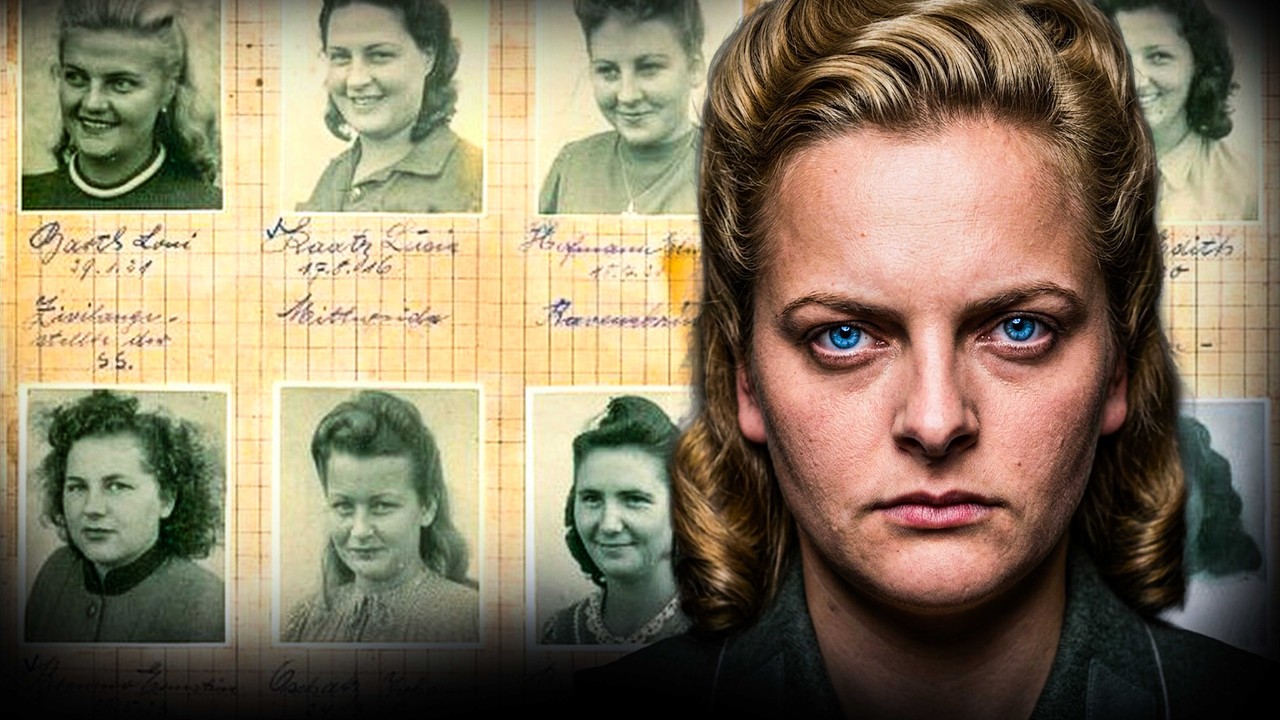
It appears in the photographs taken at the Belsen trial, where she sits in the dock, young and composed, an ordinary-looking young woman surrounded by the evidence of an extraordinary evil. And it appears in the growing scholarly literature that has sought to understand not just what she did, but how she became capable of doing it.
The cultural afterlife of Irma Grese is an important part of the broader story of how her family and the world she came from has been remembered and misremembered. Unlike many of the women who served in the camp system and have remained relatively obscure, Grese became a figure of considerable cultural fascination.
The earliest popular representations of her appeared in the immediate post-war period in the British press and in the newsreel coverage of the Belsen trial. She was presented consistently as a "beautiful monster." Her physical appearance was noted in almost every account.
This framing served certain ideological purposes. It preserved the notion that evil was fundamentally aberrant and detectable through some visible marker, and that the failure to detect it in Grese's case was due to the deceptive combination of her appearance and her gender.
The historical record, as subsequent scholarship has established beyond any reasonable doubt, does not support this reassurance. But the popular image of Grese as a beautiful anomaly proved remarkably durable and has shaped the way her story has been told in popular culture for more than 70 years.
Several films were made about or partly based on Irma Grese and the Belsen trial in the decades following the war. Some were serious attempts to engage with the historical record, and others were exploitative productions that used her notoriety as a vehicle for sensationalism.
For the Grese family and the families of other Belsen defendants, seeing their relatives depicted in film, sometimes accurately and sometimes in distorted or sensationalized ways, was another dimension of the post-war experience that could not be easily managed or avoided.
The British psychologist who examined Grese during her imprisonment before the trial noted that she was psychologically intact, showed no signs of psychiatric illness in any conventional sense, and appeared to understand the nature of what she was accused of without showing any emotional response that suggested remorse or distress.
This clinical observation raised the question that has occupied scholars ever since. Was she a psychopath in the clinical sense, someone for whom the normal human capacity for empathy was constitutionally absent? Or was she a normal person who had been so thoroughly conditioned by the environment of the camp system that her empathy had been functionally extinguished?
The answer to these questions matters enormously for how we understand the families that produced people like Grese. If she was a constitutional psychopath, then her family can be understood as the unlucky relatives of an aberrant individual. If she was a conditioned normal person, then the question of who did the conditioning becomes central.
Most serious scholars take a position that incorporates both individual personality factors and situational and institutional factors. This combined account is probably the most historically accurate one available, but it is also the most challenging for the families of perpetrators.
The specific trauma of Berta Grese's suicide in 1936 deserves further consideration. Irma was 12 when her mother died, and the manner of her death, drinking acid, was violent and presumably witnessed or discovered in circumstances that would have been deeply traumatic.
The psychological literature on the long-term effects of parental suicide on children is extensive and consistent. Children who lose a parent to suicide experience elevated rates of depression, anxiety, post-traumatic stress disorder, and behavioral difficulties.
Irma's siblings would have carried these burdens as well as she did. But they did not all make the same choices she made. This suggests that the trauma of their mother's death, while significant, was not by itself sufficient to produce the specific trajectory that Irma followed.
Helene, the oldest of the Grese siblings, was old enough at the time of her mother's death to have already formed a relatively stable identity. The trajectory she followed after the war appears to have been the most conventional of the surviving siblings.
There are suggestions in various biographical accounts that Helene made deliberate efforts to distance herself from the Grese name as it became notorious, moving geographically and perhaps eventually changing her name through marriage to create a degree of separation from the identity her younger sister had so catastrophically defined.
Alfred Jr., Irma's older brother, was in his mid-20s at the end of the war, old enough to have served in the German military. In the Soviet occupation zone, where the Grese family's home region fell, former Wehrmacht soldiers faced particular scrutiny from a communist administration interested in identifying those who had served in organizations associated with the Nazi state's worst crimes.
Lydia Grese, the youngest of the surviving siblings, entered adulthood in the late 1940s and early 1950s in a Germany that was becoming two separate states. In East Germany, the official narrative was one of having superseded and overcome fascism through the construction of a socialist state.
Whether Lydia used this mechanism, whether she built a family of her own, and what she told them about their heritage is unknown. She represents in her very obscurity the experience of hundreds of thousands of ordinary Germans whose family histories intersected with the Nazi period in ways that were never publicly confronted.
The fall of the Berlin Wall in 1989 and the subsequent reunification of Germany created a new cultural and political environment for families like the Greses. The reunification brought together the two different approaches to the Nazi past that East and West Germany had developed over 40 years.
The newly unified Germany of the 1990s and 2000s faced the challenge of integrating these two approaches, and in the process, many stories that had been suppressed in the East for decades began to surface. For families in the former East Germany with connections to Nazi perpetrators, this was a period of potential exposure and reckoning.
The historiography of the female SS guard specifically has undergone enormous expansion since the 1990s, driven by the opening of Eastern European archives after the fall of communism and by a generation of scholars who came to the topic without the apologetic circumspection that had sometimes characterized earlier researchers.
Works by scholars such as Gudrun Schwarz, Elissa Mailänder, and Wendy Lower built a comprehensive picture of female perpetrators that had not previously existed. This expansion of knowledge created renewed public interest in specific figures like Irma Grese.
Documentaries, books, and online resources produced in the 2000s and 2010s about Grese were more historically sophisticated and less sensationalistic than many of the earlier popular treatments. They also reached audiences that included potentially descendants of the Grese family themselves.
The town of Wrechen where Irma Grese was born no longer exists as an independent settlement. It has been absorbed into the administrative structure of the surrounding region, and its population in the post-war period was significantly affected by the changes that came with the Soviet occupation and then the East German state.
The physical landscape of Irma Grese's childhood has been transformed by 70 years of German history since her birth, and the community of people who knew her family has largely died out or dispersed. This has contributed to the sense that the Grese story is somehow sealed off from the present.
But history is not sealed off by physical transformation. The records remain, the testimony remains, the scholarly literature remains, and the descendants of the people who lived in that community in the 1930s and 1940s carry whatever they have been told or not told about the past with them into the present.
The immediate post-war years were particularly brutal for ordinary Germans in the Soviet occupation zone. The Soviet occupation of Eastern Germany in 1945 and 1946 was characterized by widespread violence against the civilian population, including mass rape, looting, and arbitrary arrest.
In this environment, being the family of a woman who had been executed by the British for war crimes was not necessarily a source of danger from the Soviet occupiers, but it was a source of social stigma within the German community.
Alfred Grese, the father, was in his 50s at the end of the war. He had lived through the First World War, the Weimar period, the rise of Nazism, the Second World War, and the collapse of everything his country had built in 12 years of Nazi rule. He had lost his wife to suicide in 1936.
He had watched his daughter enter the SS and then watched her tried and executed for crimes that shocked the world. He died in 1948, and one might argue without excessive sentimentality that he had been through enough.
The question of whether Alfred Grese knew what was happening in the camps, and what exactly was being done to the prisoners his daughter was guarding, cannot be answered with certainty from the available historical record.
The broader question of how much ordinary Germans knew about the Holocaust has been one of the most contested topics in the historiography of the Nazi period. More recent scholarship, including the work of Peter Longerich, has presented a nuanced picture, suggesting that while knowledge of the broad outlines was widespread by 1942 or 1943, knowledge of the specific industrial methods of the death camps was more restricted.
Alfred Grese, a dairy worker in rural Mecklenburg, may or may not have known the full details of what his daughter was participating in. But he was not living in an information vacuum, and the execution of his daughter by British military authorities would have made the reality impossible to avoid.
The Belsen trial's significance extended far beyond the specific defendants who sat in the dock. It was, as legal historian Donald Bloxham has argued, a foundational moment in the development of international humanitarian law and in the broader project of establishing individual criminal accountability for state-sponsored atrocities.
The legal principles established at Belsen and at the subsequent Nuremberg proceedings shaped the framework of international law for the rest of the 20th century and into the 21st. The International Criminal Court, established in 2002, is a direct institutional descendant of those principles.
For the survivors of Bergen-Belsen, the trial and its outcomes were meaningful but also inevitably inadequate. The survivors who gave testimony were given the opportunity to speak publicly about what had happened to them, which was itself historically significant.
The Belsen trial was one of the first major occasions on which survivor testimony was placed at the center of a legal proceeding. But the execution of the most notorious defendants, while symbolically important, could not bring back the dead.
For survivors who had lost entire families to the system of which Grese had been a part, the hanging of a 22-year-old woman at Hamelin Prison was in one sense a form of justice and in another sense an almost meaninglessly small gesture in the face of a crime of incomprehensible scale.
Survivors who came into contact with Irma Grese during their imprisonment and who subsequently gave testimony or wrote memoirs offered perspectives on her that were more complex than the purely demonizing portrait that popular culture sometimes produced.
Primo Levi, the Italian Jewish writer who survived Auschwitz, wrote about the broader category of perpetrators that Grese exemplified with a reflective depth that refuses simple condemnation. He was interested in the gray zone, the spaces where moral clarity dissolves and human complexity reasserts itself.
Elie Wiesel, another survivor and Nobel Peace Prize laureate, spoke often about the importance of testimony and memory in the decades after the Holocaust, and about the responsibility of subsequent generations, including the descendants of perpetrators, to engage honestly with historical truth rather than retreating into denial or silence.
For the families of perpetrators like the Greses, Wiesel's call for honest memory was directed precisely at them, even if it was not addressed to them by name. It was a call that most of them, by the evidence available, were unable or unwilling to answer.
The archive of survivor testimony collected by Steven Spielberg's Shoah Foundation, established in 1994, contains hundreds of accounts by survivors of Bergen-Belsen and Auschwitz that mention Irma Grese by name. These testimonies offer a remarkable documentary record of how survivors remembered her.
Some accounts focus on her physical appearance and the uncanny quality of her combination of youth and cruelty. Some focus on specific incidents: a particular beating, a selection in which she pointed toward the gas chambers, a moment of arbitrary violence that left a scar or killed a fellow prisoner.
What is consistent across all of them is the specificity, the sense that Grese was not a vague, generic presence but a specific individual whose face, voice, bearing, and particular cruelties were stamped into memory in a way that time could not fully erode.
For the descendants of the Grese family, if any remain and if any have engaged with this material, the experience of encountering their family member in this documentary record must be unlike anything most people will ever face.
The silence of the Grese family about their history, which might otherwise seem simply like a chosen strategy of self-protection, becomes, in the light of this documentary record, something more complicated. Perhaps an inability to speak that is not entirely different from the inability to speak that characterizes many survivors as well, albeit for very different reasons.

Among the 45 defendants at the Belsen trial, 11 were acquitted, 14 were executed, and the remaining 20 received prison sentences ranging from a few years to life imprisonment. Of those sentenced to prison, most were released well before the completion of their full sentences.
The pattern of early release and social reintegration that characterized many of the surviving Belsen defendants was mirrored across the broader landscape of post-war West German justice. The Allied denazification process was wound down relatively quickly in the context of the emerging Cold War.
By the early 1950s, most of the denazification proceedings had ended, and a broad social consensus had emerged in West Germany that the past should be allowed to recede in favor of the economic and political project of reconstruction.
This consensus, the famous "Schlussstrich," the desire to draw a line under the Nazi period, was the social environment in which the families of convicted war criminals, including the family of Irma Grese, had to build their lives in the 1950s and 1960s.
The renewed prosecution effort that began in West Germany in the late 1950s and accelerated through the 1960s and 1970s was driven partly by the Central Office for the Investigation of National Socialist Crimes, established in Ludwigsburg in 1958.
It was this office that eventually built cases against figures like Hildegard Lächert and others who had escaped the immediate post-war proceedings. But even this renewed effort was limited in its reach, as the passage of time had eroded evidence and made witnesses harder to find.
The story of Ilse Koch provides a useful counterpoint to Irma Grese's story. Koch was a female perpetrator whose post-war fate was dramatically different and whose family situation illustrates a different dimension of how the Nazi camp system's legacy played out in personal and familial terms.
Ilse Koch was born on September 22, 1906, in Dresden, which made her 17 years older than Irma Grese. She had joined the SS auxiliary system in the late 1930s and had married Karl Otto Koch, who became the commandant of Buchenwald concentration camp in central Germany.
As the commandant's wife, Ilse Koch occupied a position of considerable social power within the SS community at Buchenwald. Survivor accounts described her riding through the camp on horseback, supervising beatings, and cultivating a collection of human skin taken from murdered prisoners, which gave rise to her lasting nickname, "the Witch of Buchenwald."
The lampshade allegations were specifically and strongly contested by later forensic examination, with experts concluding that the infamous lampshades displayed at the Nuremberg proceedings were made of animal skin, not human. This did not exonerate Koch of the very real crimes she had committed, but it illustrated how cultural representation sometimes crossed the boundary between documented fact and lurid myth.
Ilse Koch was tried by an American military tribunal in 1947 and convicted, receiving a life sentence. However, in one of the most controversial decisions of the postwar trials, the American military commander General Lucius Clay reduced her sentence to four years in 1948.
The decision provoked enormous outrage among survivors, in the American press, and in the US Senate, which held hearings on the matter in 1949. Koch was released in 1949, having served only two years of her original sentence.
The West German government, responding to public pressure, subsequently charged Koch under German law and tried her again, convicting her in 1951 and sentencing her to life imprisonment. In 1967, facing her imprisonment with no realistic prospect of release, she hanged herself in her cell. She was 60 years old.
What makes the Ilse Koch story particularly relevant is the question of her son. Koch had given birth to a child, a son named Uwe, while in American captivity in 1947. The identity of the child's father was never established with certainty.
Uwe grew up without his mother for the first years of his life, was raised for a period by foster families and in institutional care, and eventually established contact with his mother during her long imprisonment. The psychological burden he carried was immense and publicly documented in a way that was unusual for the children of female perpetrators.
He gave interviews to German journalists in which he described a childhood defined by the weight of his mother's notoriety and by the complex emotional reality of loving a person whose actions you cannot defend. His story became one of the case studies in the psychological literature on perpetrator family dynamics.
When Ilse Koch died in 1967, Uwe was 20 years old. He continued to live in West Germany, and the later trajectory of his life is not extensively documented in English-language sources, but his early experiences serve as a window into the kinds of psychological landscapes that the children of female perpetrators were forced to inhabit.
The broader category of perpetrator families has been the subject of growing scholarly attention since the 1990s. Research conducted by scholars including Harald Welzer, who has studied the transmission of Nazi-era memories in German families across three generations, reveals that the dominant pattern was not open confrontation but managed silence.
Welzer's research, summarized in his 2002 book "Opa war kein Nazi" ("Grandpa Wasn't a Nazi"), showed that grandchildren of perpetrators often received family stories that had been significantly sanitized from the historical record, in which grandparents who had done terrible things were remembered as essentially decent people caught up in forces beyond their control.
This pattern of familial self-protection through narrative management was so widespread that it could be considered a defining feature of German family life in the post-war decades. Its effects, the gradual erosion of accurate family memory and its replacement with self-exculpatory mythology, are still being worked through by German families today.
The specific situation of the Grese family is distinguished from these patterns by one crucial factor: the fame and documentation of Irma's case. Most families of perpetrators were dealing with histories that were not extensively documented in the public record.
The Grese family did not have this luxury. Irma's trial was extensively covered in the British and German press. Her photograph was widely circulated. Her name entered the historical record in a way that was permanent and irremovable.
Any family narrative that attempted to soften or reframe her story was in direct and visible conflict with an enormous public record that could be consulted by anyone. This may actually have made the Grese family silence more total than the managed half-silences of perpetrator families dealing with less documented histories.
One of the most thought-provoking aspects of the Irma Grese story is the question of whether she ever expressed anything to her family that approached remorse. Her conduct at the trial was notably devoid of emotional display. She was described repeatedly as composed, controlled, even cold.
When the death sentence was pronounced, observers noted no visible reaction. When she was executed, Albert Pierrepoint described her composure and noted only the single word she spoke. None of this tells us what she felt internally.
What it means for her family is that there is no documented record of Irma Grese having said anything to them or to anyone who transmitted it to them that might have served as a point of emotional or moral departure for the family's subsequent processing of her crimes and her execution.
There is no reported deathbed statement, no letter to her father, no communication from prison that has entered the historical record. She died without, so far as can be documented, having offered her family any interpretive framework for what had happened.
The Bergen-Belsen memorial site, established at the former camp location in Lower Saxony, has been an important center for commemorative and educational activities. It underwent a major expansion in 2007 when a new permanent exhibition was opened.
The memorial site receives tens of thousands of visitors every year, including school groups from across Germany and other countries. The names of the camp's perpetrators, including Irma Grese, are documented in the exhibition, and the history of the Belsen trial and its outcomes is presented as part of the broader narrative.
The former site of the camp itself has been transformed over the decades since liberation. The British forces who liberated Bergen-Belsen in April 1945 faced an immediate public health crisis, with the risk of typhus spreading to the surrounding population.
They made the decision to burn the wooden barracks in which the prisoners had lived and died, using flamethrowers. The camp was burned partly for practical reasons and partly as a symbolic act, and the land was cleared.
In the decades since, the site has been progressively memorialized, with mass graves marked by large earth mounds bearing simple plaques, trees planted in the surrounding landscape, and the memorial and documentation center built on the adjacent property.
Walking the site today, a visitor encounters a place that is simultaneously ordinary and extraordinary. A gently rolling landscape in the Lower Saxony heathland has been transformed by the weight of what happened there into something that can only be experienced as sacred ground.
The question of how the families of perpetrators relate to these memorial sites has been raised periodically in discussions of how Germany manages its Nazi legacy. In general, perpetrator families are not invited into the memorial space as a specific stakeholder group, and the primary commemorative focus is appropriately on the victims.
But some scholars and educational practitioners have argued that a complete understanding of what happened and why requires some engagement with the perspectives and experiences of perpetrator families, not as a form of moral equivalence with the victims, but as a way of understanding the full social ecology of atrocity and its aftermath.
The silence of families like the Greses is itself a form of historical evidence about how German society processed, or failed to process, its complicity in the Nazi crimes.
Germany's engagement with its Nazi past is by any comparative measure unusually thorough and unusually honest. There is no other country in the world that has so comprehensively incorporated the crimes of its recent history into its public culture, its educational system, its architectural landscape, and its legal framework.
German criminal law makes Holocaust denial a crime. German schools dedicate substantial curriculum time to the history of the Nazi period. German cities are covered with Stolpersteine, the small brass memorial stones that mark the former addresses of Holocaust victims.
All of this is genuine and significant, but it operates at a level of cultural generality that can coexist with the specific silence of individual families about their own specific histories. It is possible to live in a Germany that publicly acknowledges collective responsibility while privately maintaining the silence of a family that has never spoken honestly about what one of its members did.
The descendants of Irma Grese's siblings, if any exist, and given the span of generations since 1945 there almost certainly are, are living in a Germany that is very different from the one their ancestor knew. They are living in a country with a stable democracy and a cultural infrastructure that is remarkably candid about the worst episodes of its history.
Whether any of them has chosen to move from the silence that their immediate family appears to have adopted toward a more active engagement with their history is not known. It is one of the many questions that the historical record cannot answer.
There is a difference between the legitimate public interest in historical truth and the private rights of individuals to manage their own family histories according to their own psychological and moral resources. The descendants of Irma Grese did not choose their ancestor.
They are entitled, if they choose, to their silence, but they are not entitled to distort the record. As far as the available record indicates, the Grese family has been silent, not denialist. While that silence is not the same as genuine moral reckoning, it is at least not an active participation in the falsification of history.
The final years of Germany's last surviving connection to the world that produced Irma Grese are themselves a form of testimony. The generation that was alive and adult during the Nazi period is now entirely gone.
The transition from living memory to historical memory is one of the most significant cultural shifts in the management of a traumatic past. The last survivors of Bergen-Belsen, Auschwitz, and Ravensbrück are either very old or gone.
The last perpetrators, including those who escaped postwar justice and lived into old age, are gone. The last people who knew the Grese family in the village of Wrechen in the 1930s, who went to school with Irma's siblings, who watched Alfred Grese age and die in the shadow of his daughter's execution, are gone.
What remains is testimony, documentation, scholarship, and the cultural memory that generations continue to maintain or allow to fade. The facts do not change when the last survivor dies.
The legacy of Irma Grese's family is a legacy of silence, of survival, of the kind of diminished, shadowed ordinary life that falls to people who are implicated in catastrophe, not by their own direct actions, but by the actions of those closest to them.
Alfred Grese, the father, died in 1948, three years after his daughter, carrying whatever he carried to his grave. His surviving children lived out decades of ordinary and largely undocumented lives in a Germany that was rebuilding, recovering, and trying with various degrees of success and failure to understand what had happened to it and why.
Their descendants, whoever and wherever they may be, carry a history that is permanently inscribed in the public record, available to anyone who looks. Whether they have looked, whether they have read, whether they have wept or felt shame or sought in some private way to honor the victims of their ancestors' crimes, is not known. It may never be known.
The story of Irma Grese does not end with her execution on December 13, 1945. It continues in the lives of the people connected to her, in the testimony of the people she victimized, in the legal and scholarly record of the Belsen trial and its significance, and in the ongoing cultural conversation about how ordinary human beings become capable of extraordinary evil.
The families she left behind, her own family and the families of the women who stood in the dock beside her and were hanged or imprisoned for the same crimes, are part of that continuing story. Even in their silence, even in their absence from the public record, they are the human shadow that falls from the historical event.
The history of what happened at Bergen-Belsen and at Auschwitz and at Ravensbrück belongs to all of us now. Not only to the survivors and their families, not only to the perpetrators and their families, but to the whole human community that must decide what to do with the knowledge of what our kind has done to our kind.
The families of the perpetrators are part of that human community. They did not escape the consequences of what was done. They simply experienced those consequences in a different register, a private and largely silent register that the public record can glimpse but never fully read.
Irma Grese was 22 years old when she died. She had grown up in a village in Mecklenburg, lost her mother to suicide at 12, left school at 14, and entered the SS at 18. In the four years between her entry into the camp system and her execution, she participated in the murder of hundreds of thousands of people.
She was not unique. She was not a monster in any supernatural sense. She was a human being shaped by specific historical forces who made specific choices that resulted in specific harms and who was held accountable for those choices in a court of law.
The family she came from was a family of ordinary rural Germans who did not share her crimes but who bore the consequences of them for the rest of their lives. And the consequences of those crimes extend further still into the present, in the testimony of survivors, in the scholarship of historians, and in the ongoing human effort to understand how the world that produced Irma Grese was possible.