His name was John A. Logan, and he was not headed to the front lines to fight. He was headed to Nashville, Tennessee, to fire one of the most successful commanders in his army; a general who had not lost a major battle in three years of war, and who was, at that very moment, defending one of the Union’s most important cities against a desperate Confederate army marching toward it. Logan carried orders from Ulysses S.
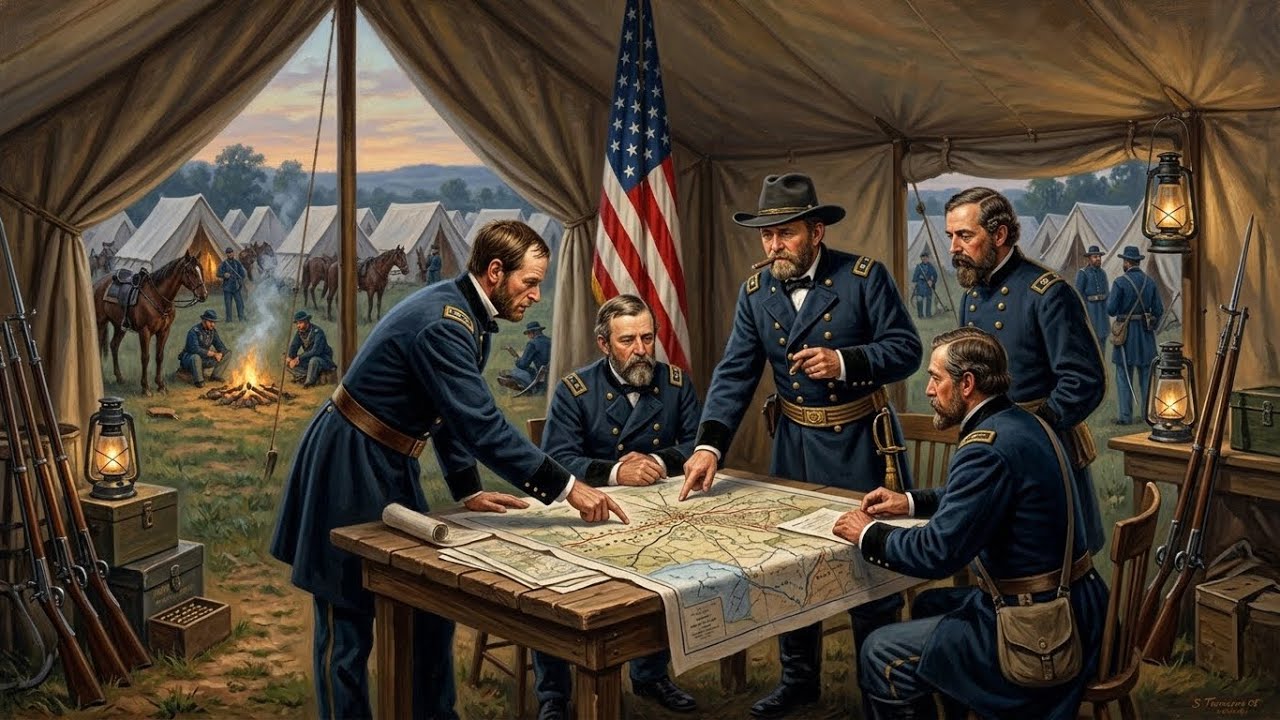
Grant himself. If the commander in Nashville had not launched an attack by the time Logan’s train arrived, Logan was to relieve him on the spot and take command of the army himself. Two days later, Grant grew so worried that Logan might not move fast enough that he boarded a train himself, traveling the same route, ready to fire the man personally if his subordinate had not already done so. The general they were racing to replace was named George Henry Thomas.
History would later call him the “Rock of Chickamauga,” a nickname earned for holding a collapsing Union line almost alone while the rest of the army fled around him. He would finish the war with a record no other Union general could quite match. He never lost a battle he fully commanded. Not one.
And Ulysses S. Grant, the general who would become President of the United States, was racing across three states to fire him. To understand why Grant was so ready to dismiss Thomas in the middle of a desperate defense, you have to understand the reputation that followed Thomas for most of his career. A reputation built, ironically, on the very trait that made him nearly unbeatable.
Before the war, as an instructor at West Point, Thomas had earned a nickname from the cadets he trained: “Old Slow Trot. ” A sarcastic reference to his insistence that cavalry work be done with control and precision rather than reckless speed. It was meant as gentle ribbing at the time. But it would stick to him far less kindly for the rest of his career.
There was a deeper tension beneath that reputation, too. Thomas was a Virginian by birth, one of the few senior Union generals from a southern state who remained loyal to the Union rather than joining the Confederacy. A choice that reportedly cost him his family relationships for the rest of his life. According to most accounts, his sisters never spoke to him again after he chose to stand with the Union.
And within Grant’s inner circle of trusted commanders—Sherman, Sheridan, and Grant himself, all men who had built their reputations together in the western campaigns along the Mississippi—Thomas remained something of an outsider, respected for his record on the battlefield, but never fully accepted as one of them. That outsider status would follow him into three of the most important battles any Union general would fight in the entire war. And each one would feature the same pattern: methodical preparation away from the spotlight, followed by results that were almost impossible to argue with. Long before Chickamauga, long before Nashville, Thomas secured one of the very first genuine field victories of the entire war for the Union.
A battle almost no one remembers today, despite its real importance at a moment when the Union desperately needed such a win. In January 1862, in the rugged hill country of eastern Kentucky, Thomas led Union forces against a Confederate army commanded by Major General George Crittenden. The broader Union war effort at this stage of the conflict was struggling badly. A string of setbacks and stalemates had left morale in the North flagging.
Abraham Lincoln was desperately searching for any general who could deliver an unambiguous victory to counter the growing sense that the war might drag on indefinitely. Thomas had been sent to push the Confederates out of eastern Kentucky, but Crittenden was a determined opponent who had planned to strike first. The two forces met along the banks of a rain-swollen creek called Mill Springs, near the small town of Somerset. It was mid-winter, the conditions were miserable, and the Union soldiers were not at their best.
Thomas had been given permission to wait for reinforcements, to hold his position and avoid a risky engagement. He chose instead to attack. In the cold drizzle of January 19, 1862, Thomas launched a hard-hitting assault that caught the Confederates off guard. The fighting was sharp but relatively brief.
Crittenden’s line collapsed, and his army retreated in disorder, pulling back all the way to the Confederate stronghold at Murfreesboro. The victory at Mill Springs did more than push the Confederates out of Kentucky. It was the first clear, unambiguous Union field victory of the war. A moment when the Army of the Potomac was still recovering from its humiliating defeat at First Bull Run.
The victory opened the way for Union forces to advance deeper into Tennessee, and it came at a time when Lincoln was publicly begging his generals for results. Thomas became an overnight hero in the North, his name praised in the same breath as the war’s earliest successes. But the same victory that made his reputation also revealed the trait that would define his entire career: Thomas did not celebrate victory by charging after a retreating enemy. He was content to hold the field, count his dead, and prepare for the next phase of the campaign.
He considered the battle over. He saw no reason to risk his men in pursuit through unfamiliar territory, in the rain, against a shattered enemy. And so he stopped. Crittenden lived to fight again.
That instinct for restraint, so effective in defense, would frustrate Grant and Sherman endlessly. They saw it as slowness, hesitation, a lack of the killer instinct that defined men like Sheridan. What they failed to understand was that Thomas approached battle like an engineer approaching a bridge. He wanted the ground prepared, the supply line secure, the numbers in his favor.
He did not believe in improvisation. He did not believe in heroic gambles. He believed in mathematics and logistics. And that belief would bring him to the edge of being fired twice more before the war was over.
The second instance came in September 1863, after the Union’s catastrophic defeat at Chickamauga. The Army of the Cumberland, shattered and demoralized, had retreated into the city of Chattanooga. The Confederates under Braxton Bragg surrounded them on the high ground above the city, cutting off the Union supply line. The men were starving.
The army was trapped. Grant ordered Thomas to hold the city at all costs and then planned to attack the Confederate positions as soon as reinforcements arrived. But Thomas, as always, wanted to do it carefully. He wanted to wait until the supply lines were secure, until his men were rested, until he was certain the attack would succeed.
Grant, under intense political pressure from Washington, wanted to attack immediately. He sent word to Thomas that he was being relieved. Thomas refused to be relieved. He sent word back that he was holding the city and that an attack would be a mistake.
And then, in a move that infuriated Grant, Thomas simply declined to move until his conditions were met. He spent days inspecting the Confederate positions, waiting for his logistics to catch up, while Grant fumed in his headquarters and sent increasingly angry messages. It was only when Thomas was finally ready that he launched his attack at the Battle of Chattanooga. The battle was a decisive Union victory, breaking the Confederate siege and opening the way for Sherman’s march into Georgia.
Grant had to admit that Thomas’s caution had been vindicated. But he never forgave him for it. The third and final conflict came in December 1864, in the battle that would cement Thomas’s legacy forever: Nashville. The Confederate Army of Tennessee, under General John Bell Hood, had invaded the state with a desperate plan to cut off Sherman’s supply lines and force the Union to divert troops away from the burning South.
Thomas was given command of the Union forces tasked with stopping Hood’s advance. But Thomas’s army was a polyglot force, a mix of garrison troops, raw recruits, and cavalry that had been stripped of its best officers. He needed time to train his men, to integrate his cavalry, and to build up his supply lines. Hood, meanwhile, was marching north, hoping to catch Thomas unprepared and destroy his army in detail.
The race was on. And it was this race that had sent Logan heading to Nashville with those orders to relieve Thomas. The orders were based on Grant’s growing belief that Thomas was too slow, too cautious, that he was letting the Confederates slip away. Grant was right that Thomas was being cautious.
But Thomas was also fighting the very same kind of war he had always fought: methodically, carefully, and only when he had stacked the deck in his favor. And it was that method that would finally win him the battle that Grant would call his greatest of the war. The Battle of Nashville was a stunning victory, a complete rout that effectively destroyed the Confederate Army of Tennessee. But the fact that Thomas had to win it while under the threat of being fired is a story of its own.
To understand how deep that distrust ran, you have to look at what happened in the days before the battle. Grant was so convinced that Thomas was moving too slowly that he sent a series of telegrams, each one more demanding than the last. He ordered Thomas to attack immediately, regardless of conditions. Thomas, his supply lines still not fully secured, his cavalry still not fully integrated, refused.
He told Grant that an attack now would be a disaster and that he would attack when his preparations were complete. Grant responded by issuing the order that sent Logan on his journey: Thomas was to be relieved if he did not attack immediately. The decision to relieve Thomas was not a secret. Word spread through the Union high command that Thomas was on the verge of being fired.
Soldiers, who had come to respect their commander for his calm professionalism, were reportedly shocked. Officers wrote letters home, describing the tension between Thomas and his superiors. And still, Thomas refused to be rushed. He spent his days inspecting his lines, reviewing his troops, and waiting for the weather to clear.
When it finally did, he launched his attack on December 15, 1864. The battle that followed was one of the most one-sided victories of the entire war. The Confederates were routed, driven from the field in complete disorder, and the army that had marched north so confidently was reduced to a shattered remnant. In the aftermath, Grant was forced to admit that Thomas had been right.
The victory at Nashville was the most complete victory of the war. But the relationship between the two men was permanently damaged. Thomas was never given another major field command. He spent the rest of the war in relative obscurity, commanding rear-area departments and serving in administrative roles.
When the war ended, he was not invited to the Grand Review in Washington, D. C. , the great victory parade that celebrated the Union’s triumph. He was not promoted to full general, as Sherman and Sheridan were.
He was, for all intents and purposes, forgotten. And yet, his record spoke for itself. In three years of war, he had never lost a battle. He had won the first major Union field victory at Mill Springs.
He had saved the Union army at Chickamauga. He had broken the siege at Chattanooga. And he had destroyed an entire Confederate army at Nashville. All of it achieved while fighting not just the Confederates, but the skepticism of his own superiors.
His tactics were never flashy. His victories were never celebrated with the same enthusiasm as Sherman’s March or Sheridan’s cavalry charges. But his results were undeniable. He was, by any measure, one of the greatest Union generals of the war.
Thomas remained in the army after the war, serving in administrative roles in the West. But the war had taken a toll on him. His health declined in the years following Appomattox, and he died in 1870, at the age of just 54. His death went largely unnoticed by the public, a final indignity for a man who had given so much to his country.
It was only later, with the passage of time, that historians began to reassess his legacy. Today, he is often ranked among the top tier of Union generals, a man whose caution was a sign of strength, not weakness. But the journey to that recognition was long and painful, filled with the very misunderstandings that had dogged him his entire career. He was, in the end, a man who did his duty without complaint, who fought his battles with quiet competence, and who never once wavered in his loyalty to the Union he had chosen over his own family.
The story of George Henry Thomas is a story about judgment and its consequences. It is a story about what happens when a man is defined by a single mistake, or in this case, a single misunderstood trait. It is a story about the difference between looking the part and being the part, between the flash of a cavalry charge and the steady hand of a man who knew exactly when to hold and when to strike.
And it is a story that begins, as it ends, with a train ride that almost changed the course of American history.