On April 4, 1945, Allied forces were pushing through the heart of Germany as the Nazi regime neared collapse. The spring weather was uncharacteristically warm, and the trees were blooming, creating a deceptive sense of rebirth across the shattered landscape.
For the men of the United States Fourth Armored Division, that beauty was about to be shattered. As their jeeps navigated a quiet country road near the medieval town of Gotha, the lead elements did not encounter a final defensive line or Tiger tanks. Instead, they hit a wall of smell.
The air was choked with a stench so thick and overpowering that seasoned combat veterans began to gag uncontrollably. It was a visceral odor of rotting meat, burning hair, and sulfurous decay that clung to their uniforms and filled their lungs.
General George S. Patton, commander of the Third Army, was writing in his command car nearby when he sniffed the air. His tactical mind initially sought a rational explanation, theorizing they were approaching a chemical factory or a glue processing plant handling dead horses.
He demanded to know the source of the foul atmosphere rolling across the valley. Hours passed until a lone jeep raced back to headquarters and screeched to a halt. The officer who emerged was pale, his hands shaking, his eyes holding the vacant stare of a man who had seen a ghost.
He approached Patton and bypassed all military protocol, stating simply that the general had to come and see the site for himself because words would fail to convey the magnitude of the discovery. Patton drove toward the coordinates provided and arrived at a place called Ohrdruf.
Ohrdruf was a small subcamp of the larger Buchenwald complex. It would go down in history as the first Nazi concentration camp liberated by the United States Army on the Western Front.
Patton, known to the world as Old Blood and Guts, had seen thousands of corpses in his career, from North Africa to Sicily. Yet when he walked behind a wooden shed at Ohrdruf, he was overcome by a physical revulsion so intense that he moved out of sight and vomited.
This was not the honorable death of a soldier in combat. It was a mechanized, calculated eradication of human dignity. Once the initial sickness passed, it was replaced by a cold, terrifying rage.
He looked at the clean, tidy town of Ohrdruf sitting peacefully just two miles away, its residents watching from behind lace curtains as if the nightmare next door was none of their concern. In that moment, Patton realized that liberation was not enough. Justice required a confrontation with the truth.
He turned to his subordinates and issued an order that would reverberate through the history of the occupation. He commanded them to round up the local German leadership, including the mayor, his wife, the town's baker, the butcher, and every prominent citizen.
If they claimed they did not know what was happening within walking distance of their homes, Patton was determined to ensure they would know now. He was preparing to force an entire town to walk through hell at gunpoint to shatter the veil of denial.
To comprehend the source of Patton's fury, one must understand the scene that greeted the Fourth Armored Division. While Ohrdruf was small compared to industrial death factories like Auschwitz, it was a concentrated horror show.
The SS guards had fled as the American tanks approached, but in their final hours they had attempted to erase the evidence of their crimes. They had machine-gunned prisoners too weak to join forced marches deeper into Germany, piling their bodies into sheds and covering them with quicklime to dissolve the flesh.
However, the speed of the American advance had outpaced the Nazi cleanup efforts. The American soldiers who entered the gates were met not by an army, but by walking skeletons. Men clad in tattered striped pajamas, some weighing as little as 60 or 70 pounds, stared back with eyes that seemed too large for their sunken faces.
These survivors were too weak to cheer. They simply wept as they touched the white stars painted on the armor of the American tanks, needing to feel the metal to confirm that liberation was real and not a final hallucination of the starving mind.
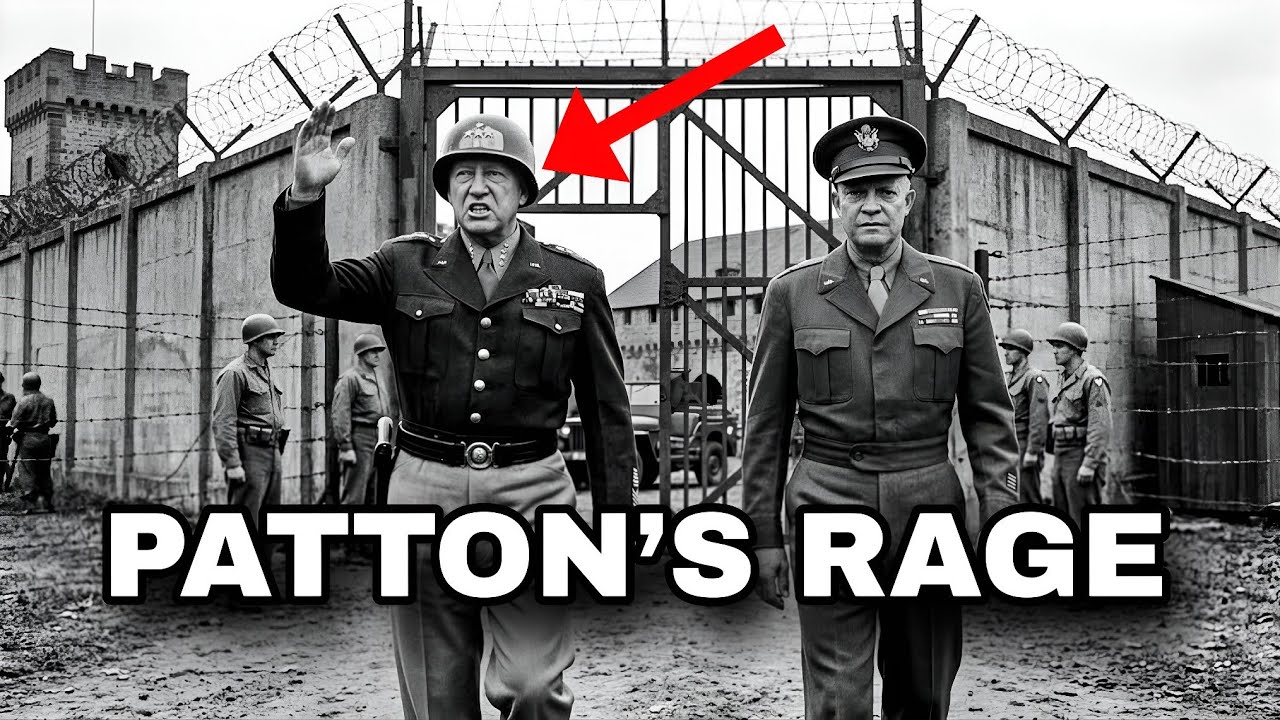
The gravity of the situation was so immense that General Walton Walker called Patton immediately, urging him to bring the highest levels of command to witness the site. Soon, the three most powerful men in the American military hierarchy stood together at the gates of Ohrdruf: General George Patton, General Omar Bradley, and the Supreme Allied Commander, General Dwight Eisenhower.
Together, they had commanded millions and directed the deaths of countless men in the pursuit of victory. They believed themselves to be hardened warriors, immune to the shocks of war, but they were wrong.
Patton entered the camp with his characteristic polish, his helmet shining and his riding crop in hand, looking every bit the conqueror. Yet as he moved deeper into the roll call square, his posture slumped.
Before him lay the able plots, where bodies were stacked like cordwood in piles of 20, 30, and 40. These were men who had been starved to the point of transparency or shot in the back of the neck as they lay helpless.
Patton walked up to one of these piles and stood in a long, grim silence, whispering a plea to a higher power as he stared at the carnage. A survivor, little more than a frame of bones, crawled toward him and attempted to kiss Patton's boots in a gesture of profound gratitude.
Patton, a man often criticized for his lack of empathy, stepped back gently and helped the man stand, his eyes filling with tears as he confronted the human cost of the Nazi ideology.
The generals then discovered the torture shed, a place where the darkness of the human soul was on full display. Inside, they found a whipping block stained a deep, dark brown with years of dried blood. They saw hooks on the walls where men had been suspended by their necks until they suffocated.
A prisoner who spoke English served as their guide, explaining with a haunting detachment how the SS guards would beat men to death for no reason other than their own amusement. As the details of the camp's daily life emerged, Eisenhower's face turned white, his expression hardening into a mask of stone. Bradley was rendered silent, unable to find the words to process the depravity.
Patton, however, did not remain silent. He vibrated with a kinetic anger that demanded action. He retreated to the back of the shed, his aides observing his shoulders heaving as the toughest general in the world was once again overcome by the physical reality of the scene.
When he returned to the group, his voice had shifted. It was no longer the voice of a tactical commander discussing troop movements. It was the voice of a prosecutor delivering a final indictment.
He questioned a young American military policeman about the awareness of the local population. When the MP reported that the townspeople claimed they believed the site was merely a prison for criminals, Patton erupted with a dark, bitter laugh.
He pointed out the obvious. The smell alone was enough to blanket the entire county, and there was no possibility that the residents of the town were ignorant of the slaughter occurring in their own backyard.
Without waiting for the formal approval of Eisenhower, Patton seized control of the situation. He summoned the provost marshal and pointed his riding crop toward the picturesque horizon where the medieval spires of Ohrdruf were visible.
He looked at the town with its flower boxes and clean streets, and he issued the command that would force the civilian population to confront the monster they had nurtured through their silence. The order was absolute. The army was to go into the town and fetch the burgermeister, the leading citizens, the bankers, and the doctors.
When the MP inquired about the protocol if the citizens refused to cooperate, Patton's hand drifted toward the ivory handle of his famous revolver. He made it clear that they would not refuse. His men were authorized to use trucks or bayonets if necessary, but every single person of influence in that town was going to tour the camp that very day.
This was a form of forced witnessing, an extra-legal punishment designed to destroy the comfort of denial and rub their noses in the filth of the regime they had supported.
The following morning, the reality of Patton's order began to take shape as trucks filled with German civilians arrived at the camp gates. They were dressed in their Sunday best, men in suits and ties, women in fine dresses and coats, as if they were attending a formal social function rather than a tour of a graveyard.
Initially, they looked more annoyed than terrified. They were offended by the inconvenience and complained about the lingering smell, holding handkerchiefs to their noses in a display of aristocratic disdain. They still carried the arrogance of those who believed themselves to be the master race, questioning why they were being dragged to such a dirty place.
Patton watched them with the eyes of a hawk, his expression one of pure, unadulterated contempt. He ordered the MPs to form a line and marched them through the perimeter, giving the specific instruction that no one was to look away.
He told his soldiers that if any civilian tried to close their eyes or turn their head, they were to be prodded with a rifle butt. They were to be made to look at the consequences of their passivity.
As the tour began and the group was led to the first pile of emaciated corpses, the transformation began. The idle chatting and the haughty complaints died away, replaced by a hollow silence broken only by the sound of the wind and the constant buzzing of flies around the bodies that looked like sticks covered in parchment paper.
The silence that fell over the citizens of Ohrdruf was not the silence of peace, but the silence of a collapsing worldview. As they were marched past the whipping blocks and the open ovens where the remains of the innocent had been incinerated, the arrogance of the master race dissolved into a primal horror.
Some women became hysterical, while others fainted under the weight of the visual evidence. But the American MPs, acting under Patton's strict mandate, pushed them forward with the command to move. They were forced to look directly into the open, glassy eyes of the dead, confronting the faces of those they had ignored for years.
Patton studied their faces for signs of genuine realization. He observed the initial shock transition into a deep, soul-crushing guilt. While some men wept and women cried out, Patton noticed that many simply stared at their own shoes, unable to meet the eyes of the liberators or the victims.
He knew that deep down, they had always known what was happening. They had simply made the conscious choice to look away until the American army arrived to hold their heads toward the truth.
He walked up to the mayor of Ohrdruf, who was trembling so violently he could barely stand, and looked him in the eye with a piercing intensity. When Patton asked the mayor if he had known, the man could not provide a verbal answer. He simply shook his head as tears streamed down his face, a silent admission of a burden too heavy to voice.
Patton turned to his staff and remarked with a biting clarity that these were not members of a master race, but merely human beings who had lost their souls to a cult of death.
The tour lasted for two grueling hours, and by its conclusion, the people of Ohrdruf were broken. They were no longer the proud citizens of a tidy German town. They were people covered in the dust of a concentration camp, the smell of death forever embedded in the fibers of their Sunday clothes.
As they were loaded back onto the trucks and driven in a haunted silence back to their houses with the flower boxes, Patton felt a grim sense of satisfaction. He believed he had delivered a necessary form of justice that went beyond the battlefield.
That night, he wrote to his wife, expressing that while he had never felt such intense anger, he believed they had taught the German people a lesson they would never be able to forget.
However, for some, the weight of that lesson proved to be fatal. The mayor of Ohrdruf and his wife returned to their home, and while the details of their final conversation remain unknown, their subsequent actions spoke of a complete psychological collapse.
The next morning, when American soldiers went to the mayor's residence to issue further administrative orders, they found a house that refused to answer their knocks. Upon kicking the door open, they discovered the mayor and his wife dead in their living room, having slit their own wrists in a desperate act of escape.
They left a note that was brief but devastating in its clarity, stating simply that they could no longer live with the shame of what they had witnessed.
When Patton was informed of the suicides, he showed no pity. He nodded with a grim resolve, remarking that it was two fewer Nazis the Allied forces would have to feed. His heart had been hardened by the sight of the innocent, and he had no empathy left for those who had facilitated the crime through their silence.
The liberation of Ohrdruf did more than just fuel Patton's rage. It fundamentally transformed the perspective of Dwight Eisenhower. Eisenhower was typically a man of calm, measured temperament, a strategist who viewed the war through the lens of logistics and diplomacy. However, after walking the grounds of Ohrdruf, he became a crusader.
He possessed a prophetic realization that in the future, people would attempt to deny that such atrocities had ever occurred. He foresaw a time when the world would dismiss the accounts of the camps as mere wartime propaganda or exaggerations of the victors.
To combat this future denial, Eisenhower issued a command to every unit in the vicinity. They were to bring cameras, reporters, and film crews to the site. He ordered them to photograph and film everything, no matter how grizzly or disturbing.
He famously declared that the record must be made now because some son of a bitch would eventually rise up to claim it never happened. He did not stop there. He ordered thousands of American soldiers to tour the camp, wanting every man under his command to understand exactly why they were fighting and why their comrades had died on the march to Berlin.
Before the discovery of Ohrdruf, many American GIs viewed the war as a matter of politics, territory, and maps. After Ohrdruf, the conflict was reframed as a battle between good and evil. Soldiers began to write in their diaries that they no longer felt pity for the German people, realizing that they were not just fighting an army, but a monstrous ideology that had consumed an entire nation.
While Ohrdruf was geographically small compared to the later discoveries at Buchenwald or Dachau, its impact was seismic because it was the first to pull back the curtain. Because of Patton's anger and his refusal to let the civilian population look away, the veil of secrecy was permanently torn.
The German people could no longer use the defense of "Wir haben es nicht gewusst" — we did not know. Because Patton had made certain that they were forced to see, smell, and touch the reality of the Holocaust.
This event fundamentally hardened the American attitude toward the occupation of Germany. The era of friendly occupation was over. The process of denazification began in earnest, fueled by the memories of the stacked bodies in the Ohrdruf town square.
History often remembers George S. Patton for his aggressive tank maneuvers, his ivory-handled pistols, and his colorful speeches about blood and guts. He was a man of contradictions, sometimes criticized later in the war for being soft on former Nazi officials in an effort to rebuild civil administration.
Yet on that sunny day in April 1945, he was the primary catalyst for exposing the crimes of the regime to the world. He was a human being confronted with pure evil, and his response was not to retreat into the comfort of military bureaucracy. Patton's instinct was to grab the evil by the neck and force the world to stare it in the face.
The mayor of Ohrdruf may have been unable to live with the shame, but because of Patton's intervention, the world was never allowed to forget the names of the victims or the complicity of the bystanders. Eisenhower's warning about the rise of deniers remains relevant today, as the truth of the camps is a fragile thing that must be protected by each succeeding generation.
The events at Ohrdruf served as a moral compass for the final weeks of the war in Europe. It ensured that when the surrender documents were finally signed, there would be no doubt about the necessity of the Allied victory. The soldiers who had seen the camp became the primary witnesses to the collapse of civilization, carrying the stories of the survivors back to every corner of the United States.
As the 4th Armored Division moved on from the town, the site remained as a permanent scar on the landscape and a testament to Patton's resolve. The general himself would continue to lead his troops with a newfound intensity, driven by the images that had made him sick to his stomach. He had seen the ultimate end of the road the Nazi party had traveled, and he was determined to ensure that road ended forever.
The liberation of the camps would continue as the Allies pushed deeper into the Reich, with each new discovery reinforcing the lessons learned at Ohrdruf. But it was here, in the small town near Gotha, that the American soul first truly grappled with the scale of the tragedy. It was here that the war stopped being a game of generals and became a crusade for the survival of human decency.
By remembering the actions of Patton, Eisenhower, and the soldiers of the 4th Armored Division, we fulfill the mandate set forth by the Supreme Allied Commander. We ensure that the records remain clear and that the voices of those who were silenced at Ohrdruf are heard across the decades. The truth is the only defense against the return of the darkness.
Patton was a man of war, but at Ohrdruf, he fought his most important battle — not for territory, but for the historical memory of the human race. He made sure that the world would never be able to say it didn't know. And in doing so, he secured a victory that would outlast any treaty or border change.