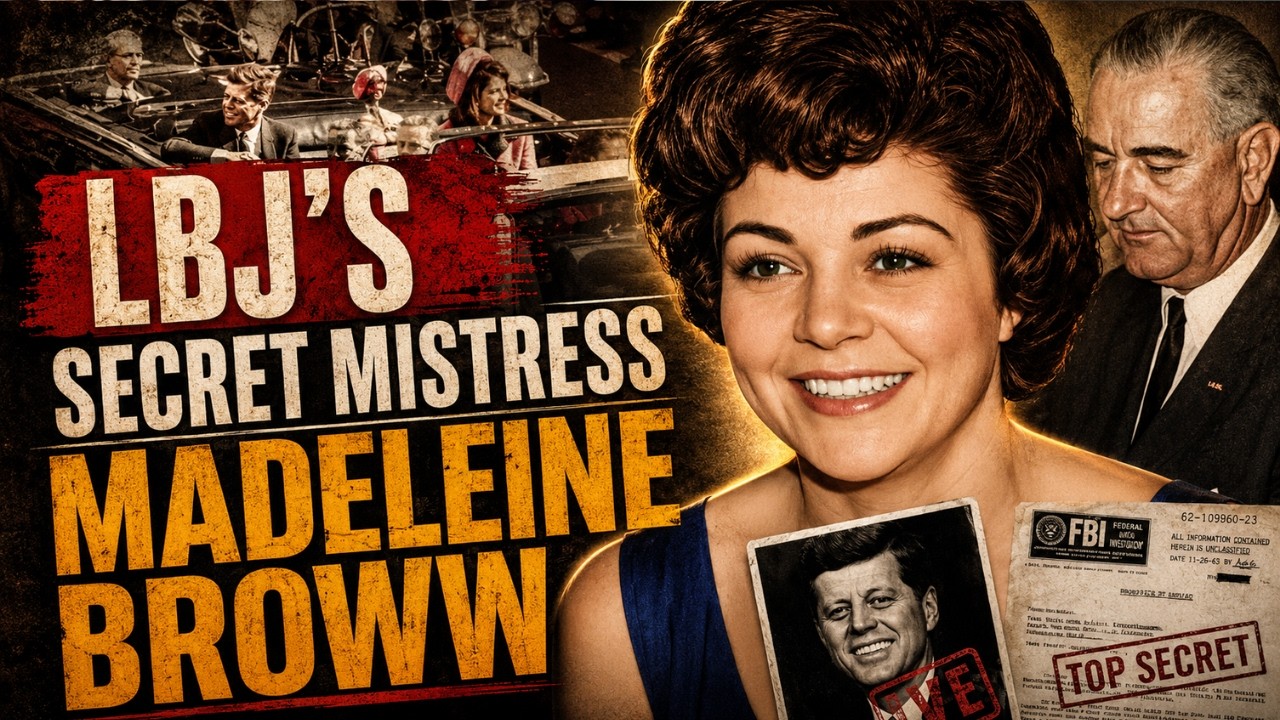
On the night of November 21, 1963, just hours before President John F. Kennedy was assassinated in Dallas, Vice President Lyndon Johnson allegedly whispered a chilling promise to his secret mistress: "After tomorrow, the Kennedy family will never embarrass me again."
The woman who heard those words was Madeleine Brown. For decades, she said she lived under constant threat from the Secret Service, forced into total silence to protect one of the most brutal political conspiracies in American history.
Madeleine Duncan Brown was born on July 5, 1925. From an early age, she possessed a personality that clashed with the strict expectations around her. She was outgoing, highly observant, and striking in appearance.
She learned early how to read people, adjusting her behavior to meet her parents' expectations while quietly nurturing a strong inner ambition. At W.H. Adamson High School, she was not merely a student but a prominent social figure.
She used her intelligence and natural charm to build strong social connections. She was articulate and quick-witted, learning how to win over both authority figures and her peers. She refined an elegant outward appearance, a skill that would later become her primary survival mechanism.
But the life she carefully built was upended at age nineteen. Madeleine married James Glynn Brown, a young man she had known since childhood. James was a former U.S. Marine.
Outwardly, the marriage aligned perfectly with the expectations of her Catholic upbringing. In reality, it was a sudden and devastating slide into chaos.
James returned from military service psychologically broken. He suffered from chronic paranoid schizophrenia and treated his terrifying internal delusions with enormous quantities of alcohol.
The man Madeleine married quickly disappeared, replaced by a volatile and dangerous stranger. Domestic violence began almost immediately. It was frequent, physical, and unpredictable.
For Madeleine, the transition from a strict but safe childhood home to a daily struggle for physical survival was psychological shock. The abuse shattered her basic sense of safety.
She lived in a state of permanent high alert, analyzing James's moods, listening for his footsteps, and trying to predict the unpredictable to avoid the next beating. The trauma permanently reshaped her psyche.
When a person falls into a spiral of severe abuse, the brain prioritizes immediate survival over long-term reasoning. Madeleine realized she was physically powerless. She realized the strict rules of her upbringing offered no protection behind closed doors.
Most importantly, chronic fear created a vast and permanent void in her life. It stripped her of her independence and left her with a desperate, unconscious desire for physical and financial security. This trauma-induced vulnerability became a core element of her personality, making her highly susceptible to individuals wielding absolute authority and total control.
The marriage reached its inevitable breaking point when James's schizophrenic condition escalated beyond the confines of their home. His delusions and violent outbursts required full medical intervention.
James was forced out of Madeleine's life and committed to a Veterans Administration psychiatric hospital for long-term intensive care. In early 1948, at twenty-three, Madeleine found herself completely alone.
The illusion of her marriage was over, and she was legally separated from her institutionalized husband. She was a single mother with full responsibility for her two-month-old son, Jimmy Glynn Brown.
The Catholic community offered her only condemnation, not salvation. She had no financial safety net, no immediate family fortune to rely on, and an infant depending on her for survival.
Desperation replaced fear. Madeleine urgently needed money, and she refused to accept any low-paying, menial work. She looked at her skills: she was articulate, highly persuasive, and knew how to attract attention.
She targeted the advertising sector. In 1948, Madeleine sought and obtained a job at the Glenn Advertising Agency. She entered the office with relentless focus, absorbing everything.
She learned the mechanics of corporate budgets, the psychology of consumer targeting, and the art of powerful persuasion. She worked longer hours than her male colleagues. She used her elegant appearance and charm to conceal a highly pragmatic work ethic, driven by survival.
Her performance at Glenn Advertising caught the attention of local radio managers. She was soon recruited by KLIF, a leading local radio station. They hired her as an advertising space buyer.
This position radically changed her life. As an advertising space buyer, Madeleine was responsible for purchasing, negotiating, and allocating commercial airtime. She suddenly controlled the budgets of major corporate advertising campaigns.
Her daily routine involved high-stakes negotiations with ambitious executives, station managers, and wealthy business owners. She excelled at it.
Madeleine discovered her natural talent for influencing deals. She knew how to seek better rates, secure the best airtime, and close agreements. She built a vast network of contacts.
Her work required attending client dinners, corporate events, and high-level meetings. The transformation was radical. In private, she was a traumatized single mother struggling to survive, legally tied to a schizophrenic husband.
In public, she was an elegant, immaculately presented media executive working at the heart of the city's communications network. She succeeded in overcoming her trauma by using her career as a protective shield.
She built a strong new identity, but this rapid rise up the professional ladder came at a steep price. Her position at KLIF put her in direct daily contact with the men who controlled the city's wealth and political machinery.
She was an attractive, prominent, but unprotected woman navigating an environment dominated by ruthless powerful men. She had carved her way out of a violent home and achieved financial independence. But in doing so, she walked directly into the crosshairs of a predator with power beyond her comprehension.
The Adolphus Hotel in downtown Dallas was the undisputed throne of power in Texas in the late 1940s. Dark wood panels, massive chandeliers, and thick cigar smoke formed the backdrop for the state's most ruthless political and business deals.
In late 1948, the Adolphus Hotel was the scene of a victory celebration that would radically change the course of Madeleine Duncan Brown's life. The guest of honor was Lyndon Baines Johnson.
Johnson had just won his seat in the U.S. Senate after a controversial and fiercely contested Democratic primary. He won by only 87 votes, a victory that earned him the mocking nickname "Landslide Lyndon."
But that night, there was no mockery at the Adolphus. There was a powerful, intoxicating scent of absolute political victory. Johnson had proven his ability to bend the system to his will, crush his opponents, and emerge unscathed. He was riding a wave of immunity.
Madeleine attended the Adolphus celebration not as a political activist but as an advertising space buyer for KLIF radio. She was there to network, secure advertising contracts, and ensure her station remained in the new senator's favor.
She was intelligent, strikingly attractive, and carried within her the toughness of a single mother who had survived a violent marriage. But the survival instinct often overlooks new and more complex forms of danger.
Lyndon Johnson was not a man who respected social boundaries. He was a physical giant who used his bulk and aggressive demeanor to dominate everyone around him, a tactic later known as the "Johnson treatment."
That night at the Adolphus, despite being accompanied by his famous mistress Alice Glass, Johnson fixed his gaze on Madeleine. The audacity of that moment was a textbook lesson in psychological domination.
He did not care that the hall was packed with journalists, donors, and political rivals. He did not care that his mistress was watching him. He saw a young, beautiful, independent woman working in his territory and decided to claim her.
Johnson approached Madeleine with a terrifying blend of charm and absolute power. He physically cornered her. He spoke in a low, conspiratorial tone, isolating her from the rest of the attendees.
This encounter triggered a complex psychological reaction in Madeleine. Her painful marriage to James Glynn Brown had left her desperately needing a protector, someone with unwavering strength and control. Johnson radiated exactly that power.
He was the opposite of the broken, volatile man she had left behind. In that brief, intense conversation at the Adolphus Hotel, the trap was set.
But a U.S. senator does not simply invite a young radio executive on a date. The machinery of power requires intermediaries to absorb the risk. This is where Jesse Kellam came in.
Kellam was a pivotal, mysterious figure in Johnson's empire. He was a trusted adviser who managed the highly profitable KTBC radio station in Austin, owned by Johnson's wife, Lady Bird Johnson. Kellam's job was to protect the senator's interests, both financial and personal.
He was a skilled fixer, operating with total secrecy and absolute loyalty. Less than a week after the Adolphus celebration, Madeleine received a phone call at her KLIF office. The caller was Jesse Kellam.
The pretext was purely professional. Kellam wanted to discuss broadcasting synergies, advertising rates, and potential cooperation between KLIF and KTBC. It was a perfect cover.
An advertising buyer in Dallas dealing with a station manager in Austin would raise no suspicion. But the content of Kellam's call was entirely illegitimate. He was probing Madeleine, assessing her discretion, and carefully laying the logistical groundwork for the senator.
Kellam established a secure communication channel and imposed the terms of their dealings. He made it implicitly clear that any relationship with Lyndon Johnson would be managed entirely on their timeline, under their rules, and in complete secrecy.
Three weeks after the first meeting at the Adolphus Hotel, the first rendezvous was arranged. The location was the Driskill Hotel in Austin.
The Driskill was Johnson's true political stronghold and operational base, where staff, security, and the flow of information were controlled. As Madeleine drove along Highway 81 from Dallas to Austin, she was crossing a threshold.
She was abandoning the fragile independence she had built at KLIF radio and heading directly into the center of gravity of a political machine. The mechanics of the relationship were cold, precise, and highly organized.
Madeleine did not enter the Driskill lobby to meet her lover. She followed Kellam's instructions. She used private entrances, took service elevators, and was escorted to a private suite away from public view.
When the door closed, the illusion of traditional romance vanished. Johnson was not looking for an equal partner. He sought her total submission.
He used his vast wealth, political influence, and overwhelming personality to undermine what remained of Madeleine's independence. The psychological siege was extremely insidious.
Lyndon Johnson understood the financial terror that haunted Madeleine as a single mother. He worked to gradually remove that terror by burying it in money and privileges.
He began transferring funds to her secretly through hard-to-trace channels. He ensured she had access to luxury goods, high-end clothing, and exclusive social circles. He provided her with a level of material comfort that a twenty-three-year-old single mother in 1948 could not have achieved alone.
But this financial safety net was a heavily fortified cage. The money was not a gift; it was a constraint. As the 1950s entered, the relationship deepened into a suffocating routine.
Madeleine's life split into two irreconcilable halves. During the day, she maintained her professional appearance in Dallas. Madeleine was a skilled and capable advertising buyer at KLIF, but her private life was entirely subject to Lyndon Johnson's political schedule.
If the senator had free time in Austin, Kellam would call. Madeleine was expected to drop everything—her work, her son, her personal plans—and drive south. If Johnson was in Washington, she waited in silence.
She was forbidden from contacting him directly. She was not allowed to mention his name publicly. She was not allowed to date other men. She was like a ghost in her own life, existing only to serve the schedule of a volatile, demanding man who viewed her as private property.
The psychological impact of this existence was profound. Madeleine was severely torn between two realities. Fear of poverty and the trauma of her first marriage drove her to seek security.
She found it in the arms of an American senator. She no longer had to worry about a medical bill for her son or her apartment rent. But the price of this security was the complete erasure of her personal freedom.
She was no longer an independent woman. Madeleine was a carefully managed asset in Lyndon Johnson's portfolio. This subjugation reached its peak in one of the strangest and most disturbing requirements of her captivity: a sham marriage.
As the relationship continued through the 1950s, Madeleine's unexplained wealth became a burden. A divorced woman living a life far beyond her radio station income was bound to attract attention.
In the highly conservative Dallas society, fueled by gossip, an unmarried woman enjoying sudden wealth was a target for investigation. Johnson's machine could not afford a scandal, so they needed a permanent, legally binding cover.
The solution devised by Johnson's aides was terrifying in its cruelty. Madeleine was ordered to marry again, but this marriage would not be real. It would be a paper screen designed specifically to divert public attention.
Through his extensive network in the Dallas business community, Johnson's operatives identified a local businessman. The details of how this man was forced into the arrangement remain secret, but the methods of Johnson's machine are well documented.
Whether through financial leverage, political blackmail, or simply an exchange of profitable favors, the businessman agreed to the terms. He and Madeleine were officially married.
They signed the papers, presented the certificates, and appeared respectable before Dallas high society. She carried his name and wore his ring. But the truth behind closed doors was entirely hollow.
They never consummated the marriage. They never lived in the same house. They never shared meals, money, or a life. The businessman was merely a cover.
If anyone asked how Madeleine could afford her lifestyle, the answer was simple: she had a successful husband. This sham marriage, lasting five years, was the ultimate embodiment of the gilded cage.
Madeleine was legally bound to a fictitious person to protect the political ambitions of a fictitious lover. She sat alone in her well-furnished home, completely isolated from any real human connection.
Her psychological isolation was absolute. She could not confide her secrets to her family for fear of their religious judgment, nor to her colleagues for fear of destroying her career. She could only talk to Kellam, the man assigned to watch her.
The tragic absurdity of the sham marriage ended years later when the businessman committed suicide, weighed down by his hidden demons and the strange nature of his existence. His death drew little attention from the men who had arranged the marriage; he was merely a discarded tool.
But for Madeleine, it was a terrifying reminder of the collateral damage caused by the men she served. By the early 1950s, the trap was fully set.
Madeleine Duncan Brown had exchanged the overt physical violence of James Glynn Brown for the covert, systematic violence of Lyndon Baines Johnson. She was financially stable and outwardly professionally successful, but she was completely besieged.
She had surrendered her identity, her freedom, and her voice. She was a silent witness in the theater of her own life, waiting by the phone for Jesse Kellam's permission to move. Then the unbelievable happened.
The tightly managed system collapsed. Severe political consequences emerged, threatening to bring down the entire empire and making Madeleine a direct target. Biological reality and political ambition cannot be reconciled.
In April 1950, the tightly organized operation around Madeleine Duncan Brown suffered a catastrophic breach. She discovered she was pregnant.
In modern politics, an extramarital relationship resulting in a child is a serious scandal, often managed through public relations teams and negotiated settlements. In the highly conservative, religiously strict Texas environment of the 1950s, it was absolute political suicide.
Lyndon Johnson was no longer just a newly elected senator. He was actively consolidating his power in Washington, building the alliances that would eventually make him Senate Majority Leader. He was already planning his path to the White House.
The existence of an illegitimate child was a fatal vulnerability. If his political opponents in Texas—an elite that included conservative Democrats and oil barons angered by his federal power grabs—discovered this pregnancy, Lyndon Johnson's political career would end immediately.
When Madeleine informed Johnson of the news, there was no emotional reconciliation, no discussion of shared responsibility, or even public acknowledgment. Johnson treated the pregnancy as a hostile tactical threat to his empire and immediately activated his crisis management network.
The primary intermediary, Jesse Kellam, was ordered to step aside. The situation required specialized skills beyond booking hotel rooms and managing radio station contracts. It required a man skilled in manipulating the legal system, concealing evidence, and enforcing permanent silence.
The operation was assigned to Jerome T. Ragsdale, a prominent and widely influential Dallas attorney who was a pillar of the Texas legal establishment and a fierce Johnson loyalist. Ragsdale did not practice the kind of law that required appearing in open courtrooms and flashy displays.
He worked behind the scenes, through civil litigation, property transfers, and secret settlements. Ragsdale was a master intermediary. When Ragsdale took charge of Madeleine's case, he implemented a harsh, multi-faceted containment strategy.
The first objective was falsifying the legal record. Stephen Mark Brown was born in December 1950. A man with Ragsdale's influence could easily bypass hospital protocols of the time.
When it came time to fill out the birth certificate, the biological truth was erased. Ragsdale ensured the document legally established paternity as James Glynn Brown, Madeleine's former husband, who was severely schizophrenic and institutionalized. It was a calculated, legally sound maneuver.
Because James was confined to a Veterans Administration psychiatric ward, he was completely incapable of contesting paternity. He was a ghost, repurposed by Johnson's machine as a permanent legal shield.
The second objective was material containment. Johnson could not allow his mistress and illegitimate son to live in fragile financial conditions, where desperation might lead to exposure. Ragsdale was authorized to invest substantial sums to ensure Madeleine's silence and compliance.
He bought her a house in South Winnetka, a quiet, upscale Dallas neighborhood. The property cost $15,000, a significant sum in 1950, representing solid middle-class stability. It was a spacious six-room house, designed to provide Madeleine comfort and keep her out of sight.
But Ragsdale did more than real estate. He established an untraceable financial channel. He provided Madeleine with a full-time live-in maid to help with childcare and issued her a series of credit cards with instructions to cover her living expenses indefinitely.
This financial structure was not an act of generosity. It was an advanced form of blackmail. Ragsdale made the terms clear. The only non-negotiable condition was Madeleine's provision of care and her absolute silence about Stephen's father's identity.
Ragsdale exploited this void to establish a second layer of protection. He began visiting the South Winnetka house regularly, presenting himself to the neighbors, and then to young Stephen, as a surrogate father figure.
He was the one who brought gifts, handled home maintenance, and provided an outward appearance of male stability for the family. By directly involving himself in the family dynamic, Ragsdale ensured close, constant surveillance of Madeleine.
He monitored whom she spoke to, where she went, and how she handled pressure. He was in charge of her new life. Madeleine's psychological reality during the 1950s and 1960s was bleak.
She was a mother raising a child on a foundation of lies. Every significant event in Stephen's life—his first steps, his first days of school, his birthdays—was overshadowed by her prohibition against telling him the truth.
She had to teach her son to call the corporate lawyer "Uncle Jerome" or accept him as a father figure, while the man who actually fathered him was rapidly ascending to the highest levels of global power. As Lyndon Johnson's influence grew, the risks of Madeleine's silence multiplied.
When Johnson became Vice President under John F. Kennedy in 1961, the scrutiny surrounding him intensified. The Secret Service, the FBI under J. Edgar Hoover, and the national press became integral parts of his life.
For Madeleine, this meant containment protocols became stricter. Physical meetings with Johnson became increasingly rare and significantly more dangerous. They no longer met in easily accessible hotels.
Logistical arrangements required military-level precision, often involving secure private residences and tightly vetted transportation. Despite the physical distance, the specter of ruin did not fade.
Madeleine watched Lyndon Johnson on television, managing the Cuban Missile Crisis, the escalating conflict in Vietnam, and the raging domestic battles over civil rights. She knew the man commanding the U.S. armed forces was the same man who had orchestrated the erasure of her son's identity.
The power imbalance was so immense that the idea of rebellion was practically impossible. If she dared to speak, she would not just be fighting politically; she would be fighting the executive power of the United States government.
The shift in their physical relationship did not come from a political scandal or a change of heart, but from a harsh physical shock. In 1967, Madeleine was in a horrific car accident.
Her son Stephen, then a teenager, was driving. The accident was catastrophic. Madeleine suffered severe injuries requiring long hospital stays and extensive physical rehabilitation.
The accident radically changed her outlook on life. Facing death shattered her remaining illusions about her relationship with Johnson's political machine. She realized with terrifying clarity that if she had died in that accident, Stephen would have been left completely alone, legally tied to a woman with schizophrenia, and entirely dependent on Jerome Ragsdale's cold, interest-based goodwill.
The physical weakness she endured during her recovery ended what remained of their relationship. The logistical nightmare of arranging meetings with a sitting president, combined with her limited physical capabilities, effectively ended the intimate side of her relationship with Lyndon Johnson.
Their last face-to-face meeting occurred two years later, in 1969. Lyndon Johnson was no longer president. He had chosen not to seek re-election in 1968, after the extremely low popularity of the Vietnam War and his rapidly deteriorating health forced him from office.
The meeting was held at the Shamrock Hotel in Houston. The dynamic had completely changed. The imposing political giant who had cornered her in 1948 was gone. In his place was a physically exhausted man facing his own mortality.
The conversation at the Shamrock was not a cinematic reconciliation. It was a quiet termination of a twenty-year covert operation. There were no grand apologies for erasing their son's identity, no dismantling of the legal lies Jerome Ragsdale had built.
The financial arrangements remained in place, and the demand for silence remained binding. They parted at the hotel, aware that the structure they had built to protect his career would outlast them both.
Four years later, the last link between them was severed. On January 22, 1973, Madeleine received a phone call from Jesse Kellam. More than two decades had passed since Kellam first called her KLIF office to arrange the first meeting at the Driskill Hotel.
His tone was brief, matter-of-fact, and devoid of emotion. Lyndon Baines Johnson had suffered a severe heart attack at his Stonewall, Texas ranch. He was dead.
For Madeleine, the news did not bring immediate liberation. The architect of her silence was gone, but the machine he built, the falsified records, the financial dependencies, and the ingrained psychological fear remained fully operational.
She was a woman in her late forties carrying a secret still capable of destroying an American president's legacy. The physical relationship was over, but the true burden of silence had only just begun.
To understand the magnitude of the silence Madeleine carried into the 1970s, one must go back a decade. The final link binding her to Lyndon Johnson was not forged in a hotel room, but amid the raging political conflict in Dallas on the eve of the darkest days of the Kennedy administration.
By the fall of 1963, the political climate in Dallas, Texas, was extremely volatile. The city was not only conservative but openly hostile to the federal government, specifically the administration of President John F. Kennedy.
The gravity of Madeleine Duncan Brown's claims about the night of November 21 can only be estimated in light of the intertwined power forces in Texas. These factions viewed the Kennedy brothers not merely as political opponents but as an existential threat.
The hostility was driven by three distinct factions, all wielding immense influence in Texas. First, the independent oil barons, led by men like H.L. Hunt and Clint Murchison. These men had amassed enormous fortunes thanks to the oil depletion allowance, a tax loophole the Kennedy administration sought to eliminate.
For the oilmen, John Kennedy's economic policies represented a direct attack on their empires. Second, the intelligence and law enforcement apparatus. FBI Director J. Edgar Hoover viewed the Kennedy brothers, especially Attorney General Robert F. Kennedy, with deep contempt.
Robert Kennedy bypassed Hoover's protocols, waged fierce campaigns against organized crime, and exerted unprecedented control over the Justice Department. Hoover, who had ruled the country as an untouchable autocrat for decades, found his power actively undermined by men he considered arrogant upstarts.
Third, the criminal underworld. Organized crime syndicates were said to have helped the Kennedy campaign win crucial states like Illinois during the extremely close 1960 election. In return, they expected a lenient Justice Department.
Instead, Robert Kennedy declared all-out war on the Mafia, deporting its leaders and launching relentless prosecutions. The sense of betrayal among mob leaders was absolute.
At the heart of this volatile system was Vice President Lyndon Baines Johnson. By November 1963, Johnson faced political oblivion.
His influence in the Senate had been neutralized by the vice presidency, a role he hated for its powerlessness. Worse, he was mired in two massive escalating scandals involving close associates: the Bobby Baker financial corruption case and the Billy Sol Estes agricultural fraud case.
Congressional investigations were tightening the noose around him, and rumors spread that John F. Kennedy was planning to drop Johnson from the Democratic ticket in 1964. For Johnson, a man whose entire psychological system was built on acquiring and exercising absolute power, the prospect of being driven out of Washington in disgrace was unbearable.
He was cornered, desperate, and running out of time. This was the immense pressure facing President Kennedy on November 22. Ostensibly, it was a trip to unite the fractured Democratic Party in Texas.
In reality, he was walking straight into hostile territory. On the evening of November 21, less than 12 hours before the president's motorcade passed through Dealey Plaza, Madeleine Brown attended a private gathering.

According to her detailed testimony given decades later, the meeting was held at the sprawling Dallas mansion of Clint Murchison, the aforementioned oil baron. The stated purpose of the party was to honor FBI Director J. Edgar Hoover and his close aide Clyde Tolson, who were reportedly visiting Texas.
But the guest list, as Madeleine noted, transformed the gathering from an elegant social occasion into an unprecedented assembly of Kennedy's fiercest enemies. Madeleine was 38 at the time.
She had spent the past fifteen years dealing with the highest levels of power in Texas. As Lyndon Johnson's secret mistress, she knew the personalities and faces and knew how to read the mood of a room.
When she entered the Murchison mansion, the atmosphere was not celebratory. It was tense and cold. She recognized the attendees immediately.
Among them was H.L. Hunt, the eccentric billionaire who generously funded anti-Kennedy propaganda across the South. There was George Brown of Brown & Root, the massive construction company that had financed Lyndon Johnson's entire political career and relied heavily on federal military contracts.
Present was John J. McCloy, a senior Wall Street figure, former World Bank president, and a pivotal figure in the military-industrial complex. Most surprisingly, Madeleine noted the presence of Richard Nixon, who had recently lost the California governor's race and was representing Pepsi-Cola in corporate legal affairs.
Also present, among corporate titans and intelligence directors, were men Madeleine described as high-level representatives of organized crime. The presence of these disparate factions—Wall Street, Texas oil, the FBI, and the Mafia—in one room was anomalous and terrifying.
In the normal American system, these groups maintain strict boundaries, interacting only through intermediaries. Their meeting at the Murchison home suggested a convergence of interests that defied normal political behavior.
Only one common denominator united them: an urgent, powerful desire to remove the Kennedy administration from power. The party continued quietly and calmly until late in the evening. Then the turning point came suddenly.
At around 11:00 p.m., Vice President Lyndon Johnson arrived. According to Madeleine, Johnson did not come to socialize. His arrival instantly changed the room's atmosphere.
He bypassed the usual pleasantries and headed quickly toward a closed office. As he moved, the prominent figures in the room broke off their conversations and followed him. Hoover, Tolson, Murchison, Hunt, McCloy, Nixon, and others entered the room behind the vice president.
The heavy wooden doors closed, shutting out the rest of the guests. For Madeleine, standing in the ornate hallway, the psychological weight of that closed door was crushing. She understood the mechanics of power better than almost anyone outside that room.
Men of this level did not meet secretly late at night on the eve of a presidential visit to discuss trivial matters. They only met if a fateful decision required final consensus.
She stood in the Murchison mansion, an experienced observer, watching an immense mass of wealth and lethal capabilities isolate itself. The meeting was not short. It extended late into the night.
The silence in the office contrasted sharply with the whispers of the remaining guests. Madeleine waited. Her fifteen-year relationship with Lyndon Johnson imposed its own conduct.
She did not leave until she was permitted to. She had to wait for him to exit. When the doors finally opened, the change in Lyndon Johnson was clear and immediate.
He did not display the polished, imposing confidence of a seasoned politician. He appeared in a state of extreme agitation. Madeleine noticed his face was deeply flushed, radiating an angry red color.
His movements were twitchy, tense with a rush of adrenaline he was struggling to suppress. He looked like a man who had just crossed a point of no return. He spotted Madeleine and walked directly toward her.
He did not greet her. He reached out and grabbed her arm. His grip was not a gentle gesture of affection. It was brutal.
His fingers dug deep into her body, a physical manifestation of the immense internal pressure he was under. He leaned in, bringing his face close to hers, ensuring his words were directed at her alone, but he spoke in a sharp tone that made his voice tremble.
He looked directly into her eyes and uttered a sentence that would echo throughout her life, a phrase she would later swear to on national television under extreme pressure and legal threat. "After tomorrow, those damn Kennedys will never embarrass me again. That's not a threat. That's a promise."
He did not elaborate. He did not wait for a response. He released her arm, turned, and rushed out of the Murchison mansion surrounded by his guards, disappearing into the Dallas night.
Madeleine stood frozen in the hallway. The physical pain in her arm faded against a sudden, paralyzing clarity. Lyndon Johnson's words were not merely a passing venting of a frustrated politician.
Men like Johnson did not make promises they could not keep. He had just emerged from a room containing the financial and operational capital necessary to dismantle a government. She left the party shortly afterward, returning to her home in South Winnetka.
The city of Dallas was asleep, quietly awaiting the president's arrival the next morning. But for Madeleine Brown, the night of November 21 was not over. It stretched into a suffocating, terrifying dawn.
She realized with the cold certainty of an insider that some mechanism had been activated. She did not know the logistical details, the operatives, or the exact timeline. But she knew the intent.
As the Texas sun rose on the morning of November 22, 1963, Madeleine Duncan Brown sat in her silent home watching the clock, waiting for the previous night's promise to be violently fulfilled. At exactly 12:30 p.m. on November 22, 1963, the political reality of the United States violently collapsed in Dealey Plaza.
Three shots rang out amid the cheers of Dallas crowds. President John F. Kennedy's motorcade, meant to be a triumphant display of Democratic unity, turned into a chaotic crime scene in an instant. Within 30 minutes, the president was declared dead at Parkland Memorial Hospital.
For the American people, it was an unbelievable national tragedy. For Madeleine Duncan Brown, sitting in her South Winnetka home, it was the terrifying execution of a promise made to her. News broadcasts interrupted regular programming, sending shockwaves across the country.
As Madeleine watched the black-and-white images of panic in downtown Dallas, the words Lyndon Johnson had said to her just 13 hours earlier echoed in her mind with terrifying clarity. He had stood in the Murchison mansion hallway, his face flushed with adrenaline, and vowed that the Kennedys would never embarrass him again.
Hours later, aboard the crowded, stifling cabin of Air Force One, Lyndon Baines Johnson raised his right hand and took the oath of office. Surrounded by a blood-stained Jacqueline Kennedy and a group of ashen-faced Texas loyalists, the transfer of power was immediate and decisive.
The man who had secretly controlled Madeleine's life for fifteen years, the man who had forced her to hide their biological son behind falsified legal documents, was now the 36th President of the United States. He now commanded the military, the intelligence agencies, and the entire federal government.
For Madeleine, the fear she had lived with since 1948 turned into paralyzing terror. She was no longer just the mistress of a powerful senator. She was a witness to the prelude of a presidential assassination.
She carried a secret that, if exposed, would not only end a political career but ignite a constitutional crisis and potentially tear the country apart. She waited in silence amid the chaos following the assassination.
She watched Lee Harvey Oswald, the accused lone assassin, presented to the press. She watched how the narrative of a deranged communist sympathizer quickly spread across all major media. Two days later, she watched Jack Ruby emerge from a crowd of journalists in the basement of Dallas police headquarters and shoot Oswald dead on live television.
The public saw a grieving nightclub owner seeking revenge. Madeleine saw a desperate cover-up carried out by a man she knew personally. Dallas was a big city, but its circles of power and vice were very small.
Madeleine's position in the media, along with her luxurious lifestyle funded by the Johnson machine, made her familiar with the city's nightlife. She knew Jack Ruby. The Carousel Club, Ruby's burlesque nightclub, was a known hub where local police, politicians, and underworld figures mixed.
According to Madeleine's later testimony, her knowledge of the conspiracy did not begin at the Murchison party. There were hints weeks earlier. In the fall of 1963, she claimed she was at the Carousel Club and witnessed a quiet, intense meeting between Jack Ruby and Lee Harvey Oswald.
Furthermore, she asserted she heard Ruby openly bragging about Oswald's shooting skills, specifically referring to a failed assassination attempt targeting General Edwin Walker, a right-wing Dallas figure, earlier that year. At the time, she considered it routine underworld bragging in Dallas.
But after watching Ruby silence Oswald on national television, the full picture became clear. The Mafia, local police connections, intelligence operatives, and the oil barons at the Murchison estate were all moving parts of a single machine, and Lyndon Johnson was driving it.
The terrifying confirmation of this fact came a month later. On New Year's Eve, December 31, 1963, Madeleine received the call she dreaded. It was time for a meeting.
The location was the Driskill Hotel in Austin, the same building where their secret relationship began fifteen years earlier. But the situation had completely changed. The Driskill was now heavily fortified by the U.S. Secret Service.
When Madeleine was escorted to the private suite, she was not facing the hostile vice president she had met in November. She was facing the Commander-in-Chief. The tension in the room was suffocating.
Madeleine, driven to the brink of a nervous breakdown by a month of silent terror, finally broke protocol. She bypassed pleasantries and confronted him directly. She asked if he was responsible for what happened in Dealey Plaza.
Johnson's response, as Madeleine later recounted, was devoid of any defensive anger. It was a cold, calculated admission. He did not claim to have pulled the trigger, nor did he claim to have laid out the operational blueprints. He confirmed the general architecture of the coup.
He looked at her and stated plainly that the assassination was orchestrated by Texas oil interests and rogue intelligence operatives in Washington. He acknowledged that the forces that despised Kennedy had united, and that he had stepped aside, allowing the execution to proceed to fill the power vacuum.
This confirmation on New Year's Eve completed the construction of Madeleine's invisible prison. By admitting his complicity, Johnson tied a tight knot around her neck. He was implicitly telling her: "You know the truth. You know who did it. And you know what happens to those who become a burden."
From 1964 onward, Madeleine's life became a severe test of psychological endurance. She was raising her teenage son, Stephen, who grew increasingly curious about his origins, and his "Uncle Jerome" Ragsdale, the lawyer who continued to manage their financial affairs.
The flow of cover-up money continued. The South Winnetka house was paid off. The credit cards remained active, but the money now carried a completely different weight. It was blood money.
It was a monthly reminder that she was being paid to cover up the assassination of an American president. The Johnson administration moved forward, escalating the Vietnam War and passing historic civil rights legislation. Johnson was reshaping the world.
Meanwhile, Madeleine watched her own world shrink. She lived in a state of acute paranoia. She noticed cars parked for long periods on her street. She heard strange clicks and echoes on her phone line.
Whether she was actually under constant surveillance by federal agents or simply suffering from the profound psychological trauma of her situation, the result was the same. She was besieged.
Her fear was constantly reinforced by the external reality of the 1960s and 1970s. People surrounding the John Kennedy assassination began dying. It was a slow, systematic attrition of witnesses, journalists, and operatives.
Jack Ruby died in prison from a sudden, aggressive cancer before he could be retried. George de Mohrenschildt, a pivotal figure in Oswald's life, committed suicide just hours before his scheduled appearance before the House Select Committee on Assassinations. Dozens of secondary figures died under violent or suspicious circumstances.
Madeleine watched the body count rise. She realized her survival depended entirely on her absolute insignificance in the public narrative. If she made any noise, tried to contact a journalist, or told her son the truth, she would become just another number in the tragic, mysterious statistics of the Dallas police files.
She withdrew. She focused entirely on Stephen. She clung to the lie that his father was James Glynn Brown, confined to a psychiatric hospital. She played the role of the quiet, respected media professional.
Even after Lyndon Johnson's death in January 1973, she did not collapse. The system he built was too vast, and the operatives who executed the 1963 conspiracy—the intelligence officers and oilmen—were still alive and in control.
The 1970s stretched into the 1980s. The world moved past the Kennedy assassination, relegating it to the realm of historical debate and conspiracy theories. The Warren Commission issued its massive, heavily redacted report, officially declaring Oswald the lone assassin.
The government closed the file. Madeleine Duncan Brown reached her sixties. The traumas of her life—her abusive first marriage, her suffocating 15-year relationship with a political giant, the burden of her hidden son, and the immense weight of the November 21 secret—had taken a severe physical toll.
She had survived the predators of Dallas by staying completely out of sight. But silence that lasts too long becomes poison. It corrodes the soul.
She was approaching the end of her life, and the son she had fought so hard to protect was now an adult still living inside the fiction Jerome Ragsdale had designed in 1950. The machine of power had won every battle.
It had stripped her of her youth, her independence, and her truth. But as the 1980s progressed and her health rapidly deteriorated, Madeleine realized she possessed one final lethal weapon against Lyndon Baines Johnson's legacy. She had nothing left to lose.
The invisible prison was about to collapse. Secrets of immense importance do not simply fade; they fade with time. For more than three decades, Madeleine Duncan Brown carried the burden of a secret presidential relationship, a falsified paternity, and terrifying foreknowledge of a presidential assassination.
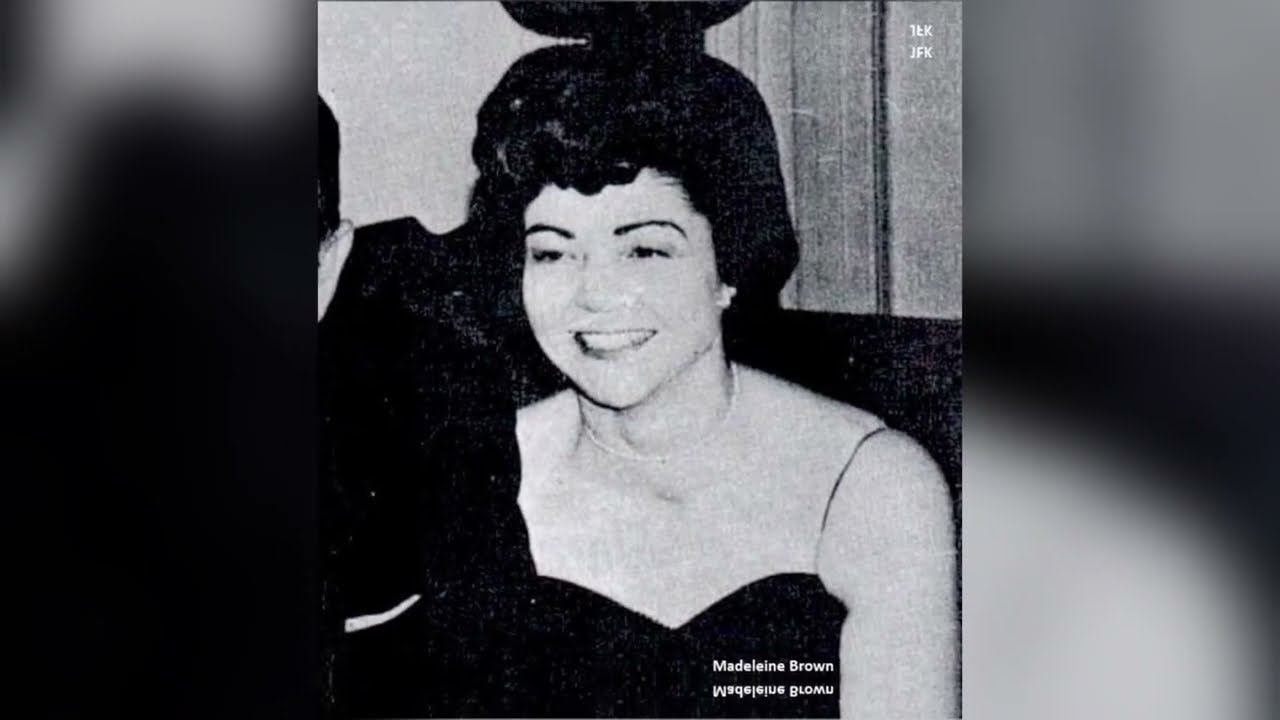
She absorbed the paranoia, the constant surveillance, and the implicit threat of Johnson's political machine. But the human body is not designed to withstand this level of chronic psychological stress indefinitely. Eventually, it takes a physical toll.
By the mid-1980s, Madeleine's health began to deteriorate. The polished media executive who had navigated the treacherous Dallas high society was now an aging woman suffering from severe heart deterioration. She had spent her adult life calculating her odds of survival, maintaining silence to protect her son, Stephen Mark Brown, from the lethal collateral damage of the men who controlled Washington.
But survival is a finite game. In February 1987, her patience ran out. Madeleine suffered a severe heart attack. She was rushed to the hospital and placed in intensive care, where she faced the bitter reality of her mortality.
Doctors gave a grim prognosis. Believing she had only days, perhaps hours, left, her priorities changed radically. The fear of Lyndon Johnson's retaliation, which had controlled her every move since 1948, was suddenly overshadowed by a much deeper, instinctive fear.
She had taken the truth to her grave, leaving her son imprisoned by a fabricated lie. She summoned Stephen to her hospital bedside. Stephen was 36 years old at the time.
His entire life had been shaped by legal maneuvers and deliberate concealments. He grew up believing his father was James Glynn Brown, a former U.S. Marine with severe schizophrenia, whom he never knew. He grew up under the financial supervision of Jerome Ragsdale, the influential Dallas attorney who acted as a stern, distant uncle.
Stephen's life was a puzzle missing its essential pieces. In that sterile hospital room, struggling to breathe, Madeleine finally detonated the lie. She looked at her son and unveiled the cover-up that had lasted 36 years.
She explained the Adolphus Hotel, the Driskill Hotel meetings, and the mechanics of Johnson's machine. She told him that James Glynn Brown was merely a name on a piece of paper, a convenient ghost exploited by the political elite. She told him his biological father was Lyndon Baines Johnson, the 36th President of the United States.
For Stephen, the revelation was a psychological earthquake. The acknowledgment did not bring him peace of mind. It revealed an infuriating truth.
The sudden flow of wealth during his childhood, the mysterious presence of Jerome Ragsdale, and the strange, isolated nature of his mother's social life all suddenly made sense. But this clarity came with a profound sense of theft. He realized his identity, his inheritance, and his basic right to know his parentage had been stolen to protect the political ambitions of a man who refused to acknowledge his existence.
Stephen Mark Brown did not quietly surrender. He erupted in immense anger, like a man who discovered his entire life was a carefully orchestrated operation. He decided to fight back.
He chose the Texas legal system as his battlefield. In 1987, after Madeleine miraculously survived the heart attack and began a slow recovery, Stephen filed a stunning $10.5 million lawsuit against the Lyndon Johnson estate, based on his mother's deathbed confession.
The primary defendant in the suit was Lady Bird Johnson, the former First Lady and fierce guardian of Johnson's legacy. But the lawsuit went further, legally outlining the details of the conspiracy.
Stephen formally accused Lady Bird, along with senior Johnson aides, specifically Jesse Kellam and Jerome Ragsdale, of orchestrating a decades-long conspiracy to deprive him of his rightful inheritance. The suit demanded a full disclosure of the estate and, most importantly, a court-ordered DNA test to conclusively prove paternity.
The lawsuit was a direct attack on one of the most powerful political families in American history. Stephen was not just demanding money. He was demanding historical recognition.
He was demanding the American legal system force the Johnson machine to acknowledge what it had done in secret. The moment the lawsuit was filed, the containment protocols Madeleine had feared for decades were breached. The secret was out.
Realizing she was now fully exposed and that her son had become a target of a ruthless legal and political establishment, Madeleine made a tactical decision. She could no longer rely on the shadows for protection. Her only defense was absolute transparency.
If she was going to be targeted, she would ensure the entire world was watching. Madeleine Duncan Brown stepped into the national spotlight. In 1988, she made her television debut on the nationally syndicated program "American Exposé" in an episode titled "Who Killed John Kennedy?"
She did not just confirm Stephen's lawsuit. She dramatically escalated the narrative. For the first time, the American public heard the harrowing account of the Murchison party on November 21, 1963.
She detailed the meeting of oil barons, mob figures, and intelligence operatives. She looked directly into the camera and recounted Lyndon Johnson's promise that the Kennedy family would never embarrass him again. Her appearance caused a shockwave in historical and media circles.
She followed it with interviews on "A Current Affair" in 1992, refusing to retract her claims. She was articulate, composed, and utterly candid. She did not appear to be a deranged conspiracy theorist.
She appeared as she was: a seasoned figure who had survived the brutality of Texas politics. But public opinion is fundamentally different from a court of law.
While Madeleine dominated television screens, Stephen was being systematically dismantled in the legal arena. The Johnson estate did not panic publicly. It responded with overwhelming efficiency and unlimited legal capital.
It mobilized an army of prominent lawyers who immediately began strangling Stephen's lawsuit through procedural motions, jurisdictional challenges, and demands for evidentiary standards impossible for a man born under a cover-up to meet. The legal strategy of the Johnson heirs was not to prove Lyndon Johnson was not the father, but to ensure the case never reached a courtroom where Stephen could compel a DNA test.
They weaponized the legal system against him. The lawsuit dragged on for two exhausting years. Stephen, lacking the immense financial resources of the Johnson heirs, found himself drowning in legal fees and administrative hurdles.
In 1989, the Texas legal system issued its ruling. The $10.5 million lawsuit was abruptly dismissed. The official reason cited by the judge was Stephen's failure to appear.
It was a baffling and deeply unsatisfying conclusion. Stephen's legal representation had faltered. Procedural obstacles became insurmountable, and the court effectively threw out the case without addressing the merits of the paternity claim.
The Johnson heirs had successfully maintained their legal position. Lady Bird Johnson was never forced to answer a single question under oath. The dismissal was a severe blow, but Stephen refused to give up.
Stephen began preparing a new legal strategy, determined to refile and aggressively demand a DNA test to bypass the procedural hurdles. DNA analysis technology was advancing rapidly in the late 1980s, becoming an indisputable biological record.
Stephen realized that if he could force the test, the entire Johnson empire would be forced to rewrite its history. But the Johnson machine, whether by fate or covert intervention, was never forced to face that test.
In 1990, while Stephen was regrouping for a second legal assault, he fell ill. What began as mild fatigue quickly turned into a catastrophic health crisis. He was diagnosed with lymphoma.
Cancer is unpredictable, but the speed at which Stephen Mark Brown's disease progressed was astonishing. It did not develop; it exploded. Within weeks of the diagnosis, it had engulfed his body.
The man who had spent three years fiercely fighting the most powerful estate in Texas suddenly found himself bedridden in a hospital, physically exhausted. Before any new lawsuits could be filed, before any biological samples could be secured for future DNA analysis, and before the public could fully grasp the implications of his case, Stephen Mark Brown died. He was 39 years old.
The timing of his death seemed highly convenient to objective observers. To those who understood the lethal capabilities of the forces Madeleine had pointed to, it was deeply suspicious. Stephen's sudden, severe illness had eliminated the greatest biological threat to Lyndon Baines Johnson's legacy.
With Stephen's death, the demand for a DNA test died with him. The legal right to sue the estate evaporated. The physical evidence in the case was erased forever. Madeleine Duncan Brown was left completely alone.
She had finally broken her silence. She risked everything to give her son his true identity, and the result was total devastation. The legal system crushed their lawsuit in a fierce, suspicious illness that claimed her son's life.
The invisible cage she had lived in for 40 years was shattered. But the forces outside the cage proved to be just as lethal as she had always feared. The empire had protected itself, leaving Madeleine with only her memories, her deceased son, and a story the establishment was determined to discredit.
Stephen Mark Brown's death in 1990 removed the physical evidence for Madeleine Duncan Brown's claims, but it did not silence her. Grief did not force her back into the shadows. It transformed her into a weapon.
With the freedom of a woman who had lost everything, she decided to bypass the legal system entirely. If the courts would not validate her truth, she would take it directly to the public. In 1997, Madeleine self-published her memoir, "Texas in the Morning," the story of her love affair with President Lyndon Baines Johnson.
The decision to self-publish was not merely a commercial choice. It was a tactical necessity. Major publishing houses employ strict legal and fact-checking departments, especially when a manuscript accuses a former U.S. president of orchestrating the assassination of his predecessor. Madeleine bypassed this institutional barrier.
The resulting book was a highly sensational, unedited account of her life. It delivered exactly what the growing conspiracy community demanded: a clear narrative, a known villain, and a definitive quote that perfectly aligned with their pre-existing suspicions of Lyndon Johnson. The memoir cemented her status as a martyr in fringe historical circles.
She became a highly sought-after speaker at John Kennedy assassination symposiums. Audiences listened, captivated by the articulate, elegantly dressed older woman who spoke with established authority as an informed Texas insider. But television interviews and self-published memoirs are tightly controlled environments.
They are one-way broadcasts. When Madeleine's claims were finally subjected to rigorous, multi-directional scrutiny by independent historians, investigative journalists, and legal scholars, the structure of her story began to collapse. The collapse of her narrative did not come from government pressure. It emerged from the cold, hard reality of the documented historical record.
The first major blow to her credibility was the core of her story: Stephen Mark Brown's paternity and the timeline of her confession. Madeleine's central claim on national television was that Stephen lived his entire life in ignorance, believing James Glynn Brown, confined to a psychiatric hospital, was his father.
She swore she only broke down during a near-fatal heart attack in February 1987, finally revealing that Lyndon Johnson was his biological father, prompting Stephen to file an immediate $10.5 million lawsuit. But the legal archives of Dallas County revealed a very different story.
Independent researchers found the files of Brown v. Crockett, a probate lawsuit filed in 1980. The plaintiff in this case was Stephen Mark Brown, while the estate of Jerome T. Ragsdale, the wealthy Dallas attorney and close Lyndon Johnson associate who served as Stephen's uncle and financial guardian, was the defendant. Ragsdale had died in 1978.
In a lawsuit filed in 1980, seven years before Madeleine's alleged deathbed confession, Stephen filed a legal petition asking the court to recognize him not as the son of President Lyndon Johnson, but as the son of Jerome T. Ragsdale. Stephen's legal papers explicitly asserted that Ragsdale was his true father and presented witnesses, including family members, who testified that Ragsdale had secretly acknowledged the boy as his own.
Stephen filed this lawsuit in a direct attempt to claim a portion of Ragsdale's substantial estate. This documented legal maneuver demolished Madeleine's 1987 narrative, proving that Stephen was not a naive son surprised by a deathbed confession, but had been exploiting his ambiguous paternity to claim inheritance years earlier. When the Ragsdale lawsuit failed to yield the desired financial outcome, the target shifted to a larger, more lucrative estate: that of Lyndon Johnson.
The discovery of the 1980 lawsuit recast the 1987 Lyndon Johnson lawsuit from a quest for truth into a calculated, opportunistic pursuit of capital. The second blow, equally devastating to Madeleine's credibility, destroyed the most sensitive element of her public persona.
On November 21, 1963, at the Murchison mansion, Madeleine had staked her reputation on her claim that she saw Johnson enter a closed meeting with Richard Nixon, Edgar Hoover, and Texas oil barons in Dallas at 11:00 p.m., emerging to declare his intention to destroy the Kennedy administration. Assassination researchers, relying on primary source documents rather than testimony, reconstructed Vice President Johnson's movements precisely on the night of November 21.
The timeline was not in dispute. It was meticulously documented through White House records, Secret Service schedules, local press reports, and photographic evidence. On the evening of November 21, Lyndon Johnson was not in Dallas. He was in Houston.
Johnson attended a dinner at the Rice Hotel in Houston with President Kennedy. After dinner, the two men attended a massive rally at the Sam Houston Coliseum. They did not leave Houston until after 10:00 p.m.
Air Force Two, carrying the vice president, landed at Carswell Air Force Base in Fort Worth at exactly 11:07 p.m. After landing, Johnson traveled in a motorcade to the Texas Hotel in downtown Fort Worth. He was extensively photographed arriving at the hotel at 11:50 p.m., where he spent the night.
Fort Worth is approximately 35 miles from Dallas. It was practically, geographically, and logistically impossible for Lyndon Johnson to attend a secret meeting at Clint Murchison's Dallas home at 11:00 p.m. Furthermore, the supporting cast for this alleged meeting disintegrated under scrutiny.
Official FBI travel records confirmed Director J. Edgar Hoover and Clyde Tolson were in Washington, D.C., on November 21. Clint Murchison Sr., the supposed host of the party, had suffered a severe stroke and was living quietly in East Texas, far from the Dallas social scene. In fact, the Dallas property Madeleine described belonged to Murchison's son, John, and his wife, Lupe.
When questioned, Lupe Murchison vehemently denied hosting any such party on the eve of the assassination. Val Imm, the meticulous society editor of the Dallas Times Herald, who dedicated her career to tracking the city's elite gatherings, confirmed there was no record, rumor, or trace of a party at the Murchison home that night. Historians concluded that Madeleine may have conflated another elite gathering, perhaps one she attended years later in 1969, with the assassination timeline to insert herself into the center of the historical narrative.
The final blow to Madeleine's public standing was not historical. It was criminal. In November 1992, at the height of her media fame, Madeleine Duncan Brown was charged with forgery and tried in Texas.
She was accused of altering the will of a deceased elderly relative in a blatant attempt to seize his estate. The trial was short and harsh, with prosecutors presenting evidence showing a clear pattern of financial manipulation. The jury convicted Madeleine, and she was sentenced to ten years in prison.
In 1994, an appellate court overturned the conviction based on a precise legal technicality, ruling that the prosecution had failed to prove Madeleine held the pen that forged the signature, even if she had orchestrated the scheme. The damage was permanent. She was utterly discredited, no longer viewed by mainstream media and the historical establishment as a whistleblower.
She was a legally recognized fraud with a documented history of exploiting probate courts for financial gain. Madeleine Duncan Brown spent the final years of her life largely marginalized. She continued to give sporadic interviews to fringe media, refusing to retract a single word of her story.
She remained defiant until her death on June 22, 2002. She died with her claims thoroughly debunked by the establishment, yet highly respected by those who believed the establishment was exactly what she was fighting against. The legacy of Madeleine Duncan Brown requires separating factual accuracy from historical utility.
Under the harsh light of rigorous objective investigation, her narrative collapses. The timelines do not align, the legal records contradict her motives, and the physical impossibility of her claims renders them historically void. She was not the secret key to unlocking the Kennedy assassination mystery.
Yet her story persists precisely because it brilliantly reflected the deep irony of American public opinion. People wanted to believe her because the man she described—a ruthless, power-obsessed politician willing to sacrifice anything and anyone to ensure his dominance—perfectly matched the darkest public suspicions about Lyndon Johnson and the rampant corruption of the 1960s. Madeleine Brown may have fabricated the details of the crime, but the psychological portrait she painted of unchecked political power, absolute intimidation, and the devastating collateral damage inflicted on those caught in its wake remains an accurate and terrifying reflection of that era.