Newly resurfaced testimony from the late Major Richard “Dick” Winters has reignited one of the most debated questions in World War II history: did Lieutenant Ronald Speirs, the legendary Easy Company officer immortalized in “Band of Brothers,” execute unarmed German prisoners of war? Winters, the decorated commander of Easy Company, 506th Parachute Infantry Regiment, 101st Airborne Division, confirmed in a previously recorded interview that Speirs personally admitted the stories were true, a revelation that has stunned historians and veterans alike.
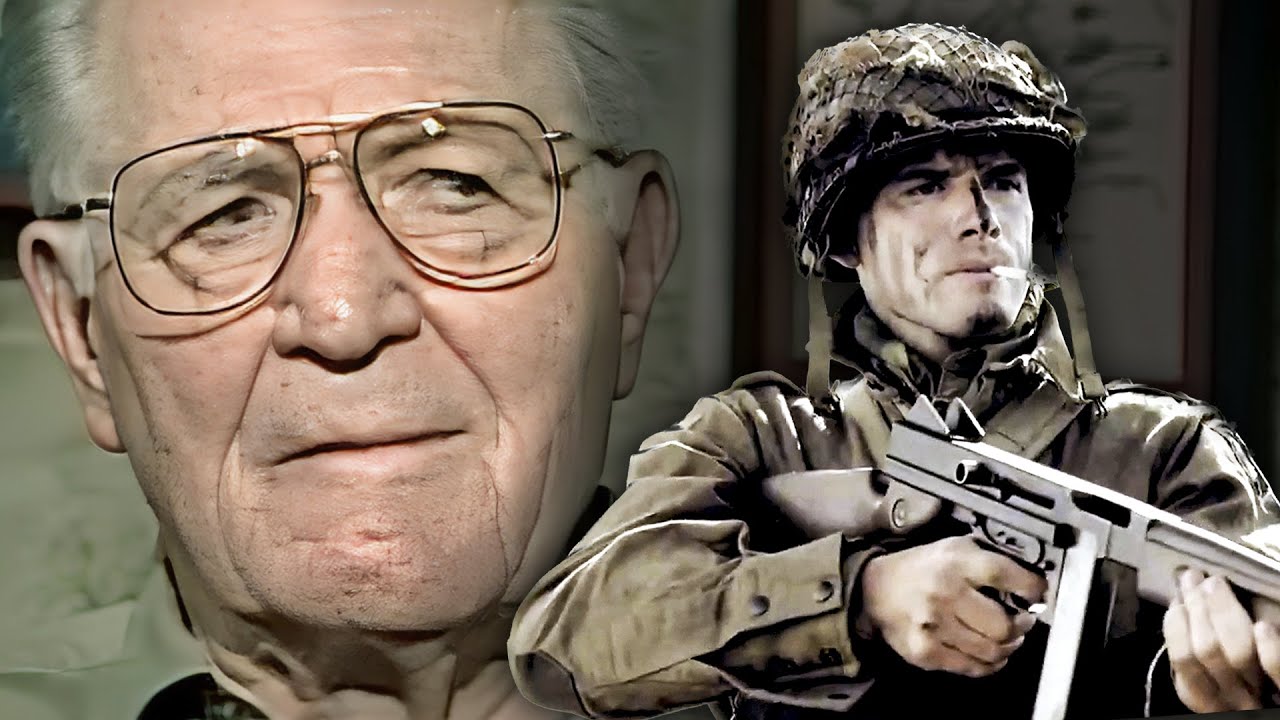
The interview, conducted in the early 2000s by former Pennsylvania state representative John D. Payne, captures Winters recounting a critical moment when publisher Simon and Schuster threatened to halt publication of Stephen Ambrose’s bestselling book over fears of defamation lawsuits. The legal department flagged multiple allegations in the manuscript, including accusations that Speirs had shot prisoners of war, a direct violation of the Geneva Conventions and the laws of armed conflict.
Winters described receiving a frantic call from Ambrose, who was uncertain how to proceed. “Steve, relax, I’ll take care of it for you,” Winters recalled telling the author. Winters then telephoned Speirs directly, leveraging the deep bond forged between the two men during the war.
Winters had been responsible for promoting Speirs to company commander, and their relationship was built on mutual trust and respect earned under fire.
“Sparky, you know these stories have been going around for years and everybody says it, nobody saw it directly,” Winters said he told Speirs. “I’m going to ask you, are they true?” According to Winters, Speirs responded without hesitation: “Oh yeah, yeah, they’re true, Dick.”
When Winters explained the publisher’s legal concerns, Speirs reportedly offered to put his admission in writing. He did so, and that letter remains in the archives, effectively shielding Simon and Schuster from any litigation. “Nobody’s ever had a problem with that thing because it’s a true story,” Winters stated.
The revelation adds extraordinary weight to long-circulating rumors that have fascinated historians and fans of the HBO miniseries for more than two decades. In “Band of Brothers,” the character Don Malarkey and other Easy Company men are depicted discussing the rumor that Speirs shot as many as twenty German prisoners on D-Day after first cordially handing out cigarettes, then turning his Thompson . 45-caliber submachine gun on them.
 The series also portrays a separate rumor that Speirs shot a drunk sergeant in his own platoon who refused to go on patrol, a story that has since been proven inaccurate in its details.
According to declassified accounts and eyewitness testimony, the real-life shooting of a sergeant occurred on the morning of June 7, 1944, during the attack on Saint-Côme-du-Mont. Speirs was commanding Dog Company’s Second Platoon, which had been ordered by regimental headquarters to hold position until tanks passed, allowing concealed paratroopers to engage enemy troops flushed out by the armor. A drunk sergeant refused to obey the hold order, and when Speirs told him he was too intoxicated to carry out his duties and should withdraw to the rear, the sergeant raised his rifle and pointed it at Speirs.
Speirs shot him in self-defense.
Private First Class Art DiMarzio, a nineteen-year-old from Ohio who was standing next to the sergeant, witnessed the entire incident. He and the rest of the platoon clearly saw that Speirs had no other choice. Speirs immediately reported the shooting to his commanding officer, Captain Gross, who visited the scene, gathered information, and deemed it a justifiable act of self-defense.
The incident was never pursued, partly because Captain Gross was killed in battle the following day. The sergeant was officially listed as killed in action.
But it is the prisoner shootings that remain the most contentious and most asked-about aspect of Speirs’s legacy. According to DiMarzio, the only known firsthand witness to such an event, he landed with Speirs on D-Day and was with him and Sergeant Corrington when they encountered three German soldiers walking down a road shortly after landing. A brief physical brawl ensued before the three American paratroopers overpowered the Germans, who appeared confused about the unfolding chaos.
Speirs then addressed his two subordinates firmly, stating, “We’re going to have to take them out. We can’t take them with us.” He ordered each man to shoot a prisoner, and Speirs shot the third himself.

Historians note that this was not an isolated incident but rather a grim reality of the Normandy landings. Paratroopers were scattered across the countryside with no rear elements and no way to manage prisoners. Taking captives was often logistically impossible.
It was either 𝓀𝒾𝓁𝓁 them or let them go, and letting them go could mean they would rejoin German units and 𝓀𝒾𝓁𝓁 Americans later. Many paratroopers openly proclaimed they were taking no prisoners, statements that were even reported in newspapers at the time.
The context of the Normandy invasion was brutal beyond measure. American soldiers saw the bodies of fellow paratroopers riddled with bullets hanging from trees, and they wanted revenge. German forces harbored the same sentiment when they saw their comrades lying dead.
Adolf Hitler had ordered all Special Forces, including paratroopers, to be shot on sight. Similarly, General Maxwell Taylor, commander of the 101st Airborne Division, instructed his paratroopers to take no prisoners during the invasion. Easy Company paratrooper Don Malarkey later said that General Taylor told them taking prisoners would handicap their ability to carry out their mission.
Historians have discovered that many U. S. units were ordered to take no prisoners during the D-Day landings.
A few hours after the first incident, DiMarzio and Speirs left the Marmion farm, which had become a major gathering point for scattered troops. With them were men from various segments of Dog Company. On their way toward Hiesville, they encountered four unarmed Germans.
This time, Speirs shot them himself. It is this second incident that sparked the rumors relayed in “Band of Brothers.”
 Major Winters, who passed away in 2011, consistently described Speirs as one of the best combat officers in the battalion and a natural-born leader. Speirs’s toughness and bravery earned him a Silver Star in Holland, a Bronze Star in Normandy, and two Purple Hearts, one for wounds sustained in Normandy and another for Holland. Winters noted that Speirs welcomed the reputation of being merciless.
While fellow soldiers called him by the nickname “Sparky,” the men of his platoon, who both respected and feared him, called him “Killer.” The rumors swirling around him were not contained to his own platoon but spread throughout the entire 506th Parachute Infantry Regiment.
Stephen Ambrose, who authored the book on which the miniseries is based, acknowledged that while he heard the stories from many sources, all were secondhand. No one other than DiMarzio claimed to have actually witnessed Speirs shooting prisoners. As emphasized in “Band of Brothers,” there were indeed many exaggerated and distorted rumors floating around about Ronald Speirs.
Don Malarkey had heard some of these stories and desperately hoped he would never be under Speirs’s command. Of course, things did not work out that way for Malarkey, who eventually served under Speirs and came to respect him deeply.
The question of whether Ronald Speirs shot German prisoners remains the most asked question about him to this day, gaining renewed interest after the release of “Band of Brothers.” Winters’s confirmation that Speirs admitted the truth of the allegations provides the most authoritative answer available. Yet historians caution that separating rumor from fact in other alleged incidents remains impossible, as they are not firsthand accounts.
Stories about Speirs grew and evolved until they hardly resembled the kernel of truth that may have started them.
For those seeking a deeper understanding, the book “Fierce Valor: The True Story of Ronald Speirs and His Band of Brothers” offers extensively researched insight into these allegations and innuendos. It remains one of the primary sources for understanding the complex, controversial, and undeniably heroic figure who led Easy Company through some of the most brutal combat of World War II. The revelation from Winters does not diminish Speirs’s bravery or his contributions to the war effort.
Instead, it underscores the moral complexities of combat, where ordinary men were forced to make impossible choices in extraordinary circumstances. The truth, as Winters confirmed, is that Ronald Speirs did what he believed was necessary to accomplish the mission and protect his men, and he carried that burden with him for the rest of his life.