On March 15, 1939, six months after the annexation of the Sudetenland, Nazi Germany invaded and occupied the Czech provinces of Bohemia and Moravia in flagrant violation of the Munich Agreement.
Adolf Hitler himself arrived in Prague, and on March 16 he established the Protectorate of Bohemia and Moravia by proclamation. Konstantin von Neurath, the former foreign minister of Nazi Germany, became its Reich Protector.
Because Hitler felt that von Neurath's rule was too lenient, and that his soft approach had promoted anti-German sentiment and encouraged resistance through strikes and sabotage, he dismissed him in September 1941.
In his place, Hitler appointed Reinhard Heydrich as Deputy Reich Protector. Heydrich's brutality would earn him the nickname "The Butcher of Prague."
But in a land where fear and oppression ruled the day, Heydrich's reign of terror ended on May 27, 1942, when he was mortally wounded by two Czechoslovak paratroopers. One of them was Jozef Gabčík.
Jozef Gabčík was born on April 8, 1912, in the village of Poluvsie, in what is today Slovakia and was then part of Austria-Hungary. He was one of four children of well-to-do peasants.
In October 1932, Gabčík enlisted in the Czechoslovak Army and was assigned to Infantry Regiment 14, stationed at the historic city of Košice. There, among men of diverse backgrounds, he began to learn not only the art of warfare but also the virtues of loyalty and sacrifice.
His exemplary conduct and natural leadership soon earned him a place at the non-commissioned officer school in Prešov, a city in the east of today's Slovakia, then part of Czechoslovakia. Gabčík saw his path in the army, even if it came at the cost of his father's disapproval.
He served in various units until March 1937, when his voluntary contract expired and he did not renew it. At his father's insistence, he remained in contact with the army, taking a job in a factory producing combat gases in the Slovak city of Žilina.
There he suffered an accident when he came into direct contact with the gases and almost lost his sight. After recovering, he worked in a chemical warfare warehouse in the Slovak village of Skalica nad Váhom. That place was also where his life changed forever.
On March 14, 1939, Jozef Tiso, the Slovak politician and Roman Catholic priest, declared independence from Czechoslovakia by an act of the Slovak assembly. The same day, Tiso became prime minister of the new Slovak State.
One day later, on March 15, Nazi Germany invaded and occupied the Czech provinces of Bohemia and Moravia in flagrant violation of the Munich Agreement. Slovakia became a Nazi puppet state whose followers established a fascist, authoritarian one-party dictatorship, strongly influenced by the separatist Catholic clerical hierarchy in internal policy and closely allied with Nazi Germany.
It was in Skalica nad Váhom, amid the tangible symbols of Czechoslovak military might, that Gabčík's path veered decisively toward active resistance against Nazi Germany and Slovak collaborators.
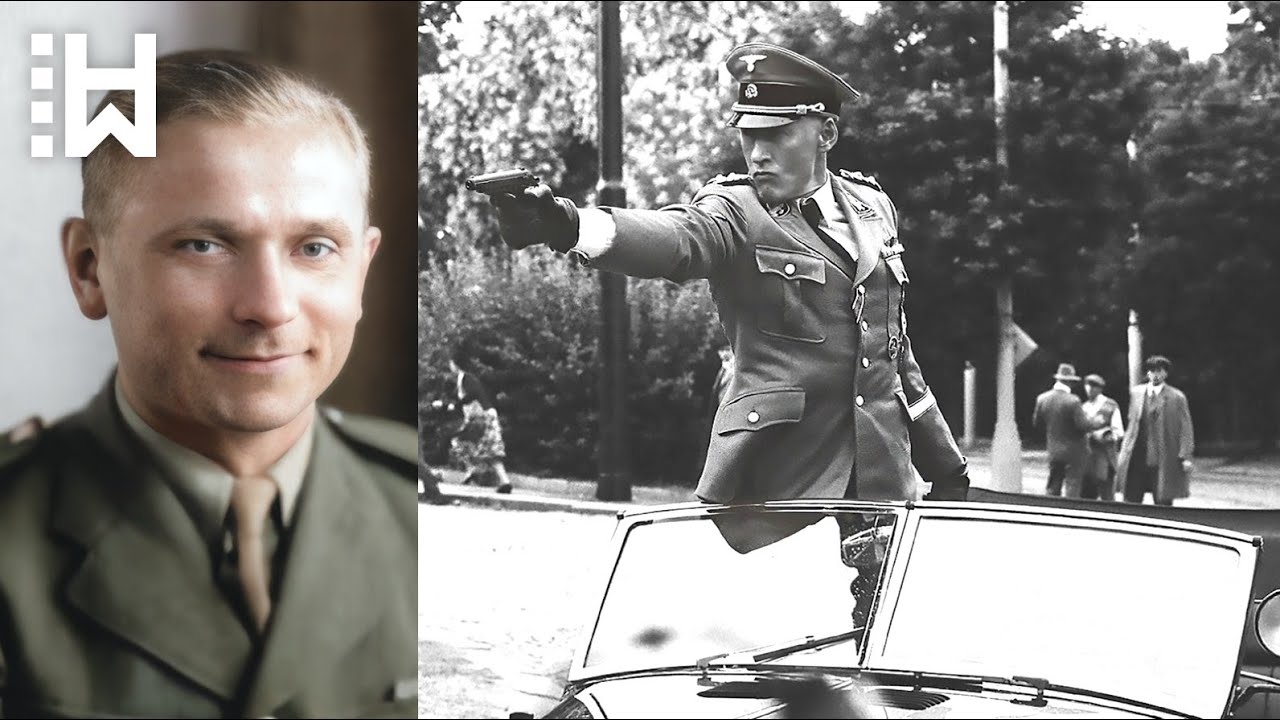
When representatives of the occupying German armed forces arrived to seize control of the warehouse after the dismemberment of Czechoslovakia, Gabčík faced a dilemma. With no explicit orders from his superiors to cooperate, he made a choice that would define his legacy.
Refusing to surrender the warehouse without proper directives, he turned the German officers away and chose exile over submission and collaboration with Nazi Germany. He wanted to join the Czechoslovak foreign army that was being formed.
Allegedly, he damaged the combat gas tanks, but this is probably a made-up story connected with his later actions in the Protectorate of Bohemia and Moravia.
Venturing northward along a treacherous route, he sought refuge first in Poland. In the historic city of Kraków, he enlisted in the newly forming Czechoslovak Army in Exile, a force born out of desperation and the hope of one day reclaiming national freedom.
It was during this critical period that he met Jan Kubiš, a Czechoslovak soldier whose destiny would soon become intertwined with his own in the pursuit of a common cause.
Yet the path to effective resistance was fraught with obstacles. The Polish government, preoccupied with its own internal challenges and wary of antagonizing its powerful neighbor, was reluctant to support the formation of a Czechoslovak army on its soil.
Undeterred, Gabčík and his compatriots soon embarked on another journey, this time by sea. In late July 1939, aboard the ship Chrobry, they left Poland for France, a nation that despite its own uncertainties offered hope for the fight against Nazi tyranny.
Once in France, Gabčík continued his military career by joining the French Foreign Legion, a unit known for accepting men from all walks of life and forging them into hardened soldiers.
The outbreak of the Second World War on September 1, 1939, however, dramatically altered the landscape. An agreement between the French Republic and Czechoslovak representatives resulted in the transfer of Czechoslovak soldiers from the Foreign Legion into a reconstituted Czechoslovak Army in Exile.
On September 26, 1939, at a Czechoslovak camp in French Agde, Gabčík was formally accepted into this force. He then took part in the bitter fighting during the French Campaign, which lasted from May 10 to June 25, 1940.
After the defeat of France, he left for Great Britain. His bravery in combat was recognized with the award of the Czechoslovak War Cross 1939 on October 28, 1940, a tangible testament to his courage under fire.
Yet as the shadow of Nazi oppression deepened across Europe, Gabčík's role was about to take on an even more daring dimension. Driven by an urgency to strike directly at the nerve center of enemy power, he volunteered for special operations training.
The rigorous program was conducted in cooperation between the Czechoslovak Army in Exile and the British Special Operations Executive, or SOE. He mastered the techniques of parachuting, sabotage, and covert warfare, skills that would soon prove indispensable.

Gabčík emerged from this training as one of the first Czechoslovak soldiers willing to risk everything by returning to the occupied homeland on a covert mission. By October 1941, his competence and unwavering resolve earned him command of the audacious Operation Anthropoid.
The mission's objective was as daring as it was dangerous: the assassination of Reinhard Heydrich, the Deputy Protector of Bohemia and Moravia and one of the architects of Nazi terror.
The planning of Operation Anthropoid was fraught with challenges. An injury to the original second in command, Karel Svoboda, necessitated his replacement by Gabčík's trusted friend and comrade Jan Kubiš.
Moreover, the logistics of inserting a small team of agents deep behind enemy lines proved a formidable task. Repeated delays forced by problematic weather and other unpredictable factors tested the patience and fortitude of the entire team.
In the early morning of December 29, 1941, near the quiet village of Nehvizdy near Prague, Gabčík and Jan Kubiš were parachuted into enemy territory.
Unlike many clandestine operations that faltered before even reaching their destination, their landing was met with some luck. Despite being dropped off at a different location than planned, they soon established contact with local resistance networks, among them members of the Sokol movement, whose invaluable support would enable the meticulous planning and execution of their mission.
Every detail was scrutinized and every contingency planned for as the operatives prepared to strike at the very heart of the Nazi administration. For weeks, Gabčík and Kubiš moved through the occupied streets, every step guided by an unyielding desire for justice.
The set date of the operation was May 27, 1942. This would be the day when Reinhard Heydrich, head of the Nazi secret police and an embodiment of Nazi brutality in the protectorate, would meet his fate.
Because Heydrich was so confident that his pacification program had succeeded, he flagrantly disregarded measures for his own security and traveled around Prague in an open vehicle.
On May 27, 1942, Jozef Gabčík and Jan Kubiš ambushed Heydrich's open-top Mercedes as it slowed for a turn while coming from his residence outside Prague.
As planned, Gabčík attempted to fire his Sten submachine gun at point-blank range, but the weapon jammed. Seizing the moment, Heydrich tried to confront the attacker, giving Kubiš the opportunity to throw a modified anti-tank grenade.
The grenade hit the car and detonated, sending lethal shrapnel into Heydrich's body. Though he initially survived the blast, Gabčík and Kubiš had succeeded in their mission, and Heydrich succumbed to his wounds on June 4, 1942.
The consequences of Operation Anthropoid were swift and brutal. The assassination attempt and Heydrich's subsequent death unleashed a wave of terror and retribution that would engulf the protectorate in an onslaught of violence.

Determined to root out those responsible and crush any flicker of resistance, the Nazi regime launched a series of ruthless reprisals. Executions took place, and the destruction of the Czech villages of Lidice and Ležáky, which the Nazis boasted about, became a symbol of the beastly actions that followed.
Gabčík's comrades from various special operations, now fugitives in their own land, were forced to move from one hiding place to another. Their survival depended on the network of underground resistance fighters and their families, who risked everything to shelter them.
For a time, the Gestapo search for the elusive agents yielded little success. The meticulous planning of Operation Anthropoid had allowed them to vanish into the streets of Prague, their identities and whereabouts shrouded in secrecy.
However, the tenuous safety of their underground existence was shattered by a single act of betrayal. Karel Čurda, a member of another Czechoslovak resistance group named Out Distance, voluntarily surrendered to the Gestapo and divulged vital information about the network of resistance fighters and the hidden safe houses that had been protecting the Anthropoid team.
The enemy's relentless pursuit finally converged on the sanctuary of the Orthodox Church of Saints Cyril and Methodius on Resslova Street in Prague. There, after several harrowing hours of desperate resistance against overwhelming odds, the situation reached its tragic climax.
Faced with the inevitability of capture and unwilling to let his comrades fall into the hands of a brutal Gestapo, the 30-year-old Jozef Gabčík made a fateful choice. In an act of defiant finality, he took his own life on June 18, 1942, rather than endure the indignity of capture and torture.
Alongside him, six of his brave comrades and fellow agents from various missions perished that day. Their sacrifice was a testament to their unwavering commitment to the cause of freedom.
After all seven men were dead, the Germans took their bodies to the Institute of Forensic Medicine in Albertov in Prague, where an autopsy was carried out. All the bodies were decapitated.
The heads of Gabčík and Kubiš were to be perfectly preserved and displayed in the crime museum the Nazis planned to create after the war. As for the five remaining men, only the skull was to be retained.
On April 20, 1945, just a few weeks before the liberation of Prague, the Gestapo took them away, and what happened to them next has not been credibly confirmed. Allegedly, their bodies were buried in a mass grave at Ďáblice Cemetery in Prague.
The repercussions of Operation Anthropoid reverberated far beyond the borders of occupied Czechoslovakia. Internationally, the assassination of Heydrich galvanized support for the resistance, lending a powerful moral impetus to the Allied struggle against Nazi tyranny.
The Czechoslovak government in exile in London seized upon this act of audacity to assert its demands for liberation and self-determination. In a significant diplomatic twist, the British government withdrew its signature from the Munich Agreement in the aftermath of the horrors that took place in the protectorate after Heydrich's assassination.
Gabčík's sacrifice, though it cost him his life, had ignited a spark that contributed to the eventual downfall of the Nazi regime. There were many tears shed for Jozef Gabčík.