Pamela Beryl Digby was born on March 20, 1920, at Farnborough in Hampshire, the eldest daughter of a family whose blood was old and whose money was thin. Her father, Edward Kenelm Digby, was the 11th Baron Digby, master of Minterne, a handsome house set in the green folds of Dorset. It was the picture of English landed permanence, and like many old county families between the wars, it was far grander in name than in funds.
That gap between the title on the gate and the figures in the ledger shaped Pamela from the beginning. She grew up in the conventional rhythm of the interwar rural gentry, a world of horses and hounds, governesses and cold corridors. She learned to ride almost before she could read, was sent abroad to be finished in Paris and Munich, and came home speaking good French and carrying the polish her class expected of its daughters.
In 1938, she was presented at the court of King George VI, a debutante in white among the other debutantes, taking her place in the marriage market exactly as generations of girls before her had done. There was, however, a problem, and Pamela was clear-eyed enough to see it early. She was not beautiful. The great beauties of her generation were slim and sculpted and luminous, and she was none of those things.
She was auburn-haired and fair-skinned, round of face, inclined to plumpness, pretty in a healthy English way, but never the woman who stopped a room when she entered it. In a world where a girl of small fortune was expected to trade on her looks to marry well, she had been handed a modest hand of cards.
A lesser woman might have accepted the verdict and settled for a quiet county marriage to a neighboring squire. Pamela did something far more interesting. She found the one card she did hold, and she learned to play it better than anyone alive.
From her earliest years in society, the people who met her noticed the same thing again and again across 60 years and three countries. She made every man believe he was the only one. She listened as though the man in front of her were the single most fascinating person who had ever spoken. She remembered the details of his work, his worries, his small vanities, and fed them back to him with a warmth that felt entirely genuine.
She did not dazzle a room. She captured one person in it completely and made him feel larger and cleverer and more important than he had ever felt before. In Pamela, that charm functioned more like a craft, practiced and refined and aimed. She understood that in a world run entirely by men, the woman who could command a powerful man's attention held a sliver of his power in her own hand.
She had no money to bring to a marriage and no exceptional beauty. So she made herself instead into the most attentive, most flattering, most necessary companion a great man could find. And she set out to attach herself to the greatest men she could reach.
Consider the smallness of her starting position against the size of what she became. A baron's daughter from a cash-poor Dorset house, plain by the standards of the day, with a finishing school education and no inheritance to speak of. Within three years she would be the open lover of the most powerful American in wartime Britain. Within 30, she would be kept by the heir to the Fiat empire and a baron of the house of Rothschild. Within 50, she would be a maker of presidents and an ambassador of the United States.
The summer of 1939, when she came out fully into the adult world, was the last summer of the old order. The parties went on, the dances, the country weekends, but the shadow of the coming war lay over all of it. Pamela, 19 years old and impatient with Dorset, came up to London hungry for a life larger than the one she had been born to.
She did not yet know how she would get it. She only knew that she would. And then, in the first week of September, with the country sliding into war, she sat down to dinner beside a man whose surname was the most famous in Britain.
She met Randolph Churchill at a dinner table a fortnight after Britain declared war, and she was engaged to him before the week was out. It was the kind of courtship that only happens when the world feels as though it is ending.
Randolph was the only son of Winston Churchill, then First Lord of the Admiralty and soon to be Prime Minister, and he carried his father's name like a weight he could neither match nor put down. He was 28, handsome in a heavy way, brilliant in flashes, and already marked by the drinking and the recklessness that would ruin him.
He was a serving officer now, and like many young men in uniform that autumn, he was seized by a single urgent thought: that he might be killed, and that he ought to father a son to carry the Churchill line before he went. Into that urgent sea walked Pamela, 19 and fresh from Dorset, attentive and warm and flattering in exactly the way that a vain, insecure, much criticized young man found irresistible.
Randolph had proposed to a string of women that autumn, by some accounts as many as eight, in a kind of scattergun search for a wife and an heir. Pamela said yes. She was not in love with him in any deep sense, and she was not blind to his faults, but she understood with great clarity what the marriage offered. It offered the name. It offered entry into the most famous and most powerful family in the country at the very moment that family was about to lead the nation through its greatest trial.
They were married on October 4, 1939, at the Church of St. John in Smith Square, Westminster, one month and one day after Britain had gone to war. She was 19. He was 28. It was a small wartime wedding, hurried and a little improvised, but the name on the register changed everything about her position in the world.
The plain baron's daughter from Minterne was now Pamela Churchill, daughter-in-law of the man who would within seven months be Prime Minister of Great Britain. Whatever else the marriage was, it was the single most effective social maneuver of her early life, and she had executed it in a matter of days.
The marriage itself began to disappoint almost at once. Randolph drank heavily. He gambled with a recklessness that bordered on the pathological, losing sums he did not have at the card tables and then expecting others to make them good. He was loud, quarrelsome, and given to picking fights with the very people his father needed as allies.
Pamela, who had married the name rather than the man, found herself yoked to a personality that even his adoring father struggled to manage. But the name was doing its work. As Randolph went off to his regiment, Pamela was drawn into the heart of the Churchill family at the precise moment it became the heart of the nation.
When Winston Churchill became Prime Minister in May 1940, his daughter-in-law was already installed within his orbit, a fixture at the family gatherings, a young woman the great man found pleasant and easy and undemanding company at a time when almost everyone else in his life brought him problems. She had a genius for being agreeable to powerful men, and there was no more powerful man in Britain than the one whose son she had married.
A year before, she had been one of hundreds of debutantes, a girl with a good name and no money and no particular prospects beyond a sensible marriage. Now she dined at Downing Street. She spent weekends at Chequers, the Prime Minister's country house, while the fate of the war was decided in the rooms around her. She was inside the building where Churchill paced and dictated and held the line through the worst summer in British history. And she was there not as a servant or a secretary, but as family.
On October 10, 1940, almost exactly a year after the wedding, she gave birth to a son. They named him Winston after his grandfather, and the birth of a male Churchill heir secured Pamela's place in the family beyond any question. She had done the one thing Randolph had married her to do. She had produced the son.
Whatever happened to the marriage now, she was the mother of the Prime Minister's grandson, and that was a position no divorce could take from her. The early war years saw her living a curious double life. On the surface, she was the dutiful young wife and mother, the daughter-in-law who charmed the great man and soothed the household. Underneath, the marriage to Randolph was disintegrating with remarkable speed.
The trouble, as it so often was with Randolph, came down to money and to the careless, ruinous way he treated it. Sent abroad on service, first toward the Middle East, he ran up gambling debts on the very voyage out, losing heavily at cards to his fellow officers, and then writing home to instruct Pamela to settle the accounts.
One such demand was for a sum of around $12,000, a fortune in those years, worth many times that figure in modern money, and Pamela had no means of paying it. What she did next reveals the steel beneath the soft manner. Rather than go to the Churchills and expose her husband's recklessness, she protected the family name and shouldered the problem herself.
She took a paid job at the Ministry of Supply, earning around 12 pounds a week, a modest wage for hard administrative work. She quietly sold the wedding presents. She sold a good deal of her jewelry. She moved the baby out of London to the countryside for safety and economized wherever she could, all while keeping the scale of Randolph's debts a secret from his parents.
The girl who had married for the name now found herself working to defend it, and she did so without complaint, because the connection to the Churchills was worth more to her than any wounded pride. London in the winter of 1940 and 1941 was a city under siege from the air. The Blitz battered the capital night after night, and Pamela, like everyone else, lived with the sound of the sirens and the bombs and the long uncertain nights in the shelters.
She was a young mother, effectively without a husband, carrying her family's debts in a city that might be destroyed around her at any moment. The pressures of that period would have broken many women of her background. Instead, they seem to have concentrated her, sharpening the instinct for survival and the talent for managing powerful people that would define the rest of her life.
She made herself useful to her father-in-law in small, constant ways, the kind of attentive companionship that a man under enormous pressure comes to rely on. She was good with him in a way few people were, undemanding, cheerful, easy to have at the table at the end of a terrible day. Clementine Churchill, Winston's formidable wife, kept a cooler eye on her daughter-in-law, but even she found Pamela hard to dislike.
The contrast at the center of her life by early 1941 was stark. Here was a marriage that existed now mostly on paper to a husband who was absent, unreliable, and sinking under his own failings. And here, all around her, was the most concentrated power in the nation, the war cabinet, the prime minister, the secret comings and goings of a country fighting for its life.
Pamela was bound by name to the weakest man in the Churchill story and surrounded daily by the strongest. A woman whose entire method was to attach herself to power could hardly fail to notice the difference or to feel the pull of it. And the war was about to bring to her door the one relationship that would tie the whole of her long life together.
Across the Atlantic in Washington, President Roosevelt had decided to send a personal envoy to London. A man of immense wealth and total discretion to oversee the lifeline of supplies that Britain could not survive without. He would arrive in the spring of 1941. He would be seated almost at once beside the prime minister's daughter-in-law. And the affair that followed would be tolerated at the very top of the British government because the man she chose was too important to lose.
In March of 1941, a tall, grave, immensely rich American stepped off a plane into wartime London carrying the power to keep Britain in the war. His name was William Averell Harriman, and he had arrived as the personal envoy of President Franklin Roosevelt, charged with overseeing the program that the Americans called Lend-Lease, the vast flow of weapons, ships, aircraft, food, and raw materials that the United States was sending to a Britain that could no longer pay for them.
He was in that single role the most important American in the country. Without the supplies he controlled, Britain could not fight. Churchill knew it, and so did everyone around the Prime Minister. Harriman was 49 years old, the son of one of the great fortunes of American history. His father, Edward Henry Harriman, had been a railroad baron, the man who controlled the Union Pacific and the Southern Pacific lines and built one of the largest transport empires the United States had ever seen.
Averell had been born into wealth on a scale that few Englishmen, even titled ones, could imagine. He had spent his life moving between business and public service, between the family banking house and the corridors of Washington. He was reserved, serious, a touch cold, a man of duty rather than charm. He was also married to his second wife, Marie Norton Whitney, and he had a grown daughter close to Pamela's own age.
The position he held in London in the spring of 1941 made him, for Churchill, a man to be courted with everything the British had. The whole strategy of British survival rested on binding the United States ever closer, drawing the Americans from sympathy toward supply, and from supply, eventually, toward war. Harriman was the living embodiment of that lifeline, the man on the spot who decided how much flowed and how fast.
Churchill flattered him, dined him, took him to Chequers, brought him inside the family circle, treated him with a warmth reserved for the most valued of allies. To keep Harriman happy and engaged was, quite literally, a matter of national survival. It was in exactly this atmosphere of careful, deliberate hospitality that Averell Harriman was introduced to Pamela Churchill.
The introduction came, by most accounts, at the Dorchester Hotel during an air raid in the early days after his arrival, and then again within the warm embrace of the Churchill family weekends. Here was the most attentive young woman in London, schooled in the art of making a great man feel he was the only one, seated beside the most important American in the country, a serious and rather lonely man far from home, married to a wife 3,000 miles away, carrying the heaviest responsibility of his life.
The chemistry was almost inevitable, and it was almost instantaneous. What makes the meeting so striking is the perfect alignment of need on every side. Harriman was lonely, powerful, and far from his wife. Pamela was trapped in a failing marriage to an absent and unreliable husband, burdened with his debts, hungry for a connection to real power rather than the borrowed kind. And the Churchill household, watching it all, had every reason in the world to want the great American envoy to feel happy, welcome, and emotionally tied to Britain.
The numbers around Harriman tell their own story of the gulf Pamela was crossing. He commanded a program that would, across the war, channel goods worth more than 30 billion dollars to Britain alone, in the money of the day, a sum so vast it defies comparison with anything in Pamela's Dorset upbringing. He came from a family fortune built on tens of thousands of miles of railroad track.
The girl from Minterne, who had sold her wedding presents to cover her husband's card debts, was about to attach herself to one of the largest concentrations of private wealth and public power in the Western world. She was 21 years old.
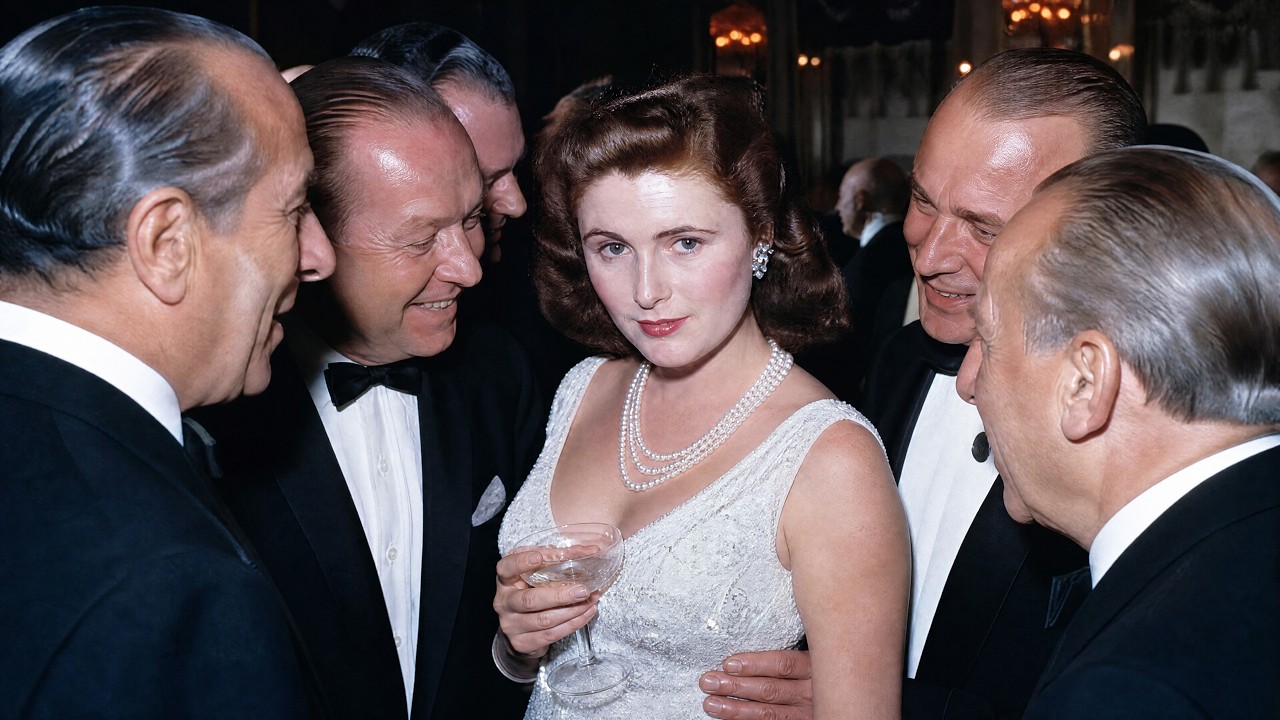
There was something in Harriman that made him unusually vulnerable to a woman of Pamela's gifts. For all his wealth and his power, he was not a man of easy warmth. He had spent his life in the cold disciplines of business and public service, and he carried himself with a gravity that kept most people at a distance. He was far from his wife, isolated by the secrecy of his work, surrounded by men who wanted things from him, and by the unrelenting pressure of a job on which a nation depended.
What he lacked, and what he had perhaps never quite had, was someone who simply made him feel at ease, who listened without wanting, who made the weight of his position seem lighter for an evening. Pamela gave him precisely that. And a man who had everything found in the attention of a penniless girl of 21 something he could not buy anywhere else.
She did not hesitate. Within weeks of their meeting, Pamela Churchill and Averell Harriman were lovers. The affair would become one of the worst-kept secrets of wartime London, and one of the most quietly consequential. For it was conducted not in spite of the Churchills, but in a strange and unspoken way, with their tolerance.
She was 21, he was 49 and married. And within weeks of their first meeting, the whole of Downing Street knew what was happening between them. The affair between Pamela Churchill and Averell Harriman was extraordinary, not because it was secret but because it was not. In an age when such things were meant to be hidden, conducted behind locked doors and never spoken of, this one was carried on with a boldness that startled even the worldly society around them.
They were seen together. They were known to be together. And the family at the center of British power, the Churchills themselves, said nothing, did nothing, and allowed it to continue.
To understand how remarkable that silence was, it helps to remember exactly who these people were. Pamela was the wife of Winston Churchill's only son. She was the mother of his infant grandson and namesake. By every ordinary standard of the time, her taking a lover while her husband fought abroad was a scandal that should have brought the full weight of family disapproval down upon her.
Randolph was away on active service, risking his life, and his wife was openly involved with another man under the noses of his own parents. In almost any other family in Britain, this would have been a catastrophe, hushed up at best, punished at worst. Yet Winston and Clementine Churchill, who missed very little, chose to look away.
There is no record of Winston confronting Pamela, no record of Clementine casting her out, no record of any attempt to end the relationship or to protect their absent son's marriage. The silence was deliberate, and it was in its way a calculation. The Prime Minister of a country fighting for its survival had decided that the comfort and goodwill of the American envoy mattered more than the propriety of his daughter-in-law's behavior.
Harriman, happy and emotionally bound to Britain, was worth more than Randolph's wounded honor. It was a cold piece of arithmetic, and the Churchills, masters of the larger picture, made it without apparent hesitation.
Pamela herself navigated the situation with a poise that belied her age. She did not flaunt the affair to wound her husband, nor did she pretend it was not happening. She simply carried on conducting the relationship with discretion enough to preserve appearances and openness enough that everyone who mattered understood the truth. She remained throughout the perfect daughter-in-law to Winston, attentive and warm, and she gave the Churchills no reason to regret their silence.
She had grasped something that would serve her for the rest of her life: that a powerful family will tolerate a great deal from a person who makes their lives easier and asks nothing awkward in return.
The relationship deepened through 1941. Harriman, grave and reserved in public, was by all accounts deeply taken with the young woman who listened to him so completely and asked for so little. For Pamela, the affair was both a genuine attachment and a profound education. Through Harriman, she came to understand the inner workings of the Anglo-American alliance, the personalities, the tensions, the flow of decisions between London and Washington.
She was no longer merely close to power through her marriage. She was now intimate with one of the men who held the lifeline of the war in his hands. And she was learning night by night how that world truly operated.
There is a striking detail in the geography of the affair. For a time, Harriman's own grown daughter, Kathleen, came to London and became Pamela's close friend and flatmate. The two young women shared quarters even as Pamela carried on her relationship with Kathleen's father. The arrangement, which would have been unthinkable as a scandal made public, was absorbed into the strange intimacies of wartime, where the old rules bent under the pressure of the bombing and the sense that ordinary life had been suspended.
Pamela had a gift for making such arrangements seem natural, for smoothing away the awkwardness that should have surrounded them, and she exercised it now to keep every relationship in the delicate web intact.
The society around them watched and gossiped and marveled. London in the war was a small world at the top, a few hundred people who all knew one another and dined in the same handful of hotels and houses. And a thing like this could not be hidden among them even had anyone wished to hide it. The Dorchester and the Savoy, where the powerful sheltered from the bombing in their grand basements, hummed with the knowledge of it.
That the Prime Minister's daughter-in-law was openly the mistress of the American envoy was the kind of fact that everyone knew and almost no one would say aloud. A secret kept not by silence but by a collective agreement that it served no one to mention.
Pamela moved through it all with an unbothered grace that some found admirable and others found chilling. A young woman, seemingly untouched by the disapproval that would have crushed a more conventional spirit. She had decided very early that the judgments of society were a price worth paying for the things society could not give her. And she paid that price without flinching for the rest of her life.
Some who knew her well came to believe that Pamela was not only Harriman's lover, but Churchill's most useful private channel to the Americans. And the idea, once raised, is difficult to set aside.
The argument runs like this. Pamela spent her nights with the man who controlled the flow of American supply and who knew the mind of the Roosevelt administration as few others in London did. She spent her days inside the Churchill family, dining with the Prime Minister, weekending at Chequers, trusted and welcome at the very center of British decision-making. She was, in other words, perfectly positioned to carry what she learned from the American at night to the Englishman at breakfast. And several of her biographers have concluded that this is exactly what she did.
It is essential to be careful here and to mark the line between what is documented and what is interpretation. That Pamela had the affair is beyond dispute. That she was close to Churchill is beyond dispute. That she moved between the two worlds, the American envoy's bed and the Prime Minister's table, is beyond dispute. What cannot be proven in the way a historian likes to prove things is the precise content of what passed between them, or whether Churchill consciously used his daughter-in-law as an instrument of intelligence.
The idea that she was a deliberate conduit, a kind of willing listening post between Number 10 and the White House, sits on the interpretation side of the line. It is what some serious students of her life believe, argued from the circumstances, not a thing recorded in any document she signed.
But the circumstances are suggestive, and they fit everything else that is known about her. Pamela was an extraordinary listener, the kind of woman to whom men talked freely, unburdening themselves of worries and opinions and indiscretions, because she made it feel safe and flattering to do so. Harriman was a man under immense pressure, far from home, and she was the person he relaxed with. It would have been entirely in character for her to absorb a great deal in those private hours and entirely in character for her to understand the value of what she absorbed.
Whether or not Churchill formally directed it, the simple flow of a clever, attentive woman between two centers of power could not help but carry information with it.
The wider truth this points to is more important than any single past secret. Pamela was learning in the most direct way possible that intimacy with powerful men was itself a form of power. She was discovering that the woman who holds a great man's confidence holds something that other people want, and that such confidence can be converted into position, into usefulness, into a place at the center of events.
She was not a spy in any formal sense. She was something subtler and in the long run more durable: a woman who understood that proximity to power, patiently cultivated, was a currency she could spend for the rest of her life.
The arrangement also taught her the value of being underestimated. To the men around her, Pamela was a pretty, agreeable young woman, charming and undemanding, the sort one talked freely in front of precisely because one did not take her entirely seriously. That underestimation was her great advantage. She could sit at a table of powerful men, absorbing everything, weighing everyone, and they would think of her only as a delightful presence, never as a player in her own right. She would spend decades exploiting that blindness, allowing important men to dismiss her as decorative right up until the moment she revealed how much she had understood and how much she had quietly arranged.
The scale of what she was now operating among is worth measuring. She was 21 years old. The man she shared her nights with controlled a supply program that kept an entire nation fighting. The man she dined with by day directed the war effort of the British Empire, with its hundreds of millions of subjects and its forces spread across every continent. Between those two men passed decisions that would shape the fate of the world. And in the narrow, intimate space between them moved a baron's daughter from Dorset, plain and penniless three years before, now woven into the private fabric of the alliance that would win the war.
By the time Harriman's duties carried him away from London later in the war, Pamela had been transformed. She had entered the war a 19-year-old bride of a difficult man. She was emerging as something entirely new, a woman who understood exactly what she was worth in a world of powerful men, and who had no intention of ever again settling for less than the most powerful she could reach.
When Harriman sailed home to other duties, the war brought a steady parade of powerful Americans to London and to Pamela, and she received them. The years between 1941 and the war's end saw the British capital fill with the most important men of the United States, soldiers and statesmen and broadcasters and businessmen, sent across the Atlantic to fight, to organize, to report, and to bind the two nations together.
They moved through a London stripped of its old certainties, far from home, living with danger and the strange heightened emotion of wartime. And many of them found in Pamela Churchill exactly the warmth and attention they craved. She became, in the words that would later cling to her, the great hostess of the Anglo-American alliance, and a good deal more besides.
The most famous of these attachments was to Edward Murrow, the celebrated American broadcaster whose nightly reports from London, opening with the words "This is London," brought the courage of the bombed city into millions of American homes. Murrow was the voice of Britain's suffering to the United States, a man of enormous prestige and moral weight, and his relationship with Pamela was serious enough that it shook his marriage to its foundations. By some accounts, he came close to leaving his wife for her, and the affair left a deep mark on him.
Then there was William Paley, the founder and chairman of the Columbia Broadcasting System, the network that Murrow worked for, one of the architects of American mass media, and a man of immense and growing fortune. Paley was in London during the war on government service, and he, too, fell within Pamela's circle.
And there was John Hay Whitney, known as Jock, heir to one of the largest fortunes in the United States, descended from the Whitney and Payne families, whose money came from Standard Oil and tobacco and a dozen other ventures. A man who would later serve as the American ambassador to the Court of St. James.
These three men, Harriman, Paley, and Whitney, are the figures the story gathers under the dramatic banner of the three American billionaires. The label flattens some distinctions that are worth keeping. In the money of the 1940s, they were not billionaires in the literal sense, but ultra-rich men of the first rank, commanding fortunes and empires that would swell into the billions in the valuations of later decades.
What is true, and what matters, is that Pamela attached herself in a single span of wartime years to three of the richest and most powerful Americans alive: the master of the Anglo-American supply line, the founder of a broadcasting empire, and the heir to one of the great Gilded Age fortunes.
Around these three moved others, lesser in fame but considerable in their own right. There was Major General Frederick Anderson of the United States 8th Air Force, a senior commander of the American bombing effort. There was the broadcaster and writer Quentin Reynolds. There were others whose names are recorded more faintly.
Through them all, Pamela built something no money could have bought her: an address book of the American establishment, a web of personal connections to the men who were rising to run the most powerful country on Earth. Those connections would lie dormant for years, and then, decades later, spring back to life and carry her further than any of them could have guessed.
There is a question worth asking about how she did it, and the answer is not the obvious one. It was not simple seduction, not mere beauty, for she had already been told often enough that she was not a beauty. It was the rarer thing she had cultivated since girlhood: the total, flattering, unhurried attention that made each of these formidable men feel, for the hours he spent with her, that he was the most interesting and important man alive.
In a war that had stripped powerful men of their certainties and thrown them into a foreign city far from everything familiar, that gift was worth more than any face. She offered ease and admiration and the sense of being understood, and the most powerful men in the Western world found they could not do without it.
The cost of all this was her marriage, and by the war's later years, there was almost nothing left of it to lose. Randolph, returning periodically from his service, learned of his wife's affairs, and the discovery enraged and humiliated him. The union that had been built on a hurried wartime impulse collapsed under the weight of his failures and her appetites.

There were furious scenes, bitter recriminations, a sense on his side of having been made a fool of within his own family. The marriage that had given Pamela the Churchill name was finished in all but the legal sense, held together only by the child and by the awkwardness of a divorce within the Prime Minister's family during a war.
By the time the guns fell silent in 1945, Pamela Churchill stood at a strange crossroads. She was 25 years old. She had a son, a famous name, and a collection of powerful friends and former lovers scattered across the most important country in the post-war world. She had no husband worth keeping, no fortune of her own, and a reputation that hovered between glamorous and scandalous.
The divorce from Randolph Churchill came in 1945 and was finalized in the months that followed. A quiet ending to a union that had been dead for years. There was little to fight over and little appetite for a public battle within the Churchill family. Pamela kept two things from it that would matter for the rest of her life. She kept her son, young Winston. And she kept the name Churchill, which she would carry through every later marriage because she understood better than anyone what that name was worth.
Randolph's own story moved swiftly toward tragedy. Freed of the marriage, he did not recover. The drinking deepened. The quarrels multiplied. The brilliance that had always flickered in him was steadily drowned. He made attempts at a career in journalism and politics, and he undertook a serious history of his father. But the demons that had wrecked his marriage wrecked the rest of his life as well. He died in 1968 at the age of 57, a disappointed and diminished man, remembered chiefly as the difficult son of a great father and the discarded first husband of a woman who went on to eclipse them both.
Pamela, by contrast, was only beginning. In the late 1940s, she made a decision that would define the middle of her life. She left England, with its rationing and its gray austerity and its memory of her wartime reputation, and she moved to Paris.
The choice was shrewd. Post-war Paris was reviving as the capital of European pleasure and style, filling once more with the rich and the titled and the displaced. A city where a beautiful manner mattered more than a fat inheritance, and where a woman with charm and connections could remake herself entirely. In London, she was Randolph's discarded wife, the girl with a past. In Paris, she could be whoever she chose to be.
She arrived with very little money and a great deal of nerve. What she had instead of a fortune was the thing she had always had, the ability to make herself indispensable and irresistible to wealthy and powerful men. And Paris was full of them.
The city in those years was a gathering place for the surviving aristocracy of Europe, for industrialists and bankers and heirs, for men of enormous fortune looking for beauty and amusement and the company of a woman who knew how to listen. Pamela set herself up, modestly at first, and began to do what she did better than anyone: to attach herself to the very richest men she could find.
It was a deliberate reinvention and a remarkably complete one. She shed the identity of the wartime English bride and took on a new one, that of the international beauty, the woman who moved through the grandest houses and the smartest restaurants of Europe as though she had always belonged there. She refined her taste. She learned about art, about wine, about furniture and food, and all the small expensive languages of the very rich.
She converted, in time, to the Roman Catholic faith, a change that some attributed to genuine conviction and others to the practical hope of marrying into the great Catholic families of the continent. Whatever its source, it was of a piece with the larger project: the steady, patient construction of a woman who could marry the highest of the high.
Paris in those years ran on a particular economy that suited Pamela perfectly, an economy of the kept woman raised to an art form. It was understood among a certain stratum of the very rich that a beautiful and amusing companion was a thing a great man maintained as he maintained his houses and his horses, and that such a woman might be given an apartment, an allowance, clothes, jewels, and a place at the best tables in exchange for her company and her discretion. There was no shame attached to it in that world, only a kind of professional admiration for the woman who did it well.
Pamela did it superbly. She understood the unspoken terms of the arrangement, the need to be charming without being grasping, present without being possessive, devoted without being a burden. And she made herself the most desirable companion in a city full of competition for the attention of rich men.
The first of the great men of this period, the one she would later call the great love of her life, was the dashing young heir to one of the largest industrial fortunes on the continent.
His name was Gianni Agnelli, and in the Italy of the early 1950s, he was the most glamorous man alive. He was the grandson and heir of the founder of Fiat, the car company that was rebuilding industrial Italy, and he would one day run that empire and become, in effect, the uncrowned king of his country. He was handsome, charming, fabulously rich, and recklessly alive, a man who drove fast cars and sailed beautiful boats and moved through the playgrounds of post-war Europe like their natural prince.
When Pamela met him, she was a divorced Englishwoman in her late 20s with a famous name and little money. He was a few years younger, an heir to one of the great fortunes of Europe, and entirely without obligations. The affair that followed was, by every account including her own, the romance of her life.
For roughly five years, through the early 1950s, Pamela was Agnelli's companion, installed in style, moving with him between Paris and the Riviera and the great houses of Italy. He gave her access to a life of almost unimaginable luxury, the villas, the yachts, the parties that defined an era of European glamour. She, in turn, gave him the thing she always gave: a complete and flattering attention, a warmth and ease that the restless young heir found soothing.
They were, for a time, one of the golden couples of the continent. And Pamela seems to have allowed herself, in those years, to love as well as to calculate.
To be the companion of Gianni Agnelli was to stand at the very center of European glamour. And Pamela, the divorced Englishwoman who had arrived in Paris with almost nothing, now found herself there, admired and envied, mistress of the most coveted man on the continent. She learned in those years the deep grammar of great wealth, the houses, the art, the food, the clothes, the thousand small refinements that separated the truly rich from the merely well-off. And she absorbed them so completely that they became second nature.
But beneath the glamour ran the old familiar problem, the one that would shape the entire middle of her life. Pamela wanted to marry him. She wanted the security, the title, the permanence that marriage to Agnelli would bring, the transformation from kept companion into wife and heiress. And Agnelli, for all his devotion, would not marry her.
The reasons were a tangle of family pressure, religion, social expectation, and his own reluctance to surrender his freedom. But the result was simple and for Pamela devastating. She had given five years to the great love of her life, and at the end of them, he chose someone else. In 1953, Gianni Agnelli married Marella Caracciolo, a beautiful Italian princess of impeccable lineage, and Pamela was left with nothing but the memory of the happiest years she would ever name.
The pattern of the rejection is worth dwelling on, because it would repeat and because Pamela would eventually learn its lesson in the hardest possible way. She had made herself the perfect companion to a great man, indispensable in every respect but one. She could give him everything except the bloodline and the social fitness that his family demanded in a wife. And when the moment of decision came, those things outweighed her. She was good enough to keep and not good enough to marry, and the distinction cut to the heart of her whole position in the world.
For a woman whose entire strategy was to convert intimacy into permanence, the discovery that the conversion could be refused was a profound and painful one.
There was wreckage on the personal side as well, the kind the glamorous accounts tend to skip. The years with Agnelli were not all sunlit. There were tensions, jealousies, at least one serious car accident in which Agnelli was badly hurt, and the steady undertow of a relationship in which one partner wanted marriage and the other would not give it. Pamela held on as long as she could, deploying every art she possessed, but some things cannot be charmed into being. And a man's decision about whom to marry, when his family and his faith and his future are all weighing on the scale, was one of them.
She lost. And the loss marked her. Yet even in defeat, she was building the equipment for her later triumphs. The years with Agnelli completed her European education. She emerged from them with flawless taste, deep knowledge of art and food and wine, fluency in the manners of the very richest people on earth, and a polish that no finishing school could have given her.
After Agnelli came a Rothschild, and after the Rothschild came the lesson that would harden into the principle governing the rest of her life. Baron Elie de Rothschild was a member of the French branch of the most famous banking family in the world, a partner in the family bank, and a master of the great vineyard of Chateau Lafite, whose wines were among the most coveted on earth. He was cultivated, worldly, immensely rich, and crucially, married.
When Pamela became his companion in the years after Agnelli, she entered a relationship with a man whose wealth and sophistication matched anything she had known. And his marital situation guaranteed from the very start that the old problem would return in an even sharper form.
The relationship was, in its way, another stage of her education. A de Rothschild schooled her further in the connoisseurship of the European elite, deepening her knowledge of wine, of art, of the refined pleasures that the very rich made into a way of life. Through him, she moved among the Rothschild circles, the houses and collections and cellars of a family that had financed kings and governments for generations. She was by now a woman of genuine cultivation, able to hold her own in any conversation among the cultured rich, and the relationship with Rothschild burnished that cultivation to a high shine.
But the heart of the matter was, once again, marriage. And once again, it was denied her. Rothschild was married, and a Rothschild did not divorce his wife to marry a divorced and somewhat notorious Englishwoman, however charming, however cultivated, however devoted.
Pamela, by several accounts, pressed the point. She wanted, as she always wanted, the permanence and the security that only marriage could give. And she is said to have issued something close to an ultimatum, a demand that he choose her fully or let her go. The answer was the one she had heard before. He would not leave his wife.
And so a second great relationship with a fabulously rich man ended on exactly the rock that had wrecked the first. The House of Rothschild was, of course, a name to conjure with, one of the great financial dynasties of the modern world, a family whose loans had steadied governments and whose wealth had become a byword for riches beyond ordinary reckoning. To be the companion of a Rothschild baron, master of one of the most famous vineyards on earth, was to stand at yet another summit of European wealth and prestige.
And yet the very grandeur of the name was part of what doomed Pamela's hopes. For a family so conscious of its lineage and its position was the last family on earth to absorb a divorced Englishwoman with a colorful past as the wife of one of its sons. The higher she reached, the more impossible the marriage became. And the cruel arithmetic of her situation was that the men most worth marrying were precisely the men whose families would never permit it.
It was the repetition that taught the lesson. Once might have been bad luck, a single great love lost to the cruelties of family and circumstance. Twice was a pattern. And Pamela was far too intelligent not to read it. She had now given years of her life to two of the richest men in Europe, and both had been content to keep her and unwilling to wed her.
The conclusion was inescapable and bitter. As long as she pursued men who were already attached, men whose families and positions made her unmarriageable, she would remain forever the companion and never the wife, the woman of the moment rather than the woman of the future. She had been refused twice. She resolved in effect never to be refused a third time.
A softer woman, twice wounded in love, might have retreated, might have settled for a quiet life, or surrendered to bitterness. Pamela did neither. She treated her two great romantic failures not as heartbreaks to be mourned, but as data to be analyzed, evidence about how the world actually worked, and she adjusted her conduct accordingly. The romantic in her had loved Agnelli and wanted Rothschild. The strategist in her noted coolly that neither could be converted into a husband, and resolved to spend her remaining beauty and charm only where they could buy permanence.
It was this capacity to learn from pain, rather than be destroyed by it, to keep advancing where others would have stopped, that separated Pamela from the thousand other charming women who passed through the great houses of Europe and vanished without trace.
Pamela stopped chasing the unattainable married princes of Europe, and began instead to look for a man she could actually marry, a man whose situation made marriage possible, and whose wealth and standing made it worthwhile. She would no longer settle for being kept. She would hold out for the ring, the name, the legal permanence that she had craved through all the years of glamorous impermanence.
In New York, she found at last a man who would marry her, a Broadway producer who left his own wife to make Pamela his bride. His name was Leland Hayward, and he was one of the most successful theatrical and film producers of his era, the man behind a string of celebrated Broadway shows and Hollywood pictures, an agent and impresario of great charm and great success.
When Pamela met him at the end of the 1950s, he was married to his wife Slim, a famous beauty in her own right, and moving at the center of American theatrical society. He was exactly the kind of man Pamela had decided to pursue: rich, established, and unlike the princes of Europe, attainable.
This time the campaign succeeded where the others had failed. Pamela set her sights on Hayward and did not let go, and where Agnelli and Rothschild had refused to leave their attachments, Hayward did leave his. He divorced Slim, an episode that earned Pamela a fresh wave of hostility from a society that watched her take another woman's husband with cool determination, and in 1960, he married her.
After two great refusals, after all the years of being the companion who was never quite the wife, Pamela Churchill had finally won the thing she had wanted since Agnelli. She had a husband, a real and legal one, a man of wealth and standing who had chosen her over everyone else. She was now Pamela Hayward, and she had crossed the Atlantic to become an American wife.
The marriage transplanted her into a new country and a new role, and she threw herself into both with the total commitment she brought to everything. She reinvented herself once more, this time as the devoted wife of a leading American producer and as a hostess at the heart of New York's theatrical and social world. She made their homes beautiful. She entertained brilliantly. She cared for Hayward and his interests with the same flattering attention she had once given to wartime envoys and Italian heirs, and she made herself, as ever, indispensable.

The woman who had been the scandalous adventuress of postwar Paris became, in her American incarnation, the respectable and accomplished Mrs. Hayward, a fixture of a glittering new society.
It was not without its frictions. Pamela's arrival in Hayward's life had broken a marriage and disrupted a family, and his children from the previous marriage did not welcome the woman who had displaced their mother. There were tensions and resentments that would echo for years, but Pamela had learned long ago to absorb such hostility without letting it deflect her. And she settled into her role with a determination that wore down most resistance.
For 11 years, she was Leland Hayward's wife. And by the accounts of the period, it was, in its way, a successful and even happy marriage. She had stopped chasing the impossible and settled into the achievable. And the achievable turned out to suit her.
And then, in 1971, Leland Hayward died. And Pamela, at the age of 51, found herself a widow in a foreign country. The death might have ended her story or reduced it to a long and comfortable retirement. A woman of 51, twice divorced and now widowed, might reasonably have expected the most dramatic chapters of her life to be behind her.
But Pamela Harriman, as she was about to become, had never been a woman to accept the verdict the world handed her. Within months of burying Leland Hayward, she would marry again. And the man she married would be the very first of her great lovers, the American envoy from the blacked-out London of 30 years before, now a widower himself, and richer and more powerful than ever.
Six months after she buried one husband, she married the man she had taken as a lover 30 years before, in another country, in another life. The reunion of Pamela and Averell Harriman is one of the most remarkable turns in a life full of them.
Harriman, the grave American envoy of 1941, had gone on to a towering public career. He had served as ambassador to the Soviet Union and to Britain, as secretary of commerce, as governor of New York, as a negotiator and elder statesman of the Democratic Party, one of the most respected figures in American public life. His wife, Marie, had died. And in 1971, he was a widower in his late 70s, immensely rich, still active, and suddenly, like Pamela, alone.
They met again at a dinner in Washington, the old lovers, both now free, 30 years after the blacked-out nights of the Blitz. The attraction that had drawn them together in wartime reasserted itself with remarkable speed. And within a matter of weeks they had decided to marry.
The wedding took place in 1971, only about six months after Leland Hayward's death, a haste that scandalized some and astonished others, but that made perfect sense in the long arc of Pamela's life. She was marrying not a stranger, but the first of her great men, the one who had taught her all those years before exactly what intimacy with power was worth. The lover she had not been able to keep at 21 became the husband she secured at 51.
The marriage transformed her circumstances completely. Through Averell Harriman, Pamela gained two things she had pursued her whole life and never fully possessed. She gained American citizenship, becoming legally a citizen of the country she had adopted, shedding at last the identity of the visiting Englishwoman. And she gained access to one of the great American fortunes, the Harriman railroad money, with all the houses and the security and the standing it conferred.
She became the wife of a revered elder statesman, the chatelaine of his estates, the partner of a man at the very center of the Democratic establishment. The baron's daughter, who had sold her jewelry in the Blitz, was now one of the wealthiest and most connected women in the United States.
She devoted herself to Averell with the same completeness she had brought to every important man in her life, and in his case the devotion took on the shape of genuine care. He was an old man now and growing older through the 1970s and into the 1980s, and Pamela nursed him, managed his life, and kept him at the center of things long after most men of his age would have retired from view.
Through him, she was drawn ever deeper into the world of Democratic politics, the fundraising, the strategizing, the network of powerful figures who ran the party. She was no longer merely the wife of a statesman. She was becoming, in her own right, a figure in American political life.
Averell Harriman died in 1986 at the age of 94. And his death left Pamela a very rich widow and plunged her into one of the bitterest battles of her life. The Harriman fortune and the trusts through which much of it flowed became the object of a long and savage legal war between Pamela and Averell's children and grandchildren from his earlier marriages.
They accused her, in essence, of mismanaging and draining the family money that should have passed to them. And the litigation dragged on for years, costly, public, and damaging to her reputation. The fortune she had married into proved harder to keep than to win. And the fight over it consumed a great part of her later years and a great part of the wealth itself.
The Harriman children and grandchildren had watched their father's vast fortune pass, in large part, into the hands of a woman who had married him late in his life and who had first come into the family 30 years before as the lover who broke their parents' world. They believed she had spent and lost what was rightfully theirs, that money meant to be held in trust for them had been poured into her houses, her entertaining, and the political career she had built in the family's name. The lawsuits ran for years and reached into the tens of millions of dollars, a grinding, public, expensive war that tarnished the dignified image she had spent so long constructing.
It was the price of her method laid bare. The woman who attached herself to great fortunes was also, inevitably, the woman whom the heirs of those fortunes came to resent. And at the end of her life, that resentment broke into open and damaging conflict.
Yet even as the inheritance battle raged, Pamela was building something the Harriman heirs could never take from her: a position of real and independent power in the politics of the United States. She had used the long years of her marriage to Averell to learn the machinery of the Democratic Party from the inside, to gather the connections and the knowledge and the confidence to operate on her own when he was gone.
By the start of the 1980s, the Democratic Party was in disarray, beaten and demoralized, locked out of the presidency and short of money and direction. Pamela, drawing on everything she had learned at Averell Harriman's side and everything she had always known about charming powerful people, decided to do something about it.
In 1981, she founded a political action committee, formally called Democrats for the '80s, and known to everyone with affection and a little awe as Pam PAC. From her estate at Middleburg, Virginia, she set out to raise money and rebuild the party's fortunes.
She turned out to be magnificent at it. The same gifts that had drawn wartime envoys and Italian heirs now drew donors, politicians, and operatives to her dinners and her gatherings. She made every guest feel important, every donor feel valued, every rising politician feel that she believed in him personally. She hosted the powerful and the promising at Middleburg, fed them and flattered them and bound them to her cause, and the money flowed.
In its first 20 months alone, her committee raised more than a million dollars, and over its life, it is credited with raising on the order of 10 million, a vast sum channeled into the rebuilding of Democratic campaigns and the support of more than a hundred candidates for office. She had become, in late middle age, one of the most effective fundraisers and party builders in the country.
The crowning achievement of this final career came with the rise of Bill Clinton. Pamela was an early and important backer of the young governor of Arkansas, lending him her prestige, her network, and her formidable fundraising power at a moment when many in the party doubted he could win. A single fundraiser at her Middleburg estate in 1992 is said to have gathered more than 3 million dollars for his campaign in one day, an extraordinary haul that demonstrated the reach of the network she had built.
She helped bring the party's money and its grandees behind him, and she played her part in the alliances that carried him to the White House. When Clinton won the presidency in 1992, Pamela Harriman had backed the winner. And winners remember their friends.
In 1993, President Clinton appointed Pamela Harriman the United States Ambassador to France. The baron's daughter from Dorset, the plain girl with no money, the scandalous adventuress of post-war Paris, returned to the city of her great love affairs, not as a kept companion, but as the official representative of the most powerful nation on Earth.
She took up residence in the magnificent Ambassador's house in Paris, the very heart of the French establishment. And she filled the role with distinction, working hard at the substance of diplomacy, and bringing to it all the charm and connection she had spent a lifetime perfecting. The woman who had once sold her jewelry to pay a husband's debts now represented the United States to the Republic of France.
What she brought to American politics was, in the end, the same thing she had brought to every man and every room across her whole life, only now turned to a public purpose. She made people feel seen. She made the nervous donor feel important, the ambitious young politician feel believed in, the jaded party grandee feel that his loyalty still mattered. She remembered names and worries and small particulars, and she fed them back with a warmth that bound people to her.
The difference was that the gift was no longer aimed at a single powerful man in a darkened London dining room, but at an entire political party in need of rebuilding. And it worked on the party exactly as it had worked on the men.
It is worth measuring the full distance she had traveled, because it is almost without parallel. She had begun as the penniless daughter of an obscure English barony, plain, unremarkable, with nothing but a single talent and an iron will. She had married the son of a prime minister, taken the most powerful American in wartime Britain as her lover, been kept by the heir to Fiat and a baron of the Rothschilds, married a Broadway producer, and then the railroad heir she had first loved in the Blitz, and finally, at an age when most lives are winding down, made herself a maker of presidents and an ambassador of the United States.
She had done it, moreover, in a century that gave women no formal path to power at all. She had never held an elected office until the very end, never commanded an army or run a company or inherited a throne. She had risen entirely through the one avenue open to a clever woman in a world run by men: the cultivation of those men, patiently, brilliantly, across 50 years and three countries.
Her enemies called it the work of a courtesan. Her admirers called it the work of a genius. The truth was that she had seen the machine of power more clearly than almost anyone and had worked it more skillfully than most of the men who thought they owned it.
On a day in early February of 1997, Pamela Harriman, then 76 years old and serving as the American ambassador, went as she often did to swim her laps in the indoor pool of the Hotel Ritz, the most famous luxury hotel in the city, its pool ringed with columns and painted with scenes of Roman baths. She came there several times a week, a vigorous woman still, keeping herself fit in the surroundings of perfect luxury that had been the backdrop of her entire adult life.
It was there, in the water, that she suffered a sudden cerebral hemorrhage. She was pulled from the pool and rushed to the American Hospital at Neuilly, on the edge of Paris. And there, the following day, she died.
The death of an ambassador is always an occasion of state, but the honors paid to Pamela Harriman went far beyond the ordinary, and they measured exactly how far she had risen. The president of France, Jacques Chirac, came in person to honor her and laid upon her flag-draped coffin the Grand Cross of the Legion of Honor, the highest order France can bestow. An honor, it was said, never before given to a woman serving as a foreign diplomat.
The honors did not end there. President Bill Clinton, whom she had helped to power, sent the presidential aircraft, Air Force One itself, across the Atlantic to bring her body home to the United States. Her funeral was held in February of 1997 at the National Cathedral in Washington, the great church where the nation marks the passing of its most important figures, and the powerful of American public life gathered to mourn her. Clinton himself spoke in her praise, honoring her service and her contribution to his party and his country.
The woman who had entered history as the scandalous wife of Randolph Churchill left it as a figure of American national importance, mourned by a president, and carried home in his own plane.
And yet the argument over who she had really been began at once, and it has never entirely been settled. To her detractors, Pamela Harriman was the courtesan of the century, a woman who had slept her way from a Dorset barony to a Washington cathedral, whose every advance had been won in a bedroom, whose honors were the gilding on a fundamentally tawdry tale.
To her admirers, she was something far more impressive: the cleverest political operator of her generation, a self-made woman who had risen through the only door history left open to her, and had ended as a builder of presidents and a servant of two nations. The same life, read two ways, produced a courtesan or a kingmaker, and the gap between the readings is the most interesting thing about her.
Perhaps the truth lives in that very gap, in the refusal of her life to resolve into either story. She had been denied the fortune her name implied. She had been refused twice by the men she most wanted to marry. She had been called a great many cruel things across a long life lived in the full glare of society. And she had answered every denial and every refusal and every insult not with protest but with relentless, patient, brilliant advance, until the country that had nothing to offer the plain girl at Minterne was sending its president's plane to carry her home.
She had made every man believe he was the only one. And in the end, she had made an entire establishment believe she belonged at its center, which she had never been born to do.
Picture once more the young woman of 21 at the wartime dinner table, plain and penniless and unremarkable, fixing her whole attention on the most important man in the room and making him feel he was the only one alive. Everything that followed, the husbands and the lovers and the fortunes and the honors, flowed from that single gift exercised without rest for more than 50 years. She had no money, no great beauty, and no power the world would recognize. She had only attention and the will to spend it. And with those two things alone, she rewrote the whole of her own ending.