On April 12, 1865, four days after surrendering the Army of Northern Virginia at Appomattox, Robert E. Lee began his journey home to Richmond. He traveled with a small escort as a paroled prisoner of war, riding his favorite horse, Traveller, through the burned-out streets of the Confederate capital. When Lee reached the brick house at 707 East Franklin Street, a crowd had gathered.
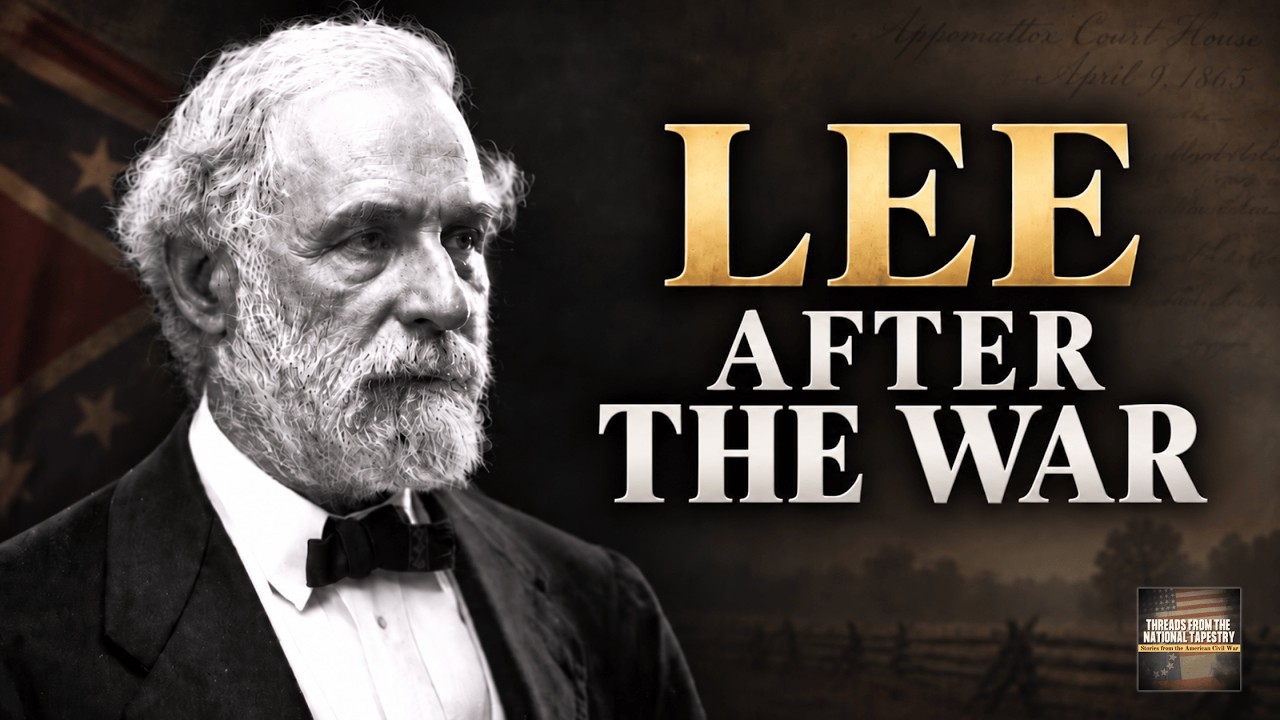
He dismounted, climbed the steps, and turned to remove his mud-stained hat, bowing to the onlookers before disappearing inside. There, waiting for him, were his ailing wife Mary, three of his daughters, and two of his sons. His youngest son, Rob, was still with the fleeing Jefferson Davis and would not arrive for another two weeks. In his first days home, Lee slept often and rarely left the house.
When photographer Mathew Brady arrived and asked him to sit for a portrait, Lee refused, saying it was impossible while the world’s eyes were upon him. Brady eventually reached him through a family friend, and Lee reluctantly posed on the back porch, surrounded by his son and aide. Visitors came constantly, so many that family members took turns guarding the door. To avoid the crowds, Lee took his walks late at night, often accompanied by his daughter Mildred.
He told the homeowner he wanted a quiet little house in the woods where he could find shelter and his daily bread, if the victors permitted it, and expressed a wish to get his wife out of the city as soon as possible. That quiet hope was shattered on June 7, 1865, when a federal grand jury in Norfolk indicted Lee on charges of treason. Six days later, he wrote to General Ulysses S. Grant, arguing that the terms of surrender protected Confederate officers from prosecution as long as they honored the agreement.
He also enclosed his request for a pardon from President Andrew Johnson. Grant backed Lee’s interpretation and threatened to resign if Johnson forced him to break his word given at Appomattox. On June 20, Johnson relented, and Grant assured Lee he would not be tried for treason. That same month, a letter Lee wrote to his brother Carter revealed his private racial views.
“I have always observed that wherever the black man is, everything around him deteriorates,” he wrote. “Wherever the white man is, you see everything around him improving. ” The war had not changed Lee’s hierarchical assumptions about race. In public, however, his actions sometimes told a different story.
At St. Paul’s Episcopal Church in Richmond, when the congregation was called to communion, a tall Black man approached the altar rail. This was normally done only after all white communicants had finished. A murmur swept through the congregation.
Then Lee rose from his pew, walked forward, and knelt near the Black man, breaking the tension and allowing the rest of the congregation to follow. Later that month, Lee left Richmond. His family moved to Derwent, a small wooden house on a property between Richmond and Charlottesville, owned by Elizabeth Randolph Cocke. There, Lee spent the summer riding Traveller and considering writing a book about his campaigns.
In August, Judge John W. Brockenbrough of Lexington, Virginia, made an unannounced visit. He had borrowed $50 for the trip and wore a borrowed suit. The trustees of tiny Washington College had unanimously elected Lee as their new president.
The school was badly damaged by the war; a Pennsylvania regiment was still using some of its buildings. The offer included a house, a garden, a plot for vegetables, a share of tuition fees, and a salary of $1,500 a year, money the college did not yet have. Lee considered the offer for two weeks, seeking advice from others. He had doubts, particularly about teaching, as he disliked public speaking.
He wrote to the trustees suggesting he should decline because he did not feel able to conduct classes. He also feared he would bring hostility upon the college. But he changed his mind and accepted the position, and the trustees, relieved, agreed not to require him to teach classes. On September 15, 1865, Lee rode alone on Traveller to Lexington, a small mountain town of about 2,000 people.
He arrived wearing a gray suit, his old uniform stripped of all Confederate insignia and buttons, as required by federal authorities. Not everyone approved of the appointment. The New York Independent wrote that as president, Lee would be responsible for the morals of young men and called him “the most bloodthirsty and guilty traitor in the whole South. ” The trustees showed Lee the grounds, barren and war-damaged, and told him they had begun a fundraising campaign, with the attraction for donors being that gifts would increase his salary.
Lee quickly rejected that idea. On the first day of classes, October 2, the trustees had imagined a brass band and young girls in white. Lee stopped that too. That morning, there was a prayer and a brief welcome.
Lee took an oath, signed a copy, received the keys to the building, and began his work. That same day, he signed another document: he had to apply for a special pardon from President Andrew Johnson, adding a signed oath to his earlier request. Lee had about 50 students, many of them Confederate veterans, and he made an effort to learn their names and meet each one individually. When one veteran told Lee he was impatient to make up for the time he had lost in the army, Lee’s face flushed with anger.
“Mr. Humphreys, however long you live and whatever you accomplish, you will find that the time you spent in the Confederate army was the most profitable part of your life. Never speak again of having lost time in the army. ” The student later said he never did.
He went on to earn a doctorate in Leipzig and enjoy a long career as a classics professor at three major American universities. Lee’s daily routine was strictly organized: breakfast at 7:00, chapel at 7:45, office from 8:00 until 2:00, lunch, a short nap, a long ride on Traveller, a light dinner at 7:30, then reading until 10:00, when the windows were closed and he went to sleep. He answered all his mail personally and gave his faculty great freedom. He might enter a classroom mid-lecture, stay for a while, and quietly withdraw.
As president, he was responsible for discipline. When a student from Kentucky entered his office chewing tobacco, Lee sent him out. The student returned a few minutes later with the same plug still in his mouth. Lee wrote a notice and asked the student to read it: “The student whose name is mentioned is dismissed from Washington College for disrespect to the president.
” Lee was rarely harsh, but once he made a decision, it was final. At a trustees meeting on October 24, Lee arrived with a list of requests: he wanted five new professorships and five new departments, introducing one of the first elective systems in the country. He proved highly successful at fundraising. Cyrus McCormick, known for the reaper, agreed to donate $10,000.
As Lee settled into his role, Reconstruction politics began to intrude. The Thirty-Ninth Congress convened, and former Confederates appeared in Washington expecting to take seats as senators and representatives. Republicans questioned President Johnson’s Reconstruction plan, and a joint committee of 15 members was formed. Lee, more than most Southerners, understood the war was lost, but he and most of the country did not yet grasp that the Union of 1865 was not the Union of 1861.
In February 1866, Lee was called to testify before that joint committee in Washington. He arrived on February 16 and was hesitant to visit old friends, writing that he was “considered such a monster” that he hesitated to cast his shadow on the doors of those he loved. The next day, he took the oath, wearing his gray uniform stripped of insignia because he owned no other suit. Senator Jacob M.
Howard of Michigan led the questioning. Lee said Southerners would submit to taxes, most would prefer not to mix socially with Northerners moving South, and they believed President Johnson’s plan would restore civil government. Asked about the freedmen, Lee stated he did not believe the Black man was capable of acquiring knowledge like the white man. He described them as a friendly, social race who looked more to the present than the future.
Asked whether Southerners would oppose a constitutional amendment allowing Black men to vote, Lee said they would. He believed it would provoke unfriendly relations between the races. When Senator Howard pushed further, Lee said Black men could not “vote intelligently” and that granting them suffrage would exclude proper representation. Senator Henry T.
Blow of Missouri took up the questioning. Asked whether Virginia would be better off if its Black population left for other Southern states, Lee answered, “I think it would be better for Virginia if she could get rid of them. ” He added that this was not merely his opinion and that he had always been in favor of emancipation, gradual emancipation. Asked whether Southerners were loyal to the Union, Lee said the prevailing feeling was that the Southern states were not being granted equality with the North.
Asked whether he feared any combination of secessionist leaders to resume the war, Lee replied he had no reason to believe so and had not even heard a hint of it. Asked what his choice would be if a powerful foreign ally offered a chance to resume the war, Lee answered, “I have no desire to do it now, and never had. ”
Howard then asked whether a jury in Lee’s district could ever convict Jefferson Davis of treason for waging war against the United States. Lee said it was very probable they would not consider it treason.
When Howard asked about Lee’s personal views, Lee responded that Virginia’s decision to secede had bound him as a citizen, and its laws and resolutions were binding upon him. Lee had been on the stand for two hours. His themes of reconciliation and recovery remained consistent, and the disappointed committee dismissed him. He returned happily to Lexington.
His wife Mary was more outspoken. In May 1866, she complained of being “terribly robbed” by “lazy idle blacks” hanging around the streets. Historian Emory Thomas, in his 1995 biography, wrote that some of Mary Lee’s writings to a friend reflected her husband’s feelings, but Robert E. Lee rarely allowed his feelings to find public expression.
By the end of June 1866, Lee’s first academic year was clearly successful. The faculty had grown from 4 to 15 members, the college had received more than $100,000 in donations, and there were now 10 departments. Lee’s salary had been doubled. Lee’s personal lifestyle remained austere.
He slept in a bare white-painted room separate from Mary’s quarters, in an old camp bed. In the room’s umbrella stand, which he never used because he never carried an umbrella, rested a sword presented to George Washington by the Continental Congress, a sword belonging to his father, Light-Horse Harry Lee, and two swords of his own: one from the Confederate Congress and the one he had worn at Appomattox. During one of his rides, he visited an elderly woman north of Lexington who showed him the remains of a tree damaged by Union artillery fire. She waited for his comment.
“Cut it down, my dear madam, and forget it,” he said. In his correspondence, Lee accepted the results of the war and the abolition of slavery but worried that an overly powerful federal government would prove a threat to the reserved rights of the states and the people, leading to a nation that would be “certainly aggressive abroad and despotic at home. ”
The summer of 1866 was turbulent, with racial riots in New Orleans and Memphis and the founding of the Ku Klux Klan in the spring. Lee, meanwhile, was deeply involved in the college’s buildings and grounds.
He ordered his new superintendent not to plant trees in rows and to paint fences as inconspicuously as possible. The new chapel was his favorite project. Washington College had no written rules; everyone was expected to act as gentlemen. A grade was given in every subject every week, and any struggling student received a note to see Lee.
One student recalled that an invitation to visit Lee was the most feared event in a student’s life. In March 1867, politics again intruded. Congress passed the Reconstruction Acts, and on March 13, Virginia ceased to be a state and was designated Military District Number One. White speakers from the North were scheduled to give speeches to African Americans in Lexington.
Five angry students, one from Alabama carrying a pistol, decided to attend. When the Alabama student was confronted by a Black man, he drew his pistol until others intervened. The students were arrested and jailed except the one from Alabama. On campus, many resolved to rescue their classmates, but an official intervened and calmed the crowd.
The four jailed students were released but charged with disturbing the peace. When they met with Lee, the Alabama student was already there, having come voluntarily, and admitted he was the one to blame. Lee agreed and dismissed him immediately. The other four were placed on probation.
Lee’s conciliatory stance won him admirers even in the North. There was a Lee Society in Poughkeepsie, New York, and the Daily Sentinel in Evansville, Indiana, urged the Democratic Party to nominate him for president, an interesting suggestion for a man still awaiting his presidential pardon. Back in December 1865, Lee’s personal qualities had inspired four students to create an organization modeled on his character. That fraternity, Kappa Alpha, today has about 122 active chapters.
When a student asked Lee for a copy of the college’s rules, Lee replied, “Young gentleman, we have no printed rules. We have but one rule here, and that is that every student must be a gentleman. ” This was, in essence, the birth of the honor system. By the end of Lee’s second administrative year, the faculty had grown to 22 members.
Students came from Massachusetts, New Jersey, Pennsylvania, Kansas, and even California. The library held more than 5,000 books, and enrollment had reached 411, ten times the number at the war’s end. Cyrus McCormick added another $5,000 to his original $10,000 donation. Richard S.
Ewell, Lee’s former second corps commander, gave $500 but stipulated it be used to increase Lee’s salary. Lee thanked him but asked permission to use the money for the school’s general endowment instead, adding a revealing comment: “For my part, I am enjoying the pleasures of civil life very much, and find late that I have wasted the best years of my existence. ”
The rheumatism that had long plagued him continued to cause pain; future doctors would recognize it as angina. His hair had turned completely white, and he had gained weight.
Still, there was work to be done. A major fundraising event for the college was planned for March in New York City, with 500 prominent and potential donors invited. Everything seemed promising. Then, once again, his past brought a new round of trouble, not only for him but for the college he served.
That story continues in Part Two.