Muammar Gaddafi, the man who ruled Libya with an iron fist for more than four decades, died in the dirt of a drainage pipe outside his hometown of Sirte on October 20, 2011, bloodied, captured, and beaten by the very fighters he had once dismissed as rats and traitors.
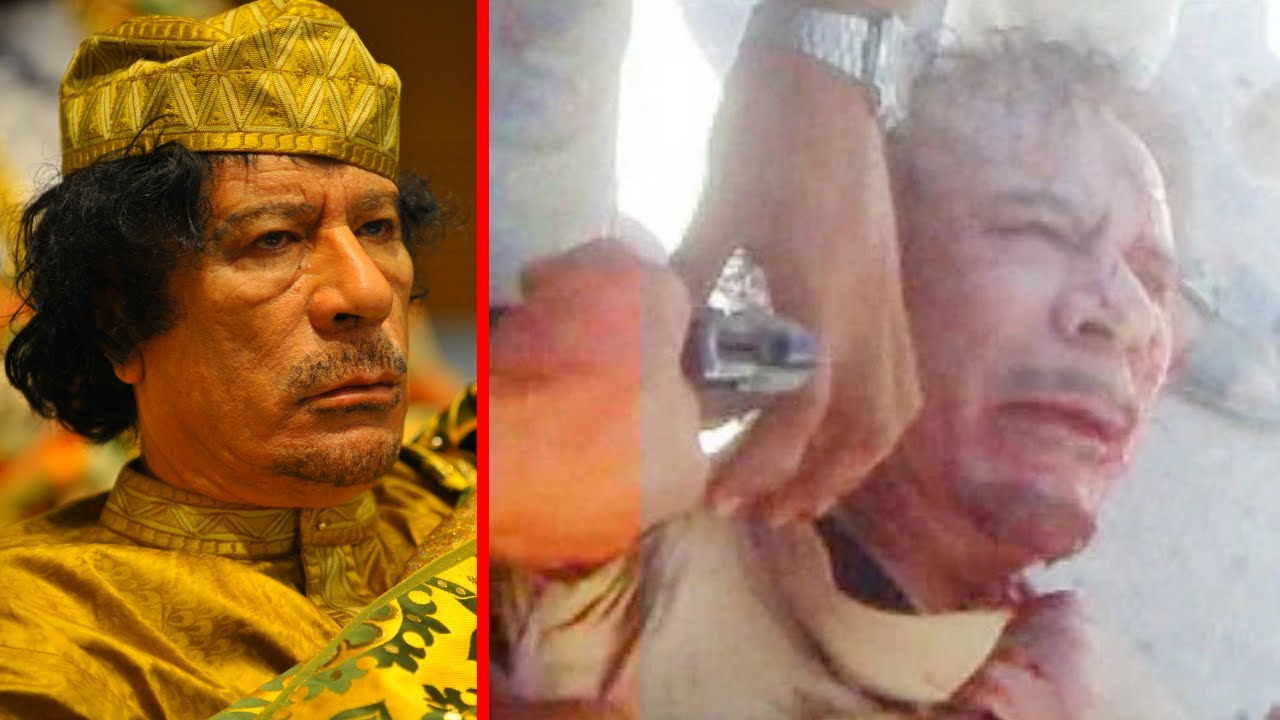
His death at the age of 69 ended one of the most brutal and unpredictable dictatorships of the modern era, a reign that began with a bloodless coup in 1969 and collapsed under a storm of NATO airstrikes, popular uprising, and tribal betrayal.
The final hours of Gaddafi’s life were chaotic, violent, and captured on dozens of cellphone cameras, images that would be broadcast around the world within minutes and seared into the memory of a nation that had suffered under his rule for generations.
By October 2011, Gaddafi was a fugitive in his own country. Tripoli had fallen in late August. His wife, Safia Farkash, and several of his children had fled across the border into Algeria.
His son Saadi had escaped to Niger, where he was later detained.
But Gaddafi refused to leave Libya. He believed that abandoning the country would mean total defeat. Instead, he retreated to Sirte, the Mediterranean coastal city he had built up as a personal fiefdom and once dreamed would become the capital of a United States of Africa.
Sirte was more than a hideout. It was the heart of his tribe, the Qadhadhfa, and the last patch of territory still loyal to him. By mid-September, forces from the National Transitional Council had surrounded the city and begun a slow, deadly block-by-block advance.
Inside Sirte, Gaddafi moved between abandoned homes and underground bunkers. He avoided phones and radios, fearing that any electronic signal would bring a NATO bomb down on his head. Messages were carried on foot by runners who slipped through the rubble.
His inner circle had shrunk to roughly 200 fighters, most of them from his own tribe. Among them were his son Mutassim, a military commander, and Abu Bakr Younis Jabr, Libya’s longtime defense minister. Both men would die within hours of Gaddafi himself.
Witnesses later described a man transformed by fear and deprivation. Gaddafi had lost weight. His beard had grown long and white.
He looked pale, exhausted, and far removed from the confident figure who had once addressed crowds from balconies and television screens.
He suffered from high blood pressure, mild diabetes, and stress-related illness. Medical supplies were almost nonexistent. Wounded fighters were treated with basic tools, and antibiotics were reserved for the most severe cases.
Hunger and dehydration weakened everyone in the group.
Still, Gaddafi refused to surrender. His plan was to break through the siege and flee south toward Sabha, a desert city in central Libya, and from there possibly cross into Niger or Algeria, where other members of his government had already found refuge.
Every exit route was blocked. Rebel forces watched the roads. Convoys leaving the city were attacked or turned back.
NATO drones and surveillance aircraft circled overhead constantly, tracking heat signatures and radio signals in the hope of finding him.
On October 19, Gaddafi made the decision to run. He and his remaining loyalists prepared a convoy of more than 50 vehicles, mostly pickup trucks and SUVs, many fitted with mounted machine guns and anti-aircraft weapons.
Among those in the convoy were Mutassim Gaddafi, Abu Bakr Younis Jabr, and Mansour Dao, Gaddafi’s chief of security. A few family members were also present. The plan was to leave under cover of darkness and follow a desert route southwest toward Wadi Zam Zam.

Around 8:00 p. m. , the vehicles began moving out from a hidden location in the city.
They traveled without headlights, trying to stay hidden between buildings and under trees. The darkness, they hoped, would shield them from the eyes in the sky.
They were wrong. American and French intelligence had been monitoring unusual movements around Sirte for weeks. That same night, a US MQ-1 Predator drone picked up heat signatures showing a convoy forming and moving out of the city.
In the early hours of October 20, as the convoy reached the western outskirts of Sirte, it was spotted again, this time more clearly. Around 8:30 a. m.
, NATO made its final move. A Predator drone launched a Hellfire missile directly at the lead vehicles.
The missile struck the front of the convoy, halting it immediately. Minutes later, French Mirage fighter jets dropped laser-guided bombs on the rear. Multiple vehicles exploded in flames.
The attack trapped those in the middle and sent the rest into panic.
Dozens of loyalist fighters died on the spot. Survivors jumped from their vehicles and ran toward nearby unfinished buildings, open lots, and a large concrete drainage pipe under the road. Gaddafi, Mutassim, Mansour Dao, and a handful of others fled on foot.
Covered in dust and blood, they slipped into the pipe, which was about four feet in diameter, just large enough for a man to crawl through. Inside, they waited in silence, hoping to avoid detection as rebel fighters from Misrata moved into the area.
The rebels had been following the convoy’s path for days. They arrived shortly after the airstrike, armed with rifles, grenades, and light machine guns. They began searching damaged vehicles, nearby buildings, and the surrounding land.
It did not take long before they noticed blood stains and footprints near the road. A few fighters followed the trail and spotted the drain entrance. They threw in a grenade first, expecting more guards to be hiding inside.
Then they moved closer to inspect.
That was when they saw Gaddafi crouched inside. He was wearing brown pants, a bloodstained shirt, and a flak vest. His hair was matted.
His face was covered in blood and dirt. He had injuries on his left arm, back, and right leg, most likely from the blast and debris.
They pulled him out into the sunlight. He stumbled, barely able to walk. Mutassim Gaddafi, also wounded but still standing, was captured moments later along with Abu Bakr Younis Jabr, who was seriously injured.
A few others tried to flee and were shot or captured on the spot.
The rebels dragged Gaddafi to a nearby road. They sat him down and placed him in the back of a pickup truck. By now, more and more fighters had gathered.
News of his capture had spread quickly over radios and phones, and many rushed to the scene.
As the truck moved slowly through the narrow roads, people began hitting him with sticks, fists, and gun butts. Some pulled his hair and yanked at his clothes. Others shouted insults, referencing the years of dictatorship, torture, and bombings Libyans had endured under his rule.
 A few fighters climbed into the back of the truck to get closer to him. There was little control over the situation. Multiple videos later shared across the world showed Gaddafi slumped over, bleeding heavily from the head and midsection.
At one point, he tried to sit up but was forced back down.
The violence continued for several minutes as the truck tried to move through the packed streets. The exact moment of his death remains unclear. According to medical reports, he had been shot in the head and abdomen.
Some say he was shot during the struggle in the truck. Others believe a fighter may have pulled the trigger deliberately. There was no official trial, no announcement of a formal execution, and no confirmation of who fired the fatal shot.
What is certain is that by the time the truck left the outskirts of Sirte and reached an NTC-controlled checkpoint, Muammar Gaddafi was dead. His body was covered in blood, his shirt torn, and his pants soaked. He had multiple gunshot wounds and bruises across his body.
Doctors who later examined him confirmed that he died around 1:00 p. m. on October 20, 2011.
His body was taken to the city of Misrata, which had suffered deeply during the war, and for three days it was kept inside a refrigerated meat locker in a local market.
People lined up in the hundreds to see it. Many took photos or recorded videos. It was a moment of closure for some and revenge for others.
The bodies of Mutassim Gaddafi and Abu Bakr Younis Jabr were also brought to Misrata. Both men had died shortly after capture.
On October 23, just three days later, the National Transitional Council officially declared the end of the civil war. After more than eight months of conflict and more than 30,000 deaths, Libya was now under new leadership.
Once the public viewings ended, the question of Gaddafi’s burial became urgent. On the night of October 25, 2011, he was buried in a remote desert location somewhere in western Libya. To this day, the precise burial site remains unknown to the public.
Gaddafi’s end was violent, but it reflected the kind of rule he had maintained for years. He seized power in 1969 at the age of 27, overthrowing King Idris in a bloodless coup. He abolished the monarchy, closed US and British military bases, and nationalized the oil industry.
He created his own political system, the Jamahiriya, which he claimed gave power to the people but in reality concentrated all authority in his hands. Political parties were banned. Freedom of speech did not exist.
Corruption was everywhere, and the wealth from oil mostly stayed with the elite.
During the 1970s and 1980s, Gaddafi was known around the world for his radical ideas and support for armed groups in other countries. He was blamed for terror attacks, including the 1988 bombing of Pan Am Flight 103 over Lockerbie, Scotland, which killed 270 people.
Libya faced heavy international sanctions for years. But Gaddafi also tried to present himself as a pan-African and pan-Arab leader, pushing for unity among African countries and positioning himself as a strong voice against the West.
By the 2000s, he had started to soften his image. He gave up weapons programs, reopened ties with Western nations, and tried to rebuild Libya’s economy. Still, inside Libya, many people were angry.
They lived under tight control and watched as Gaddafi and his family lived in luxury while ordinary Libyans struggled.

When protests broke out in February 2011, inspired by the Arab Spring uprisings in Tunisia and Egypt, they spread quickly. In Benghazi, families of political prisoners gathered outside a police station on February 15 to demand the release of human rights lawyer Fathi Terbil.
The protest gained momentum, and by February 17, thousands of Libyans filled the streets in Benghazi, Bayda, Tobruk, and Derna. Security forces opened fire. Reports from hospitals confirmed that over 230 people were killed within four days, many shot in the chest and head.
Gaddafi’s son, Saif al-Islam, appeared on television warning of civil war and threatened that rivers of blood would flow if the protests did not stop. But the crackdown only pushed more people to resist. By the end of February, key military units began to defect.
The opposition organized into the National Transitional Council, formed officially on February 27 in Benghazi and led by former Justice Minister Mustafa Abdul Jalil. Meanwhile, Gaddafi held on to Tripoli and surrounding areas in the west, using elite units and foreign mercenaries to suppress protests.
By early March, Gaddafi’s forces were using heavy weapons, tanks, and air power to retake rebel-held cities. Civilians were being bombed. International news showed graphic images of destroyed neighborhoods.
The fear was growing that Gaddafi would carry out a massacre if he reached Benghazi.
On March 17, 2011, the United Nations Security Council passed Resolution 1973, authorizing the use of all necessary measures to protect civilians, including a no-fly zone. Two days later, airstrikes began. Over 110 Tomahawk cruise missiles were launched from US and British warships in the Mediterranean.
On March 23, NATO took full command of all military operations under a new mission named Operation Unified Protector. The air campaign quickly destroyed a large portion of Gaddafi’s military infrastructure. His fighter jets, bombers, and air bases were hit.
Supply convoys and command centers were targeted.
Despite the damage, Gaddafi remained defiant. He continued to speak to the public through state television, accusing NATO of trying to colonize Libya. He called the rebels rats and traitors and promised to cleanse the country street by street.
By mid-2011, the situation on the ground had shifted in favor of the rebels. On August 20, they launched Operation Mermaid Dawn, their final assault on Tripoli. Five days later, they overran Bab al-Azizia, Gaddafi’s heavily guarded compound in central Tripoli.
But the man himself was gone. He had fled the city before the final attack began, likely around August 19 or 20. He moved between safe houses with the help of loyal tribal networks, refusing to leave Libya even as his family scattered across borders.
His decision to stay sealed his fate. For weeks, he hid in Sirte, moving between abandoned homes and bunkers, avoiding phones and radios, relying on human messengers who moved through the city on foot. His world had shrunk to a few hundred fighters and a handful of loyal aides.
Even after his death, many questions remained. Who ordered the final shot? Why wasn’t he tried in court?
Could his capture have ended differently? But for many in Libya, it did not matter. The man who had ruled them for 42 years was gone, and the country he left behind was already sliding toward a new and uncertain future.