VERDUN, France — Gen. George S. Patton Jr.
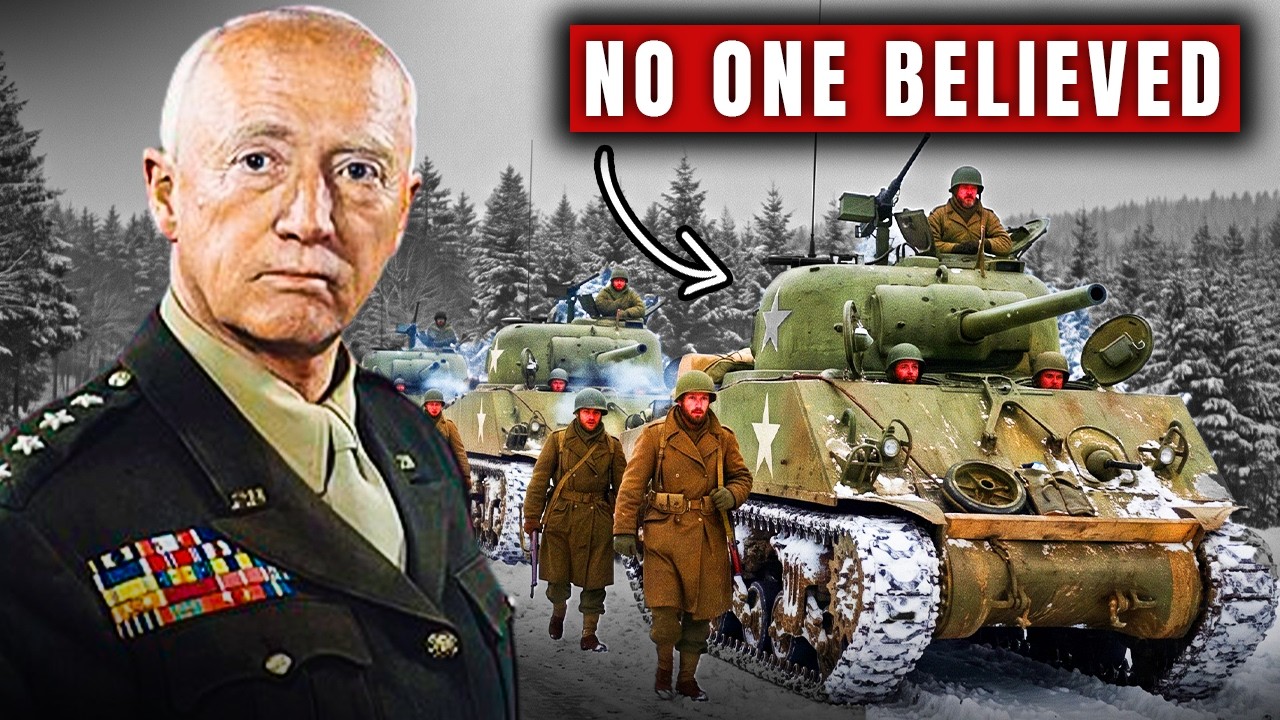 told Gen. Dwight D. Eisenhower he could attack toward Bastogne in 48 hours, a promise that stunned the room and set in motion one of the most audacious relief operations of World War II.
The date was Dec. 19, 1944. Three days earlier, Germany had launched the largest offensive on the Western Front since 1940, tearing a 50-mile gap in the American line through the supposedly impassable Ardennes Forest.
Three German armies were driving west. The 6th SS Panzer Army under Sepp Dietrich pushed northwest toward the Meuse River. The 5th Panzer Army under Hasso von Manteuffel drove due west, its armored divisions converging on Bastogne.
That small Belgian crossroads town held the key. Seven roads converged there from every direction, making it the logistical node through which any German advance west had to pass to maintain operational coherence.
The 101st Airborne Division, rushed from its rest area at Mourmelon in trucks on Dec. 18, had arrived ahead of the German encirclement. Brig.
Gen. Anthony McAuliffe was organizing the defense with remnants of the 10th Armored Division’s Combat Command B, the 705th Tank Destroyer Battalion, and assorted artillery and engineer units.
They were surrounded, or would be within hours. They needed relief. The question was from whom and when.
Eisenhower turned to Patton. How soon could the Third Army attack toward Bastogne?
The professional calculation was staggering. The Third Army had been pressing northeast toward the Siegfried Line, its divisions oriented east, its logistical infrastructure aligned for that direction. Now it would have to swing 90 degrees north into the Ardennes over 100 miles of Belgian winter roads.
Normal military planning projected such a reorientation would require five to seven days minimum. The relief force would have to disengage from contact with the enemy, be supplied with ammunition and fuel for a different direction of attack, reorient its march columns, and conduct a 100-mile road march before the actual attack could begin.
Eisenhower was probably expecting to hear a week. Every professional calculation in the room produced a week.
Patton said 48 hours.
The room went silent. But not the silence of disbelief. Patton’s fellow senior commanders had worked with him long enough to know his operational estimates were more reliable than his social behavior.
When Patton said he could do something in a specific time, the professional evidence of the Lorraine campaign and the race across France suggested he had the operational foundation to back the claim.
The silence was the silence of men recalculating the possible, recalculating their own estimate of what the situation required and what the forces available could produce against the estimate Patton had just delivered.
What the room did not yet know was that Patton had been preparing for this moment for two weeks.
Before the German offensive began, before the Verdun conference was called, before anyone was asking the question Eisenhower was now asking, Col. Paul Harkins and the Third Army G3 section had been working on contingency planning that Patton ordered in early December.

Patton’s professional assessment of the German military situation had convinced him that an offensive in the Ardennes was not a theoretical possibility but an operational probability. He could not identify the timing precisely, but he had identified the direction with the professional accuracy of a commander who had been reading German operational doctrine for years.
The contingency plans were specific. They named the divisions, identified march routes by route number and code name, calculated fuel and ammunition requirements for the 100-mile march and the first three days of combat. They specified the communications reorganization the 90-degree reorientation would require.
If the Germans attacked through the Ardennes and the Third Army was ordered to reorient north, the plan specified which divisions would form the relief force: the 4th Armored Division and the 26th and 80th Infantry Divisions. It identified which routes they would take north through Luxembourg and Belgium. It calculated the logistics requirements for approximately 50,000 soldiers conducting a 100-mile road march in December.
The plans existed before Dec. 16. They were not theoretical exercises requiring days of staff work.
They were operational planning documents whose existence allowed Patton to say at Verdun that the orders were already written and the march could begin within hours of the conference’s conclusion.
When he told Eisenhower he could attack in 48 hours, he added that he could have the 4th Armored Division and two infantry divisions moving north within the day. Not would have them moving, but could have them moving, because the orders that would make it happen were already written and already in his staff’s hands.
He was not improvising. He had been ready for this for two weeks.
The orders went out from Third Army headquarters on the night of Dec. 19. Lt.
Gen. John Millikin’s III Corps was designated as the relief force. Maj.
Gen. Hugh Gaffey’s 4th Armored Division would drive the armored spearhead north from Luxembourg toward Bastogne on the Arlon-Bastogne Road.
The 26th Infantry Division under Maj. Gen. Willard Paul would secure the 4th Armored’s eastern flank against German forces along the Sauer River.
The 80th Infantry Division under Maj. Gen. Horace McBride would protect the western flank.
The three divisions pulled out of their positions along the Saar front in a complex choreography of simultaneous disengagement and reorientation. They extracted from contact with German forces they had been pressing since November, reversed their march columns on roads aligned for east-facing operations, and reoriented north on the Belgian road network.
The roads north were narrow. The columns were long. The Belgian winter was hostile to motorized military movement.
Ice formed on the asphalt. Snow narrowed the road surface and covered the ditches. Darkness arrived at 4 p.
m. and persisted until 8 a. m.
, hours in which the column had to move by blackout light on roads it had never traveled before.
On Dec. 21, the relief drive met its first serious resistance. The 4th Armored Division’s Combat Command B, driving north on the Arlon-Bastogne Road, encountered the German 5th Parachute Division’s defensive positions south of Bastogne.
The fighting was close, expensive, and slower than the operational timeline required. The 5th Parachute Division had been positioned across the Bastogne relief corridor by a German command that recognized the Americans would attempt relief from the south.
American tank crews worked with infantry in the close-range fighting of the Ardennes winter, where visibility was limited by forest and snow, and where the 5th Parachute’s anti-tank guns extracted the price that the blocking position’s preparation had made it capable of extracting.

Progress was slower than Patton’s plan projected. The 48-hour promise was under pressure.
On Dec. 22, the near failure of the Bastogne relief arrived simultaneously in Bastogne and on the road south of it. In Bastogne, the German 47th Panzer Corps delivered a formal surrender demand to McAuliffe, delivered by four German officers under a white flag.
McAuliffe read it and produced the reply that would become one of the most famous responses in American military history. The single word, delivered in the same formal procedure through which the demand arrived, was the specific and public statement of a garrison commander who had been told by Patton that relief was coming and who believed it.
But from the III Corps’ perspective, advancing from the south through the Belgian winter, the near failure was the specific and operational problem of the 4th Armored’s Combat Command B having been checked by the German 5th Parachute Division’s blocking position. The relief columns could not find the gap that would allow the armor to break through to the town before the 101st Airborne’s ammunition ran out.
The 101st Airborne was rationing artillery rounds, calculating ammunition expenditure against the assault rate and determining that the rate of expenditure was outrunning supply at a pace that would produce operational inability to sustain the defense within days. Medical supplies were critically low.
The Bastogne perimeter was under constant German assault from the 26th Volksgrenadier Division and elements of the Panzer Lehr Division and the 2nd SS Panzer Division, pressing the 101st’s circular defense at every compass point, probing for the weak sector whose exploitation would collapse the perimeter.
McAuliffe had told his division that help was coming. He believed it. His soldiers believed him.
But the ammunition was running out and the relief was not there yet.
Patton was on the telephone to Millikin and to Gaffey demanding more pace, the pace that the 48-hour promise required, the pace that the Bastogne garrison’s ammunition supply required, the pace that the operational situation required regardless of what the German blocking position and the Belgian winter were producing as constraints.
On Dec. 23, the weather broke. For five days since the Ardennes Offensive began, the cloud ceiling over Belgium had been low enough to ground the Allied tactical air forces whose fighter-bombers would otherwise have been attacking German supply columns and armor concentrations.
The low overcast had been the German offensive’s ally as surely as the 6th SS Panzer Army or the 5th Panzer Army, protecting German columns from the XIX Tactical Air Command and the IX Tactical Air Command, whose aircraft had been sitting on the ground waiting for the ceiling to lift.
On Dec. 23, the skies cleared. The P-47 Thunderbolts were in the air by morning, attacking German supply lines and tank formations whose vulnerability to the fighter-bombers’ cannon and rockets had been waiting for the weather window for six days.
German logistics began to crack under the air attack. The fuel trucks that did not arrive, the ammunition vehicles burning on the Houffalize road, the supply columns whose movement the fighter-bombers turned from operational routine into operational lottery.
At Bastogne, the clearing weather brought the C-47 transport aircraft whose crews had been waiting for the ceiling to lift since Dec. 16. They dropped supplies to the surrounded garrison: food, medical supplies, and most critically artillery ammunition whose arrival restored the 101st’s artillery to the rate of fire the defense required.
On Dec. 26 at 4:45 p. m.
, the lead elements of the 4th Armored Division’s Combat Command R under Col. Creighton Abrams broke through the German encirclement south of Bastogne and made contact with the 101st Airborne’s perimeter at the village of Assenois.
The 37th Tank Battalion and the 53rd Armored Infantry Battalion, fighting together in the combined-arms operation the relief drive’s final phase had been building toward for six days, punched through the 5th Parachute Division’s blocking position in fighting whose last hours were the most costly and most urgent of the entire relief operation.

The corridor was narrow, a gap in the German encirclement that the 4th Armored had punched through with the determination of armored soldiers who had been fighting through the Belgian winter for six days with the knowledge that 18,000 men in Bastogne were depending on them to arrive.
Abrams drove his command car through the corridor himself, through the gap whose narrow width was the measure of how close the German blocking force came to preventing the relief entirely. He reached the Bastogne perimeter as the December dark settled over the Belgian countryside.
The siege of Bastogne was broken. The corridor would be widened in the days that followed, and the fighting around Bastogne would continue into January. But the essential operational fact was established at 4:45 p.
m. on Dec. 26, seven days after Patton promised to do the impossible in 48 hours.
The relief of Bastogne had been accomplished.
The numbers tell part of the story. Patton swung three divisions of III Corps, approximately 50,000 soldiers with their tanks, artillery, trucks, and logistical tail, 90 degrees in 48 hours and drove them 100 miles through the worst winter weather in the Ardennes in 40 years against a German offensive force of 250,000 men.
The operation preserved 18,000 American soldiers of the 101st Airborne and attached tank destroyer and armored elements from capture or destruction. It stabilized the southern shoulder of the Ardennes salient at the moment when the German 5th Panzer Army’s advance was threatening to reach the Meuse River.
The tactical cost was significant. The 4th Armored Division suffered approximately 1,000 casualties in the Bastogne relief drive. The 26th and 80th Infantry Divisions together suffered comparable losses securing the corridor’s flanks.
The 101st Airborne Division suffered approximately 2,000 casualties inside the perimeter before the relief.
But the alternative — the fall of Bastogne, the destruction or capture of the 101st Airborne’s 18,000 soldiers, the German advance accelerating through the broken southern shoulder toward the Meuse and beyond — was calculated by the Allied command at Verdun on Dec. 19 as a cost too large to bear.
Patton’s pre-planned contingency orders, the operational preparation that allowed him to save 48 hours when every military calculation said a week, to promise the impossible at the moment when the Allied command needed the impossible to be promised, are the professional legacy of the Bastogne operation.
They demonstrate what the American military’s best operational commanders had become by December 1944. Not commanders who respond to the crisis after it arrives, but commanders who anticipate the crisis before it arrives, who build the operational plan for the contingency before it is required, and who arrive at the moment of Eisenhower’s impossible request with the plan already written and the orders already drafted.
Patton did the impossible at Bastogne because he had already done the preparation. The promise was the last step of a process he had been building since Dec. 1.
The lesson is not merely that Patton was a military genius, though the professional evidence of the Lorraine campaign and the Bastogne relief and the Rhine crossing at Oppenheim supports the characterization with a documented operational record of achievements that were not theatrical performances but operational facts.
The lesson is that genius in war is preparation applied to the crisis that no one else was ready for. The preparation that requires the professional to anticipate what has not happened yet, to build the plan for the contingency before the contingency has arrived, to carry the weight of the unasked question until the moment when the question is asked and the answer is ready.
The difference between the impossible and the achievable is usually measured not in the hours between the request and the response, but in the weeks between the professional who saw the crisis coming and the moment when everyone else discovered it had arrived.
Patton saw it coming. He was ready. And when Eisenhower asked the impossible, the answer was already written.