At twenty-six years old, Queen Marie Louise of Spain began to show terrifying symptoms. Abdominal pain, violent cramps, and vomiting. By the following day, she was dead. Rumors of poisoning swept through the court, but the truth was far more heartbreaking.
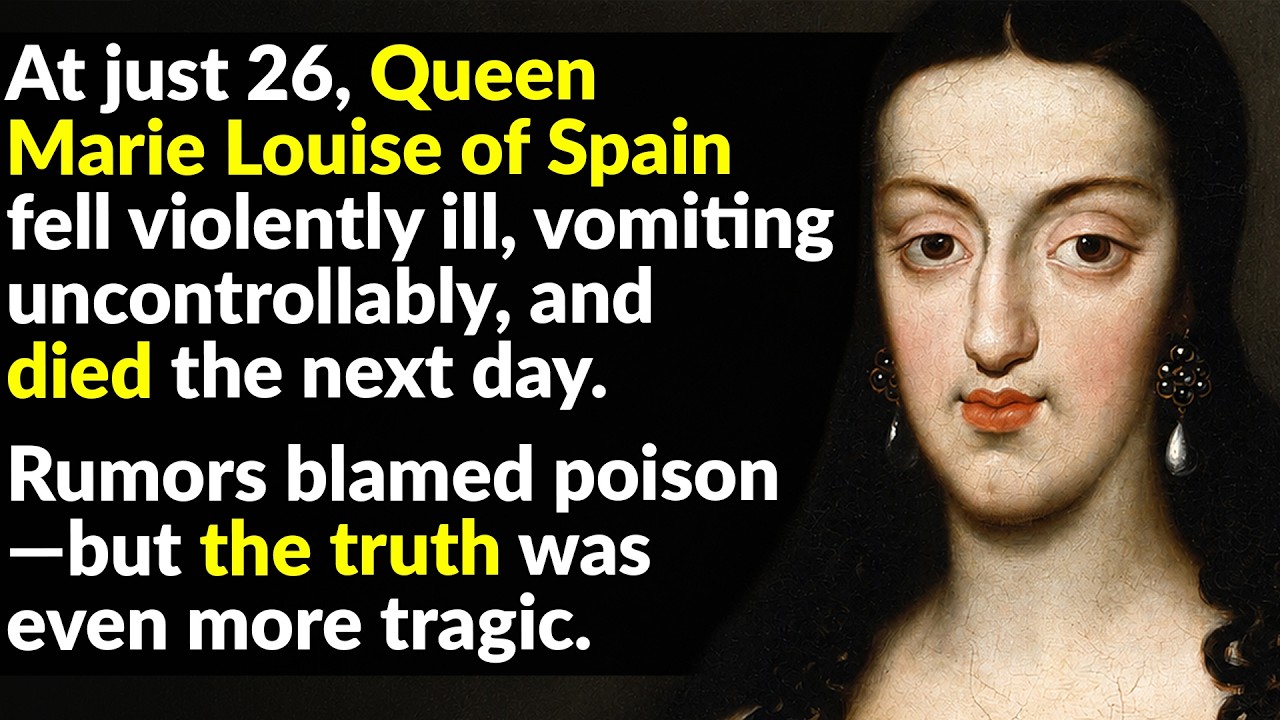
Marie Louise d’Orléans had been a French princess who became Queen of Spain. But when she failed to produce an heir to the throne, her new Spanish home became far less welcoming. She tried to soothe her sorrow with an unhealthy diet, and then she was struck down by a mysterious and fatal illness—just like her mother before her. Marie Louise d’Orléans was born on March 26, 1662, inside the elegant Palais Royal.
As the eldest daughter of Philippe I, Duke of Orléans, and Princess Henrietta of England, she belonged to the finest royal bloodlines in Europe. But her pedigree carried heavy burdens. Even in an era when royal inbreeding shocked no one, her family tree was alarmingly tangled. Philippe’s father and Henrietta’s mother were siblings, which made Marie Louise the daughter of first cousins.
She would never be able to escape the consequences of that lineage. As a granddaughter of King Louis XIII, Marie Louise held the lofty title of Petite-Fille de France, a mark of immense royal standing, though she was commonly called simply Mademoiselle. Her childhood contained moments of joy and moments of loss. Her younger brother, Philippe Charles, didn’t survive to the age of three, leaving her the only surviving child of her parents.
Fortunately, a sister named Anne Marie was born in 1669. That younger sister would one day become Queen of Sardinia. Marie Louise, however, would not be so lucky. Philippe I adored Marie Louise, and it was perfectly clear she was his favorite child.
Unfortunately, she wouldn’t get to enjoy her father’s love and protection forever. Marie Louise spent her early years moving between the bustling Palais Royal and the peaceful countryside estate of Saint-Cloud. She grew up surrounded by gardens, servants, and a loving extended family. Between her father andher paternal grandmother, Anne of Austria, Marie Louise wanted for nothing.
As a young girl, she spent countless hours with her grandmother. One source noted that Anne showered her with affection and left her much of her fortune, and the loss of Anne in 1666 devastated the young princess. In 1670, eight-year-old Marie Louise watched her mother Henrietta fall violently ill. Within hours, Henrietta was dead.
Her body had barely grown cold before whispers of poison spread across the court. Modern historians have since concluded that the illness was most likely caused by a perforated ulcer. But the rumors persisted. Just one year after Marie Louise lost her mother, her father remarried.
Her new stepmother was Elizabeth Charlotte of the Palatinate, known as Liselotte. Fortunately, this was not a Cinderella situation. In fact, it was quite the opposite. Unlike the wicked stepmothers of fairy tales, Liselotte did not seek to torment Marie Louise.
Instead, she embraced Marie Louise and her younger sister Anne Marie with warmth and playfulness, forming a genuine bond with both girls. For Marie Louise, who had lost so many maternal figures in her life, Liselotte stepped into the role of mother beautifully. She guided Marie Louise, comforted her, and helped her through the difficult times she was about to face in Spain. In 1678, Marie Louise’s uncle, King Louis XIV, signed a treaty with Spain.
But the fragile peace between the two kingdoms needed certain guarantees—and Marie Louise was that guarantee. To solidify the peace agreements, Louis XIV agreed to marry Marie Louise off to the troubled young King of Spain, Charles II. At just sixteen years old, her fate was sealed. In July ️1679, her father and her uncle summoned her to break the news.
Whether she liked it or not, she would marry Charles II of Spain. Marie Louise did not hide her feelings. She was deeply upset by this arranged marriage, and according to witnesses, she spent most of her time in tears. But the real bad news wasn’t just that she was a political pawn.
It was that her heart belonged to someone else. Since she was a child, she had been in love with her cousin, Louis, the Grand Dauphin. And everyone knew it. In desperation at the prospect of marrying Charles II, Marie Louise confronted Louis XIV herself.
His response to her pleas was brutally cold. Louis XIV asked her whether she could hope for a better match than a king for a daughter of France. Marie Louise, however, didn’t see it as a suitable marriage at all. She replied, “No, but you could have found a better match for your niece.
”
Marie Louise’s future husband was a king, but he looked more like a frog she was expected to kiss. The French ambassador to Spain said Charles II was so ugly he inspired fear and looked sickly. Unfortunately, the French ambassador wasn’t exaggerating. Charles II’s horrifying appearance was the tragic result of generations of inbreeding.
Throughout his youth, he battled a host of illnesses, including measles and smallpox. To make matters worse, he also suffered from rickets, meaning he needed leg braces until the age of five. His deformed jaw and oversized tongue made even chewing painful for him. The real question on Marie Louise’s mind was: why would her uncle be cruel enough to marry her off to such а man in the first place?
Louis XIV hadn’t chosen Charles II for Marie Louise out of affection or even political necessity. Frankly, his motivation was closer to obsession. Louis XIV saw that Charles II had been weakened by years of inbreeding in the Habsburg family, and he wanted to control him through marriage. Marie Louise would have to go along with it.
Fortunately for Marie Louise, she didn’t have to kiss Charles II just yet. On August ️30, 1679, she married by proxy to her distant relative, the Prince of Condé, who stood in for the absent King of Spain. She played her role as bride while her cousin pretended to be the groom. After her proxy wedding, Marie Louise broke down.
Her fate was sealed. According to contemporary reports, Marie Louise remained inconsolable after the ceremony. With the proxy wedding over, she had to leave the only home she had ever known. Before her departure for Spain, the French court held weeks of lavish celebrations in honor of the new Queen of Spain.
But Marie Louise could only focus on everything she was leaving behind. She went to the Val-de-Grâce convent before she left, where her mother’s heart was preserved. She would never return to France again. Louis XIV did not make Marie Louise’s departure any easier.
He feared she might flee Spain just as their relative Marguerite Louise had fled a loveless marriage in Tuscany. So, as his niece left France, he told her, “Farewell, Madame. ”” And he made sure to add,“And forever. ” Fortunately, Marie Louise had one last person who cared about her happiness.
To soften the blow of her exile, Liselotte traveled with Marie Louise for part of the long journey. Even after they parted, Liselotte’s letters became Marie Louise’s emotional lifeline in Spain. She was about to meet her husband face to face. In late 1679, Marie Louise finally met Charles II and held the wedding she had dreaded.
Once the royal couple exchanged their vows, Marie Louise was officially Queen of Spain. There was just one problem. She didn’t speak Spanish. Marie Louise and King Charles II shared a crown, but they did not share a single language.
Throughout their already awkward wedding ceremony, the bridal couple relied on the Marquise de Villars and her husband, the French ambassador, to translate their vows and interactions. It was not a romantic or promising beginning. As expected, Marie Louise hated the Spanish court. Their codes of conduct were far stricter than those in France.
Spanish tradition forbade anyone, even servants, from touching queens like Marie Louise. Marie Louise wasn’t merely restricted. She was practically imprisoned. In her new Spanish home, queens weren’t even allowed to look out of a window, lest commoners catch sight of their faces.
Yet, the things Marie Louise did see made her wish she could go home. Marie Louise found Spanish Catholic practices horrifying. Unlike the French version, she learned that the Spanish court expected queens to watch public punishments of the Inquisition, which included burning heretics at the stake. From themoment she arrived, Marie Louise was resented by her new Spanish subjects.
Courtiers whispered thatshe and her French servants were conspiring against the king. Fortunately, she had one ally at court—and the only one who truly mattered. Despite the hostility Marie Louise faced from the people and nobles of Spain, one person adored her. King Charles II himself.
He was said to have fallen in love with her the moment he saw her portrait. His devotion to her only grew once she arrived. In a sudden twist of events, her marriage wasn’t entirely awful. Marie Louise didn’t reciprocate Charles II’s deep love, but she eventually grew fond of him.
They even exchanged lessons. She taught him French. He taught her Spanish. Their friendship blossomed, but one part of the marriage was never successful.
Despite their best efforts, the couple could not produce an heir. After ten years of trying, Marie Louise confessed to the French ambassador that she knew she would never have children. Though it was a heartbreaking reality, she understood the fault wasn’t hers. With a sickly king and no heir in sight, the Spanish court sank into a state of fear.
Everyone—from ministers to nobles to commoners—sought answers, but no one dared blame Charles II. Marie Louise bore all the blame for the couple’s infertility. After Charles II’s death, the truth finally emerged. An autopsy revealed he had a shrunken testicle.
This was undoubtedly the cause of his childless marriage to Marie Louise. By then, however, Marie Louise had long since passed away, having endured the blame her entire life. The empty nursery, the frozen court, the endless accusations—it was all more than Marie Louise could bear. Sinking into deep depression, Marie Louise buried her sorrows in sweets while dreaming of France.
All those pastries had grave consequences. Marie Louise emotionally ate. Her favorite dishes were highly sweetened lemon and cinnamon drinks that required thirty-two pounds of sugar to prepare. Her diet caused her to gain weight.
The weight gain had fateful consequences. On February 11, 1689, Marie Louise went out riding. Afterwards, she complained of a sharp pain in her abdomen. By evening, she was suffering violent cramps and bouts of vomiting.
No one knew what was happening, but they knew what the final outcome would be. Marie Louise’s condition did not improve. So when her doctors finally admitted she would not recover, they did the only thing they could. They summoned a priest.
Confessors rushed to administer last rites to Marie Louise. Her final confession was something no one expected. In her last moments, Marie Louise said words to her husband he never imagined he would hear. She whispered,“There may be many women with His Majesty.
But none of them will love him more than I do. ”” Given how their marriage had begun, this was an ending no one could have predicted for the couple. On the night of February ️12, 1689, Marie Louise died inside the Royal Alcázar of Madrid. Just ten years after her unexpectedly happy marriage to Charles II.
She was only twenty-six years old. Marie Louise left behind a husband suddenly consumed by grief anda kingdom full of speculation. Marie Louise’s sudden, fatal illness sparked widespread rumors of foul play. All fingers pointed in one direction.
It was no secret thather mother-in-law wanted a more fertile wife for Charles II. Could she really have poisoned her daughter-in-law? Although many at the time believed Marie Louise was poisoned, historians believe something simpler and far sadder. Marie Louise most likely succumbed to a simple case of appendicitis—an infection easily treated with modern surgery.
The rumors of Marie Louise’s poisoning began in France, where the aggrieved Orléans family sought a pretext for revenge against their old enemy. To put an end to those rumors, the Spanish performed an autopsy on Marie Louise’s body and found no trace of poison. Marie Louise was laid to rest in the Pantheon of Infants. The Pantheon of Infants is reserved for Spanish princesses and queens who did not bear a future king.
Marie Louise joined their ranks—a young French bride who dreamed of home but found only sorrow, loneliness, and suspicion in Spain.