Barbara Hutton was born into a fortune that was vast even by the standards of the families history had already measured, yet her life became a cautionary tale told in public, a story of a woman who had everything money could buy and almost nothing it could not. Her grandfather had built an empire from buttons, thread, and penny candy, transforming a single correction in his business into a retail giant. He was new money, however, in a world that still valued the age of a fortune over its size, and this background of acquisition without acceptance set the stage for the next generation. Barbara was four years old in 1917 when she walked into her mother’s suite at the Plaza Hotel and found her dead.
There was no funeral conversation held for her benefit, no explanation offered, no acknowledgment in the years that followed that the event had happened to her at all. She was raised by governesses, a child taught early that a room could be full of people and still be entirely silent of affection. Her inheritance, when it came, was a sum adjusted for today’s terms that approaches a billion dollars, a figure that in the depths of the Depression sounded less like a legacy and more like a fable. She had staff for every task, schedules kept to the minute, and a lesson learned early that her wealth was the only thing about her that was consistently valuable to others.
Her first marriage, to the Georgian prince Alexis Mdivani, was a pattern of collection and cash-out. He was charming, fluent in five languages, and entirely without income of his own, and his attention was a thing she had never had without competition. For a few months she was happier than she had been since she was four, but when he left, the first of what would become a pattern across seven marriages was established: she had been collected briefly and then cashed out. In 1935, she married again, and the cruelty of that marriage was real and well documented.
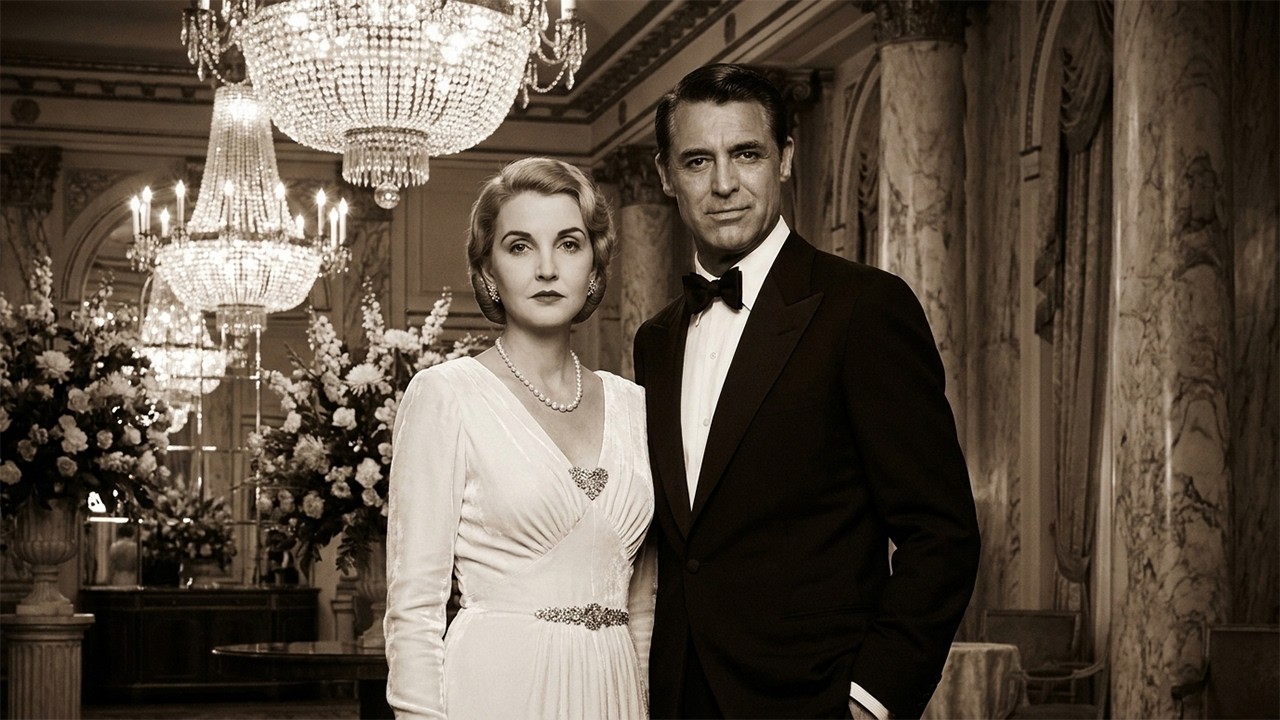
It was during this time that she developed the substance dependence and disordered relationship with food that would recur across the rest of her life. The marriage most often remembered as a punchline was her third, to the actor Cary Grant. It was the one marriage in which money changed hands the least and the affection, by all evidence, ran the deepest. Grant made it clear from the outset he wanted none of her fortune, and for roughly three years they lived something that resembled an ordinary, if extraordinarily wealthy, domestic life.
They remained genuinely fond of each other for the rest of their lives, exchanging letters for decades. The public had the joke exactly backwards: this was not a cash-and-carry transaction but a real connection between two people. What followed across the next two decades was a pattern that defined the rest of her life. A party, a husband, a withdrawal, a silence, and then eventually another party, as though enough noise might drown out what the silence in between kept returning to say.
She spent long stretches away from her fourth husband, the tennis player Igor Troubetzkoy, who was on the international circuit that had made him famous. The press loved these women for the same reason it punished them, dangling before an impoverished public the idea that money did not buy what it promised. Barbara Hutton did not invent this story; she simply lived the most extreme version of it in public for nearly 50 years. Beneath the headline-grabbing extravagance, however, ran a thread of real, unglamorous philanthropy that was largely uncovered by the same press that mocked her debutante ball.
Quiet generosity, unlike a $60,000 party, does not photograph. It was during her years in Tangier, Morocco, that this paradox of extravagance and isolation was most pronounced. She was a woman who had spent her entire life being looked at, and she had finally found a city willing to let her be looked at on her own terms. Yet the public spectacle of those parties sat directly beside a private loneliness that almost everyone who actually lived in the house described in nearly identical terms.
The one relationship that survived every divorce, every relocation, every collapse of every marriage that came before and after his birth was with her son, Lance. He was by the late 1950s a young man with a passion entirely his own—motor racing—that had nothing to do with his mother’s money or his mother’s name. He seemed, watching from a distance, to want as little to do with both as he reasonably could while still loving her. It was the most independent thing anyone in the family had managed in two generations.
He was the one object she kept until the end, a love that was never for sale. She withdrew further from public life in her final years. Her cousin, the actress Dena Merrill, and Merrill’s husband, the actor Cliff Robertson, were among her most frequent visitors. Robertson’s account of those visits became one of the most widely cited descriptions of who Barbara Hutton had become: a strong, determined mind housed inside a body that had simply stopped being cared for.
She died with almost nothing left of the fortune that had once been beyond ordinary imagining, and the one object she kept until the end had never been worth a single dollar to begin with. The world had decided what kind of story her life was going to be, but it was in the final accounting of her estate that the truth of her life was finally told. She had spent her entire life trying and failing to buy the one thing that had never been for sale: genuine, disinterested love.
A person raised from infancy inside that confusion may spend an entire lifetime unable to tell the difference between the two, paying and paying for something that by its very nature was not for sale.