In January 1927, a young civil servant sat before Britain’s Prime Minister and quietly confessed that he sometimes wished the next king would break his neck while out riding to hounds. The Prime Minister, Stanley Baldwin, looked at him for a long moment, then said: “My God, I’ve often thought the same thing. ”
That employee was Tommy Lascelles. Almost no one outside Buckingham Palace knew his name.
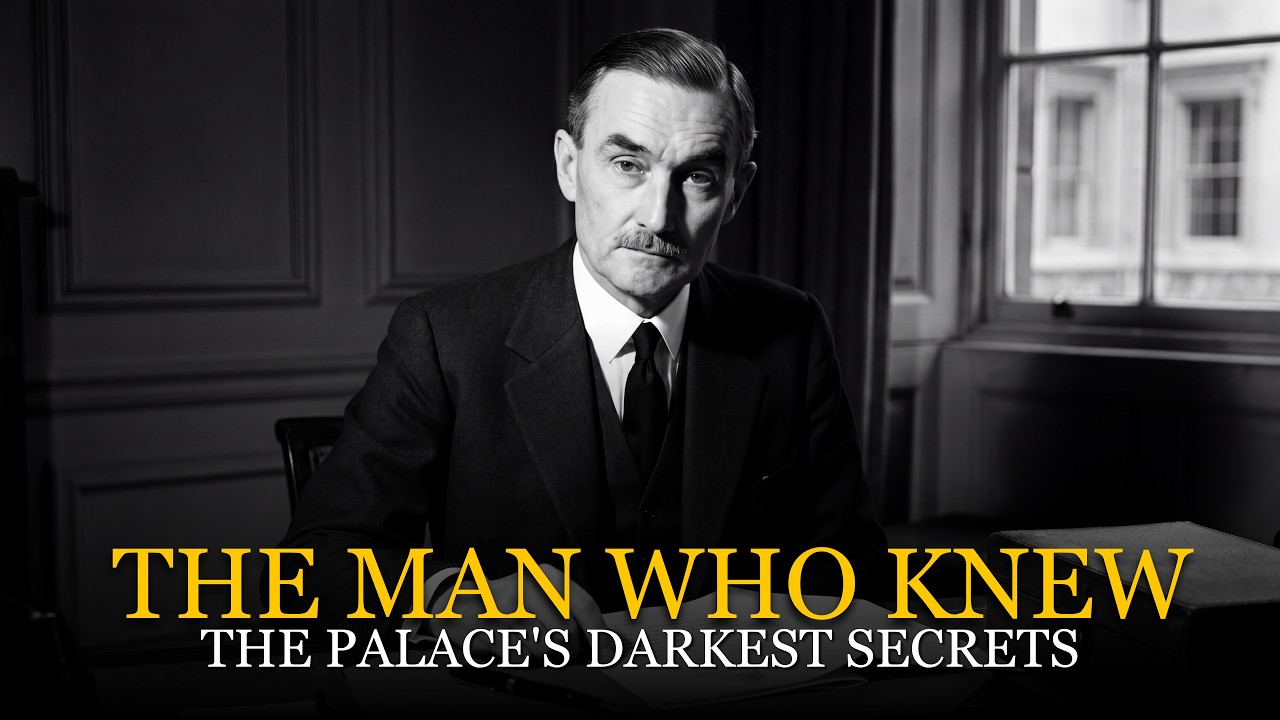
Over the next fifty years, he served four monarchs, kept a secret diary the size of a small library, and decided what aspects of royal life the British public would be allowed to see. He was the youngest son with no clear future. In 1920, a slim young man in a borrowed morning coat walked through the front gate of York House at St. James’s Palace, looking for the office of the Prince of Wales.
He was thirty-two years old. He had a military medal in a drawer at home and a degree in modern history from Oxford that no one had asked him to use. His name was Alan Frederick Lascelles, though no one who knew him called him Alan. Since childhood, he had been known as Tommy.
Born on April 2, 1887, in an unpretentious house in Kensington, his father was the Venerable Frederick Lascelles, the youngest son of the fourth Earl of Harewood. Younger sons’ sons inherit very little. They inherit the name, and the style. And if they are clever, they inherit the expectation that they should find something useful to do with their lives, because no fortune will be left to them.
Tommy was clever. Marlborough College, then Trinity College, Oxford. He got his degree in 1910 and, having no particular plan, went to Bavaria to learn German. The world was about to change.
In August 1914, he joined the Bedfordshire Yeomanry as a junior officer. He served on the Western Front. He won the Military Cross. He never spoke about it afterwards.
He returned home, like so many of his generation, with a quiet, unshakeable conviction that he owed the country something his survival had not yet paid off. He married a clever, kind woman named Joan Thesiger in 1920. She was the daughter of the first Viscount Chelmsford. Lord Chelmsford was the Viceroy of India.
Tommy spent eight months as his aide-de-camp in Delhi. There, in the heat of the Viceroy’s residence, he first learned how large institutions work. When the post of assistant private secretary to the Prince of Wales came up in 1920, he wrote to Lord Cromer, the Lord Chamberlain, asking to be considered. He was thirty-three years old.
The Prince was twenty-six. He thought he would be working for the most popular young man in the world. Edward, Prince of Wales, was on the front page of every newspaper from Toronto to Sydney. He toured Canada and crowds flocked around him.
He toured Australia and they flocked again. He had a slightly lopsided smile and a habit of looking at women in a way that made them remember the look for years afterwards. He flew his own plane. He drank cocktails.
He wore the sort of suits that English tailors would be copying for the next decade. The British monarchy, after the First World War, had a brand-new product, and he was it. Tommy arrived at York House on a grey morning. He was given an office and a stack of correspondence, and a quiet warning from the first assistant secretary, Godfrey Thomas, that the work was not always easy.
Within a fortnight, he realized the work was not even what he had been told it was. The Prince did not read his red boxes. The Prince was rarely in the office. The Prince was clearly in love with a married woman named Freda Dudley Ward, and the entire household was organizing itself around protecting that fact.
His true education began on a weekend visit to the Prince’s country estate. Tommy watched as a footman in full livery served a luncheon of pressed beef and salad. The Prince ate quickly, drank a glass of champagne, and spent the rest of the afternoon asleep on a sofa in the library. Tommy, who had been raised on the strict code that duty came before pleasure, was stunned.
He began to keep a diary. He wrote down everything: the names, the dates, the whispered conversations he overheared in the corridors. He recorded how the staff moved in silence and how the Prince’s temper could flare over a mislaid tie but never over a broken promise. The pattern repeated itself with each passing year.
In 1924, the Prince fell for Lady Furness, an American divorcée. In 1928, it was Thelma, Lady Furness’s sister-in-law, who introduced him to a circle that included a certain Wallis Simpson. Tommy watched from his desk as the royal romance played out in drawing rooms and country houses. He watched as the Prince made plans to visit Germany, and he listened as the Prince complained that the government never let him do anything interesting.
Tommy noted in his diary that the Prince had a short attention span and a habit of confusing his own desires with the national interest. In 1929, Tommy was promoted to assistant private secretary, a role that gave him direct access to the King’s correspondence. He sat in on meetings with the King’s advisers. He read the secret telegrams from the dominions.
He knew about the King’s illness, and about the Prince’s reckless letters to Wallis Simpson, which were passed around by her friends like party favours. He knew that the Prince had proposed marriage to her in 1934 and had been refused. He knew that she had a hold over the Prince that no other woman, not even his brothers, could break. When King George V died in January 1936, Tommy was in the room when the Prince, now Edward VIII, announced that he intended to marry Wallis Simpson.
The King’s private secretary, Alexander Hardinge, reminded him that the government would resign. The Prince replied that he was prepared to go on the throne alone, without a government. Tommy later wrote that the new King was “a little boy who wanted to play with the big boys’ toys without understanding the rules. ”
The final act unfolded over the course of 1936.
Tommy drafted memos warning of a constitutional crisis. He watched as the King attempted to force the issue with Prime Minister Stanley Baldwin, who had become his prime minister. Baldwin, a cousin of the King’s, tried to reason with him. The King refused to listen.
He insisted that Wallis Simpson was the only woman he would ever love and that he would rather abdicate than lose her. On December 10, 1936, the King signed the Instrument of Abdication. The following evening, he made a radio broadcast to the nation, saying that he could not “carry the heavy burden of responsibility and discharge the duties of a king” without the help of the woman he loved. He then left for France with Wallis Simpson, whom he married in June 1937.
Tommy Lascelles stayed behind. He served the new King, George VI, with the same devotion he had given the old. He watched as the shy Duke of York, who had never wanted to be king, took the throne. He saw the strain of the Second World War in the King’s eyes.
He remained at the palace until 1943, when he was appointed to the Royal Household as the Queen’s private secretary. He later served as private secretary to Queen Mary and then to the new Queen, Elizabeth II, in 1952. In his later years, Tommy wrote his memoirs, but he kept them locked in a bank vault. He knew that the true story of the abdication would not be told for decades.
He knew that the diaries he had kept contained details that would have shaken the monarchy to its foundations. He died in 1974, at the age of 87, leaving behind instructions that his diaries should not be published until fifty years after his death. They were finally published in 2024, revealing the full extent of his secret work and his candid, often damning, assessments of the royal family.